Getting my Journal On

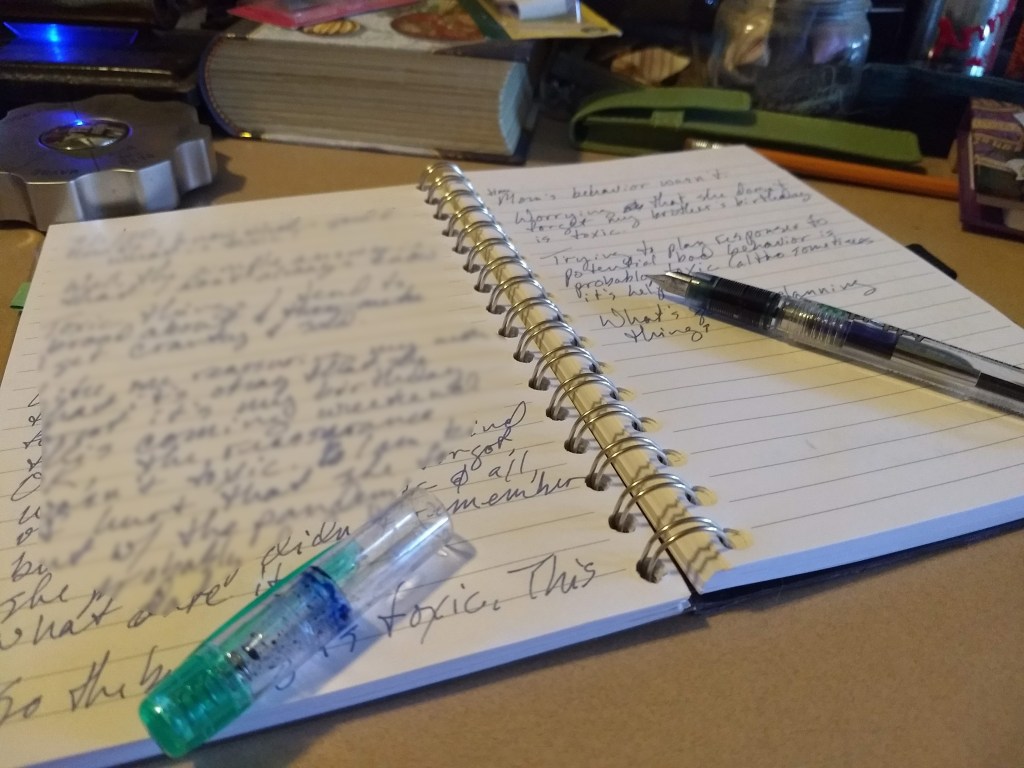
Over the last few months, I have taught two different classes on journaling, one of which has become a weekly group. The idea was that we are living in historic times, and personal journals have always been a valuable part of the historic record down through the ages.

Now, you’d think with Facebook and Twitter, that would count. Um, it doesn’t. Facebook and Twitter are public, and we tend to put our best posts forward, so to speak. There is something about the private nature of a journal that encourages more honesty, perhaps.

Another advantage of a journal is that it really does help keep a grip on all the insanity around us. Just in the past few days I’ve added a prompt to check for what’s currently bugging me and already I’m having trouble thinking of things that are bugging/worrying me.

My personal process began several years ago – I’ve lost track of how many – and is based in my own spiritual practices and a practice developed by St. Ignatius of Loyola (as in the guy who founded the Jesuits) called the Examen of Conscience.

The interesting thing is that as I was growing up and hearing about authors and being a writer and all that, I kept hearing about how important it is to keep a journal. I will admit, I tried, but it never took. Let’s face it, I am the ADD poster child, and sitting still to write something that doesn’t enthrall me, like what I had for breakfast the other day, is not going to happen. Then I heard a Jesuit priest talking about the Examen of Conscience and how it worked. In short, it gave me a series of questions I could check in with every day, or more accurately, every day I thought about it, and write.

The process this particular priest proposed was putting yourself in the Presence of God, checking in on where you’ve sinned the day before, then reflecting on how to do better and, finally, offering up a prayer of gratitude. I added a reflection on what I’ve done well because I’m really good at beating up on myself.

Believe it or not, I really like the idea of checking in to see where I’ve sinned, and actually, it helps work against the beating up on myself. It’s awfully hard to improve yourself if you don’t know where you’re falling down. To use a writing metaphor, you can’t fix your story if all you know is that it doesn’t quite work. If the actual “sin” is digressing all over the place (an example I used in Fascinating Rhythm), then you can go back and pull out all those bits that don’t relate to the full plot. If I know that I was meaner than I should have been to that tech non-support person, then I can take steps to get less pissy the next time I have to call about a problem.

I’m the last person to tell anyone that if they want to be a writer, they must journal. And if I’m honest, my journaling practice has had little to no effect on my writing that I know of. I guess trying to be a better person may help me be a better writer, and I suppose being able to stay on an even keel makes it easier to plot chaos in my made-up worlds.

Journaling is one of those things that is intensely personal and unique to each person. For me, it took a centuries-old prayer practice to put pen to paper (and, yes, I do prefer handwriting my journal). For you, it make take something else. I know someone who finds it easiest to dictate her thoughts on her phone as she takes her morning walk. And there is the possibility that journaling may not work for you at all.

But it is kind of interesting to think that someone, a hundred years ago, after I’m dead and gone, will look at my journal pages and exclaim, “Ah-hah! That’s what that was all about!”

I Love Research!

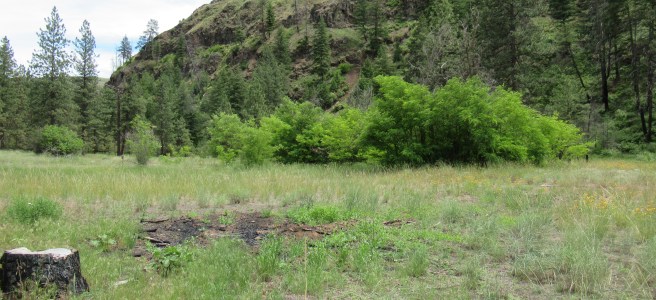
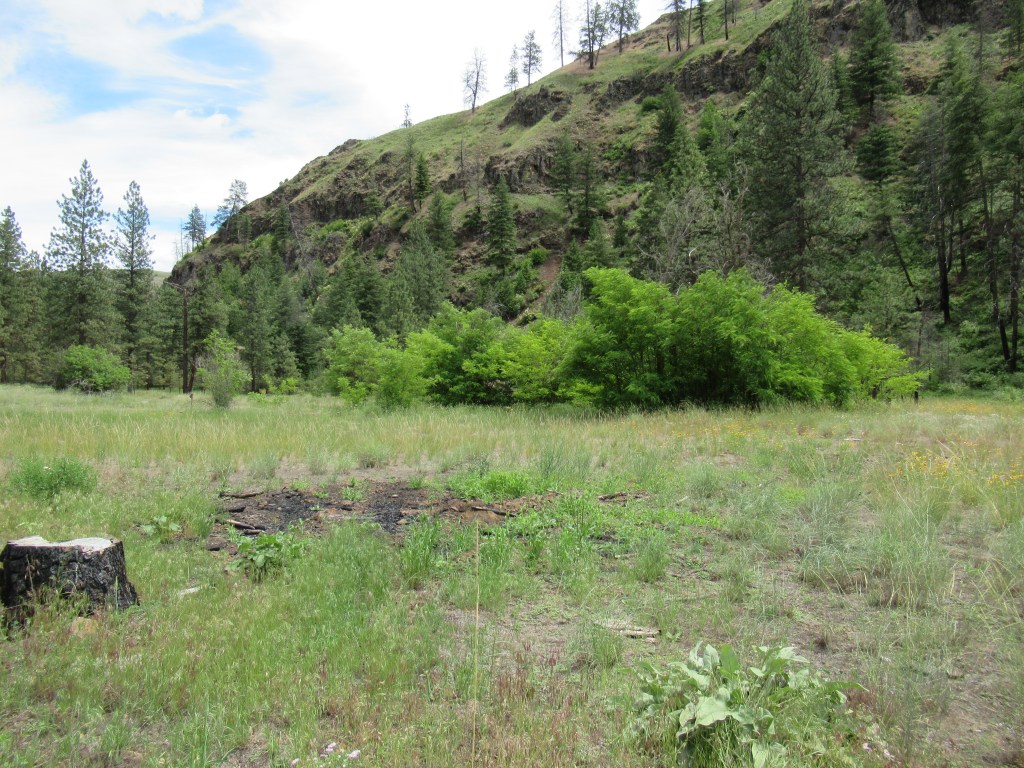
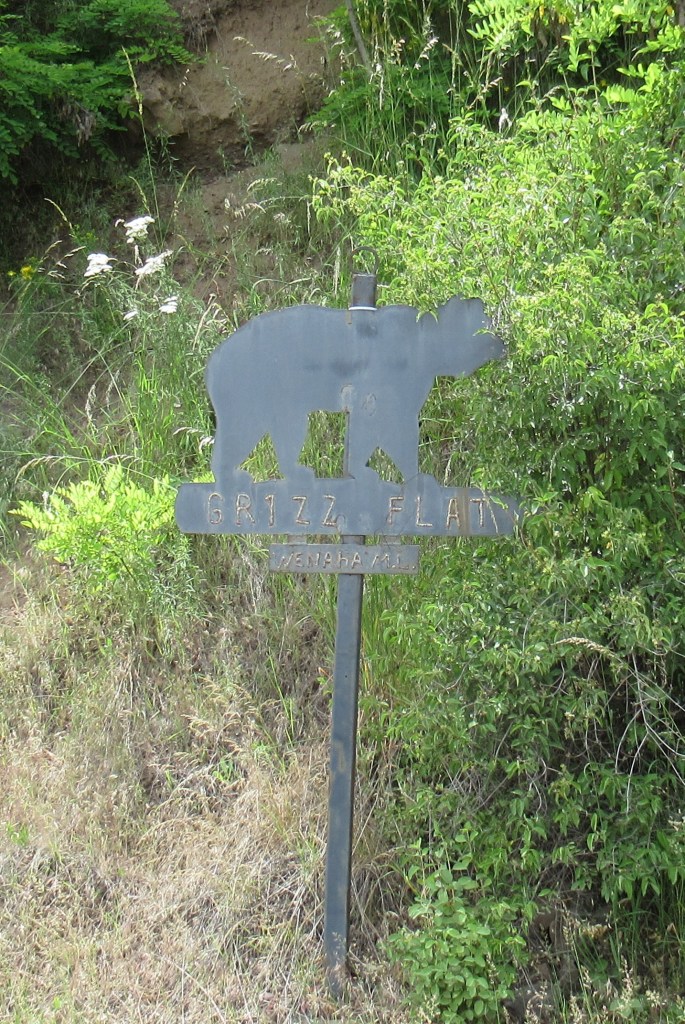
Photo I took of Grizz Flat

No matter what genre I write, there is always research. Did I say I love research? LOL The current work in progress is the 6th Gabriel Hawke novel. You would think setting the book in the county where I grew up and having had a ride-along with the State Trooper of the Fish and Wildlife Division I’d have everything I need to write the book.

I don’t and I’m having fun learning about muzzleloading rifles, rendezvouses, shooting competitions, and the general lifestyle of the people who travel to muzzleloader events.

Did you know that they not only have shooting competitions with the muzzleloading rifles, but they also have knife throwing and long bow competitions? And they all use an alias while at the events.

I contacted the person in charge of the Facebook page for the local (to Wallowa County) Muzzleloading Club to learn about the club, the rendezvous they hold every year, and all I could that would help me enhance my story. They have vendors who sell articles and clothing of the early 1800s the time period they represent while at the events.

I even drove to Grizz Flat where they hold the Rendezvous to get photos, see the area, and figure out how to set up the story.

The premise of the murder happens to be something the State Trooper told me about when I did my ride-along. He stopped on a road, across the river from Grizz Flat and pointed to the camping area. “See that campfire to the left?” I nodded. “A vehicle rolled over the campfire and caught on fire. A man died. They say he was drunk, passed out, and must have bumped the gear shirt. But after investigating, we discovered he’d had an argument with his wife.”

I said, “It couldn’t have rolled, the ground is too flat. And how coincidental would it be for the vehicle, if he’d put it in gear, to stall over the campfire. I say it was homicide.”

The trooper said, “That was what all the investigators said, but the D.A. said it was an accident.”

That is the story I am writing for this Hawke book. The vehicle is found burning over a campfire and the victim is in the vehicle. This time, Hawke will push to make sure the killer is caught and the D.A. prosecutes.

Have I mentioned the theme of my books is justice? 😉

English Language Be Gettin’ a Bad Rap Like a Overrated Airport Sammich!

That got your attention, you sticklers for grammar and its rules. For those who’re fast and loose with this part of the writing universe, you’re (maybe) applauding me I’m with you.

Before we get into the breakdown of the English language and what it isn’t and is, let’s explore some history.

From what I’ve remembered in my Greek & Latin Roots of English more than two decades (twenty years or a “score”) in completing my B.A. for journalism, our language has evolved through the Germanic and Hellenesic Wars. It also took on much change during the Battle of Hastnigs in 1066. An all day bloody battle, taking out King Harold allegedly with an arrow through his eye, ended his reign and destoryed his forces. Harold had been the final Anglo-Saxon King of England.

More of what History.com says about this war: “After his victory at the Battle of Hastings, William marched on London and received the city’s submission. On Christmas Day of 1066, he was crowned the first Norman king of England in Westminster Abbey, and the Anglo-Saxon phase of English history came to an end. French became the language of the king’s court and gradually blended with the Anglo-Saxon tongue to give birth to modern English. (Illiterate like most nobles of his time, William spoke no English when he ascended the throne and failed to master it despite his efforts. Thanks to the Norman invasion, French was spoken in England’s courts for centuries and completely transformed the English language, infusing it with new words.) William I proved an effective king of England, and the “Domesday Book,” a great census of the lands and people of England, was among his notable achievements.”

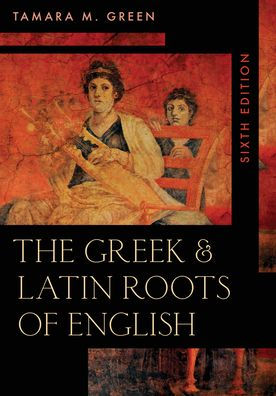
This book of my former professor’s, now in its sixth edition, says, “More than 60 percent of all English words have Greek or Latin roots; in the vocabulary of the sciences and technology, the figure rises to more than 90 percent. Through the study of the Greek and Latin roots of English, students can expand their knowledge of English vocabulary and also come to understand the ways in which the complex history of the English language has shaped our perceptions of the world around us.

“The Greek and Latin Roots of English maintains the book’s much-praised thematic approach. After an essential overview of world languages, and the linguistic histories of Greek, Latin, and English, the text organizes vocabulary into various topics, including politics and government, psychology, medicine and the biological science, as well as ancient culture, religion, and philosophy. The sixth edition features revised cumulative exercises in each chapter that reinforce both vocabulary and analytical skills learned from pervious chapter. The [sixth edition] also features alphabetized vocabulary lists, new photos and cartoons, and other reader-friendly updates.”
undefined
I (naturally!) aced this class. I’ve always loved words, how they were used, what their breakdowns were, why some words stuck and others didn’t, etc. To expound on my recent post mentioning Schoolhouse Rock and how well I did with English because of those cartoon segments, that’s how certain parts of speech made more sense and opened horizons and doors for me. Until diagramming sentences came into my world in high school, that is. I didn’t bomb those; I got cratered. But I made up for it in doing well in other parts of speech, vocabulary, subtect, contextual meanings the author was exploring, and spelling. My favorites to this day: adverbs, prepositions, conjections, interjections, punctuation marks, similies, May-the-Fours (that’s metaphors to you in Rio Linda, haha!), and plays-on-words, or more commonely know as puns.

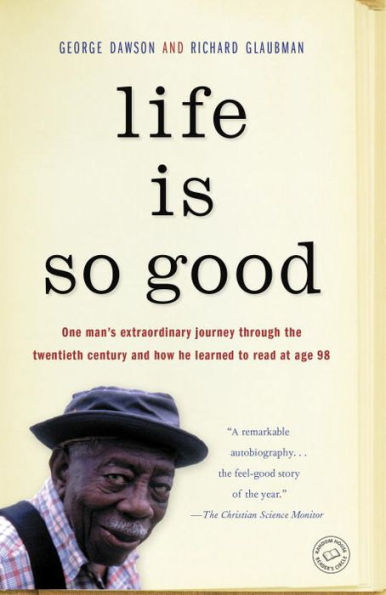
This post was inspired by a Little House episode (“School Mom”) where Caroline Ingalls pinched hit as a substitute while Walnut Grove’s regular teacher recovered from an injury. Among her charges was a near adult-aged boy near illiterate, a “Hold my beer!” moment for Caroline when her girls called the boy “Dumb Abel.” But it was a segment of this episode that always makes me misty-eyed: Each child holds a printed letter in front of him, and they takes turns representing their letter to eventually form a word. This, over time, helps the boy become literate (and sealing Landon’s often Disney-ending writing for this show–which is why I find the writing of The Waltons much stronger.). The teamwork behind this colossal effort, the simplicity in which words are just letters strung together in a certain order, and the light in his eyes how everything made sense broken down in simpler elements, was moving. That, and more importantly–somebody cared enough to care. And you’re never too old to learn, as evidenced in the fantastic book Life is So Good. So why should the adverbe, or any parts of speech for that matter, be shorted on one’s say so?

.undefined
After the show, I wondered about how anybody–writers, authors, cumudgeounly Enlgish teachers and grammaticitians, real, imagined, or self-appointed–ALWAYS have something nasty to say about somebody else’s use of the language. Foreigners are laughed at, made fun or, or corrected to their face about its use when it’s not their first line of communication. Deaf or hard-of-hearing had to evolve sign language to its bare bones; I know a little ASL to converse in it slowly. For pregnant, they place their hands so their fingers are a third on top of one another, palms down, and arc them from their bodies to touch the bottome of their bellies. Together means hooked index fingers to “link” them. Asking the time means pointing at your wrist and holding up your fingers to represent the number; thank you mean to blow a kiss; yes means to nod your head or your fist; no means to shake your head or that fist side to side; hot means to fan yourself; cold means you hug yourself is if you’re freezing; and walking means moving your index and middle fingers in a method in how legs would walk. See where this is going? So since when did those who speak English get to be the arbitors of what’s right to say and not to?

So if a grammaticitian comes into your world, dead-set on your speaking properly in your writing as strict as the grammar rules are, your end results may come across stuffy at best, or reading like the worst pain in the ass Grammar Police Patrol you’ll ever know handcuffed you and your creativity. Nobody needs this–not you, not me, and certaintly not readers. So it shouldn’t be any surprise to you, Dear Reader, when I came axross the trend of–

DON’T USE ADVERBS IN YOUR WRITING!!!!!

all the F over social media. Done by a genre-creating author, yet, with the bestest-selling book on the craft of writing in publishing history, save for The Elements of Style.

While everyone might’ve taken this author’s word as gospel, I had to contest the premise–little ol’ David me daring to cross swords with the Goliath, multi-award-winning bestseller. Not so much I come by dissension naturally–if some of you saw my recent unapologetic and unrepentant stirrings and stances in a writing group, you’ll know what I’m saying. But adverbs are one of the pillars of parts of speech; that’s like saying you’re overusing nouns, or you’re breathing too much. Instead, this author should’ve declared JUST as boldly–

USE ADVERBS LIKE YOU SHOULD DRINK–RESPONSIBLY!

Didn’t happen. So I did it.

Oopsie.

I was applauded in some cases–“Thank you, Scribe, for sticking up for us foreigners newly learning English.”–but for the most part, people attacked me in perception I attacked him! Was I a bestseller (No.)? Was I jealous (**laughing** Hardly.)? Oh, yeah? Where’s your book (In my computer, thank you for asking. Next!)? Gonna self-publish because traditional houses think you suck, huh (Um . . . some who’re traditionally published with contracts as thick as my femur is long are more interested in checking a PC box than honing decent writing for repeat business, and that ain’t me, so . . . NEXT!)? And so the storm raged. But I held my ground for the lowly, ain’t-good-for-nothin’ adverb. Inevitably, the next part of speech to be attacked, which I meant satirically, was the semi-colon. I called it–but I was only kidding! The bullies weren’t. And still ain’t–they’re attacking free speech altogether, never mind parts of it, but that’s another topic for another post.

Here’s the thing: all parts of speech, punctuation, consonants, vowels, and its references, have a place, even the ugliest of words. They. ALL. Have. A. Place. Yes, there is such thing as too much telling. There is also such thing as too much showing. And too much setting. Too much descriptions. Too much backstory. Too much info-dumping. Too much . . . too much . . . too much . . .! So it’s the adverb’s time to be bullied. In an era of can’t we all just get along, there sure is a lot of bullying going on we’re told to not do otherwise. And taking adverbs out of sentences for the sake of, guess what happens to and with that sentence? Its subtext and context are changed subtly and obviously so the paragraph around that one sentence with the shameful adverb being cross-examined is also changed. Leave the adverb alone. It’s has a place–so let it do the job it’s supposed to do.

And there is such a thing as too much use in strong verbs, too; once everyone’s doing it, and is doing it, what makes it special in that piece of writing anymore? To steal a phrase from one of my many favorite PIXAR movies, The Incredibles, where Syndrome says, “Once everyone are Supers . . . no one will be,” is just as fittin’ here as it is anywheres else.

Not bad advice from a villain, despite discovering too late his cape was a bad idea. So you too, Dear Author for your even Dearer Readers, don’t let YOUR writing cape do you in on the adverb, either. ‘Sides, if Superman and Batman and Robin handled theirs with finnesse and class, please make your use of grammar just as messy to match your imagination. Do so freely, wildly, often, richly, and boldly.

And, of course . . . do so indubitably.

Time to Write and Other Fictions

by Janis Patterson

I used to have a dream… a dream of a place where I have no responsibilities, no job to go to, no social obligations to fulfill, no time-consuming errands to run, no organizations to which I have made promises… nothing but time and quiet in which to write. The archetypical ivory tower.

Well, I can tell you the archetypical ivory tower is very overrated. Like everyone else, The Husband and I have been pretty much self-quarantined at home for what seems like the last couple of aeons. Oh, we have gone to the grocery about once a week (a giddy exercise in freedom!) and once to the bank (drive-thru only) and occasionally to pick up a take-out meal from Desperados, our very favorite Mexican restaurant (food is good as ever, but just not the same experience), but to a modern couple living in a big city with lots of connections and work and organizations, our recent adventures have been pretty thin.

Which, you would think, would be wonderful for my writing. Aside from fixing dinner most nights and a load or two of laundry each week, I have nothing to do but write.

Except I can’t.

The Husband is very good – most of the time – about not bothering me while I work. It took a couple of years in the early part of our marriage, but he did learn that when my office door is closed no one disturbs me unless there is blood or flame! (I should say we’re an older couple, and it’s just the two of us and one very bossy little dog.) While we’ve been sequestered he’s been working his way through some stuffed old boxes of his stuff that date from the time of our marriage.

Me – “You need to go through those boxes and get rid of a lot of that stuff.”

Him – “I know what’s in every one of those boxes, and it’s all stuff I want to keep.”

Me – “Well, then, go through and pack it carefully in new plastic boxes – those cardboard boxes are yucky.”

Him – “I’ll get around to it.”

Repeat this conversation a time or two a year for almost every year – and there are a number of them – we’ve been married.

Well, the Chinese plague lockdown has taken away all his excuses. He can’t go to work, we have no meetings, and he can watch only so much idiotic TV, so he finally said he’d do one box. Of course, that led to another and another (we’re actually seeing parts of the storage room floor we haven’t seen in a couple of years!) and now it’s a treasure hunt.

Him – “Look at what I found! I’ve been looking for this!” is repeated several times a day. The first few times I was jubilant – and just a little bit self-satisfied – but after a day or two I decided I had to work and went behind the closed doors of my office.

Except I can’t.

I am facing two book deadlines (not counting my recurring blogs) and I need to write. Deadlines have been sacrosanct my entire life and I will do just about anything to meet them. Worse still, I pretty much know what I’m going to write, so it isn’t a real case of writer’s block, it’s just… just… The best description I can come up with is a non-religious accidie… a laziness or indifference to the entire process.

My mind wanders – and not creatively, as it should when you’re writing. I find myself either becoming fascinated with something that has nothing to do with what’s at hand or just shutting off and staring at something, such as the rose bush outside my window or the TV screen, and both are just about as edifying.

Perhaps the dirty little secret of this Chinese plague lockdown is a lack of structure. I’ve worked since I was in school, and most of the time done it well, but there has always been a structure. There have been structure-less days, of course, and on occasion a week or so such as in a vacation or an illness, but I always knew that at the end of  a certain period of time the structure would surround me again and that knowledge kept me going. Or started me up again, to be honest.

Now, with no real end in sight and a tragically changed world waiting outside my (metaphoric) front door, I don’t know what to do. I was always pretty good at living inside a structure, but I suck at creating one. However – I know something has to change, and the only thing I can influence or change for sure is myself, so I have been working at writing out a schedule. Somehow that makes it the more real. It’s about time I learned how to schedule… oh, I’ve always known how. It’s simple. The hard part, the part I must master, is fulfilling it.

Hope all of you are staying safe and well. Please take care of yourselves.

Back in the Saddle Again

As we enter quarter 3 of 2020, I’m finally getting back into the groove and picking things up where I left off before this year took a massive left turn into the scary land of Pandemicia. Before COVID-19, I was on track to launch the first three books of my debut cozy mystery series this fall and about to start launching a series of social media courses for authors.

*whistles and puts hands in pockets* Yeah, that’s not quite how quarter 2 went. On the bright side, I was able to focus on finishing my thesis (and master’s) so now I can re-focus on other goals without that on my shoulders.

Anyone else returning to some normalcy in your writing or life after the initial onslaught of the pandemic?

It feels so good to be thinking about writing and publishing again, and be able to share that with you all! I recently finished working with an amazing cover artist on my debut cover. I’ll be sure to share the cover in a future blog post and talk about the elements of cozy mystery covers.

Another good thing about the unexpected break from writing (can you tell I’m an optimist always looking for the bright side?) is that I have SUPER fresh eyes to read the current draft of my cozy. I’m sure that’s going to come in handy.

To be honest, I can’t really recall where I left off with it. It’s like life pre-COVID is still a blur. I know I was revising and working on a revision plan, but I don’t recall quite where I was going with everything. I’m going to take that as a blessing that I can now look at it with a new perspective and not be bogged down by old ideas. Hopefully the strongest ideas from before will return or I’ll get some new ones.

This week, I’ll be reading what I currently have and tackling a new revision plan. By the time my blog date rolls around for August, I’m sure I’ll have lots of exciting things to update you on with my indie publishing journey. Possibly new release dates picked out for early 2021 (because fall 2020 definitely won’t be happening at this point, haha), tales from Revision Land, maybe even talking about the process of working with a hired editor. So much goodness to come!

I’d love to hear what’s going on with you. Do you have any summer goals? Anything you’re happy to be returning to after some time away?