Trying to Combine Two Stories Into One by Heather Haven

When I began writing Casting Call for a Corpse, my latest cozy mystery revolving around the Alvarez Family, I wanted to combine the ongoing characters from the series with a few characters from a play I penned some time ago. I also wanted to add a Scottish character in honor of my heart sister, who was adopted at birth and recently found her Scottish birth family. An homage, doncha know.

Frankly, I wasn’t sure if I could make it work. Some nights I lost sleep over whether or not I could pull this into anything readable. However, I really loved the characters from the play, in particular the internationally acclaimed actress, her loyal assistant, the Hispanic housekeeper, and a has-been writer who burned bright in his youth but had done little since. Putting Lee Alvarez, the protagonist of the Alvarez Family Murder Mysteries, and the actress together was easy. Close in age, I found making them friends from way-back-when in New York City added reality and depth to my tale. Also lots of humor! The other characters were a little tougher to place but ultimately, I managed to do it.

As for the storyline, itself, that was different. I was never too sure if ‘this’ was too much or ‘that’ was enough. So I took the throw-all-the-spaghetti-on-the-wall-and-see-what-sticks approach. Not quite my style. I usually know the first chapter, where I want to go, and how I want the story to end. This time I had no idea of any of it. I was a panster to the nth degree.

Surprisingly, while writing the novel this method was freeing. If I had a thought, it was in. I’d deal with the validity of it later. I wound up with some not-so-nice Russian businessmen, a trendy restaurant, threatening letters, jewel thieves, secret tunnels, and even a Christmas tree farm. I mean, why not? Then I added an inside take on life backstage in the theater, which was a large part of my existence in my salad days. I still had sleepless nights, but at least I had written pages to show for them.

Months later, when I finished the final draft, I went back in and took out extraneous plots, substories, and innuendos that didn’t work or were confusing. By that time, I actually had a story with a beginning, middle, and end. Hallelujah! When I handed the book off to my editors and Beta readers, I waited with the proverbial bated breath to see if the novel worked. It did. In fact, my content editor, one tough cookie, said it was the tightest of all the Alvarez books. Did that mean if I knew a storyline may not work from the very first word on the page to the very last, it made me a better novelist?

I’m thinking no. Each story is unique and different. When I start a new novel it’s almost like writing the first one. So far I’ve written thirteen novels, numerous novellas, and dozens of short stories. Not one of them has been easy or formulaic. True, I’ve developed a few tricks along the way. I believe I know what doesn’t work. But what definitively works? You got me.

In a way, I love that part. It never gets boring, this writing stuff.

Guest Blogger – Diana Rubino

I’ve been a mystery book buff since age 12 when I started reading the Trixie Belden series (similar to Nancy Drew). As my reading preferences matured, I graduated to murder mysteries. I always wanted to write one, but didn’t believe I had the ability to weave an entire plot around a murder, plant clever clues, red herrings, and surprise the reader with ‘whodunit.’ So I began writing murder mystery subplots in my historical novels, starting with FROM HERE TO FOURTEENTH STREET.

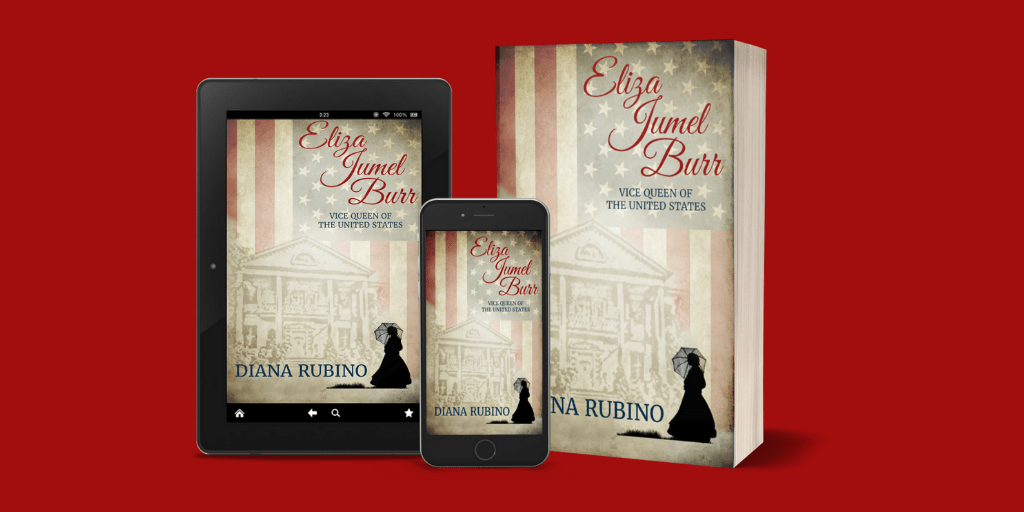
When I wrote my biographical novel about Eliza Jumel Burr, Aaron Burr’s last wife, my agent told me it needed a bit of ‘punching up.’ I pondered how to do this, then thought, ‘what would be more punched up than a few murder mysteries?’ So I wrote two subplots involving true-life murders that occurred during the time of the story. In one of them, Aaron Burr and Alexander Hamilton defended the accused, Levi Weeks, after his fiancée Elma Sands was found drowned in a well once owned by Aaron. In real life, Levi was acquitted, but public opinion maintained this was due to Levi’s high-priced ‘dream team.’ In my story, I involved Eliza in the lives of Levi and Elma, and Levi eventually confesses to her. As for all murder mystery authors, knowing the killer makes writing a mystery less daunting. I began writing mystery subplots in my books that followed: DARK BREW, FOR THE LOVE OF HAWTHORNE, and the biographical novel I just finished, about Edith (Mrs. Theodore) Roosevelt, who helps the New York City Police, of which her husband is Commissioner, find a serial killer.

I stay as close as possible to the historical record, but in writing novels, I must ‘take license’ and weave fiction in with the true life events. I’m careful to give readers lush descriptions of the settings, to send them on a journey back to that time, without rambling on, to avoid giving a history lesson. That, as well as writing murder mysteries, became easier with practice.

 ELIZA JUMEL BURR, VICE QUEEN OF THE UNITED STATES

Abandoned and left to survive on the streets of Providence, Betsy Bowen dreams of being reunited with her father – none other than George Washington. During her ninety-one years, she begs, sells her body, marries a rich man, marries a poor man, solves a murder, meets her father in secret and becomes Eliza Jumel, the wealthiest woman in New York City. She actually could have been George Washington’s daughter, according to the historical record–he visited Providence nine months before she was born.

A story of desperation, ambition, heartache and betrayal, borne with humor and refusal to compromise with what the heart asks first.

Purchase ELIZA JUMEL BURR: http://getBook.at/ElizaJumel 

Diana writes about folks through history who shook things up. Her passion for history and travel has taken her to every locale of her books, set in Medieval and Renaissance England, Egypt, the Mediterranean, colonial Virginia, New England, and New York. Her urban fantasy romance, FAKIN’ IT, won a Top Pick award from Romantic Times. She is a member of Romance Writers of America, the Richard III Society, and the Aaron Burr Association. When not writing, she owns CostPro, Inc., an engineering business, with her husband Chris. In her spare time, Diana bicycles, golfs, does yoga, plays her piano, devours books, and lives the dream on her beloved Cape Cod.
Visit Diana at

www.dianarubino.com

www.DianaRubinoAuthor.blogspot.com https://www.facebook.com/DianaRubinoAuthor

and on Twitter @DianaLRubino.

Putting the Corona Virus in My Next Book

Many have asked writers whether or not they were going to do it–include the virus in their next work of fiction. My answer at first was no, and I started writing my next Rocky Bluff P.D. mystery to be right after Christmas. But as I was writing, I realized at some point in this series I’d have to mention the virus–after all it is affecting all of us.

Another thing I considered is the fact that the virus and what it has caused may be with us for a long, long time.  It is far too big a happening to be ignored and everyone is being affected by it in many ways.

I began thinking about my ongoing characters and how they would feel about what was going on, the new rules and the restrictions. Like in the real world, because they all have different personalities, they all have different reactions. And, oh, my goodness, there is a wealth of  varied beliefs and feelings in my own family as well as on Facebook to pique my imagination as to what each of my characters might be thinking.

When I started doing that, I realized what great fun I might have. Will my police officers be good about wearing their masks when working? How do they feel about it? Who are willingly staying home? Who are resisting in a mild way, and are they a few who are completely rebellious?

Intertwining all this will whatever crimes are happening in Rocky Bluff will not only be fun to write, but a challenge as well. Do I know my characters well enough to know how they will react in certain situations complicated by the virus? I certainly hope so.

At least this is distracting me enough not to be too sad about missing all the in-person events I’d planned to go to before they were cancelled. My hope is that everything will change enough for us to see a more normal 2021, but I’m not making any bets.

Share you thoughts about all this, won’t you?

Marilyn who writes the Rocky Bluff P.D. series as F. M. Meredith


It’s Awkward

Once a month I appear on this blog, so I have about four weeks to think of what I want to say. Most of the time I have no problem coming up with an opinion on anything, but shaking loose an idea I want to explore and spend time with that will benefit other writers, even if it’s short, is harder.

My first idea usually gets shelved. This month I considered writing about Beta readers because two experiences from my earlier years came to mind. A friend who wasn’t someone I considered a book person asked about what I was working on. He asked to read it when it was ready. When I had a pretty good draft (perhaps fourth or fifth), I gave it to him. He gave me lots of notes and conversation, and a year later I reworked the story. He again asked about it, so I showed it to him. This time he didn’t like it at all even though it was essentially the same book. He took exception to things he liked the first time around and passed over things that excited him before. Okay. I don’t know what this means except that he changed in the interval, and first impressions are more useful than second impressions. I shelved that blog.

Than I moved on to the idea of reviewing. This is tricky for a writer reviewing in her genre, so after reviewing numerous titles in the 1980s and 1990s for all sorts of journals–The Drood Review of Mystery, Mystery Scene, and Publishers Weekly among them, and later Audible–I gave it up for the simple reason that it became too awkward. After attending a few conferences, including Malice Domestic and Bouchercon, as well as Crime Bake later, I knew too many writers whose books I loved as a reader but could see flaws in as a reviewer. Awkward for sure. End of that topic.

The pandemic is still with us but I’ve already posted about it twice and I’m sick of it. You may be too. I don’t know anyone who isn’t. How is it affecting my work? Hard to say, though I expect we’ll all discover in a year or two that we were in a fog for almost a year and we’ll look back on these months with their fears and restrictions and wonder why we did the things we did. It will be, yes, awkward. Enough of that topic.

And then we come to words. I love words. Nothing new there. I also love my dictionary (Webster’s New World Dictionary of the American Language, second college edition, printed on lovely onion skin paper), which comes with etymologies. The “Guide to the Dictionary” is a six-page explanation of the construction of the entry, all those little bits we lump together as the definition. My favorite line in this guide is “In no case is the first spelling considered ‘more correct’ or the one necessarily to be preferred.” There are also several pages on language, including English, and more on Americanisms. I’m enjoying myself but I’m not sure another reader would be. Time for another topic.

Editing is always a reliable subject because, Lordy knows, we writers do enough of it and we’re always looking for ways to be more efficient. I’d love to be able to write and construct a story well enough not to have to all but rewrite the damn thing during the editing process. I think of the standard advice, When in doubt, throw it out. The trouble with that advice is that it calls to mind a note on an article I sent to a publisher. It “didn’t fit” their journal so they sent it back, but in the notes a reader and editor left was the comment, “This is an excellent sentence.” I found the passage and read it. It read like all my other sentences. What was so special about this one? After turning to it every year or so, I still don’t know. It just looks like all the other passages in that article (still unpublished), so I seem to have not only no advice on editing but also no sense of what to edit. End of topic.

So here I sit at 7:30 on Saturday morning without a topic for my blog post. You’ll just have to tolerate my ineptness today, and I hope to do better next month. Yes, I know, it’s awkward.

Amber Foxx’s Goodbye Post: On Reading Diverse Mysteries

I realized this month that it’s time to move on, so I say goodbye with my final installment on this blog. I hope you enjoy it, and that it helps you discover some new authors.

*****

 I caught myself in a reading rut. I’m not the first person to have this experience, and others have addressed it already. Nonetheless,  here’s my take on the problem as a mystery reader.

What made me notice it was a book in which all the characters were white. I suppose such towns exist, but I’ve lived most of my adult life in majority-minority places. This book woke me up to the fact that almost all the authors I’d read recently were white. Most of them write a broader range of characters, but still, I want to hear from other voices. So, how did I end up buying books this way? What was I thinking?

Actually, I wasn’t thinking. Just clicking. We often get reading recommendations through algorithms. Goodreads or an online bookstore will send reminders that a favorite author has a new book, or suggest that “If you liked X, you’ll love Y.” Authors advertise on the book pages of what they perceive to be similar books. Other ads target fans of what are referred to as “comparison authors.”  It’s a system that promotes sameness, not diversity. For that, I had to exit the net of recommendations and start searching.

I liked this article from Writer’s Digest, in which writers of color discuss their experience. I agree with those who say there is an audience for their work, but publishers may not realize it.

This site is a great shopping resource: I Found This Great Book: A Home for Readers of Diverse Books. Its creator says he loves to browse bookstore and library shelves and discover new authors because of a cool cover, and he set up the directory—quite successfully, in my opinion—to give you that feeling. He gives a lot of space to indies, which I appreciated, since I love indie fiction. I wish more of those indies published wide, not exclusively on Amazon, but I still found new mysteries to read on my Nook.

Another site I used for discovery is Crime Writers of Color.

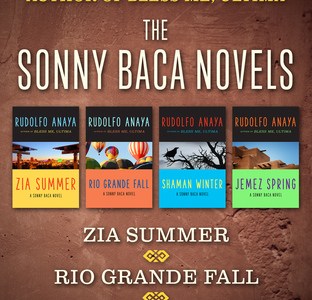
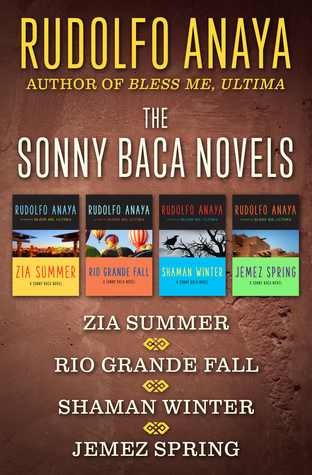
As a New Mexican, I have to recommend the Sonny Baca  books by the late Rudolfo Anaya. Most people know his classic coming of age in New Mexico story, Bless Me, Ultima, but he also wrote a series about a private investigator. These crime novels blend in much of the mysticism and cultural depth found in his better-known works.

I plan to read not only diverse American authors, but authors from other countries, other continents. African and Asian and Latin American writers. I can’t go anywhere in person during the coronavirus pandemic, but my reading can take me all over the globe into the worlds of people whose lives are not like mine.

My writing has me at home in New Mexico, of course. Working on the eighth Mae Martin mystery. And I’ll still be blogging. Follow me on https://amberfoxxmysteries.com, where you can also sign up for my newsletter.

Au revoir and Namaste.

Amber