Dammit. I’m a suspect.


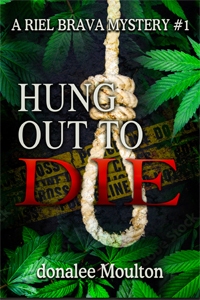
book cover from Hung Out To Die

I’m reaching for the hallway switch when I notice a light three doors down. That’s Norm Bedwell’s office. And that’s unusual. Our comptroller is typically among the last to arrive. Only a fresh honey cruller from Tim Hortons has ever changed his timeline.

I’m running to Norm’s office now, tirade at the ready. The only thing that can prevent the outside security system from working, aside from someone hacking into our server, is if the door doesn’t latch firmly behind the entering employee. A loud audible click lets you know the system is armed, and then you can move forward. Employees are trained to wait for the click; if they don’t, an alarm will sound for two minutes, albeit relatively soft as alarms go. But at this time of day, no one is around to hear it.

It must be Norm’s fault, which may mean the system has only been down for minutes if he just arrived. It’s a question I’m tossing at our comptroller even before I’ve stepped inside his office.

Norm doesn’t answer.

He can’t because he’s swinging from a rope tossed over an open beam (the designer’s brilliant idea), a noose tight around his neck. He’s blue, but not as blue as I believe a dead man should look. This poses a dilemma. I need a few moments to assess my options and identify the safest and most effective course of action. However, I am aware I don’t have the luxury of time. I’ve seen enough Law and Order episodes to know if you don’t call the cops immediately, the delay in time will get noticed, and you’re more likely to find yourself on the suspect list.

Dammit. I’m a suspect.

This realization hits at the same time I’m dialing 911. The perky young woman on the other end asks how she can help.

“I’m in the administrative office of the Canadian Cannabis Corp., and my comptroller appears to have hanged himself. He is dangling from a noose and turning blue.”

“Sir, I have radioed for police; they are on their way,” she says, inhaling to continue with her script.

I cut her off. “Look, I know I shouldn’t disturb anything, but Norm may be alive. I’m going to grab his legs, so the noose doesn’t cut into his windpipe.”

Great, now she knows I understand how hanging kills someone.

Itdoesn’t matter. I’m going to reduce the pressure around Norm’s neck. His feet are tucked into the crease in my left arm, his testicles on par with my bottom lip. I’m not a small man, 6’2”, and I work out regularly, so I can maintain this, albeit a distasteful posture, for quite some time.

I hear sirens, and it hits me. The police won’t gain access to the building without destroying expensive technology. I explain this to the 911 operator. She is not that interested in the cost of our tech.

“I’m going to get someone to open the gate for the police,” I tell her. “That means I’ll have to hang up. I’m on the third floor of the admin building, inside the only office with a light on. My name is Riel Brava. I’m the CEO.”

Guest Blogger ~ Mike Nemeth

Why Does a Nice boy from Wisconsin Write Murder Mysteries?

The simple answer is: I grew up reading detective stories, from John D. MacDonald to Ross Macdonald to Eric Ambler. I admired the intricate plotting that kept me guessing as their stories unfolded. Later, I discovered Elmore “Dutch” Leonard, a prolific writer of tales about ex-cons and petty thieves looking to strike it rich with their next caper and usually failing miserably. You may know Dutch by the many movie adaptations of his novels including, Be Cool, Get Shorty, Fire in the Hole, Killshot, Jackie Brown, Out of Sight, 3:10 to Yuma, Cat Chaser, 52 Pickup, Hombre, The Big Bounce, Stick, Mr. Majestyk, and Freaky Deaky. As much as I enjoyed Dutch’s stories, I was influenced most by his cinematic style. He never got in the way of his characters and let them tell their stories through dialog and action scenes.

The second reason I write murder mysteries is that the genre allows the writer to fold in subplots from other genres that become clues in the solution to the murder. In most of my novels an unexpected love story comes from out of nowhere and smacks the protagonist upside the head, the sort of romance that causes the protagonist to wake up and pay attention. Such is the case in The Two Lives of Eddie Kovacs. Eddie, a grieving widower, goes undercover to solve suspicious deaths at a luxury condo complex and runs into Madeleine, a wealthy widow who awakens long-dormant feelings in Eddie but is also the key to the mystery. She becomes the focal point for Eddie’s decisions about the case, his desire for redemption, and his future.

My third reason for writing murder mysteries is that a good story must contain high stakes for the protagonist and few stakes are higher or more enticing than murder. And two murders are better than one. In The Two Lives of Eddie Kovacs, the unsolved murder of Eddie’s investigative partner during his stint in the Army has haunted him for decades. Eddie has always wondered if he had inadvertently set his partner up for the crime. When another murder occurs at the condo complex during his surreptitious investigation, Eddie begins to connect the dots and sees the truth.

And finally, the murder mystery genre allows for an underlying theme that isn’t preachy and doesn’t detract from the pleasure of solving a complicated crime. In The Two Lives of Eddie Kovacs, the solution to the murders calls into question the boundary between personal freedom and the encroachment of the law. This question is a dilemma for Eddie as he grapples with love, his integrity as a lawman, and his desire for redemption.

Murder mysteries are such fun!

Propelled by two murder cases, separated by decades, The Two Lives of Eddie Kovacs is, at its heart, a provocative and suspenseful love story that explores the unbreakable connection between the past and the present, and the boundary between personal freedom and the law.

Eddie Kovacs is tormented by his experience in Vietnam when he derailed an illegal CIA plot, and deflated over his forced retirement as a DA’s investigator. When the sheriff of Chatham County, Georgia offers him an undercover assignment, Eddie jumps at the chance to end his career in a blaze of glory. His assignment is to solve the riddle of suspicious deaths at a luxury condo complex on Tybee Island before the DEA exposes the scandal that would dash the sheriff’s political ambitions.

Eddie has spent his life looking over his shoulder for the vengeful CIA agents who have tirelessly pursued him. As he investigates the deaths, he discovers that a former agent has remained vigilant for fifty years and is in the building, stalking Eddie. To make matters worse, Eddie is a grieving widower irresistibly drawn to a resident named Madeleine, and his infatuation feels like infidelity, not to mention a betrayal of his badge. In a race with the DEA and hunted by the CIA, Eddie lays a trap for his suspect and discovers Madeleine’s darkest secret—a secret that forces Eddie to choose between love and redemption.

The Two Lives of Eddie Kovacs can be found on Amazon at amzn.to/3CVzMY4 (that’s Bit.Ly short form link).

It is also in the Ingram system and can be ordered at any bookstore or online from Ingram. 

Mike Nemeth is the author of Defiled, which became an Amazon bestseller, The Undiscovered Country, which won the Beverly Hills Book Award for Southern Fiction and the Augusta Literary Festival’s Frank Yerby Award for Fiction, and Parker’s Choice, which has won a Firebird Award for Thrillers, and American Fiction Awards for Romantic Mystery and Diverse & Multicultural Mystery. Creative Loafing named Mike Atlanta’s Best Local Author for 2018.

The recurring theme of Mike’s novels is that morality and legality are two different things. The stories are romances tucked inside mysteries.

https://mikenemethauthor.com/

Research, or the Lure of the Rabbit Hole

by Janis Patterson

There’s nothing more frustrating than a novel which mangles history. Unless, of course, it is alternative history (at best a bastard genre) and clearly labeled as such. What raises my ire is when someone writes what is purported to be historical fiction but has such factual clangers in it as to stop the reader cold. My favorite example of this is from a contest I judged when a Regency hero – handsome, wealthy, arrogant as all of them are – pulls a fountain pen from his pocket to sign some important document.


Really? A fountain pen?


The bladder fountain pen that we all know wasn’t invented for at least fifty years after the Regency. Even the steel-tipped dip pen wasn’t invented until after the end of the Regency. Before that, writing was done with feather quills, usually goose.


Of course I dinged the writer severely for not doing proper research, and sent a rather kindly note of explanation of her low score, hoping to raise her consciousness about the necessity of research. Instead she attacked me viciously, not only in a private letter but on social media, ranting that it was an old-fashioned pen and who would know the difference anyway.


And there is the crux of the matter. Far too many people get their ideas of history from novels (and movies, and TV) and therefore as writers we owe them the honesty of real facts.


Such a high-minded ideal is not without its dangers to us, though. I was working on a fairly early Victorian Gothic where my librarian heroine had to make some ink. Now I knew she couldn’t just pop off to the allsorts shop in the village for a bottle, so I went online and looked up how to make ink.


Who knew there were so many ways to make ink? And there are so many people making it today? Well, it was a plethora of information and I started reading happily. Only thing was, I realized that some of the recipes used items to which my early-Victorian-working-in-remote-Scotland heroine would have no access. But I had to make sure of what was available, which took me to botanical sites and shopping sites and each of them led to other sites, most of which had little to nothing to do with Scotland, libraries or ink, and before I knew it hours later I was deep into the intricacies of making Scottish country cheese. Still don’t know quite how I got there, but it was fascinating.


Now I don’t know if I’ll ever need any minutiae about the making of country cheese in Victorian Scotland, but it did give me a deeper insight into the Scottish rural people of the time, their lives, their chores, their way of living. Besides, I believe that everything is useful in some way, some time, some how. Who knows when some snippet of rural Victorian Scottish life/mores/cheesemaking – or something influenced by them – will show up in a totally unrelated story? It’s one of the dangers and the magic of writing!


Doubtless by now you have figured out that I like research. And, having an inquiring (some say nosy) mind, I must admit I do. It’s one of the most fascinating things in the world. And one of the most dangerous. It can take hold of a story, turn it every way from up, then hand it back to you in a form totally different from the way you originally envisioned it. Or, if you are strongminded enough to corral your story to its original form, those little snippets of research are still there, adding depth and shading – and an occasional surprise – to your story.


A prime rule of good writing is Do Your Research. Another rule of good writing is Do Not Let Your Research Take Over. Usually I manage both, but it’s most definitely a delicate balancing act.

One of My Favorite Things About Writing

My favorite part about writing is learning. When I wrote historical western romance, I enjoyed visiting museums and libraries in the areas where the books were set to learn local history and to find maps of the towns. I read newspapers on microfiche to get a feel for the setting and the people. The small-town newspapers back in the 1800’s were as much gossip columns as they were filled with political news.

Writing historicals, I had to learn a lot, and I loved every minute of it. I was a nerd in school. I’d take my history, geography, and social science textbooks home even if my work was finished so I could read ahead and learn more.

Writing contemporary books, I always come across occupations or places I don’t know anything about and spend hours learning. Even if all that learning may only end up as one paragraph in the whole book.

When I write mysteries, I have to research causes of death, how law enforcement works, occupations, and settings. My horizons are always expanded when I start a new book. I’m currently researching for the next Spotted Pony Casino book, Crap Shoot. I know it will deal with MMIW (Missing and Murdered Indigenous Women) I have three articles that I’ve set aside until now to help me determine how I want to handle the subject and whether the character will be just missing or murdered. Whether it will be domestic or a stranger. So many possibilities and the research I’m doing will help me to see the direction of the story.

I’m also attending an event called- Winter Fishtrap: What is the West? Fishtrap is a gathering of writers from the West. The organization puts on several events throughout the year in the county where I grew up and where my Hawke books are set. This Winter Fishtrap has some great topics and many of the speakers are Indigenous. I’m hoping to get a better sense of that it means for them to be in Wallowa County and telling their stories from this event. To hopefully help me better articulate my character Gabriel Hawke and my character Heath Seaver from the Spotted Pony Casino Mysteries.

I first attended a Fishtrap event back in the 1980’s and quickly discovered it was more about literary writing than genre writing. that was the only multi-day event I attended. I have been in the county visiting family when they had readings and attended those with a family member, This will be the first multiday event since the 80s. I’m hoping it will be as good as it sounds.

Speaking of my Gabriel Hawke series… Wolverine Instincts is now available.

In the heart of the wilderness, the hunter becomes the hunted.

Gunshots shatter the quiet of Oregon’s Eagle Cap Wilderness, drawing Oregon State Trooper Gabriel Hawke into action. Following the sound, he stumbles upon a shredded cage, the sharp musk of a wolverine, and a dead hiker.

Tracking footprints through the rugged terrain, Hawke uncovers a second victim. It’s clear—he’s hunting a killer who’s hunting humans.

With Dog by his side, Hawke’s search leads to two brothers, one gravely injured. Enlisting the help of pilot Dani Singer, he gets the injured man to safety before returning to the wilderness.

Teaming up with a reclusive, disabled veteran who knows the Eagle Cap as well as he does, Hawke pieces together the killer’s twisted game. They suspect a poacher—one as ruthless and elusive as the wolverine he’s still chasing.

In a deadly wilderness where survival is the only rule, Hawke must outsmart a predator who knows no bounds.

Universal buy link: https://books2read.com/u/m2yARG

OR Purchase direct from the author in ebook and print from these links:

ebook link – https://www.patyjager.net/product/wolverine-instincts-ebook/  

print link- https://www.patyjager.net/product/wolverine-instincts/

The People in My Head

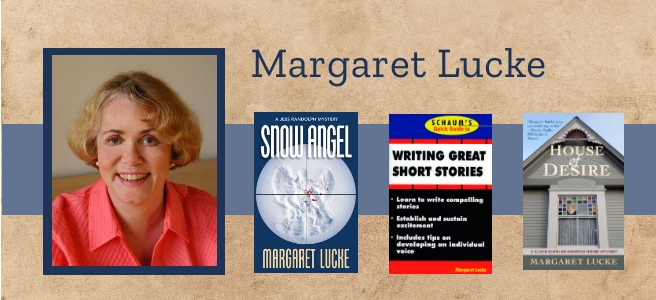
By Margaret Lucke

“Many people hear voices when there’s nobody there.
Some of them are called mad and are shut up in rooms where they stare at the walls all day.
Some of them are called writers and they do pretty much the same thing.”
– Mystery Author Meg Chittenden

Do you hear voices when there’s no one there? Or have invisible people accompany you as you go about your daily activities?

Yes? Then welcome to the club. A fairly exclusive club, as it turns out.

A few years ago I took a short road trip with my good friend Penny, whom I’ve known since our college days. As we drove we chatted, the way old friends do, about our dreams, our daily lives, and the ways we would fix the world if only someone had the good sense to put us in charge. I mentioned the book I was writing, and she asked me this:

“What’s it like to have people running around inside your head all the time?”

The question startled me. “What? You mean you don’t have them?”

“Not at all. I can’t imagine it. Is it like hearing voices?”

Now, Penny is someone with a direct line to the creative process. She’s a brilliant cook who serves the most amazing dishes. A talented seamstress who tossed together fantastic costumes out of nothing for our college theater. A devoted lover of art, music and literature. Yet she didn’t have people occupying her head? How did her brain work then? How could she possibly think?

Since then, I’ve discovered that it’s actually rare to have a head filled with people. I’ve met other fiction writers who share this trait, but usually when I mention it to someone I get a strange look, as if the person is assessing whether I need to the services of my friendly neighborhood mental institution.

Perhaps I do. But I have a hard time understanding how anyone’s mental processes could possibly function in a different way.

I’ve had people wandering around in my brain ever since I can remember. They’re my equivalent of imaginary playmates. They tell me stories, ask me questions, give me answers, and help me clarify my thinking. They keep me company when I take long walks and as I’m trying to fall asleep at night. I’ve heard that writing is a lonely profession, and in lots of ways that’s true. But even when I’m at my desk by myself, I’m never really alone.

Some of the people in my head turn into characters in my novels and short stories. Often what sparks a story is a snatch of conversation that comes drifting through my brain. That sets me on a journey to discover who’s talking, and how they’re connected to each other, and what they’re discussing and why. Gradually the story emerges.

My first novel, A Relative Stranger, began this way. Walking to a bus stop, my mind let me overhear a late-night phone conversation. The woman who answered the phone clearly found the call unwelcome. The man who had called sounded desperate to connect with her. When I reached my destination, I wrote the conversation down. Who were these people?

The woman turned out to be a private investigator named Jess Randolph; the caller was her estranged father, turning up after many years to ask for her help because he was the prime suspect in a murder. Was he guilty? Would she help him? What would they do next?

In my story “Haircut,” a flash fiction tale that was recently published by Guilty Crime Fiction Magazine (you can read it here), I woke up one morning listening to the voice of a young woman named Hallie as she described the abrupt ending to what she had hoped would be an enduring romance. I got out of bed, stumbled to my computer, and wrote down what she had to say.

I may be making the process sound easier than it is. The people in my head don’t always want to be promoted from random guest to Story Character. Once they have me intrigued, they all too often ignore me. They fight me off or hide behind the curtains. They take a vow of silence. Sometimes they disappear.

And sometimes, gradually, after I beg and plead and cajole, they start to reveal their secrets.

At last the story is underway.