The 30,000-foot view of writing

We’ve been talking about editing, an essential element in the writing process that writers relish. When you’re creating characters, polishing plot, and tossing red herrings around to mystify readers, it can be easy to lose sight of the book as a whole, to remember what happened in chapter four when you’re on chapter fourteen.

Writers also get close to their work, sometimes too close. We spend time, often at 4 a.m., thinking about the novel, the action, the actors, the unfolding of the story. It’s hard to see the whole when you’re immersed in the parts.

That’s where editing comes in. But we’ve been talking about editing as if it’s one thing. It isn’t. There are several kinds of editing, and they take place at different points in the writing process.

Substantive Editing.

This is where the high-level work begins, the 30,000-foot view before we delve into the weeds. It involves rethinking and rewriting. This may mean rewriting whole paragraphs or the entire document. It may involve restructuring or reorganizing parts of the text. It may include identifying where new information is required or existing information should be deleted.

Editors Canada has this to say about substantive editing, which is also called structural or developmental editing.

Structural Editing.

Assessing and shaping draft material to improve its organization and content. Changes may be suggested to or drafted for the writer. It may include:
– revising, reordering, cutting, or expanding material
– writing original material
– determining whether permissions are necessary for third-party material
– recasting material that would be better presented in another form
– revising material for a different medium (such as revising print copy for web copy)
– clarifying plot, characterization, or thematic elements

Substantive editing is major surgery. It is about ensuring the medical team is ready to operate. Blood work has been analyzed, the plan for the procedure reviewed, the instruments lined up neatly, everything and everyone sterilized. The goal: to ensure a successful outcome.

That’s what writers want for their readers. Substantive editing helps them do that. Editors Canada notes that this type of editing supports writers as they define their goals, identify their readers, and shape the manuscript in the best possible way. It enables writers to clarify the argument, fix the pacing, suggest improvements, and draw missing pieces from the author.

It makes the view from 30,000 feet truly spectacular.

Learn More.

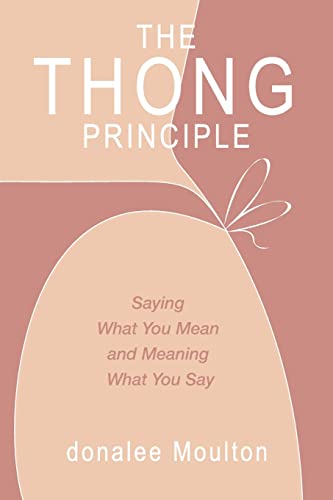
cover of Thong Principle by donalee Moulton
Saying what you mean and meaning what you say

You can learn more about this in donalee’s book The Thong Principle: Saying What You Mean and Meaning What You Say.

Editing essentials: revising, reworking, revitalizing

by donalee Moulton

Great writers don’t need an editor. They demand one. What first-rate writers understand is that another pair of eyes or a fresh pair of eyes are essential to successful communication. This second looks brings a new perspective, the distance that only time (even a little time) can offer, and renewed energy to improve content.

cover of Thong Principle by donalee Moulton

In my book The Thong Principle: Saying What You Mean and Meaning What you Say, I suggest readers try this exercise. You’ll need a piece of paper, 8.5” x 11” if possible.

Now transform that flat piece of paper into the world’s most wonderful flying machine. The goal is to soar, specifically to fly as far as possible. Take a few minutes to play with different designs, then stand up and launch your creation. How far did it go?

Now let’s rethink, or edit, the exercise. What did your flying machine look like? Something similar to a paper airplane?

Let’s review the instructions, the language. Nowhere did it say to build a paper airplane. It said a flying machine. The goal was distance. What would be an easier way to build a flying machine? What would get us great distance?

Crumpling the paper into a ball would.

That’s what editing does. As we write, whether for a reader or a listener, we dive in. Ideas flow. We create content. We think about our audience. We identify important points to make. We’re in the midst of our content, our characters, and our creativity.

When we edit, we take a step back. We come up for air. We have a different perspective – and a draft on which to overlay a fresh set of eyes. Even short pieces of writing should be edited. We need to think before we walk away. We need to give ourselves time to review and revise. To take one last read through (or think through). You’ll be surprised at what you missed or decide to revise.

Editing is essential to clear, concise, compelling writing. But editing isn’t just one thing. Just as pizza isn’t just one thing. There is deep dish pizza with red carnival spinach. Thin crust pepperoni and Bloomsdale spinach. New York-style pizza with Tyee spinach. Notice though that although the type of pizza is different there are common elements.

That’s also true when it comes to editing. There are three broad types: substantive editing, stylistic editing, and copyediting.

I thought we could spend a little time exploring these different types of editing in future blogs. Until then, I’d love to hear from you about your editing process, what drives you nuts, what makes your heart sing.

First things first

by donalee Moulton

My newest book is a first for me in two ways:

  • Cardinal is a paranormal mystery set in Nova Scotia — part of the Paranormal Canadiana Collection. It builds around the story of Catherine McIntosh, a little girl who died on April 23, 1889, one month short of her ninth birthday. Many believe Catherine is still with us today, and if you visit her grave in Pictou County, as I did, you will see the tumble of wonderful gifts people have left in her memory. Catherine introduced me to another world, and her story is the heartbeat of the book, my first paranormal mystery.
  • Private Detective E.M. Montogomery also makes her first book-length appearance in Cardinal.  (Can you guess what E.M. stands for?) The Halifax-based investigator has previously appeared in eight short stories, which have been published in anthologies and magazines across Canada and the U.S. When I was thinking about a main character to interact with Catherine and find a missing flesh-and-blood woman, Em emerged as the frontrunner. Below she meets her client for the first time – and learns this case will not be business as usual.

Day One

Saturday, April 25th

Halifax, Nova Scotia

Gord Gillis is 62. He’s a retired firefighter. He looks like a 62-year-old firefighter, I think. Now admittedly, I have no idea what a 62-year-old firefighter should look like. Except he should look like Gord Gillis.

cover of Cardinal by donalee Moulton

It’s a circular argument, and it’s giving me a headache. This is the stage in the client interview where the private detective, that would be me, leans back, nods, makes soothing sounds, and shakes their head in sympathy. I learned this technique when I was a cop with the Halifax Regional Police, and it has served me well as sole owner and employee of Bold Pursuit, although, at the moment, there is no boldness or pursuing required. Just a lot of nodding.

Gord needs to get his fear out before he can move on to dealing with that fear. Which is why I am sitting at a table in the Easy Street Diner sipping a now-cold decaf coffee. And nodding. It’s time to move on. I lean forward and give Gord’s hand, the one hugging his mug for dear life, a sympathetic pat.

“Nell sounds wonderful,” I say.

“Ms. Montgomery, you have to believe me. She would never leave me.” Gord says this emphatically. A hint of spittle makes its way to the corner of his lips. A hint of uncertainty travels with it.

I give Gord’s hand another gentle pat. I tell him to call me Em, like we are old friends enjoying an early morning chat. “Let’s not get ahead of ourselves. Tell me everything you know. Even the tiniest detail can be helpful.”

Gord has a lot of details, and in the end, very little information to help me locate his missing wife. Nell went to Pictou, about a two-hour drive from Halifax, on Monday. She’s trying to find a brother she didn’t know existed until her mother died a few months ago. The deal was Nell would visit the newspaper office, the library, and the genealogy centre. She also intended to talk to the locals to see if any of them knew anything about her brother. She was also going to have lunch with a former colleague from the RCMP.

“It was a long shot, but Nell felt she had to go.” Gord picks at his napkin, turns and looks out the window. “She said he was family. You don’t turn your back on family.”

“Someone did,” I point out softly.

Gord brings his eyes and his attention back to the table. “Nell’s mother died in January. MAID. She had stomach cancer and opted for an assisted death. That gave her time to get her affairs in order.”

I wait. Unburdening takes time. I also learned this when I was a cop. It’s Interrogation 101. Gord plucks at his napkin. He is reminding himself he is not sharing family secrets; he is helping to find his missing wife. “Nell’s father got a girl pregnant when they were both sixteen. We’re not sure what happened to the baby. All we know is the baby was a boy, and he was born in the spring of 1955.”

Gord returns to plucking the napkin, or what is left of it. “It sounds so silly when I say it out loud, but we thought that might be enough to find him. Pictou is small, like 3,000 people small. And Nell had to try.”

It’s clear I’m heading to Pictou, and I’d like to get under way as quickly as possible. Gord will have to be nudged. I reach over and take the napkin away from him. I wad it in a ball and toss it on my plate. “What makes you think Nell is missing?”

Gord reaches for what is left of his napkin. He looks down at the shredded paper. Finally, he looks up at me. “The ghost.”

All the news that’s fit to print

By donalee Moulton

            Writers are always looking to get the word out about their latest book. Readers are always looking for information about their favorite authors and looking to discover new favorites. Media plays a key role in getting information into everyone’s hands.

Newsworthy: Media Relations Without The Spin

            As a freelance journalist and a communications director, I’ve spent a lot of time trying to figure out how to make stories appealing to reporters. Now I find myself doing the same thing as a mystery writer. In part, that’s why a friend and I wrote Newsworthy: Media Relations Without the Spin (Business Expert Press). I thought I’d share some of what we discuss with you.

We talk about news as if it’s one thing. Did you hear the news? According to the news …. It was in the news. News isn’t one thing. It’s many things. In particular, it is two things: hard and soft.

Hard news is often what draws us in and keeps us reading, listening, and watching. You’ll find it on the front page, at the start of a newscast, and at the top of the hour. Hard news is big news: controversy and crisis. It is immediate, and it is important. It’s often called “breaking news.”

Soft news does not send us scrambling. It is the intersection between information and entertainment. It is not usually immediate—you can learn about the signs of stroke or how to make an easy apple pie without apples at any point in time—and it is increasingly about personalities, famous and otherwise.

Many companies have carved a niche in the soft news market. Dove, for example, is known for its “Real Beauty” campaign, which uses social media and other media platforms to promote body positivity and self-acceptance, going beyond traditional product marketing. Airbnb, Inc., uses social media and its blog to share stories about travel, local culture, and the experiences its platform facilitates, reinforcing its brand values and creating a sense of community.

To understand the distinction between hard and soft news, take a look at these headlines: 

Hard news:
20% Increase in Leafy Green Consumption Among Teens

Soft news:
Why Spinach Smoothies Are Suddenly Cool — Even for Picky Eaters

Hard news:
School Board Introduces Weight Limits for Student Backpacks

Soft news:
The Weirdest Things Teachers Have Found in Student Backpacks

Topics and timeliness are only two of the features that serve to classify news as hard or soft. How the story is told also differs. Hard news almost invariably starts up front with the “headline” then provides the details to flesh out the headline. Soft news has more options; it can be more creative and more flexible in its structure and content.

Kinda like a good mystery.

Meet the people in my newest pages

My new book Melt is a mystery. It’s also a story about friendship. And more. I thought I’d share with you 10 fun facts about the people who populate these pages.


1. There is power in numbers.

In my previous books, there was a main character. In this book, there are three. Someone asked me which of the triad was the most important. The answer: no one. Each woman—Charlene, Lexie, and Woo Woo—is equally significant and plays a key role. They also, as friends, become greater than the individual sum of their parts.


2. There is power in PPT.

When you write a book, characters develop personality quirks you hadn’t anticipated. One character has a penchant for PowerPoint. Hint: It’s the auditor.


3. There is power in professionalism.

I did not do a detailed backstory for the three protagonists when they were first introduced in Bind. Much of how the characters evolved was organic. They seemed to tell me who they were—and what they did for a living. Can you guess who is the auditor, the comedian, the reflexologist?


4. There is power in having a puppy.

This is my first cast of characters that features a pet. Madoff is the auditor’s dog, but he becomes everyone’s favorite ball of fur, and everyone is active in his life: walking him, rubbing his belly, giving him well-deserved treats, and tucking him in when he stays up past his bedtime.


5. There is power in pasta.

As with the first book, food plays a central role in Melt. It brings the women and their friends together for pleasure, and for less-pleasurable activities. The food that is dished up also serves as a way of introducing readers to some favorite restaurants, bakeries, and delis in Halifax.


6. There is power in the pub.

In the first book, the two detectives meet for beer, burgers, and business in a pub. Pubs are part of the fabric of life in Nova Scotia. They are places to unwind, eat good food at good prices, and sip something hoppy (or otherwise). In Melt, the detectives continue to gather at the Dry Dock. In some cases, they’re joined by the three women who have also become part of the fabric of their lives.


7. There is power in a punchline.

To my surprise, and perhaps my chagrin, Melt is funny. I should be neither surprised nor chagrined by this because my writing often has an edge to it. I just didn’t see it turning up here. The characters knew better.


8. There is power in place.

I grew up and live in Nova Scotia. It made sense to locate Charlene, Lexie, Woo Woo, and their friends here. What I didn’t realize was how knowing a place well would transfer to the page. Many readers have told me how much they enjoy seeing where they live come to life. Many people  who don’t live here have told me they feel like they have come to know Nova Scotia as locals know it.


9. There is power in poetry.

For the first time, poetry makes its way into one of my mystery books. It’s an inside joke admittedly, but it is also a reminder that poetry isn’t something we learn in high school and leave behind. If we’re lucky, it’s something we take with us as life unfolds.


10. There is power in a provocative first line.

The first line for Melt came to me quickly. It made me chuckle, and it set the scene for the opening chapter. I second guessed myself though wondering if the line was too much. In the end, I ended up where I started. Happily. Let me know what you think.