In Search of a Writing Routine

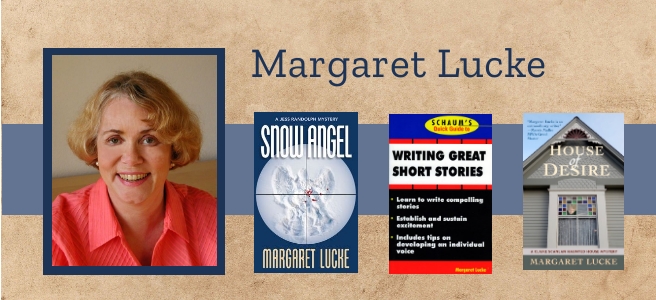
Banner showing author Margaret Lucke and some of her books

By Margaret Lucke

“A writer who waits for ideal conditions under which to work will die without putting a word on paper.” — E. B. White

The other day a nonwriter friend asked me if I write every day. With regret and some embarrassment I had to admit that despite my desires and good intentions, days (okay, weeks) often slip by without my having written a word. I mean, sure, I jot down grocery lists and dash off responses to emails, but that’s not my friend meant. She was referring to making progress on my current novel.

It’s not hard to come up with reasons not to write. Important and meaningful reasons. Errands need to be run, laundry must be done, good friends deserve a visit, the genius level on the New York Times Spelling Bee game insists on being achieved. But something feels off when I reach bedtime and realize that my protagonist has done nothing all day except sit there and twiddle her thumbs

I do believe in the value of writing routines. I’m convinced that having a good routine ensures a writer will be more productive, more focused, more intelligent, more witty and clever, more successful …

If only I could come up with one.

It’s not that I haven’t tried. In fact I’ve made quite a study of what works for others in the hope that I’d find a routine suited to my habits and temperament. What I’ve discovered is that routines are as varied as writers themselves, though they tend to fall into several categories.

>> The up-before-dawn writer

“Do they know I get up at five o’clock every morning to write 1,000 words before breakfast?” — Margaret Meade

These are the people who set the alarm for 4 or 5 a.m., get up and write for two or three hours, and then go off to report to their day jobs or whatever else places demands on their time. Anthony Trollope, who worked as a civil servant, wrote 46 novels this way. I have several friends who swear by this method and write fine books in the tender hours before sunrise.

>> The grab-bits-and-pieces-of-time writer

“The way you define yourself as a writer is that you write every time you have a free minute. If you didn’t behave that way you would never do anything.” — John Irving

Another friend, before she retired, spent all of her lunch hours at work in the parking lot, where she would sit in her car and write. Mystery writer and attorney Michael Gilbert wrote 23 novels on the train as he commuted from his home in Kent to his law firm’s London office. William Carlos Williams, a physician, scribbled stories and poems on prescription pads in between patients. I admire the way writers who do this can shift gears so quickly from other activities and home in on their writing.

>> The quota-system writer

“All through my career I’ve written 1,000 words a day — even if I’ve got a hangover.” — J.G. Ballard

These are the writers who set a daily goal and refuse to leave their desk until it is accomplished. The goal might be to write for a set number of hours or to achieve a specific page count or word count. This was the principal behind the sadly demised Nanowrimo, or National Novel Writing Month, which challenged writers each year in November to a produce a novel of at least 50,000 words. Producing 1,667 words a day would get you there. Note that the folks behind Nanowrimo didn’t insist that the novel be any good.

>> The ritual writer

“I had a ritual once of lighting a candle and writing by its light and blowing it out when I was done for the night.” — Jack Kerouac

Writers are not necessarily superstitious, but we know that sometimes we must do certain things to draw the muse to our side and appease her when she’s present. This can lead to some peculiar writing routines. Victor Hugo would shed his clothes and instruct his valet to hide them; being nude, he couldn’t leave the house so he might as well write. Charles Dickens carefully arranged certain items on his desk to foster his creativity, among them a vase of fresh flowers and a bronze statuette of dueling toads. Natalie Goldberg often wrote with a cigarette in her mouth; she usually didn’t smoke it but used it as “a prop to help me dream into another world.”

I’ve dabbled in variations from each of these categories, but I haven’t found the perfect routine for me. How about you? What works? I’m open to your suggestions.

Self-Discipline at 5 in the Morning

By Margaret Lucke

How do you define self-discipline? To me, it’s the quality that enables you to force yourself to do something you know is good for you when you’d rather do something else.

It’s focusing on business rather than pleasure.

It’s favoring long-term goals (lose five pounds, meet the deadline) over short-term benefits (eat the chocolate, spend the gorgeous afternoon taking a walk).

It’s getting up way too early in the morning, when any normal person would still be tucked up comfortably in bed.

But not everyone agrees with me.

Quite a few years ago, as an aspiring mystery novelist, I attended the late, great Cabrillo Suspense Writers Conference, a wonderful event held annually for a decade at a rustic lodge in the Santa Cruz Mountains. One day I had a conversation over coffee with a fellow writer. At that time he had published two well-received mystery novels, but he was still working long hours at his day job at a local college. Finding time to write was a challenge for me, and I asked him how he managed to do that while dealing all of the other demands in his life.

“It’s simple,” he explained. “Every morning, seven days a week, I get up at 5 o’clock and sit down at his desk to write.”

Seriously? There’s a 5 o’clock in the morning? I thought 5 o’clock automatically meant late afternoon.

I am not a morning person. I’m fine with being awake when it’s dark outside, but only if I’ve approached it from the other end, the gradual fading of daylight into night. But wake up while it’s still dark? Impossible. Until daylight touches my bedroom window, my eyes refuse to open and my brain is on strike. I can’t find the floor at 5 a.m. unless I fall out of bed. There’s no way I can write a coherent sentence.

But I have a high regard for writers, and I’ve known several, who regularly rise before dawn to produce pages. Good pages too, not the gibberish I’d come up with.

I said as much to my coffee companion: “You know, I really admire your self-discipline.”

His response surprised me. “Oh, that’s not self-discipline.”

“What do you mean?” I said. “You just said you make yourself get up every morning when you want to be sleeping and force yourself to sit and write.”

“That’s right.”

“How is that not self-discipline? It sounds like the perfect example to me.”

He took a sip of his coffee. “It’s not self-discipline because I don’t enjoy it.”

What? To me, if he didn’t enjoy it, then his peculiar (to me) habit fit the definition even more. Obviously we had different takes on what self-discipline means. I prodded, but I couldn’t get him to explain his concept any further.

Self-discipline or not, whatever he was doing worked. He went on to considerable success and acclaim as a mystery writer, with almost three dozen novels to his credit and several awards on his shelf. My track record, on the other hand, is considerably shorter.

Maybe I should try setting my alarm clock just a little bit earlier.

Love Is in the Air – and on the Page

By Margaret Lucke

Happy Valentine’s Day!

Today is the day when everyone’s mind—and heart—turns to thoughts of romance and love. We give people cards with heart designs to tell them we love them. Some lucky people receive roses and chocolates too.

And many people, whether they have personal sweethearts or not, pick up a romance novel to read. Of course, readers do that every day. My fingers are crossed that they might pick up one of mine.

Wait, you say, aren’t you a mystery writer? Yep. Always have been (I wrote my first short story featuring a private detective at age eleven). Always will be, or so I hope.

So, you might wonder, what am I doing as a member of the Bay Area Romance Writers?

I wondered that too when I first joined the organization. But the publisher of my my first Claire Scanlan Haunted House novel, House of Whispers, was billing the book as a paranormal romantic suspense, and I decided I should find out what that word romantic really meant. The book has a strong romance subplot. Maybe its potential audience extended beyond mystery fans. There are lots of romance readers—maybe one or two of them would enjoy a good love story with ghosts and murder mixed in. I hoped the group would help me figure out how to reach them.

Fact: In the year before House of Whispers came out, 74.8 million people had read at least one romance novel.

Those numbers sounded promising. So I sent in my dues and went to my first meeting not knowing what to expect. Dreamy-eyed writers wearing pink and sipping from china teacups with their baby fingers raised? Not on your life. These women were meeting in a brew-pub. For breakfast. Nowadays they meet mostly on Zoom, but what hasn’t changed is that they are a savvy, supportive, career-focused group. And they sell lots of books.

Fact: Romance fiction racks up $1.44 billion (that’s with a b) in annual sales. Mystery fiction brings in $728 million—just over half as much.

Sales of romance novels have shown a significant steady increase over the past five years. Being in love, it seems, is a more popular fantasy than being involved in a murder.

Fact: There are 39 subgenres and 127 tropes to be found within the romance genre.

I found those numbers on internet sites devoted to the genre. Of course, different sources provide different lists with different numbers, but the point is that the genre can accommodate almost any kind of story—including mystery.

I was surprised to learn how many types of books fall under the romance umbrella. It turns out that two of my favorite novels, Pride and Prejudice and Gone with the Wind, are romances. Books you might think of as mysteries, thrillers, suspense novels, science fiction, fantasy, paranormal are in fact romances. Okay, maybe not GWTW. Spoiler alert: This book falls short of the romance definition in its final pages.

Romance Writers of America has two criteria that a novel must meet to be considered a romance. First, a love story must be central to the plot—two people fall in love and must struggle to make their relationship work. Second, there must be an HEA ending—romance writer shorthand for Happily Ever After. Or at least an HFN—Happy For Now. Either way, the story must conclude on an emotionally satisfying and optimistic note.

But wait—even if a novel doesn’t fit that definition, it may still count as a romance. One of the official subgenres on RWA’s website (www.rwa.org) l is “novels with strong romantic elements”—books in which a romance plays a part even though major aspects of the story take the plot beyond the traditional romance boundaries.

So as long as one of your characters is romantically involved with another, or wants to be, then you too may have a romance novel on your hands. Perhaps Gone With the Wind fits after all. And the list of mysteries that qualify is very, very long.

“Romance fiction is smart, fresh and diverse … Romance novels may have any tone or style, be set in any place or time, and have varying levels of sensuality–ranging from sweet to extremely hot … Whether you enjoy contemporary dialogue, historical settings, mystery, thrillers or any number of other themes, there’s a romance novel waiting for you!” —From the RWA website

I’ll always be a mystery writer. But maybe I’ll get an HEA as an author if I let in a little romance.

I hope that today, Valentine’s Day, you’ll let in a little romance too—hopefully in real life but definitely between the covers of a good book.

Endings and Beginnings – Happy 2026

By Margaret Lucke

“The difference between reality and fiction? Fiction has to make sense.”

Variations of this quote have been attributed to numerous authors, from Mark Twain to Tom Clancy. All of them have had to deal with one of the big challenges of writing fiction—coming up with an ending that works.

How things end is one of the biggest ways in which fiction differs from reality. In a novel or a short story, the events of the tale are supposed to come to an orderly, or occasionally disorderly, resolution. The writer is supposed to tie the plot threads together, if not in a big bow then at least into a somewhat tidy knot. The ending doesn’t have to be a happy one, but it does have to make sense.

In real life endings are often messy. Whether it’s a romance, a marriage, a friendship, a job, a war, a civilization, the ending sometimes comes out of nowhere, a total surprise. Or it’s not so much an ending as simply a point where something stops or runs out of steam. Now and then we don’t even realize that an ending has occurred until much later.

But our human brains, aware that time marches steadily forward, like endings—and beginnings too. When we can bracket a set of events with a start point and an end point, that helps us impose a sort of logic on what’s going on in our lives and lets us achieve a measure of understanding.

Even better are the new beginnings that can follow an ending. This doesn’t happen so much with fiction unless the author is writing a series that chronicles the continuing adventures of a particular character. But in real life the closing of one door often provides us with a way to open another. New possibilities arise; we have new opportunities to reinvent ourselves.

That’s what drives our celebration of New Year’s Eve. The end of the year marks the start of a new one, a fresh page offering hope and the potential for better things to come. We make resolutions of a different kind than the ones we mean when we talk about the resolution of the plot in a work of fiction. We resolve to get organized, to lose weight, to become better people. We entertain the belief—though by now we realize that this may be another work of fiction—that the coming year will be better than the one that has just passed.

Right now we’re in that annual season of endings and beginnings. Last week, in celebration, we put on silly hats (well, not me, but some of us), we blew our noisemakers, we counted down as the ball on tower at Times Square descended, we lifted glasses of champagne in a toast (you could count me in for that one).

We said farewell to 2025, and some of us may not be sorry to see it go. We are ten days into a fresh new year, 2026, which at this point is full of hopes and dreams and positive potentials. May all they all turn out not to be fiction but become a positive reality.

I’ll close with my favorite New Year’s toast, my wish for all of you:

“May 2026 be better than any year that’s come before, and worse than every year that will follow it.”

Cheers, everyone! And Happy New Year!

Taking Stock of Taking Stock

By Margaret Lucke

One reason that English is so delightful, and so befuddling to people who are trying to learn it as a second or third language, is that the same word or phrase can mean so many different things. For example, take stock of some of the ways to take stock.

To a cowboy, stock is the herd of animals being raised on a ranch or farm. In the 1870s and 1880s taking stock meant a long dusty journey driving cattle from Texas to Kansas.

A shopkeeper’s stock is the goods on hand that are being offered for sale. Taking stock involves counting all of the items in the inventory.

A photographer who takes stock is shooting photos that others can use in ads, as book covers, as illustrations, and so on. Agencies handle the business end of licensing the rights. You can browse through millions stock photos on the Internet.

A cook thinks of stock as a rich broth made from bones and trimmings of meat and vegetables. Stock serves as the basis for soups, risottos, paellas, and many other delicious recipes. Take stock, put it on the stove, and get set to prepare a wonderful meal.

For an investor or a businessperson, stock is an ownership share, or many shares, of a publicly traded company. A corporate executive may take stock as part of a compensation package, hoping the value of the shares will go up.

When my husband and I owned a printing business, stock had to do with the paper required for a job. We would, for instance, take card stock for posters or 20-pound stock (about the lightest weight that would go smoothly through our press) for flyers.

To a gardener or a florist, stock is a flower of the species Matthiola incana, with a spicy scent and showy white, pink, or purple blooms. Take stock, and you have a beautiful addition to a garden or a bouquet.

When a genealogist or archeologist talks about stock, they are referring to an individual’s or group’s ancestral background, as in “they came from European stock” or “their forebears were of Asian stock.”

A firearms enthusiast knows that the stock is the part of a long gun, like rifle or shotgun, that is placed against the shoulder to hold the firearm steady when it is fired.

To a writer or reader, stock is something standard or conventional or unimaginative, such as a stock character or a stock phrase.

Stock can also refer to the opinion or regard with which something is assessed, as in “I take little stock in what that person claims” or “the candidate’s stock with voters is high.”

And around this time, as the year winds down, a lot of us are taking stock – by which we mean we’re reflecting on the events of the past twelve months, assessing our goals and achievements, and making our plans for 2026. We’re looking at where we are, how got here, and where we want to go.

I hope that your taking-stock process goes well, whatever that phrase means to you, and I wish abundant joy in this holiday season.

* * * * *

If your plans for 2026 include making progress on your novel, you might be interested in the class I’ll be teaching this winter for University of California, Berkeley Extension: “Writing Genre Fiction: Science Fiction, Mystery, Romance and More.” 10 Thursday evenings, January 22–April 2, with February 26 off so we can attend the Left Coast Crime convention in San Francisco. Info about the class is here.