The Great Grammar Experiment

By Margaret Lucke

It’s September (already!), and as I watch the neighborhood kids head back to school I find myself thinking about the lessons I learned early on that led to my becoming a writer. Specifically, grammar lessons.

Writers love words—their sound, their rhythm, their layers of straightforward and subtle meanings.  Words are our paint and brushes. We use them not just to tell stories, but to give our ideas color, shape, substance, and texture. Words are the magic wands we wave to bring characters to life, to set a plot into motion.

We adore words.

But grammar? Not so much.

The problem is that people tend to think of grammar as rules that seem arbitrary and arcane terms that they can’t remember. Participle, subjunctive case, subordinate clause—arrgh! Who cares?

Do I reveal myself as a hopeless nerd if I confess that I find grammar fun? No, I can’t define subjunctive case without looking it up. But that’s not the point. Grammar isn’t really about rules and labels. It’s the anatomy of the language, the essential connective tissue that binds our wonderful words into coherent and meaningful patterns. Without grammar, what we write makes no sense.

One of the most useful things I learned in school was how to diagram a sentence. Seriously! It was like I’d finally cracked a code. Gertrude Stein probably was exaggerating when she said, “I really do not know that anything has ever been more exciting than diagramming sentences,” but not by much.

When I tell people this, they laugh at me or groan. Or else they look at me blankly, especially the young ones. Apparently this valuable skill isn’t taught much in English classes these days.

I haven’t actually diagrammed a sentence in years, but I’m glad I learned how. It made me understand of how the parts of a sentence fit together—how the knee bone is connected to the thigh bone. It taught me where to put the commas, how to keep my modifiers from dangling, and how to arrange my words so that a sentence means what I intend it to.

Other than that one lesson, formal grammar instruction is pretty useless. I have scientific proof. In ninth grade I was part of the Great Grammar Experiment.

My school district developed, at great expense, a language skills curriculum using a fancy instructional methodology called programmed learning. The theory, based on the experiments of the behavioral psychologist B.F. Skinner, was that presenting the material in lessons with small, sequential steps and rewarding correct responses quickly would reinforce the mastery of the material.

For the pilot test, two English classes at my school were selected to be the guinea pigs. For twenty minutes every day, kids in the first class trudged through the special set of grammar drills.

The second class was the control group. Its students weren’t taught grammar at all. Instead they read lots of stories and essays and turned in weekly writing assignments.

In September, January, and June, both classes took standardized tests that measured their ability to use grammar correctly. You can guess the result:  To the dismay of school officials, all of that drilling made no discernible difference for the hapless class upon which it had been inflicted. But the readers and writers had developed a strong sense of how language works. Their scores improved by leaps and bounds.

The expensive program was scrapped.

I’m grateful to this day that I was in the second class.

Some Angels Have Beards


by Janis Patterson

This post has nothing to do with writing… just with life.

To be honest, I dislike facial hair. I really do dislike facial hair.

There are, however, exceptions.

Not long ago The Husband and I were driving home from a conference in Kentucky. The scenery was beautiful – trees like carpet, charming farms on the rolling hills, the highway itself was – for a change – free of construction and blessedly clearly marked.

The Husband was napping as usual, and I was tootling along at my usual 90-95 mph when suddenly a terse message appeared on the navigation screen saying that we were dangerously low on oil and we should add more or the engine might freeze.

Gulp.

We were in the middle of nowhere, with nothing in sight but trees, trees and more trees.

Immediately I slowed to a turtlesque 50 and hugged the right hand shoulder as if we were lovers. The deity of motorists was in a good mood, though, and in a very few miles a Love’s gas stop appeared. Normally, being a Texan, I prefer Buc-ee’s, but at the moment I was delighted.

Now they had people who knew 18 wheelers, but were totally adrift when it comes to a 13 year old BMW. Neither The Husband nor I are car people… though in my misspent youth I did indulge in some racing. Now if it had been a 1955 Ford I could have broken it down to the smallest part and rebuilt it in the dark…

The sad thing is that we had had the car in the dealership for a sticker and checkover before leaving for Kentucky. Once home we complained, and they admitted that they had dropped the ball and gave us a couple of free oil changes.

He knew what to do. He went into the store and found the type of oil we needed, he unscrewed the cap where it should go, and poured it in. I started the engine and the terse note went away. He did advise us to get to the closest dealership and let them take a professional look (which we did – there is a BMW dealership in Memphis who took great care of us). Once he was sure the car was okay for covering the fairly short distance to Memphis he said good bye and left. He wouldn’t even let us buy him a cold drink.

Sometimes angels do have beards.

Bots and Me by Heather Haven

Recently, the latest book in the Alvarez Family Murder Mysteries, Cleopatra almost Slept Here, debuted. Following my glory hallelujahs, emails started coming out of the woodwork written by allegedly important and famous people. To hear them tell it, I’m not only a wunderkind, but so taken were they, they ignored whatever else was on their agenda to sit right down, read my book, and then write me a lengthy email extoling the book’s virtues. Even my mother rarely went that far. Every day I receive  two or three of these classics. These emails come from far and wide, but manage to say virtually the same thing. I’ve pulled out two as an example:

A Vice President and Editor-in-Chief of a major publishing house said, “The combination of a private-investigator family, animal characters, lighthearted banter, and real investigative stakes gives the novel a strong identity within the cozy mystery space. The archaeological setting also provides an especially appealing backdrop for readers who enjoy mysteries built around history, ancient treasures, and unusual locations.” He then offered I know not what, because all this bot really wanted to do was start an exchange of emails that resulted in extracting my hard-earned moola. I never responded.

I was particularly surprised to hear from Terry Gross of Fresh Air fame, who wrote “It was a genuine pleasure to discover your novel Cleopatra almost Slept Here and to immerse myself in the delightfully witty, wonderfully entertaining, and utterly captivating world you have created. I am reaching out to you personally because I believe your voice and your gift for blending classic mystery with modern humor would make for a truly compelling conversation on Fresh Air, broadcast on Wider Horizons for You and Yours (WHYY).” At the end of the email, she sent her warmest regards while misspelling her last name. Even my two cats laughed at that one.

Here is my response to a particularly insistent bot: “If you are a real human being I apologize. However, I still suspect you are a bot who has learned the ways of charming money out of egotistical writers. I am sorry we have come to this. If you showed up at my house for dinner, I would be more inclined to believe in you. Bring a bottle of wine.”

 I think what is more galling than the unmitigated chutzpa of these emails is the idea that the receiver is so dumb —or has such a large ego — they don’t know a scam when it comes marching at them complete with ticker tape parade.

Sadly, there has to be a naive writer out there buying into this routine, losing their money and a piece of their heart along the way. Let’s face it, if this scam didn’t work, these emails would cease to exist, and the bots would move on to greener pastures. By the way, I have put a pox on the billionaires who own these bots. Like the parents of a spoiled brat, they are really the bad guys.

To muddy the waters, a few years back I received an email from a legitimate producer which led to the Alvarez Family Murder Mysteries being optioned for streaming the series on television. It’s still under option. As only one in every thousand make it to the final stage, I don’t hold my breath. But I’m in the game and it’s a lot of fun.

Given all these scams, would I have even paid attention to that email today? Probably not. I probably would have trashed it like the dozens of others. That thought gives me pause, but not much of one. Such is the climate of internet thievery. Snake oil is alive and well. I can only hope that given the scamming climate, if a legit producer is interested in an artist’s work, they will go the extra hundred miles or so to make it happen. Even though I keep the faith, I can’t help but admit this issue has taken some of the joy out of the debut of my 20th novel.

In the pool of life, swimming next to sharks is a little scary. I wonder if the shark to the right is really a bot?

Too Real?

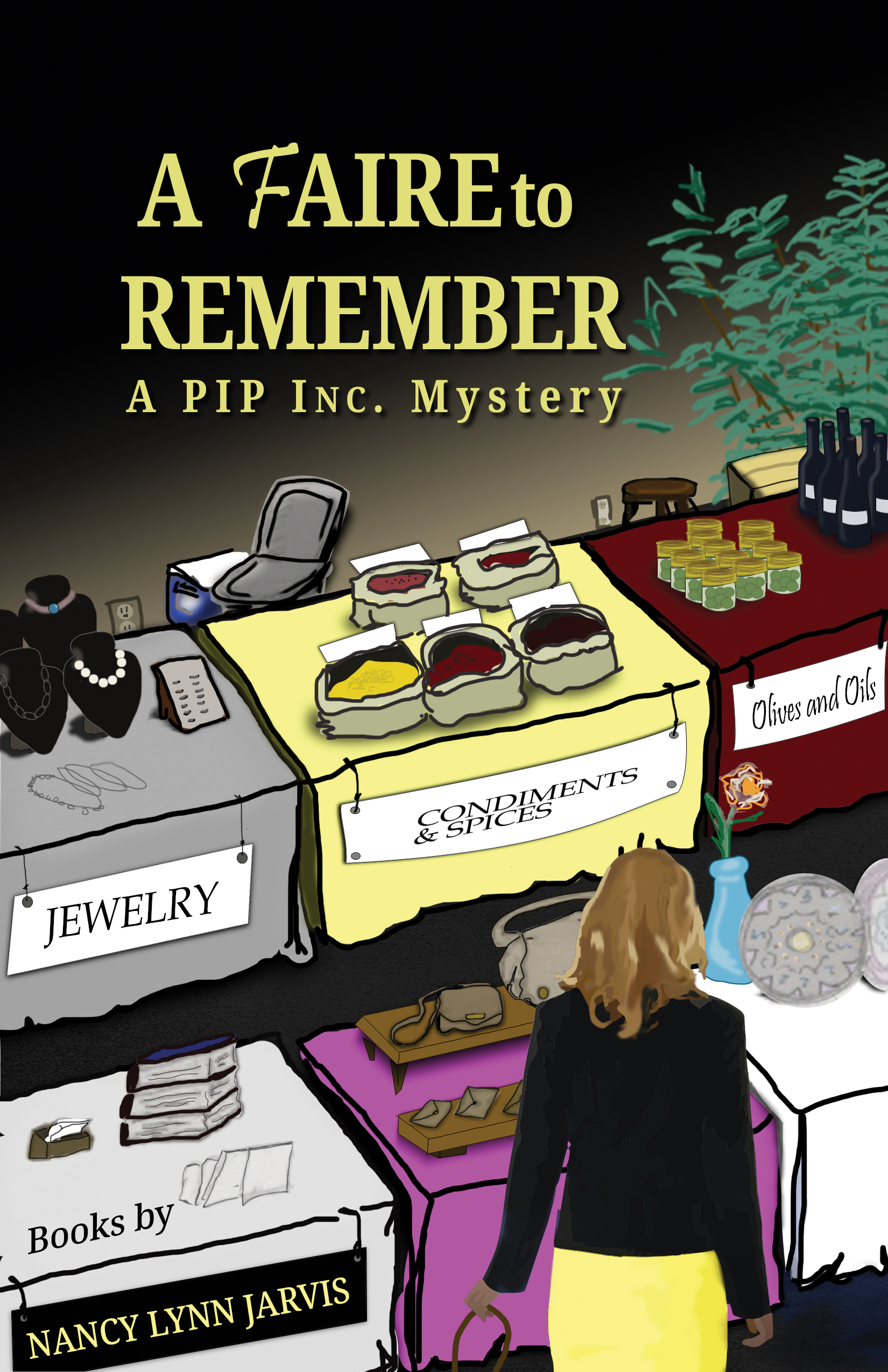
I’ve admitted it before; I’m a setting thief.  I also steal dialogue, people, and events. But book seven in my PIP Inc. Mysteries series takes my thievery to a whole new level. Last year I participated in something called Santa’s Shelves at the Felton Fire Protection District’s Fire Station. It’s an annual event, with vendors paying a fee to be included in the fundraiser for the district. The fire station is home to 30 volunteer firefighters, full-time EMTs, Captains, and a Fire Chief, serving 6,000 permanent residents and up to 15,000 summer visitors.

At the two-day Christmas faire last year, opportunities for theft of setting, dialogue, characters, and murder, presented themselves and I decided to steal all of them. I’ve done it before. The bank robbery in “Mags and the AARP Gang” took

place where I bank and my admission that I was “casing the place” to understand how to rob it made bank officials exceedingly anxious and got me put under surveillance until the book came out and I presented the manager with a copy so he and the nervous employees would understand that my robbery was pure fiction.

 And then there was the time I witnessed a death at a funeral and turned it into the beginning of

“The Funeral Murder.”  In both of those thefts, I only used the setting, a soulless entity, and created the characters…well mostly. Setting a death at the eighteenth hole pond at the Delavega Golf Course for the  “The Two- Faced Triplex, “

and the murder in the walkway near the post office for  “What Lucy Heard”

was even more settings-driven without any potentially real characters.

I’m still amazed and delighted by how eager to help with ideas and means for murder so many people are when I tell them I’m writing a cozy murder mystery. They find flaws in my reasoning and make corrections which make the killings work so well that I often wonder how many innocent-seeming bystanders fantasize about committing murder and if only the prospect of getting caught keeps them from doing it.

For “A Faire to Remember,”

I went way beyond the norms of privacy by placing many real people in the book. I fictionalized them and made up their backstories, but they will know who they are and recognize their booths and the placement of them if they read the book. I also made the fire captain a serious suspect with motive and means to be a murderer. That last decision made me worry. Was he too real? Was the setting too real?

I wondered if I should make up a town and place it in the Santa Cruz Mountains. Fellow writer Victoria Kazarian does a series set in River Grove but assures me her setting is really Felton, California. Should I borrow her town? I like that my books are set in real places and many readers enjoy recognizing local references so I really didn’t want to do that.

With the book off to the editor, I finally had to confront my dilemma. I called the fire station and explained to the volunteer who answered the phone that I had been a vendor last year when the lights strobed and a towel was put over them… 

“That was me,” he exclaimed. “I’m the one who put the towel over the light fixture. Is my name in the book?”

“You’re referenced but not named,” I offered. “Cool! But if you want to use my name, I’m good with that!”

“I hope your captain will feel the same because he’s a suspect.”

“Send him an email and ask him.”

I did. He wants to read the book when it comes out.

The Stumbling Stage (one week late)

I am in the stumbling stage.  About a month ago I got what I thought was a brilliant idea for a mystery (aren’t they all?) and settled in to let the idea percolate and my unconscious have time to work on it, to throw up opening lines, character samples, little plot points, and the like. I scribbled, tried things out, and waited. A sentence here, a character description there. And still I waited. 

 Ready or not it was time to start writing, so I did. I had the opening scene—it was riveting. Definitely riveting. It took me a while to figure out what would come next (I’m a slow writer), but then the obvious occurred to me and I went at it. Another riveting scene. I was chugging right along when again something occurred to me. I envy other writers who seem to have a narrative and trajectory all worked out before they put fingertips to keys and zip right along. At this point I realized more should come after the opening scene, and before what I thought was the second scene. So back I went. But then that originally second scene had to be revised to fit a changed plot direction, and suddenly the narrator was older but I needed her to be younger, but not too much younger. I was either traveling in a circle or a spiral, neither of which was good. 

When I was much younger my parents took us hiking and camping—anything to get outdoors in the woods and on the mountains. Dad just wanted to be with the trees, so we followed a map for walks through the forests, crossing and recrossing the Appalachian Trail and other lesser-known paths. One I remember vividly promised we’d end at a crystal-clear lake and could run straight into the water for a swim. After the expected period of upping and downing along the trail we came to the end—and looked down at the lake, where a man was climbing out of a canoe along the sandy shore. The only problem was the lake was below us, several thousand feet below us, at the bottom of a sharp tree-covered decline. How we had gotten so lost is beyond me. But Dad was undeterred. He looked at us, at the lake, at the mountainside, and off we went through the brush and over the rocks and down the nearly vertical mountainside, leaving a solid trail behind us. We did arrive at the lake and collapsed on the sandy shore rather than run energetically into the water for a swim. Dad always got to where he wanted to go. I like to think I take after him—at least when I write. At this point in the draft I really don’t know where I’m going even though I think I can see the end over there, somewhere. I know I just have to keep going, so I do.

I call this the stumbling stage. Another example of the stumbling stage is this post. I was scheduled for the fourth Saturday, which was last week. But deep into my life-is-a-haze phase I was surprised to find I’d forgotten the fourth Saturday post. So here it is. 

This doesn’t help me get through the stumbling stage in my manuscript. There’s nothing for it but to keep going, and so far I’ve revised the complications four times, making them worse each time—for me, not the reader, because I haven’t worked out how the narrator is going to solve all these problems. I could do what some writers do and finesse the worst inventions and hope no one notices. (I’m not that lucky—I’d get emails.)  

Redoing the text so far is becoming something I can’t stop doing. It’s all right that the narrator isn’t as upset as she expected to be after a particular incidence. Okay, that’s human. But I can’t leave it there. I have to come up with an explanation—note I don’t say reason, because I’m moving beyond reason. First she thinks it’s deja vue, but that seems too mundane. She starts to wonder if this has something to do with a previous life. But then she remembers she doesn’t believe in reincarnation—too complicated for her, and depressing. Then she lands on the idea of synchronous lives. Huh? How did she come up with that one? I don’t even know what it means, or even if it means something.

This is definitely stumbling and the problem with this stage is that I’ve brought it on myself. I had to complicate things, deepen the motives and actions and people and even the weather. So how do I get out of it? First I write a post one week late. Second, well, I’m not sure about the narrator’s stumbling stage. I could just delete a lot of pages and see where I end up, or what I end up with. That could be interesting. So far the stage seems to be winning.

 The stumbling stage is not to be confused with writer’s block, which is only solved by a crisis calling the writer elsewhere, to avoid which ideas and words begin to flow. Nor is the problem solved by declaring it graphomania or hypergraphia. Either one seems easy to deal with. A glass of wine. A good friend. A sunny day and a porch. That’s such an appealing scene I may give that a try. If nothing else, my narrator may get to take a break too and we’ll work out this problem together.