What a Character!

What makes a reader fall in love with a character? I’ve been thinking about this a lot lately as I write my sixth book, hoping that this will be my breakout novel. You know, the one that people can’t quit talking about.

I thought about Louise Penny’s early books. I read the first one and wasn’t that impressed. Yes, the characters were quirky, but the story was simple and didn’t hold my interest. Later, someone suggested I listen to her books on audible and I fell in love with Inspector Gamache and the rest of the cast. The narrator’s voice brought the story to life for me. But other readers loved the early books and continued to read and beg for more, making Louise Penny a household name for those of us who love mysteries. Do we all need a duck who spits profanity, a quarrelsome old lady who is a renowned poet? What is it about these books that readers love so much? Is it that the characters are larger than life?

I also love JA Jance’s Sheriff Joanna Brady books. I love the interaction between Joanna and her husband, Butch, and their children. I love that she can be a tough cop at work and a warm wife and mother at home.

Lisa Regan writes the Detective Josie Quinn series. Josie is such a great character. Even though she’s had to overcome so much—being abducted as an infant and raised by a cruel, vindictive woman— she never gives up.

There are so many books with so many great characters. I’m sure we could go for days naming our favorites and why they are our favorites.

In my first book, a standalone titled, The Truth Will Set You Free, a young woman is looking for her birthmother and travels to the small town of Cascade Locks, Oregon, where her mother grew up. It’s a dual timeline, told from the young woman’s perspective, and thirty years earlier from her mother’s perspective. Even though, Natalie, the young woman searching for her birthmother is broken because she had been lied to by the woman who raised her, the real star of the book is her mother, Colleen. Colleen makes all the wrong decisions, but you fall in love with her because her heart is so big. Even though she’s made so many mistakes in her life, when she loves someone, her boyfriend, her mother, she loves with all her heart.

I recently binge-watched Roseli and Isles. I know, I’m way behind in my TV viewing. But I fell in love with the characters on the show. I enjoyed each episode, but mostly what I loved was the relationships between the characters, and I really loved the friendship between Roseli and Isles.

I’ve watched a lot of cop shows over the years. Blue Bloods was probably my all-time favorite. I loved the family and how they interacted. I’ve been thinking a lot about acting and how actors take a character and bring them to life. Maybe an acting class would be a good way to learn how to write outstanding characters.

What makes a great character? Maybe it’s just people doing people-y things. Being scared and courageous and mean and kind and smart and doing stupid stuff, all the things that really make someone human. Or maybe it’s making each character bigger than life. Creating something inside them that makes readers sit up and take notice.

Now I’m going back to work on my characters and see if I can make them even more real. What character traits can I give them to make them stand out? I’ve heard that mysteries are more about plot than characters, but I believe characters are what bring the plot to life.

In Search of a Writing Routine

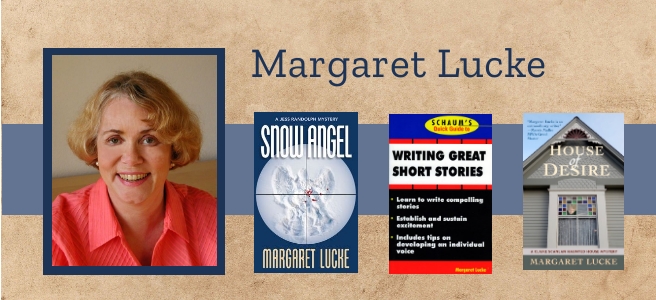
Banner showing author Margaret Lucke and some of her books

By Margaret Lucke

“A writer who waits for ideal conditions under which to work will die without putting a word on paper.” — E. B. White

The other day a nonwriter friend asked me if I write every day. With regret and some embarrassment I had to admit that despite my desires and good intentions, days (okay, weeks) often slip by without my having written a word. I mean, sure, I jot down grocery lists and dash off responses to emails, but that’s not my friend meant. She was referring to making progress on my current novel.

It’s not hard to come up with reasons not to write. Important and meaningful reasons. Errands need to be run, laundry must be done, good friends deserve a visit, the genius level on the New York Times Spelling Bee game insists on being achieved. But something feels off when I reach bedtime and realize that my protagonist has done nothing all day except sit there and twiddle her thumbs

I do believe in the value of writing routines. I’m convinced that having a good routine ensures a writer will be more productive, more focused, more intelligent, more witty and clever, more successful …

If only I could come up with one.

It’s not that I haven’t tried. In fact I’ve made quite a study of what works for others in the hope that I’d find a routine suited to my habits and temperament. What I’ve discovered is that routines are as varied as writers themselves, though they tend to fall into several categories.

>> The up-before-dawn writer

“Do they know I get up at five o’clock every morning to write 1,000 words before breakfast?” — Margaret Meade

These are the people who set the alarm for 4 or 5 a.m., get up and write for two or three hours, and then go off to report to their day jobs or whatever else places demands on their time. Anthony Trollope, who worked as a civil servant, wrote 46 novels this way. I have several friends who swear by this method and write fine books in the tender hours before sunrise.

>> The grab-bits-and-pieces-of-time writer

“The way you define yourself as a writer is that you write every time you have a free minute. If you didn’t behave that way you would never do anything.” — John Irving

Another friend, before she retired, spent all of her lunch hours at work in the parking lot, where she would sit in her car and write. Mystery writer and attorney Michael Gilbert wrote 23 novels on the train as he commuted from his home in Kent to his law firm’s London office. William Carlos Williams, a physician, scribbled stories and poems on prescription pads in between patients. I admire the way writers who do this can shift gears so quickly from other activities and home in on their writing.

>> The quota-system writer

“All through my career I’ve written 1,000 words a day — even if I’ve got a hangover.” — J.G. Ballard

These are the writers who set a daily goal and refuse to leave their desk until it is accomplished. The goal might be to write for a set number of hours or to achieve a specific page count or word count. This was the principal behind the sadly demised Nanowrimo, or National Novel Writing Month, which challenged writers each year in November to a produce a novel of at least 50,000 words. Producing 1,667 words a day would get you there. Note that the folks behind Nanowrimo didn’t insist that the novel be any good.

>> The ritual writer

“I had a ritual once of lighting a candle and writing by its light and blowing it out when I was done for the night.” — Jack Kerouac

Writers are not necessarily superstitious, but we know that sometimes we must do certain things to draw the muse to our side and appease her when she’s present. This can lead to some peculiar writing routines. Victor Hugo would shed his clothes and instruct his valet to hide them; being nude, he couldn’t leave the house so he might as well write. Charles Dickens carefully arranged certain items on his desk to foster his creativity, among them a vase of fresh flowers and a bronze statuette of dueling toads. Natalie Goldberg often wrote with a cigarette in her mouth; she usually didn’t smoke it but used it as “a prop to help me dream into another world.”

I’ve dabbled in variations from each of these categories, but I haven’t found the perfect routine for me. How about you? What works? I’m open to your suggestions.

Songs and Stories

There was always music in our house.

Mom majored in music in college, until she dropped out during World War II to marry Dad. She played the piano and sang in the church choir. She also participated in a local singing group that sang standards and show tunes and performed around town.

Dad enjoyed the music of the forties, which was when he courted and married Mom. Sometimes he’d put a record on the hi fi, grab Mom, and they would dance around the family room.

I took piano lessons for many years. I bought a guitar once but couldn’t get my little fingers to fret properly, so I passed it along to my brother. He’s the musician in the family who plays with local bands and never travels without multiple guitars, just in case someone, somewhere, might want to jam.

I love listening to all kinds of music—rock, folk, jazz, country. I sing along. I first heard of the Beatles in 1963 (yes, I’m that old) and have been a fan ever since. The Rolling Stones, the Animals (Eric Burdon!), bring it on. Then there’s Joan Baez, Joni Mitchell, Judy Collins, and Gordon Lightfoot. I saw Lightfoot in concert twice, once at the University of Wyoming fieldhouse and the second time at Colorado’s Red Rocks Amphitheater.

My best memory of that venue is a concert in the 1970s. As the sunset hit those massive, tilted slabs of red sandstone, making them glow even redder, John Denver came out on stage singing “Rocky Mountain High.”

I like songs that tell stories. There are so many of them, in all the permutations. Think of the tales we heard on the radio: Wake Up, Little Susie by the Everly Brothers. House of the Rising Sun, and no one sings it like Eric Burdon. Dolly Parton’s Jolene, El Paso by Marty Robbins. Ode to Billie Joe by Bobbie Gentry. Eleanor Rigby, the Beatles classic. Alice’s Restaurant by Arlo Guthrie. City of New Orleans, the Steve Goodman song that’s been covered by everyone from Guthrie to Willie Nelson. And of course, Gordon Lightfoot’s The Wreck of the Edmund Fitzgerald.

Songs that tell stories, yes. I had a fling with opera at one point, but my longest love affair is with musical theatre. I was raised on Broadway musicals, particularly those of Richard Rodgers and Oscar Hammerstein II.

A native Oklahoman, I spent my early years in that state. The state song is “Oklahoma!” Of course it would be, the title song of the groundbreaking R & H musical of the 1940s. I was about six years old when the movie version came out and spent my childhood hearing all those tunes.

So did lots of other people. I recently visited the Museum of Broadway in New York City. There’s a room in the three-story museum dedicated to Oklahoma! and I chuckled at the number of people who strolled through the exhibit singing “Oh, What a Beautiful Morning.”

Before R & H came along, musicals were different. The Rodgers & Hammerstein website explains why.

Why was Oklahoma! groundbreaking? It was a narrative musical which:

We’re writing fiction, not musical theatre. But essentially, we writers are doing the same thing. We use every element at hand. First, we throw our plot, characters and story into the mix. Then we pick up that chisel and start working on that big slab of marble. Cut here, polish there. We eliminate everything that’s superfluous until we have the story we want to tell.

Grab your chisel and get to work. And sing along with your favorite show tune if the spirit moves.

Karan Made Me Do It!

For the longest time and in increasing numbers, people I meet at fairs and book shows have been asking if my books are available on Audible. I’m a paper book aficionado; I don’t enjoy reading on my iPad and would never dream of reading on a phone. Oh, I do listen to podcasts which are short and usually newsy regularly, but the only book I’ve ever listened to was “1776” read by its author, David McCullough. I found it mesmerizing, and even after a seven-hour drive home, I stayed in my car until almost midnight to hear the last few pages.

In the past year the pressure to make an audiobook has been increasing, but I still successfully avoided doing it. My neighbor Karan was the pushiest. “I listen to audiobooks every day,” she said. “Please, please, please do audiobooks.”

I’m a master at finding excuses for things that scare me. I’d say “I’m in the middle of writing another book and can’t think about audiobooks until it’s finished.” When a book was finished, I’d move on to, “I can’t do anything about an audiobook right now because I’m trying to promote my new book.” If I had free time I’d say “I’m a technophobe; I could never deal with audiobook production.” And, then there was always my personal favorite: “Hey, I’m just a poor writer who could never afford to pay Meryl Streep to read a book of mine.” (Not that she would anyway.)

On January 1st, I came dangerously close to running out of excuses.  At a New Year’s Day brunch my daughter-in-law’s brother mentioned he had been setting up podcasts and book readings and said he would be happy to produce an audiobook of “The Glass House,” the first book in my PIP Inc. Mysteries series.  Panic time. But then I remembered the getting a professional to record issue. Whew.

That final excuse soon fell, too. No, Meryl Streep didn’t agree to record a book for me, but I discovered listeners are often willing to let an author read their book to them. I learned a number of other things about audiobooks, too, things like what’s happening to their market share of books consumed each year. Statistics from 2024 stated there were 270 million audiobooks sold that year and 7.93 billion dollars in revenue was generated by eager listeners. The most shocking statistic was that listeners were increasing 15% per year. I’m not great at math, but even I understood the implications of numbers like that.

So, Karan, I don’t pretend to be an actress and the results of trying to do a male voice might be questionable, but per your demands, the book came out on March 13th. Audible gave me a bunch of free codes and told me to give them to family, friends, fans, and anyone who would agree to listen to the book and promise to leave a review. The goal is to get fifty reviews; that’s evidently a magic number in Audible land.

If you are willing, please email me at nancylynnjarvis@gmail.com and I’ll send you one. At the very least, you can do more than read my posts. You can find out what I sound like.

The Glass House: A PIP Inc. Mystery (PIP Inc. Mysteries Book 1)

The Glass House: A PIP Inc. Mystery (PIP Inc. Mysteries Book 1)

By Nancy Lynn Jarvis

This Business of Writing by Heather Haven

There are a lot of things that go into being a successful author, that is, being read by readers. Unless you’re writing for yourself and hiding your work in a closet, then just ignore me. But I would say, don’t do that. The written word is meant to be read. But for some writers, if they’re the only ones reading their work, it’s fine with them. That’s what a diary is all about. BUT if you’re not writing a diary, for heaven’s sake, get that work out there.

Easier said than done, I know. You can be the best writer in the world and the most talented. But if nobody knows your work exists you’re screwed, pardon my French. And thus, we enter the world of the writing business.

I have always been a writer for as long as I can remember. As a kid, I wrote lyrics to songs and short stories. Really short stories. Pluto lost his collar. Pluto found his collar. Pluto was happy. Pluto went home. I was 8. My first paying job was at 17 years old for the Miami Beach Sun. I wrote a weekly column on the comings and goings of the tenants in a large condo complex. I got $25 a week and was beside myself. I was a paid writer!

After college, I moved to Manhattan. During the day my writing consisted of plays, ad copy, and acts for performers. At night I would work Broadway behind the scenes in the Wardrobe Department. It was a settled world for me as a writer, and one I loved. But it wasn’t quite enough. Something was missing and I didn’t know what. Then I met Norman who was a jingle singer/performer. We got married and went on with our New York City lives. But what was exciting when you’re 20 can become tedious when you’re 40.

We were tired of wondering where our next job was coming from, which goes with the territory of being in the theater. We moved to California for some stability. Norman became an English teacher, and I ran the Faculty Recruiting Department at Stanford’s GSB. We have never regretted the move, but his singing and my writing never completely left the scene. Wherever you go, there you are.

Once in the Bay Area and without the backing of the New York Theater district, I was temporarily lost. But eventually, the entire world opened up to me. I decided to try writing a novel, something I would never have considered before. I finished my first novel by getting up early and writing from 4 in the morning until I went to work and then when I came home in the evenings. Ah, youth! But that was twenty years ago.

Ready to publish, I realized publishing was going through a transitional period. To put it mildly. Ah, the ramifications of the internet! Publishing houses began eliminating genres in order to stay alive. Or going out of business entirely. Agents were forsaking their clients and opening their own online publishing houses. Everything became different. But all the time I was learning. I was learning the good, the bad, the preposition, and the proposition.

I went with two online publishers, great people, but they didn’t give my books the care I thought they deserved. I waited until publishing rights were given back to me, then I struck out on my own. This was when there was a stigma attached to self-publishing. If you self-published, it meant you weren’t a good enough writer to have a traditional publisher. I avoided the looks of sympathy and derision from my peers. Because somewhere inside me, I knew that if I pushed at it long enough, I could have the career in writing I wanted. And on my own terms.

When you self-publish, the various aspects of getting a book out there falls to you. From the first draft, to the cover, to the editing, to the final product, it lands at your feet. Not to mention advertising and publicity. I took it all on. I wanted my books to be read. So, I persevered with learning the steps needed. All the time, I said to myself: Heather, you’re competing with Big Boy Publishers. You need to do exactly what the Big Boys do. So I did.

I hired the best editor I could afford. Eventually, two of them. One for content, one for grammar and punctuation. I had beta readers. Not my friends who would soft-pedal things, but experts in the field who would give me the feedback I needed. I hired a publicist. In short, I was as professional as I could be.

My fellow mystery writers helped me. Mystery writers are the kindest, most giving people I know. If any of you are members of Sisters in Crime, you know what I’m talking about. When I was doubtful or got into trouble, they would give me all the support they could. And often great words of wisdom.

So here I am twenty years later, one of the old guard. I still learn. I hope I still grow. Newbie writers look up to me. Well, at least one or two of them. And if they ask for help I am there, as all the wonderful writers in the past were there for me.

It’s a heritage we pass down to one another, this business of writing.