
This month I’m delighted to introduce you to Judy Penz Sheluk, author and editor extraordinaire, and fellow Canadian. Judy is also a past chair of the Crime Writers of Canada. Her latest project, A Fatal Affair: The Murder of Helen Grier, co-authored with Amanda Capper, required hours of deep historical diving, even if some of that fascinating research had to be left completely out of the final book.
Into the Weeds and Down the Rabbit Hole: Researching True Crime, Guest Post by Judy Penz Sheluk
Writing a novel, regardless of genre or sub-genre, requires a certain amount of research to lend authenticity to the story. In researching the October 28, 1937 murder of Helen Grier, my co-author Amanda Capper and I would soon find ourselves knee-deep into the weeds and down the rabbit hole.
THE BACKGROUND
Vernon Spencer, Michigan dairy farmer, former professional baseball player, and married father of two had spent the past five hunting seasons with Helen Grier, a 28-year-old stenographer from Pontiac, Michigan, who was decidedly not his wife. Accompanying them to the remote cabin on Long Lake was local guide Fred Olar. October 1937 would be his sixth time escorting the couple. It would also be his last.
Olar stayed with Helen and Vernon for a “few days,” fixing a boat and cutting down a tree. Upon being dismissed, he was told there was no need to return unless some important mail came for Spencer, and if so, he was to bring it immediately.
THE WEEDS
Early on in our research, we came upon a July 1928 article in the Sault Daily Star that mentioned postal cabins in Glendale. Not only was Glendale the closest community to the Long Lake cabin, but it was also where Fred Olar, his wife, and fourteen children made their home.
We had already learned that the drive from downtown Sault Ste. Marie (the nearest city) to Glendale would have taken approximately two hours and forty-five minutes (a distance that today can be covered in about 40 minutes). It seemed well within the realm of possibility that mail for area residents would have been delivered to these cabins. We began wading through the weeds.
THE RABBIT HOLE
It turned out there were two Postal cabins, one only accessible by bushplane, the other our Glendale location. More digging led us to learn that the Postal cabins had absolutely nothing to do with mail. Rather, they’d been owned by a man named Spence Postal, rented to hunters and fishermen, and sold in December 1928 to a New York syndicate. We could find no evidence to suggest the new owners continued to operate or maintain the cabins.
Nonetheless, Bill, the current Long Lake camp owner, was able to obtain a vintage photograph of the cabins from the great-grandson of another former Glendale guide. In the Spring of 2026, Bill found something a few kilometres from the camp that might have been a remnant of an old Postal cabin. Could there have been a cabin still standing in the autumn of 1938, a place where someone of ill-repute might hole up, biding their time until Vernon left Helen alone in the cabin? Bill was convinced it was possible.
Try as we might (and we did try), we could find nothing to support Bill’s theory. There is not a single reference to the Postal cabins, however derelict they may or may not have been, in the (often wildly sensationalized) news coverage of the 1937 murder investigation. Nor is there so much as a hint of speculation during the 1938 trial where Vernon Spencer was accused of Helen’s murder. We were also privy to the archived case files of the Crown attorney and the Ontario Attorney General’s Office. Nada.
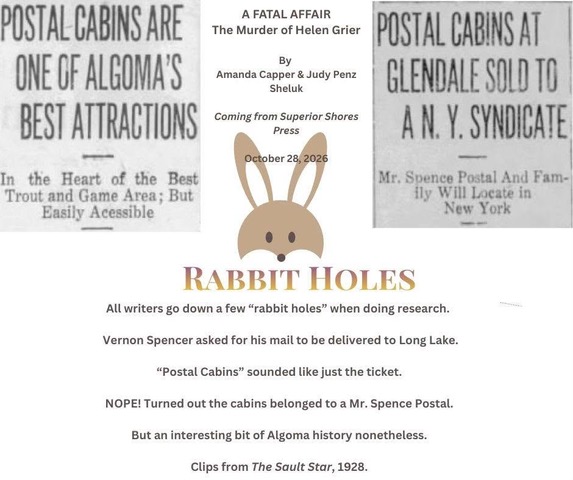
This January 19, 2026, social media post was created after countless hours of researching “Postal cabins.”
IN SUMMARY
From the get-go, Amanda and I agreed that the book would be written without bias or personal opinions, and without speculation or unsubstantiated theories. And so, despite countless hours of research, there is not a single mention of the Postal cabins in A Fatal Affair.
Was our research a waste of time? No. Because you can bet your bottom dollar that one day, someone will ask, “What about the Postal cabins in Glendale?”
And we’ll have an answer.
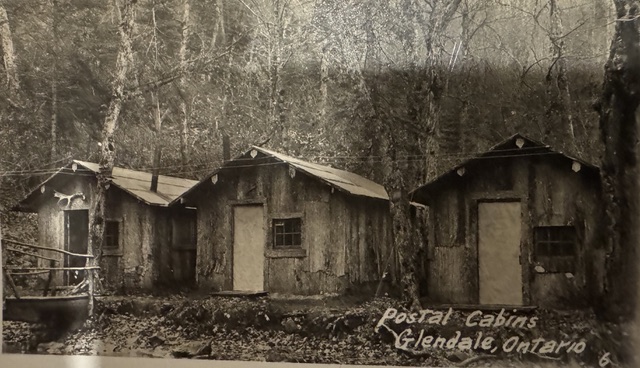
Postcard from the Postal cabins, ca. 1920s.
About the Book:
On October 28, 1937, at a remote cabin in the Algoma District of Northern Ontario, the body of 28-year-old Helen Grier was discovered by her lover, Vernon Spencer. The cause of death was a bullet to the brain.
A married father of two, Spencer, 43, was held as a material witness for 71 days before being charged with Helen’s murder. A gruelling six-day trial in Sault Ste. Marie followed. Vernon Spencer was acquitted after a scant three hours of jury deliberation.
Was the jury wrong? Did Vernon Spencer, former professional baseball player and Michigan dairy farmer, get away with murder? Could it have been someone local who dropped in to visit and found the pretty young brunette alone and vulnerable? Or is it possible, as was suggested by Spencer’s defence team, that it was Helen Grier who fired the fatal bullet? You be the judge.
Available in print and e-book at multiple booksellers. www.books2read.com/afatalaffair.
About the Authors:
A former journalist and magazine editor, Judy Penz Sheluk is the multiple award-winning author of seven bestselling mystery novels, two books on publishing, and several short stories. Amanda Capper is a writer of short fiction, and the author of the “Maybe” mystery series (coming 2027). Learn more at judypenzsheluk.com and amandacapper.com.




Thanks for sharing this, Judy. That intriguing picture has been saved straight into my “Sense of Time & Place” folder.
LikeLike
Thanks for hosting me today donalee and fellow Ladies of Mystery. It was so much fun to finally use the research on the Postal cabins! Very much appreciate your hospitality and the opportunity to shamelessly self-promote A Fatal Affair: The Murder of Helen Grier!
LikeLike