
Of Carrots and Sticks — and Cake

Margaret Lucke and her books

By Margaret Lucke

I’ve been staring at the blank page on my computer screen for what seems like hours when my Muse finally slouches into my office. She plops herself onto the soft chair in the corner. “Here I am,” she says. “Where’s my reward?”

“Reward!” I turn from the computer to face her. “What are you talking about? You just arrived. You haven’t given me anything yet. Not the first word of a sentence. Not even the glimmer of an idea. You don’t get a reward just for showing up.”

“I don’t see why not.”

“Pay for work that hasn’t happened? What kind of business model is that?”

“Ooh, I didn’t know what we do is a business.” She gets up, walks across the room, and peers at the screen. “Where’s the profit-and-loss statement? Are we making money? What’s my cut?”

“Never mind. We need to get busy on chapter 18.” I position my fingers on the keyboard, ready to type something brilliant. “When we left off, Jocelyn was waiting for Luke to show up in the empty house. She doesn’t know he’s the one who killed Gretchen. How shall we open the scene?”
My Muse crosses her arms over her chest. “I’m still waiting for my reward.”

“Later,” I say firmly. “We don’t get rewards until we’ve accomplished something.”

“What’s that then?” She points to my tea mug.

“Fuel.” I pick up the mug and take a big swig.

“Uh-huh. And this? Looks like a reward to me.”

Next to the mug is a plate with a tiny morsel (it’s a very small piece, honest) of dessert left over from last night.

“My breakfast,” I explain as I take a delicious bite. “Carrot cake.”

“Ah … carrot.” She nods knowingly. “The proverbial donkey’s reward. The farmer gives the donkey a carrot, and the donkey takes the farmer to the market. A fair arrangement, but you can see that the reward comes first.”
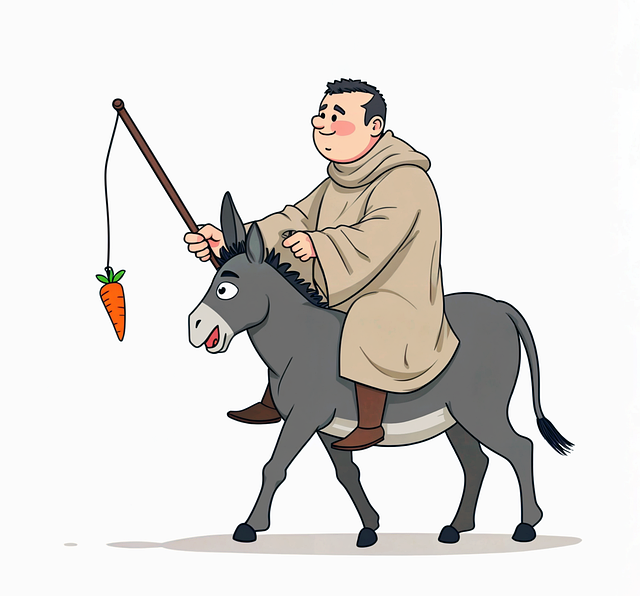
“No, no. The farmer dangles the carrot in front of the donkey. The donkey moves toward it, but the carrot stays just out of reach until they reach their destination. Only then does the donkey get its reward.”

“Can I have some of your cake?” she asks, just as I pop the last tidbit into my mouth.

I lift my hands in a gesture of apology. “Sorry.”

She rolls her eyes. “Poor donkey. It must feel as frustrated as I do.”

“Remember, the farmer also carries a stick, so he can swat the donkey’s behind if it doesn’t cooperate. The carrot is a positive motivator and the stick is a negative motivator. The idea is—”

“Motivate, schmotivate. If I were the donkey, I’d tell that farmer where to stick his carrot.”

She goes back to the soft chair to pout.

“Come on now,” I say. She doesn’t move.

I wheedle. I cajole. No response. I look around for something to use as a stick.

But I know that won’t work. Instead, I take the plate to the kitchen and refill it, this time with two slices of cake. I return to my office and set the plate beside the computer.

“Pull up your chair,” I say to my Muse. “The big piece is yours.”

She smiles as she scooches her chair forward and picks up the extra fork I brought. “Speaking of sticks, did you know Luke is bringing his hockey stick to the house with him? To use as a weapon against Jocelyn. No, wait, not a stick, a knife. That way he can hide it under his coat. Mmm, yummy cake!”

“Hey, he can’t kill Jocelyn. We need her for the rest of the story.”

“Don’t worry, she’ll save herself. A little more of this reward and I’ll figure out how. Make sure the next piece has plenty of frosting!”
Work, Craft and Frivolity


by Janis Patterson

I honestly don’t know whether to be flattered, or insulted, or sorry.

Right now I’m fighting a tight deadline for a book, and it is fighting back tooth and nail. I’m way short of where I should be with characters who, despite pre-planned expected actions/reactions/events, are stubbornly refusing to cooperate. It’s an unsettling feeling.

Looking for moral (or immoral, depending on how you might view it) support I called a writer friend expecting commiseration and encouragement.

Instead I got a breathless little laugh and a frivolous “Oh, that’s nothing. You’ll get something together to get it done. You always do” before she went on to talk at length about this party she was giving for her granddaughter’s wedding.

Now I have known and loved her granddaughter since her toddler days, and am delighted she is getting married… but at that moment I needed some support and encouragement, not punch recipes.

Plus, it is almost insulting to my craft to believe that I’ll get it done just as I would a cake or a floral decoration or any other mechanical project. Writing is an art. It is something to be taken seriously instead of a frivolous chore that can be dashed off on a whim.

In the bad old early days of romance writing, there was a popular belief held by far too many that writing was easy, that romance writers just reclined on a chaise longue, occasionally munching on a bon-bon while effortlessly spewing out another best seller between their morning horseback ride and a ball at the mansion down the road that evening.

Now that is an exaggeration (although less than you might think) but the kernel of that idea, that writing is an easy cinch which takes no time and less thought and no work at all, is still lurking about our industry like a wraith that cannot be exorcised.

In case you ever thought that, take my word – it is not true. Writing is work. Even writing a bad book is work. Writing a good book is difficult and a lot of work. To denigrate the process by saying with flip dismissal “That’s nothing, you’ll get it done” when you are asking for help and encouragement and support is not only insulting to the writer, but to the craft itself.

Writing is more than pulling words out of the air and putting them into a line. A chimpanzee can do that. The words have to make at least some sort of sense and create some sort of vaguely cohesive story; most writers – even the very bad ones can do that, though there are some I would put the chimps up against any day.

To create a real book, though, you have to work. You have to take a thousand ideas and melt them together into a seamless, interesting whole. You have to choose the right words to create the world of your book with just the ambiance and subtext you want. And most important of all, you have to make this book into something that people you have never met, people who have never heard of you, want to read.

That’s not easy, and it should not be frivolously dismissed as if it were.

End of rant. I have a book to write.

Under House Arrest, Kinda, by Heather Haven

I recently recovered from an illness caused by a stone in one of my salivary glands. This is akin to having a kidney stone but without the glamor. Instead of sympathetic friends and family saying, “Oh, no! You poor thing,” they tended to say, “huh?” I even did that myself. Before this happened, I hadn’t heard of the condition. The name of it is Sialolithiasis, but I never once tried to pronounce it. I was in enough pain as it was.

So what are the symptoms of this strange malady besides pain? My lower jaw and neck swelled up within hours and turned bright red. I looked like one of those blow-up Thanksgiving Day balloons only not as cute. I would have been the balloon everybody over the age of 12 asked who or what it represented, right before it crashed into a streetlight. I decided not to include a picture of me during this time because this is the stuff of nightmares.

After I was diagnosed, the emergency doctors decided I was a good candidate for a fairly new program that, under certain conditions, sends a patient home for care instead of being hospitalized. The hospital saves money, the patient is less likely to pick up something else in the hospital and in my case, the patient can be home with loving husband, warm fur balls, and an unlimited supply of ice cream.

Advanced Home Care is the term they use when they turn your house into a hospital. I even had to sign an affidavit swearing I wouldn’t leave the house during the allotted time. That’s the house arrest part. Once they’d set up, there was equipment everywhere. Nurses and technicians showed up whenever, drawing blood, taking my temperature, etc. I zoomed with a doctor every day on their loaned-out iPad. I had to take all required medications in front of a 24/7 “virtual nurse,” who was actually a real nurse, stationed in Texas. As I was in California, this was pretty far away. But her face was in front of me, scrutinizing my every move. I got away with nothing, not even taking my pills with coffee. “No, no, no,” she said shaking her head. “Use water, please.” It was a regimented program but a successful one.

What has this got to do with writing? Well, as we all know, we writers are never far from our craft. Or don’t like to be. My latest book, Cleopatra Almost Slept Here, debuted mid-August. Since that time, I’ve been sitting on my hands. Nothing to write. I had an idea for a new novel but couldn’t get it started. Sometimes the new story is too fresh. Sometimes you can’t let go of the previous novel, not just its creation, but the later job of getting it out there to the readers. Such was the case with me.

But back to my little stone. Whenever I’m being taken care of by healthcare workers, overworked and underpaid as they often are, one of the first things I do is learn their names. It’s not just a form of respect but yelling “hey you” when your I.V. comes loose is a little gauche. When I asked my virtual nurse’s name, she had to pronounce it several times for me and then spell it. This was because it’s a made-up family name passed on from mother to daughter. Iejoma, pronounced E- jo-ma.

Well, I loved the name. Not only was her story of how it came about fascinating, but it sprouted all kinds of ideas within me. I’d had the wisp of a character floating around in my head and this name helped solidify it. I asked Iejoma if she minded if I used her name for one of my characters and she gave me permission. Now I am unstuck. All I have to do is sit down and write an eighty-five-thousand-word novel.

Hmmm. I wish I’d phrased that last sentence better.