
by donalee Moulton
Many writers are attracted to the historical mystery genre because they like weaving a mystery for readers to solve. Many other writers are history buffs and want to share their love of the past with readers in the present. I’ve learned you need both elements to keep readers turning pages. Two worlds are always at play in the historical mystery: mayhem and yesteryear.
Writing historical mysteries means focusing on both whodunit and whentheydunit. I recently taught a course on this subject and thought I’d share some suggestions for writers to help you travel back in time to commit your crime. For readers, it’s an inside look at the process.
Start with the history, not the mystery
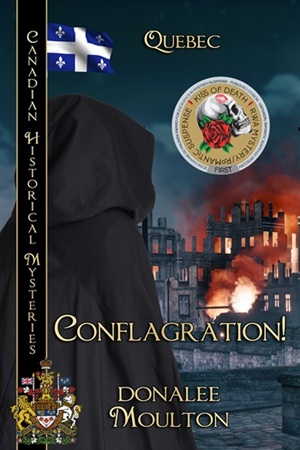
Before writers plot the perfect murder, they need to be as comfortable in their historical setting as well as they are in their own living room. The time period shapes everything in the story: how people talk, what they eat, how they live their lives – and how they investigate when a life ends.
Three questions dominate the journey back in time:
- Why this specific time? What drew you in? What do you think will fascinate readers?
- What conflicts defined this time? Political unrest, economic hardship, social upheaval—these create natural tension.
- How did people solve crimes then? In the absence of DNA and surveillance cameras, investigations relied on observation, word of mouth, and intuition and maybe sneaking in a window to surveil a crime scene.
A historical mystery’s believability depends on accuracy. This doesn’t require reciting every historical fact—indeed, this doesn’t work—but the writer must be comfortable enough in this other world to enable characters to move through it naturally.
Choose a main character who belongs
The investigator in a historical mystery guides the reader through clues and through the era. They might be an amateur or a professional. This might be the three-hundredth crime they’ve solved or the first. It doesn’t matter; they belong here.
In historical settings, investigators often have limitations modern detectives don’t—and this goes well beyond technology. Everything from restricted travel, class barriers, rigid gender roles. These limitations can be opportunities to connect with readers. Lean into them; they nudge creativity and add tension.
The sleuth’s personality and background should also reflect the era while also offering traits—curiosity, stubbornness, empathy—that transcend time.
Research like a detective, not an archivist
If a detective needs to walk down a street in 1912 Montreal, the writer should know what that street smelled like, whether cobblestones rattled under carriage wheels, and how likely the character was to meet someone selling newspapers on the corner.
Sources for rich and authentic detail include:
- Newspapers and periodicals from the time (full of language, concerns, and advertisements)
- Diaries and letters for personal perspectives (where possible)
- Historical maps for accurate geography
- Material culture research what fabrics, foods, and objects were common
The goal is to take readers into this world by recreating it for them without overwhelming them with facts that will weigh the story down and bore readers. Instead, historical details work like seasoning, enhancing the flavour without overpowering the dish.
Layer in historical conflict
The best historical mysteries don’t just place a modern crime in an old-fashioned setting; they weave the mystery into the fabric of the time. A theft in 1920 might be tied to Prohibition smuggling. A murder in 16th-century Spain could intersect with religious persecution. These historical tensions add stakes and make the story more than a puzzle; they transform it into a lens through which readers experience the era.
Make dialogue a cornerstone
Language is one of the quickest ways to immerse readers in the past, but it’s also a common pitfall. Too much archaic phrasing can make dialogue stiff and hard to follow, while overly modern speech breaks the illusion.
The key is selective authenticity:
- Use period-appropriate vocabulary for objects, occupations, and social customs.
- Avoid slang that didn’t exist yet (dictionaries can help here).
- Keep sentence structure readable for modern audiences.
Keep pacing tight
While the past moved at a different pace, the plot shouldn’t drag. There is a need to balance richly detailed scenes with moments of action and revelation. In historical mysteries, tension often comes from the slow build. This can be delays in communication, the time it takes to travel, the risk of misinformation spreading. But every delay should raise stakes, not stall the plot.
End on a deeper note
When the mystery is solved, consider how this crime fits the morality of the era. Would a killer from a higher social class face justice? Would certain motives be more understandable, or unforgivable, back then? The ending of a historical mystery should leave readers feeling they’ve solved more than a crime, but that they’ve understood something about the world that once was.


