Entitled 2: Giving your book a title to remember

Last month we talked about giving your story a title. Unlike article titles, book titles are usually the domain of the writer.

This may be because the writer has a closer connection to the topic, the editor wants the writer to do the work, or the writer and editor see it as the author’s prerogative. But just because the book writer usually develops the title doesn’t mean the editor will accept it. They will tell you if they don’t like it, and why. They will tell you if it won’t work, and why.Let’s look at what constitutes – usually – a good book title, and then I will use my first book as an example.

Because book titles are one of the first things a potential reader sees, they need to hook that reader. It’s recommended the title give away a little something about the plot and the nature of your book. Is it going to be action-packed, romantic, whimsical?

Here are the three main ingredients in a strong title:


LENGTH. 
Shorter is better. Shorter tends to be more memorable, more powerful. Some experts advocate for the one-word title, but one-word titles are more limiting for search engines. Fewer examples are found. The recommendation: three or four words.


IMPACT.  
The title should draw the reader in because it is evocative; it speaks to what lies within the pages of the book. It sets the stage for what they can expect.


UNIQUENESS.
Titles that we can remember, titles that stand out from the crowd are winners. This may be a play on words, a pun, a jab, a literary reference, a phrase that speaks to mind, heart and spirit.

In short, titles are essential to the sale of a book. And they are not easy. Let’s look at one title I’m very familiar with.

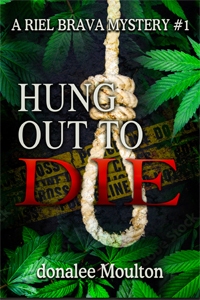
My first book is Hung Out to Die. It’s a murder mystery. The main character is CEO of a cannabis-production company in Elmsdale, Nova Scotia. As I was writing this book, a funny aside started to take place involving a word the main character had never heard before: Chunderfuck. In my mind, that became the title of the book with asterisks replacing two of the letters in the last syllable. I then built on this concept. Future books would have similar fun but profane titles: Numb Nuts, Dick Wad…. You get the idea.

book cover from Hung Out To Die

It was not meant to be. As I was starting to shop around my book, I realized the title might lead agents and publishers to conclude the book would be darker, edgier, grittier than it is. Indeed, it’s actually funny. I also didn’t want to turn off publishers before they even read the book. I went with a working title instead: So, A psychopath walked into a bar. In my mind, the book would still be called Chunderf**k, an issue I would raise with my publisher as soon as I had one. Which I (with gratitude) did. My publisher, BWL Publishing, was more than open to changing the title. But not to Chunderf**k – and not for the reason you might think. Search engines don’t pick up asterisks.

Dammit.

So the book became Hung Out to Die. It’s a play on words, drying plants is linked to cannabis, and the victim dies by hanging. It’s short, it’s got some oomph, but let’s face it. It’s no Chunderf**k.

I’d love to hear your thoughts on titles. And asterisks.

Following Through

by Janis Patterson

There is not much about writing in this post. Actually, not much about anything. Remember last month when I posted about the necessity and occasional dangers of researching? Well, I put my money (and lots of it this time!) where my mouth is.

As you read this I am – if our somewhat fluid itinerary is accurate – bouncing along in a jeep somewhere in the desert between St. Catherine’s Monastery in Sinai and Petra in Jordan. Am I researching a new book? Probably, though that was not the intent of the trip. However, I can do research on a book with a trip to the grocery store, so that’s not surprising.

No, my husband and I have decided to spend as much time as we can traveling – while we can afford it and are still physically able. I know it’s a luxury, but we’ve both worked hard all our lives and it’s something we want. And we don’t want to miss a chance to fulfill our dreams just because we got lazy.

We started a few days early in Cairo, to visit both a few of our favorite spots and to see old friends, then joined the small group of pilgrims to go on to the Dead Sea. I’ve been there before, and it is still as much of a moonscape as I remember. Then to the fabled St. Catherine’s… ah, but I’m telling too much. Next month I’ll talk a little about my trip and show a few pix. There will be more of both on my website, though, if you want to see more!

And – just a bit of writing news. I’m part of a new anthology called July 4th Murders – where every story takes place on July 4th, but each in a different time period. It’s a fascinating concept and one of which I am proud to be a part. I’ll let you know the exact date it goes up for pre-order.

After we get back from Petra, though. That’s been on my bucket list for years, and I intend to enjoy every second of it!

Silk Road Inspiration

Recently a friend told me about a trip her mother wanted to take with her to India, and asked me about some of the sights and events planned for them. I found a description of the trip online and skimmed through it thinking how I would answer her questions when just below was another trip that threw all my travel plans and budget for the year into the trash can.

When I was perhaps eleven or twelve years old I came across a book about a trip to Central Asia. After You, Marco Polo by Jean Bowie Shor describes a journey she and her husband made following in the footsteps of the explorer on his travels from Venice to China in the late 13th century. The book was published in 1955, only a few years after their trip in the late 1940s. The author is the definition of the word intrepid, and I don’t believe anyone alive today would even consider taking the same trip so dependent are we on cell phones, public transportation, emergency services, detailed maps, and reliable guides, not to mention translation programs on our cell phones and a general sense of peace and safety (now perhaps ebbing). I reread this book recently and it is still one of the most incredible survival stories of any traveler on the Silk Road in Central Asia I have encountered.

This book sparked my love of Asia, as a result of which I ended up living in India for a year doing research, and then returning for a second year for more of the same. I’ve been back several times to visit friends, and even though I’m no longer any kind of scholar, I’ve maintained my interest in India in the Anita Ray series and several photography projects. The author, Jean Bowie Shor, inspired numerous characters with her impetuous forays into forbidden areas and unbelievable luck in surviving and even thriving, as well as her fortitude in traversing a 20,000 foot mountain pass with her fever-stricken, delirious husband and two guides who were hoping to fleece their dead bodies of more money than the entire community would see in a hundred life times.

I don’t plan to write during the trip, but that’s a plan that can quickly evaporate. I do plan to take a lot of photographs, and as I often do when working on an Anita Ray story, I’ll line up the most interesting along my desk to glance at while I work after I get home. Some people like music in the background, some like a particular bit of clutter, I like photographs.

Now, after many years, I’m finally taking my dream trip—to the Silk Road. I’ve signed on for a tour with about a dozen others to visit three of the Stans—Kazakhstan, Uzbekistan, and Kyrgyzstan—along the Silk Road. After a lapse of many decades, I will be part of the kind of  ensembles of tourists that I find so stimulatingly murderous in my Anita Ray series set in South India. I’m doing a lot of background reading so I’ll be ready for my characters when they show up. The trip is scheduled for the fall, so I have a lot of time to enjoy one of the best parts of travel—anticipation.

I’m not sure what this post is about, but I’m booked for a trip I’ve dreamt about for years and taking it now seems fitting.

Research, or the Lure of the Rabbit Hole

by Janis Patterson

There’s nothing more frustrating than a novel which mangles history. Unless, of course, it is alternative history (at best a bastard genre) and clearly labeled as such. What raises my ire is when someone writes what is purported to be historical fiction but has such factual clangers in it as to stop the reader cold. My favorite example of this is from a contest I judged when a Regency hero – handsome, wealthy, arrogant as all of them are – pulls a fountain pen from his pocket to sign some important document.


Really? A fountain pen?


The bladder fountain pen that we all know wasn’t invented for at least fifty years after the Regency. Even the steel-tipped dip pen wasn’t invented until after the end of the Regency. Before that, writing was done with feather quills, usually goose.


Of course I dinged the writer severely for not doing proper research, and sent a rather kindly note of explanation of her low score, hoping to raise her consciousness about the necessity of research. Instead she attacked me viciously, not only in a private letter but on social media, ranting that it was an old-fashioned pen and who would know the difference anyway.


And there is the crux of the matter. Far too many people get their ideas of history from novels (and movies, and TV) and therefore as writers we owe them the honesty of real facts.


Such a high-minded ideal is not without its dangers to us, though. I was working on a fairly early Victorian Gothic where my librarian heroine had to make some ink. Now I knew she couldn’t just pop off to the allsorts shop in the village for a bottle, so I went online and looked up how to make ink.


Who knew there were so many ways to make ink? And there are so many people making it today? Well, it was a plethora of information and I started reading happily. Only thing was, I realized that some of the recipes used items to which my early-Victorian-working-in-remote-Scotland heroine would have no access. But I had to make sure of what was available, which took me to botanical sites and shopping sites and each of them led to other sites, most of which had little to nothing to do with Scotland, libraries or ink, and before I knew it hours later I was deep into the intricacies of making Scottish country cheese. Still don’t know quite how I got there, but it was fascinating.


Now I don’t know if I’ll ever need any minutiae about the making of country cheese in Victorian Scotland, but it did give me a deeper insight into the Scottish rural people of the time, their lives, their chores, their way of living. Besides, I believe that everything is useful in some way, some time, some how. Who knows when some snippet of rural Victorian Scottish life/mores/cheesemaking – or something influenced by them – will show up in a totally unrelated story? It’s one of the dangers and the magic of writing!


Doubtless by now you have figured out that I like research. And, having an inquiring (some say nosy) mind, I must admit I do. It’s one of the most fascinating things in the world. And one of the most dangerous. It can take hold of a story, turn it every way from up, then hand it back to you in a form totally different from the way you originally envisioned it. Or, if you are strongminded enough to corral your story to its original form, those little snippets of research are still there, adding depth and shading – and an occasional surprise – to your story.


A prime rule of good writing is Do Your Research. Another rule of good writing is Do Not Let Your Research Take Over. Usually I manage both, but it’s most definitely a delicate balancing act.

Lists and More, Always More

I belong to a chat list of people in my general geographical area, one or two counties north of Boston mostly along the water. Here we post requests for a carpenter or, right now, a snow shoveler. Members report on the remodeled bath and how well the job was done, or not done.

One man organized a picnic for anyone who wanted to come, and within days he had offers of side dishes, the loan of a grill, a small tent in case it rained while he was flipping burgers, a few tables and chairs, and a volunteer to track who was doing or bringing what. There are long discussions on what’s happening that has brought a helicopter and two police cars, and whether or not the city can or should do something about the homeless woman who has set up shop on a certain corner.

This is a community within a community, an ongoing exchange of good will, information, moral support, and occasionally humor. Lots of people are looking for small jobs, the kind that don’t attract construction companies. These are people willing to do just about any little chore—watch your elderly mother one afternoon a week, or your two pre-school children three days a week, or water your plants while you’re on vacation, or fix the front steps, or cut down a small tree that’s dying. There’s always someone who’ll help install a smoke detector, explain the restrictions on B&Bs in a specific town, or suggest a junk removal guy who is reasonable, quick, and neat. Small jobs but necessary ones.

I’ve had several jobs taken care of through this site, and occasionally I recognize another user, or another user recognizes me. The site is more efficient than asking at the local hardware store, another place I’ve come to know and love since my husband died. It’s also more informative. In almost any instance a person seeking a worker for anything will get two or three suggestions, with affirmations (or not) by other readers. 

The site is remarkably accurate as to skill, reliability, and pricing, perhaps because a failure in any one of these areas will lead to a disappointing post, at best, and complaints from others and a decline in business.

For a long time I thought of this as a useful site, but now I read the offers and requests, including occasionally my own, and I feel like I’m reading a novel or a short story as people report on life changes requiring a new home for a pet or a change in a second bedroom. This change in perspective is perhaps the result of how I see the world, or at least my corner of it. 

When I hear someone talking about an incident, or see a group of people engaged in something, within seconds my brain has constructed a narrative, just like what I did in the first paragraphs above. You read very few facts; instead you got a feel for how a group of people relate to each other, with holes where paranoia, suspicion, ill will could fold away from view.

When you’re a writer, wherever you look you find a story.