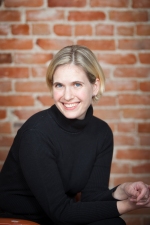
Guest Blogger – Nina Mansfield

Why YA?

By Nina Mansfield

Often, when people hear I’ve written a young adult novel, they say something like: “Ooo, YA is really hot right now.” This statement often carries the implication I chose to write YA because the genre happens to be popular at the moment.

Other times, I’ll get a very different reaction that goes something like this: “Well, I know YA is ‘in’, but…” In the silence I can hear the words, “I don’t read kids books.”

To that I can only say that you’re missing out. YA isn’t just for kids.
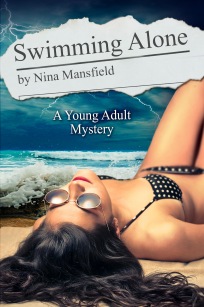
SwimmingAlonefrnt (2)But I did have kids—young teens specifically— on the brain when I started writing my debut YA mystery novel, SWIMMING ALONE.

I guess it all goes back to the adage, “write what you know.” And as high school English and Drama teacher, I really got to know teens. And I learned they come in all shapes and sizes. They can be impulsive, reserved, judgmental, accepting, free-spirited, aloof, fun-loving, cautious, passionate, restrained, anxious, unconcerned. And because their brains are still developing and they’re filled with hormones, their personalities are magnified ten-fold.  They aren’t quite adults yet, but they really think they are. And while this energy can drive some people crazy, I think it’s kind of magnificent.

As a teacher, I often felt myself stepping back into my teenage shoes—remembering what it was like to fail that quiz, or have that crush, or feel misunderstood. I had to do it to understand my students better. This constant self-reflection came in handy when developing my teen protagonist. No surprise she turned out a lot like a fifteen-year old version of myself: a bit insecure, a bit judgmental, and bit impulsive. She wants to do the right thing, but as far as she’s concerned, adult interference isn’t necessary.

There’s another reason I chose to write YA. I know plenty of adults read YA, and I am one of them. But the truth is, I wrote for young people because it breaks my heart when I hear a one say they don’t like reading. I can’t imagine a life without books. I don’t know if reading saved my life, but it certainly saved my sanity. Pippi Longstocking, Ramona Quimby, Nancy Drew, Sweet Valley Twins… I spent my pre-teen years with these characters. In junior high, thanks to a fantastic teacher, I became hooked on the books of Lois Duncan and Joan Lowery Nixon. Soon after, I started reading Agatha Christie’s mysteries. I remember that feeling of anticipation when I thought I’d figured out the twist in The Murder of Roger Ackroyd, followed by a feeling of triumph when I discovered I was right!

Throughout those tumultuous high school years—when I was in a state of constant heart break—I escaped into Brave New World and 1984. Another extraordinary teacher introduced me to Thomas Hardy. I stayed up late with Tess of the d’Urbervilles, and had my heart ripped open by Jude the Obscure. Oh, these folks had it so much harder than I did—and it helped me put my life in perspective.

I want every child to able to escape into a book when real life isn’t going as planned. During my first year teaching, I discovered even the most reluctant reader will keep turning the pages if there’s enough action and suspense. These were the readers I had in mind when I wrote SWIMMING ALONE.

BOOK BLURB:

The Sea Side Strangler is on the loose in Beach Point, where fifteen-year-old Cathy Banks is spending what she thinks will be a wretched summer. Just when she begins to make friends, and even finds a crush to drool over, her new friend Lauren vanishes.  When a body surfaces in Beach Point Bay, Cathy is forced to face the question:  has the Sea Side Strangler struck again?

SWIMMING ALONE Links

BIO:

Nina Mansfield is a Greenwich, Connecticut based writer. Her debut novel, SWIMMING ALONE a YA mystery, was published by Fire & Ice YA in 2015. Her plays have been published and produced throughout United States and internationally. Her graphic novel FAKE ID: BEYOND RECOGNITION, illustrated by Leyla Akdogan, will be out with Plume Snake in 2016. Nina’s short mystery fiction has appeared in Ellery Queen Mystery Magazine and Mysterical-E. She is a member of Sisters in Crime, Mystery Writers of America, International Thriller Writers, Society of Children’s Book Writers and Illustrators and the Dramatists Guild.


Los Angeles Times Festival of Books


copy                                        The Los Angeles Times Festival of Books was held on                                             April 9th and 10th on the campus of the University of Southern California. It’s a yearly event, the largest book festival in the country. Sisters in Crime/Los Angeles, the local chapter of Sisters in Crime, has a booth at the festival, and I’m a member.
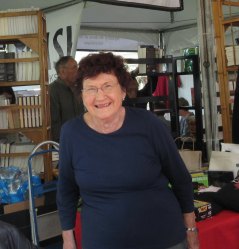
The Sisters in Crime/LA booth is in the mystery section, next to the booths of Mystery Ink bookstore, Mystery Writers of America and Mysterious Galaxy bookstore. It’s in a great location close to the main walkway, and we get a lot of visitors stopping by.

This year I was part of a team scheduling slots for our members to sign their books. Requesting a signing time was a complicated process involving a form provided on the website of Sisters in Crime National. We allocated signing times based on when applications were received, and there were lots of applications. Invariable, people signed up and then changed their minds, and people forgot to sign up and then asked for the most desirable slots. But there was less confusion than I had imagined.

Signing slots were two hours each, except for the slots between noon and two p.m. which we broke into one-hour segments because these seemed to be the most desirable signing times. All the slots were taken except for Sunday from 4 p.m. to 5 p.m., the end of the festival.

Friday, when we were scheduled to set up the booth, rain was predicted. Not a usual occurrence in April in Southern California, but this is the year of el nino and climate change, so who knows what’s going to happen? Anyway, there was a firm prediction of rain for Friday night, so we were reluctant to put books out in case a wind and rain storm blew all the coverings off. So we arrived at 7 a.m. on Saturday to unpack books, sort them out and place them in the various book racks and stands. Our six feet by eight feet space was pretty full with two tables and five chairs for signers, three tables for books, a table for merchandise and one for those selling the books.

Saturday morning was quiet with some drizzle. I was surprised at the number of people who had come out for the Festival despite the weather. At about noon, the rain began to come down in torrents. We moved the tables further into the booth, making the already Carole at Festival of Bookssmall space incredibly cramped with no possibility that two people could pass one another inside the small area. However, we managed, and the heavy rain finally ceased. In the afternoon we had lots of visitors.

Sunday was beautiful, the rain gone, and a great many people visiting the Festival of Books. All in all, it was estimated that 160,000 people came to the Festival over the weekend, and we sold nearly two hundred books, quite a remarkable number. Not surprisingly, people came in bunches to buy books with nothing happening for twenty minutes or half an hour, then four or five people arriving and wanting to purchase books at at once. Why is that? It seems to me it happens whenever I sign people up or sell anything. Do you find that that’s true for you?

Anyway, it was a fun and exhausting weekend, we sold a lot of books and made a lot of mystery writers and readers happy. It was a confirmation for me that people still read and still read books, not just electronic devices like Kindle. And that makes me very happy. And, I got to have my favorite sandwich, which I only allow myself once a year: a bacon, lettuce, tomato, and avocado sandwich with aioli, a BLTA. Delicious!


Not So True Crime

thumb_IMG_1225_1024

Vivid. Believable. Atmospheric.

I see words like this — words used by readers to describe my books — and I’m blown away. I can’t express how grateful I am for these reviews. I hope that I can keep producing books that meet these standards. It’s for this reason that much of the time I spend “writing” each book in the Adam Kaminski mystery series is actually time spent researching.

IMG_2356I spent many years studying Polish history and the Polish political system. I use knowledge I gained in my years at the State Department and National Park Service. I talk with friends and colleagues who are archaeologists, to make sure my recollection of archaeology from my graduate school days is accurate. And I read. A lot.
All of this is to ensure that my stories, while completely fictional, are also realistic and believable.

Yet I hit those points occasionally where I have to stop writing and say wait, what? (I try to say this silently in my head, but I don’t always succeed). That point where I’ve written myself into a corner and I need to come up with a realistic reason why a Philadelphia cop would be sent to Poland. Or how a religious leader could help investigate a murder. Or why a statistician, archaeologist and mathematician might be collaborating. Just for example.

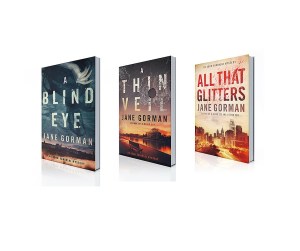
Sometimes there is no way. As Lisa Cron points out in this insightful article at Writers Unboxed, it’s rarely a good idea to try to create an internal logic to your story when one doesn’t exist.

On the other hand, sometimes it just clicks. Like when I open the New York Times to find a fascinating article about how statisticians, mathematicians and archaeologists collaborated to determine literacy rates in ancient Judah. Eureka!

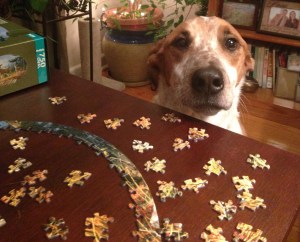
puzzle dogI love it when all the puzzle pieces somehow fit together perfectly. (And, yes, hate it when I have to delete an entire plot thread because, in the end, it just doesn’t work.)
I actually enjoy research. Learning about other people, other places, other skills. It’s part of the joy of writing for me.

But in some ways, the fun part is when I get to make stuff up. Come up with creative and unexpected motives for murder, or alibis that seem strong but have an almost invisible loop-hole. For while the scholars studying ancient Judah may have been working together on a history-changing exercise, I’m fairly certain none of them is plotting murder.

That’s all on me.

How about you – when you read or when you write, how important is it that the storyline be believable?

Find out more about me and the Adam Kaminski mystery series at janegorman.com

Simple three books

Clue, Clue, Who’s Got the Clue, or How to Sneak Your Way to a Good Mystery

by Janis Patterson

Writing a mystery means walking a very fine line.

You want to play fair with the reader and give him the chance to solve the mystery. Sort of.

Readers love to play along and see if they can match/beat your sleuth to the correct solution. In almost every case (so said because there is an exception to everything) nothing makes readers angrier than the solution just coming out of the blue with nothing leading up to it. Worse than that, it’s lazy writing.

So how do you do play fair and still mystify the reader?

Be sneaky.

Put your clues out there, but make them appear to be inconsequential, throw-away things that have no relation to the case. Also put out fake clues leading to a different conclusion (some call them red herrings, but I don’t like fish), but put them out in two ways – some as inconsequentials and some as great big whacking things that might as well have CLUE in blinking neon above them.

No one said you had to play completely fair, did they?

There’s also a traditional ploy called a MacGuffin. Sounds sort of like it should be some kind of fast food, but it’s real – trust me. The MacGuffin is a lovely tool of misdirection. That’s the word I’ve been looking for – misdirection! Just like a magician, you direct the reader’s attention in one direction with one hand while the other hand – in semi-plain view – is actually doing the trick, but no one is really looking at it.

Anyway, the MacGuffin is what everyone in the book seems to want – such as everyone believes the vicar was murdered in a foiled robbery attempt to steal an ancient chalice. All the characters go rushing around trying to figure out who wanted to steal the chalice and why, while the vicar was really murdered because his tulips were certain to win the annual flower show away from the Grande Dame of the village who dislikes losing. The chalice is only a MacGuffin. Now that’s an extremely simplistic example, but in reality the MacGuffin is one of the best tools in the mystery writer’s arsenal.

MacGuffins and misdirection – use them well, and you will keep your reader happily amused and hopefully confused. Or is it the other way around?

(For those with very good memories, you know I wrote this blog several years ago. I am reposting it now because (1) it is still true and relevant and (2) for several days before this appears and for several days after I am up to my earlobes in a very intense professional conference. It seemed better to share a ‘golden oldie’ than to just cobble together something or skip posting entirely. Hope you understand. Also, because I will not have my computer available, please forgive if I am not able to okay comments until this madness is over. I promise I will then!)

A Gun in the Hands of a Woman by Paty Jager

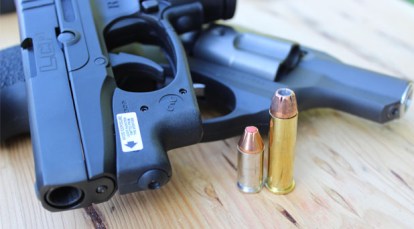
revolverI’ve had to research what type of revolver would be best for a woman to use for my murder mystery series. While Shandra knows how to handle a rifle from growing up on a large ranch, she’s never felt the need for a handgun for protection.
My male protagonist believes Shandra needs a weapon for protection and gives her one of his hand guns and lessons. When the need to arm Shandra came up I went to law enforcement professionals and asked them what would be a good revolver for a woman. These are their answers.

The main thing they all said was she would have to train often with the weapon. It was wholeheartedly stated that if a person doesn’t train with a weapon, especially a handgun, they won’t be ready to use it if necessary. Also by practicing and using the gun often, they can tell by the weight if the weapon is loaded or not and know how to take it off safety without thinking about it. I agree with this. By the end of the summer when I’ve been shooting the sage rats on our property, I can take the .22 off the safety without thinking about it. But each spring when I start shooting, I fumble with the button trying to remember which is safe and which isn’t. I agree with the shoot often to get comfortable with the weapon.

Another common comment was if the person is untrained in loading and shooting there is more chance of accidents happening.

By using the weapon often the shooter also develops habits. These habits will let the person know if they left the revolver loaded or if it’s empty.

By looking at a revolver you can’t tell if it is loaded or not. Because they don’t eject the empty shells automatically. And only an experienced shooter knows to open the cylinder and inspect for dimples on the ends of the shells.

Another thing to think about when putting a revolver in the hands of a woman is how large are her hands. Some weapons have stock grips that can change out for smaller or larger grips to fit the hands better.  Some don’t. It’s not just the size of the grip that needs to be checked. Can her fingers reach the trigger while holding the pistol/revolver correctly. The index finger must be able to bend  and pull the trigger.  It is essential that a person handles several guns and finds the one that is most comfortable for their hands.

These are models that were suggested if the woman has small hands:

Smith & Wesson (S&W) J-Frames (Model-36 Chief’s Special and Model-36 LadySmith, 442, 638, 642, 60LS, 640LS, etc.)

Taurus models 650, 850, 651, 605, 85

Charter Arms Undercover, Undercoverette

Ruger SP-101, LCR

If she has larger hands, she could use something like:

S&W model 10, 64, 66, 67, 686

Taurus model 65, 66, 82

Charter Arms Bulldog, Pug

Ruger GP-100
In the end after doing all my research, I didn’t name what type of revolver Ryan gave Shandra to protect herself.

I’ve only shot a pistol before and rely on that experience when writing scenes involving my character shooting. That and gleaning all the information I can from people who know more about weapons.

The fifth book of the Shandra Higheagle Mystery Series is available in ebook and print.

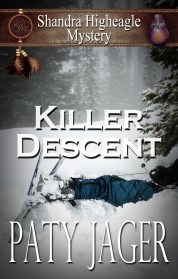
Killer DescentKiller Descent

Book five in the Shandra Higheagle Mysteries

Abuse…Power…Murder

Once again Shandra Higheagle finds herself a suspect in a murder investigation when an ex-lover is found murdered on a Huckleberry ski run. A past she’d planned to never divulge now must be shared with the first man she’s trusted, Detective Ryan Greer.

Ryan puts his job in jeopardy when he’s booted from the case and uses all resources plus a few extra to prove Shandra is innocent. The information leads them down a road of blackmail and betrayal of the ugliest kind.

http://www.patyjager.net/mystery.html

paty shadow (1)Award-winning author Paty Jager and her husband raise alfalfa hay in rural eastern Oregon.All Paty’s work has Western or Native American elements in them along with hints of humor and engaging characters. Her Shandra Higheagle Mystery series, set in a fictional ski resort in Idaho, is full of quirky characters, twists, turns, and a bit of mysticism.

You can learn more about Paty at:

blog / websiteFacebook / Paty’s Posse / Goodreads / Twitter