Where the bodies are buried

By Sally Carpenter

On the day of Nancy Reagan’s funeral at the presidential library in Simi Valley, Calif., I opened a second screen on my computer at work and during the service peeked in from time to time to check out the proceedings.

At the end of the lengthy service, the honor guard carried the casket outside and placed it on a pedestal. In my experience attending funerals in the Midwest, I was expecting the casket to be lowered into the ground next to the president’s resting place. Instead, the broadcast coverage ended with the casket still sitting outside in the rain.

How odd, I thought. Did the network run out of airtime or was the casket going to be buried later? In my research, I found the same situation happened at Ronald Reagan’s service as well—the internment of his casket was not shown to the public.

As a mystery writer, such things intrigue me.

Turns out, showing the actual entombment of Mr. Reagan’s casket would not be practical. First, the casket was placed in a bronze-lined vault inside a crypt. The casket and vault together weighed 4,000 pounds, and heavy machinery was needed to move both. The noise and sight of such a machine would hardly inspire a reverent atmosphere. Then workers replaced the earth over the crypt and installed a concrete walkway, not the stuff most people would care to watch.

 Mr. Reagan’s crypt was sealed at 3 a.m. with only some Secret Service agents along with library and mortuary personnel on hand. The Reagan family had left hours before.

 Mrs. Reagan’s casket, also no doubt placed in a heavy vault, was entombed in the crypt alongside her husband’s. A friend told me that Nancy’s casket was taken back inside the library, placed on an elevator, and transported several levels down to the crypt, which apparently has an underground entrance. That made sense. Lowering in the casket from topside would involve tearing up the concrete flooring on which Mr. Reagan’s headstone sits.

 While this sounds like much ado, vaults and a crypt are good from a security standpoint to protect the bodies from vandals attempting to dig or blow up the gravesite.

 Simi Valley has another interesting burial story. A few years ago the El Rancho Pioneer Cemetery came under fire when a family discovered a loved one had been buried in the wrong grave, and that the site management may have been double- or triple-booking plots to families.

 Other cities have tales of coffins floating away during heavy rains. Or an earthquake uprooting bodies. And I recall reading of a plan in a particular city to move bodies from a cemetery to make way for a development project.

 A mystery writer doesn’t let the dead rest in peace. Interesting burials and missing bodies are the stuff of a good story.



It’s Been a Bit Stressful Around Here

I’m writing about my own stress. It began with my husband getting sick–it seemed sudden, but looking back it really wasn’t. After a visit to the ER he ended up with a pacemaker, then a blood clot in his arm. The pacemaker is working great and medicine is taking care of his arm.

Blurb for A Crushing Death:

A pile of rocks is found on a dead body beneath the condemned pier, a teacher is accused of molesting a student, the new police chief is threatened by someone she once arrested for violent attacks on women, and Detective Milligan’s teenage daughter has a problem.

Buy link:

http://www.amazon.com/Crushing-Death-Rocky-Bluff-P-D/dp/1610092260/ref=sr_1_1?ie=UTF8&qid=1457618775&sr=8-1&keywords=A+Crushing+Death+by+F.M.+Meredith

Because I have a new book out, I’ve been busily promoting and setting up some in-person events. The first happens this Saturday, the 27th at 10 a.m. at the Nipomo Library with the Central Coast Sisters in Crime. Because there was a glitch with the cover, the books didn’t get printed when they were supposed to and a rush order is supposed to be delivered on Wednesday. Fingers crossed, because I’m headed to the cost on Friday.

Of course the cover issue was a biggie, I had to send the corrected cover to the 30 hosts of my blog tour beginning April 15 and going on through May 11.

Beginning April 1st an earlier book in the Rocky Bluff P.D. series, Murder in the Worst Degree, will be free on Kindle until April 5th. http://www.amazon.com/Murder-Worst-Degree-Rocky-Bluff-ebook/dp/B00JFKAH9A/ref=sr_1_1_twi_kin_2?ie=UTF8&qid=1458566324&sr=8-1&keywords=Murder+in+the+Worst+Degree

That took some coordinating with my publisher and setting up some advertising sites. Of course the whole point of doing this is to  interest readers in the rest of the series.

April 12, I’ll be speaking to two high school classes, always fun.

On the 14rh, at 10 a.m., I’m giving a talk at the Porterville Library about where I get my ideas.

Also this is late because I didn’t realize it was the 4th Monday, which is my day.

Please forgive me for being late and venting about my stress.

Marilyn Meredith aka F. M. Meredith

Location, Location: Using Real Places in Fiction

Amber in tree finalSign_-_New_Mexico_-_Truth_Or_Consequences_-_Exit_(4892943477)

When I read books set in cities I know well, I enjoy recognizing familiar locations. It makes me feel like I’ve set foot inside the story. There are good reasons, however, to invent addresses, businesses, even entire towns. The usual rule seems to be that if you say something bad about a place or set a disturbing event in it, make it fictitious. In Sacred Clowns, Tony Hillerman gave New Mexico an entire new pueblo, the fictitious Tano Pueblo, because he had a murder take place during a ceremony. He used real reservations for his other books. Every city, town and reservation has its problems, so it’s not maligning the entire place to write about a crime there, but he felt that the particular one in Sacred Clowns would be objectionable. He included spiritual ceremonies in a couple of other books, but not as crime settings, and only shared what was open for non-tribal members to know. Based on Hillerman’s wisdom, I’m setting a number of scenes in my work in progress at a Mescalero Apache ceremony, but the misdeeds take place in private homes or in other towns.

In my first book, The Calling, I “invented” two entire towns, even though they are intimately based on real places, because my protagonist doesn’t like living there. (I had fun coming up with the name Cauwetska. I looked up words in the Meherrin language that would make good place names, since many Southern towns’ names come from local Indian words.) I actually loved the little town that I turned into Tylerton, but the way its fictitious residents treat Mae wouldn’t reflect well on it. I invented Coastal Virginia University, too, because I wouldn’t want to attribute a professor like Charlie Tann to any real college.

I’ve sometimes invented houses or businesses because I needed specific architecture to suit the plot rather than because I was avoiding insulting anyone, but in certain cases real locations are the best.

How could I imagine anything as remarkable as Sparky’s Barbecue and Espresso in Hatch, New Mexico? It has crazy local color and live music, and I needed a setting where my protagonist encounters two musicians in a key event that ties three plot lines together in Soul Loss. The eccentricity of Sparky’s décor struck me as a perfect background to frame one of the characters. The establishment’s owner, who knows me as a regular Sunday afternoon blues fan, was happy to let me set a scene there.

In my work in progress (Ghost Sickness, book five in the Mae Martin Series) I set several scenes in Truth or Consequences’ popular coffee shop, Passion Pie Café, with the owner’s enthusiastic permission to employ a character as a barista there as well as to have a little drama take place during the busy breakfast hours. She even gave me a great idea for that scene. I needed Passion Pie because of their wonderful local artist table tops. The mystery revolves around an artist with a secret, and my plot required that his work grace one of those tables. Rio Bravo Fine Art’s owner also let me set scenes there and allowed me to have a fictitious artist exhibit in his gallery. One of T or C’s best-known artists, Delmas Howe, gave me permission to use one of his paintings in the story. It’s great having my New Mexico town come to life in this book.

I had to give Santa Fe a new exotic bird store, though. The owner of Feathered Friends of Santa Fe helped me with my research, and we agreed that I should invent some fictitious competition for her shop, a new and less well-run parrot store, because, well, something happens there. I can’t say what it is. But it involves parrots, two pueblo potters, an Apache cowboy and a struggling photographer, and something illegal. Stay tuned. Ghost Sickness will be released this summer.

Meanwhile, if you’re curious to get started on a mystery series without murders, you can go to Northeastern North Carolina and Norfolk, Virginia in The Calling, Santa Fe and Truth or Consequences in Shaman’s Blues, on a road trip across the country in Snake Face, and back to Santa Fe and T or C (and Hatch) in Soul Loss. Just for fun: Mae and Hubert’s house in Tylerton, Bernadette’s tiny Norfolk apartment, and Mae’s pea-soup-green converted trailer in T or C are all places I’ve lived in.

The Calling is on sale for 99 cents through this weekend on all e-book retail sites.callingebooknew

Barnes and Noble     Kobo         Amazon     iTunes Bookstore      Page Foundry

Murder Without Violence

thumb_IMG_1225_1024

I had the great pleasure this past weekend to attend a meeting of my local chapter of the Sisters in Crime (the Delaware Valley Chapter). The guest speaker for the meeting is a Conservator at the University of Pennsylvania Museum of Archaeology and Anthropology (which is, coincidentally, where I earned my PhD in Anthropology). Because it is a museum of archaeology rather than fine arts, Molly Gleeson conserves artifacts and other specimens. That includes human remains.

It was a fascinating talk — as they always are at these meetings. Ms. Gleeson prefaced her talk by warning us that she was going to show us images of human remains, then admitted that for this particular audience that might not be a problem. We all write and read about murder. We’re used to human remains, right?

IMG_2463Well…maybe. A murder mystery can be many, many things. It can be light hearted and funny. It can be chic lit. It can be dark, gritty. And it can be gory, a story of violence and evil. When choosing a new book to read, a mystery reader has to know what she’s getting into — or she reads at her own peril.

Personally, I prefer not to read gruesome stories. I particularly avoid books that include rape scenes, but I generally skim through (or avoid altogether) stories with too much gory detail, too much vividly painted violence. I write the books I like to read. Relatively dark mysteries, gritty even, but with the violence taking place almost entirely off the page.

As an aside, one of the most beautiful death scenes I’ve ever read was written by the late, great Ruth Rendell (who, incidentally, did not shy away from violence when she felt it was called for). I always picture that pretty corpse floating peacefully and elegantly down the river, surrounded by wildflowers, whenever I’m trying to write my own murder scenes. I have not yet achieved Rendell’s level of artistic description of death, but I’ll keep trying.

Screen Shot 2016-03-20 at 2.05.07 PMWhich brings me back to the Delaware Valley Chapter of the Sisters in Crime. Each month, a technical speaker is invited to come to our group, to share his or her knowledge of biology, ways to kill a person, how crime scenes are handled, even about ancient methods of human preservation (mummies). To an outsider, we probably seem like a pretty gory bunch.
Quite the contrary. In our group, you’ll find cozy writers, young adult writers, and many, like me, who write traditional mysteries that are high on mystery but low on sex and violence. But one thing we have in common: we’re all well-informed on those gory topics that inform the background of our stories, but don’t make an appearance on the page.

How about you? How much violence do you want to see in the mysteries you read?

janegorman.com


A NEW IDEA

copy        Left Coast Crime, the conference in Phoenix, was a lot of fun. From what other attendees have told me, it always is. LCC in Portland last year was my first, and I had a great time. This time, as I told you in my last blog, I wasn’t on a panel, which was disappointing. Instead, I had half-an-hour to myself to talk about whatever I wanted, but I was the one who had to attract an audience, and that was scary. I had visions of sitting for half-an-hour alone, looking lost and unloved.
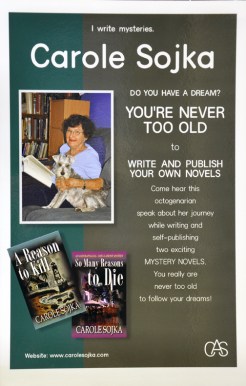
I devised a plan. First, I decided on a topic. I thought I might attract visitors if they knew what I was going to talk about. My topic, announced in the conference program, was “You’re Never Too Old.” A good friend did a poster for me, although there was nowhere to post it except inside the room.POSTER__72ppi

At the conference, I talked to everyone I knew and lots of people I didn’t know and invited them to come and see my presentation. To my dismay, I found that the rooms allocated to the single presenters were located at the very end of the meeting rooms, so it would be unlikely that I would attract a casual visitor. Someone would have to come looking for my presentation room.

I felt like a huckster, saying to everyone I met, “Remember. Come hear me 9:30 Saturday morning in Russell B.” But it worked! I got twelve or fourteen people to attend, many of whom I knew but at least four attracted by my topic. Yay!

I talked about my childhood desire to write, and the way my ego was squashed when I wasn’t accepted for the high school magazine. Although I majored in English Literature and minored in Philosophy (not good choices for a future career), I didn’t do any creative writing until many years later, when I took an interesting course which asked the participants to write an early memory in the voice of the child to whom it had occurred.

CAROLE Speaking    It was an interesting experiment and proved to be life-changing for me and for others in  the class. Many broke down in tears when they wrote a painful memory–and most were painful–in the voice and as the child to whom it happened. class.

Soon after that I joined a group of friends in reading THE ARTIST’S WAY by Julia Cameron. We read a chapter a month and did the exercises. I bogged down when I was supposed to spend a week without listening to television, radio, or music or reading a book or newspapers. I couldn’t do it. A week of living in my own head was impossible.

One exercise stayed with me for a long time though. First thing every morning I wrote three pages without thinking and without stopping. The pages were garbage, and I eventually threw them out, but they were very freeing. When I was still working, at a job with long hours and a long, traffic-filled commute, I got up at 4:30 in the morning to do my “morning pages.” These experiences were part of my journey to the dream of being a writer.

A woman who came to see my presentation suggested that I carry the theme, “You’re Never Too Old,” further, inspiring other older people–and there are lots of us–to realize their dreams of writing and publishing their stories, their memories, and in my case, my mystery novels. She suggested I write a self-help book for guidance, and I think I’ll do it.