Get Those Bad Guys!

by Janis Patterson

I admit it – I’m a crime-show junkie. Nothing makes me happier than to settle down after supper in front of the TV and watch the bad guys get it. Whether it’s real-life true crime (which can be very slow going and sometimes repetitious to fill out the allotted time slot, I know) or some scripted, fancily filmed TV series (which can be so fantastic as to be unbelievable) I love seeing the good guys triumph and the bad guys feel the full force of the law.

It makes a lovely change from real life. For example, several District Attorneys around the country have announced they will not prosecute theft crimes with a value of under $750 dollars; as one said, he doesn’t believe in prosecuting poverty. He said nothing about bad guys who are not poverty-stricken but just want to take other people’s stuff. Talk about a license to steal! This is just more reason to prefer TV justice.

All is not well in TV land, though. For the last couple of decades there has been a trend to water down the catch-the-bad-guys-and-send-them-to-jail storyline to a more biographical picture of cops as flawed human beings with wretched personal lives. I’m sure that is true in some cases, but if I wanted reality I would sit on my front porch and watch real life.

Another thing that bothers me is that about 20 years ago the focus of TV series shifted from a primarily masculine-oriented team to a female-led group where the woman is in charge while the male officers hang on her every word like adoring acolytes.

Now don’t get me wrong – I have every respect for women police officers. Real ones. They do a fantastic job and are an important part of law enforcement. They do not – like their television counterparts – constantly fluff their hair (in the middle of a gunfight, no less) or miraculously intuit the solution from the flimsiest of connections when no one else can see it.

Plus, I admit to a certain amount of personal prejudice. I would really rather watch a team of good-looking hunky men than a preternaturally gorgeous woman leading her close-to-incompetent male team around by their noses. And yes, I do know that not all real-life male police officers are good-looking and hunky, however competent they are. This is TV we’re talking about, remember? Other people’s fantasies and preferences might and probably will vary, and that’s okay.

However, my worst complaint about scripted TV series is what I call the ‘Moriarty villain.’ This is a seemingly unstoppable evildoer who has a pathological hatred of the protagonist who appears in a great number of episodes and escapes at the end of every one. The first case that comes to my mind is the infamous ‘Red John’ of The Mentalist. Another example is ‘Jack’ on the 20 year old Profiler – which I will watch anytime it comes on anyway, as I am a die-hard Robert Davi fan. Even the original (and infinitely superior) Hawaii 5-O had Wo Fat, though the producers were intelligent enough to get rid of him fairly early on. Pity far too many other producers weren’t so wise. Such indulgence is not only annoying, it is incredibly lazy writing and more than a little insulting to the viewers.

Of course, this is all TV, meaning it is both inconsequential and ephemeral. As well as very annoying. But I’ll still watch because… well, because I’m a crime-show junkie.


Decisions, Decisions by Paty Jager

I’ve been contemplating whether or not to write books out of sequence since my trip to Iceland.

The trip started out as fun way to see Iceland with other authors, but the more I thought about it, I decided to set a Gabriel Hawke book there. However, the next book in the series has already been mentioned in the last Hawke book, so I have to make sure it comes next….

But…I believe I need to write the Iceland book while it is all still fresh in my mind. One day while the tour group was having lunch, I sat with our guide, Ragnor, and asked him questions about the best way to bring my Fish and Wildlife State Trooper with Master Tracker credentials to Iceland, other than a vacation. He would never travel that far for a vacation. He would stay close to home and perhaps even stay with his mother on the reservation.

Ragnor didn’t see him coming to any conference or event that would be put on by the Icelandic police. He did say that they had a very active Search and Rescue program. *boom* That is how I will have Hawke be in Iceland. He will be doing a training on tracking for the search and rescue. I even brainstormed his superior’s sister is married to an Icelander and they are living in Reykjavik.

I still have to do the research on their Search and Rescue program and put together the who and why of the murder he’ll get involved in. But the pieces are slowly coming together and I’m getting excited to write the book.

While we were out driving around on the tour, I took tons of photos (that are a bit blurry) of businesses and things that I will mention to give the feeling of the country to the book. And good photos of the place I think will work for Hawke to take his workshop outside to do some tracking. That will be when they discover a body.

Once Hawke starts on a trail, he can’t quit. Upping the stakes, the main suspect will be the nephew of his boss back in the states. Hawke is loyal. He’ll do everything in his power to make sure they find the real killer.

So my decision? Even though it will put the next Hawke book further out on a publish date, I’m leaning toward writing the Iceland book now.

What do you think? Good plan or could it backfire in my face since there hasn’t been a Hawke book out since March and the next one may not be until the end of the year?

blog / websiteFacebook / Paty’s Posse / Goodreads / Twitter / Pinterest   / Bookbub

Changing Horses In Midstream by Heather Haven

Picture it: There are two horses standing in a stream. We’re not sure why; reasoning cloudy. Sitting astride one horse is a woman who doesn’t want to be there. Possibly, she has been whispering into the horse’s ear something like ‘let’s get a move on, sport,’ but to no avail. Said horse seems to like having his tootsies in the cool water.

She looks over at the other horse just lollygagging around, and decides that’s the saddle to be in. Several minutes later she is either swept downstream or trampled to death by two horses having had enough of her silliness. Which brings to mind another wise old saw: They died with their boots on.

So there I was, soggy boots and all, writing a romance and wanting to jump into the saddle of suspense. My reasoning wasn’t cloudy. I suck at writing pure romance. I didn’t know it then, but I sure know it now. Frankly, If I hadn’t been so stubborn, I’d have changed genres within the first three months instead of waiting so long. I was turning out the most boring drivel I’d ever written in my life and I have been known to drivel with the best. There was no longer any joy in writing. My bliss had done a bunk.

Of course, this particular book had a deadline that could not be overlooked. Christmas Trifle was holiday-bound. But at the rate I was going, not in my lifetime. Desperate, I threw in a murder even though I was already half-way through the book. And glory be! Suddenly scenes had a little zing, characters a bounce to their step. They used snappier dialog. A readable plot was developing.

So I went with it. Not that it was easy going. It was a nightmare, actually. Stuff like, where should the suspense go? And how much? Who should be the villain? Should I use a new character? An existing one? What should come out? Stay in? I would wake up in the middle of the night in a cold sweat with but one burning thought: Was I trying to meld a bicycle pump with a hat?

Wait, wait. Didn’t Andy Warhol do that back in the 70’s?

I’m good.

Wait, wait. It was a tomato soup can, not a bicycle pump.

I’m dead.

But short of writing me in as the corpus delicti, I persevered. If nothing else, for six long months I’d been creating a backstory for these people. I knew how every character would react to anything without even thinking about it. I hadn’t been wasting my time, I told myself. Take note: it’s amazing what you can talk yourself into if you have to.

When I finished  – or ran out of anything else to put down on paper – I sent it to the three courageous buddies in my writing group in the hopes they could help. They did not fail me. Their comments were honest and inciteful. They are the best.

1 – C. offered great questions, reminding me about specificity. That’s something you can only do at a certain point in a novel, she reiterated, but it’s absolutely the most fun.

2 – M. said it started out as a love story and morphed into a mystery. It didn’t bother her she wrote, but she was surprised. Uh-oh. That’s the kiss of death for any work. You make a contract with your reader in the first chapter regarding what type of work you’re going to deliver. I hadn’t lived up to that contract.

3 – J. said it didn’t have the Haven sparkle he was used to. Don’t release it until it does. Better to miss this Christmas deadline, but turn out your best work. There’s always next Christmas. Words to live by. But could I pull it together no matter what Christmas loomed ahead? Dread to live by.

I worked for two more months, eight to ten hours a day, seven days a week. I was obsessed. C. was right about specificity. I had a ball with that one. Now readers will know who, what, where, when, how, and why. So will I. M’s comment about the genre switch was easily correctable. I started the story with two unsolved murders from the previous year. The killings hover over the characters from page one and foreshadow every scene.

J’s comment was the most haunting. Did it have the Haven sparkle? Yes, the novel grew a lot, changed a lot, solidified. I actually wound up liking it. But was it any good?

I handed it over to my editor and asked her for a verdict. I was too close to know anything anymore. This was a first, but I had tried something new and if it didn’t work, into the trashcan it would go. It would be a lesson well-learned.

Fortunately for me, she said it was one of my best, and only needed tweaking. Relieved, I went back to the keyboard resolving to get it right no matter how many Christmases it took.

Because that’s what I do. I write novels.  But I write murder/mystery/suspense novels with a touch of romance. You’d think I’d have known that by now. After all, I’m on book number fourteen, bicycle pumps notwithstanding.


True Crime Podcasts by Lisa Leoni

I spend a lot of my free time listening to podcasts. When I’m driving, cleaning, crocheting, or even falling asleep – I usually have one playing. Most of the podcasts I listen to fall in one of two categories: entrepreneurship and true crime. I’m just waiting for the day that those two categories cross. Maybe that’s a podcast I should launch?

If you’re not familiar with podcasts, they’re episode-based audio files you can listen to. Sort of like niche-themed radio shows that you can listen to on-demand. If you have an iPhone, there’s a built-in app called Apple Podcasts where you can search for shows on just about any topic. If you’re on an Android or Windows phone, there are tons of other apps like Stitcher.

While I’m a big audiobook fan, I love that podcasts are short (most are under an hour each episode). It’s great to listen to the start, middle and end of something if you only have a short amount of time.

I get a lot of ideas for stories from listening to true crime podcasts. There’s ones just about cults, crimes in the specific geographic areas like the United Kingdom, serial killers, kids who kill or unsolved murders. There’s also a wide range of styles from a couple of comedians gabbing about crime to well-researched storytelling by a single person. Some shows focus on one case throughout the whole series or season while others have multiple crimes discussed in each episode (and everything in between).

I’m subscribed to more than 30 true crime podcasts (gulp!) and I wanted to share some of the ones I’m currently listening to in case you find them as interesting as I do.

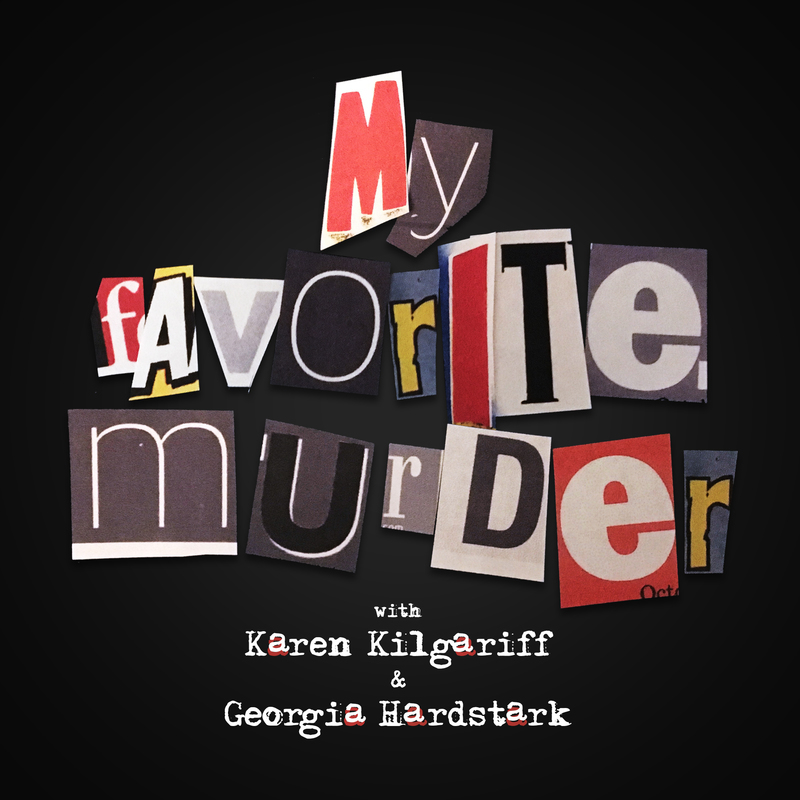
logoMy Favorite Murder: Two comedians in LA tell each other about a crime. This wasn’t the first true crime podcast, but it’s hands-down the most successful and opened the door to many more podcasts. Serial is another a gateway podcast for many, though it wasn’t one I was really into.


Casefile: An Australian man (great accent, if that’s your jam) tells really in-depth and wonderful stories from all over the world. The stories are thoroughly researched.

Red Handed: Two women from London co-tell a crime each episode. I enjoy their banter and the super interesting crimes they talk about.

Cold: Though I tend to prefer shows where a different crime is talked about each episode, this is a fantastic one (and also horrifying). It’s about a murdered mom in Utah and the sordid history involving her husband and father-in-law.

Okay, one more, Root of Evil is another show about one topic. This is connected to the infamous and unsolved Black Dahlia murder, but not just about that case. It’s about the family of a man who possibly killed her and the fallout of his actions on his descendants into today.

Do you have any favorites? I’d love to hear about them! I also have more than 30 more to recommend if you’re looking for something specific.

At this moment in my life as a writer … by Amber Foxx

At this moment, nearing midnight, I’m stuck on a certain paragraph in chapter twenty-nine. It’s Act Three. The tension needs to be high. But I can’t skip my protagonist’s inner processes, either. She has to think, feel and plan. Is the paragraph too slow? I like the section before it and the section after it, but this transition is a clunker. What if I move the middle line to the end? How much can I cut and still make sense? Should I just skip it and move on? No. I’m revising. I’m not letting myself off the hook. There could be some error of logic, some failure to follow my character’s heart and mind, that will affect the validity of the subsequent part that I— so far—like. (How many times have I cut something I loved because it no longer worked after I fixed what came before it?)

I tried rearranging the lines. Not much better. Maybe I can cut the whole paragraph. Replace it with one tight sentence once I grasp what the scene needs as a transition.

I could say more about this battle with the paragraph, but I have to get back to it.  That’s what’s happening tonight in my life as a writer.