Do You Ever Use Real People in Your Mysteries?

Do You Ever Use Real People in your Mysteries?

The reason I’m asking, I’m contemplating doing exactly that in my next Deputy Tempe Crabtree mystery.

Oh, I’ve based characters on people I know or have known and made enough changes the person would never recognize him or herself.

I’ve used real crimes I’ve read about in the newspapers or someone has told me about, and changed the people and the situations enough that no one ever said they knew where my plot came from.

Once, at the request of a friend, I put her into one of my mysteries, described her as she is, and included her dogs and cat. The only thing I changed was her name. She loved it, and her friends all recognized her.  I even included her in another book because she asked.

As the result of contests, I’ve used the names of real people, but the descriptions and personalities came out of my imagination to fit the book I was writing.

In the next Rocky Bluff P.D. mystery, (which I just sent off to the publisher) I used two real situations I knew about in the plot, but changed both radically.

Recently, I met the strangest group of people in an even stranger situation. I don’t want to say any more because I truly want to use them in the next book I’m planning. In order to make it not obvious what I’m doing, of course the names and descriptions will be much different than they are, as will be the setting.

I’m not sure I can pull this off—but the big thing I have going for me is I know none of them read my books.

I’m eager to hear what my fellow authors have to share. And readers,  have you ever recognized a real person or situation in a mystery you were reading?

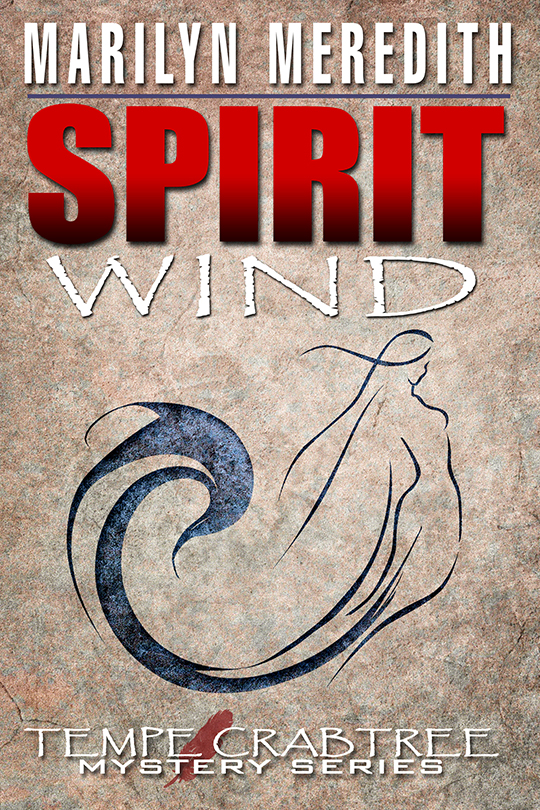
Marilyn, whose latest Deputy Tempe Crabtree mystery is Spirit Wind.

Spirit Wind cover

Blurb for Spirit Wind: A call from a ghost hunter changes Deputy Tempe Crabtree’s vacation plans. Instead of going to the coast, she and her husband are headed to Tehachapi to investigate a haunted house and are confronted by voices on the wind, a murder, and someone out to get them.

Buy link: https://www.amazon.com/Spirit-Wind-Tempe-Crabtree-Mysteries/dp/1092112081/ref=sr_1_fkmrnull_1?keywords=Spirit+Wind+by+Marilyn+Meredith&qid=1556631664&s=books&sr=1-1-fkmrnull


Guest Blogger: Jeri Westerson

History and the Religious Thriller

By Jeri Westerson

When you write about the medieval period, religion looms large. Of course, I’m talking the Catholic Church when it truly was a universal (catholic) church, where everyone who was Christian was Catholic and any reformists were to be condemned. In the time period that I write—late fourteenth England—being a reformist was dangerous but not necessarily life-threatening. That was later, in the fifteenth century (after all, no one expects the Spanish Inquisition).

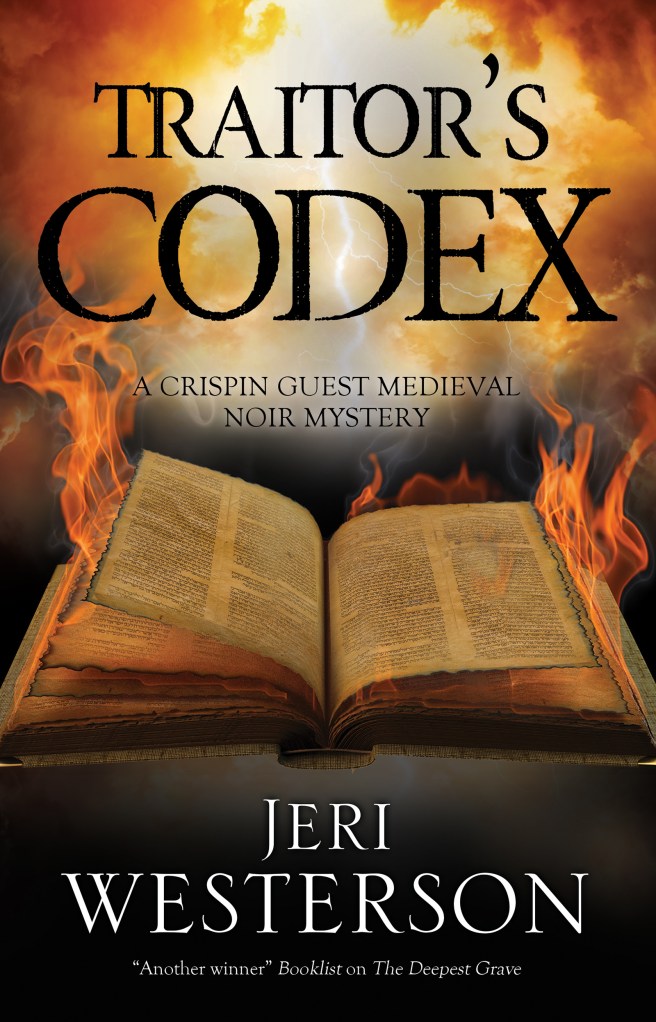
I’m always looking for something interesting for my disgraced-knight-turned-detective Crispin Guest to deal with, besides murder. And I remembered reading about the Judas Gospel a few years ago. It’s only one of several “apocryphal” gospels, meaning “hidden”, or those that weren’t accepted at the time when the early Church fathers were deciding what to include in the New Testament, like the Gospel of Thomas and the Gospel of Mary Magdalene. But the Gospel of Judas would be sufficiently intriguing and dangerous enough for my detective to discover and try to fend off forces beyond his control. Judas is the “traitor” in TRAITOR’S CODEX, but the “traitor” is also Crispin, whose treason got him disgraced and banished from court in the first place.

By delving into its strange history, the religious reformers of the day (called Lollards), and getting him mixed up in murders and a mysterious agent of the Church out to get this book to destroy it, Crispin has his hands full doing his detecting.

The Judas Gospel, as did many of the apocryphal gospels, had a different voice from the four chosen gospels we know of today. It follows a very spiritually eastern path with its emphasis on one’s inner divinity, and that Judas was the favored Apostle not John, the one to whom Jesus entrusted this distinctly different philosophy. It’s presence certainly made Crispin think about what it means to be a faithful Christian, when the most auspicious decision one could make in the day was whether to follow the orthodoxy of the Church, or follow Lollard tenets. Lollards did not believe, for instance, that baptism and confession were necessary for salvation. They believed in the laity reading scripture in their own language and they considered asking intercession of saints and statues a form of idolatry—essentially, the beliefs that would eventually come to fruition in Henry VIII’s reformation in the sixteenth century.

When I started writing my series, I was interested in the medieval setting, with its mores and society so very different from our own. The challenge was to world-build just enough so that readers not wholly familiar with the fourteenth century and the court of Richard II, would be able to relate to my characters. Authenticity sometimes wars with accuracy (I give you the taste of the language, for instance, instead of writing it in Middle English), but history is never sacrificed for plot. Sometimes it’s tight-rope walking that fine line, but it’s never dull.

Disgraced knight turned detective Crispin Guest is caught in a deadly conspiracy within the Church to suppress what they consider a dangerous relic from falling into the hands of the reformist Lollards. But murder and betrayal are the coin of the realm amid the turmoil stirred up by a mysterious nemesis. Crispin struggles to find a killer and might have to bring a painful truth to light while avoiding falling into the lethal hands of a shadow organization within the Church.
Buy links: Amazon https://www.amazon.com/Traitors-Codex-Crispin-Guest-Mystery/dp/0727888757/ref=sr_1_1?crid=2BH7SKBABH45&keywords=traitors+codex&qid=1561419959&s=gateway&sprefix=traitors+codex%2Caps%2C248&sr=8-1Barnes & Noble https://www.barnesandnoble.com/w/the-traitors-codex-jeri-westerson/1130151313?ean=9780727888754#/Indiebound  https://www.indiebound.org/book/9780727888754Google Play https://play.google.com/store/books/details/Jeri_Westerson_Traitor_s_Codex?id=7MeDDwAAQBAJKobo https://www.kobo.com/us/en/ebook/traitor-s-codex

Los Angeles native JERI WESTERSON is the author of twelve Crispin Guest Medieval Noir Mystery novels, a series nominated for thirteen national awards from the Agatha to the Shamus. Jeri also writes the urban fantasy series, BOOKE OF THE HIDDEN. She has served two terms as president of the Southern California Chapter of Mystery Writers of America, twice president of the Orange County Chapter of Sisters in Crime, and as vice president and California Crime Writers Conference co-chair for the Los Angeles Chapter of Sisters in Crime. See more about Jeri at JeriWesterson.com or visit BOOKEoftheHIDDEN.com

Social Media:Facebook https://www.facebook.com/author.westerson Instagram  https://www.instagram.com/jeriwestersonauthor/
Pinterest  https://www.pinterest.com/jeriwesterson/

Inspired by Solitaire

There are two immutables that drivSolitaireShote my writing life. One is that I am the ADHD poster child. This means that focus is not my strong suit and that I am fidgety as all get-out. The other is that I am an audial writer. I have to hear it in my head before I can write it. So, sitting still while mulling over my next line can be a bit of a problem.
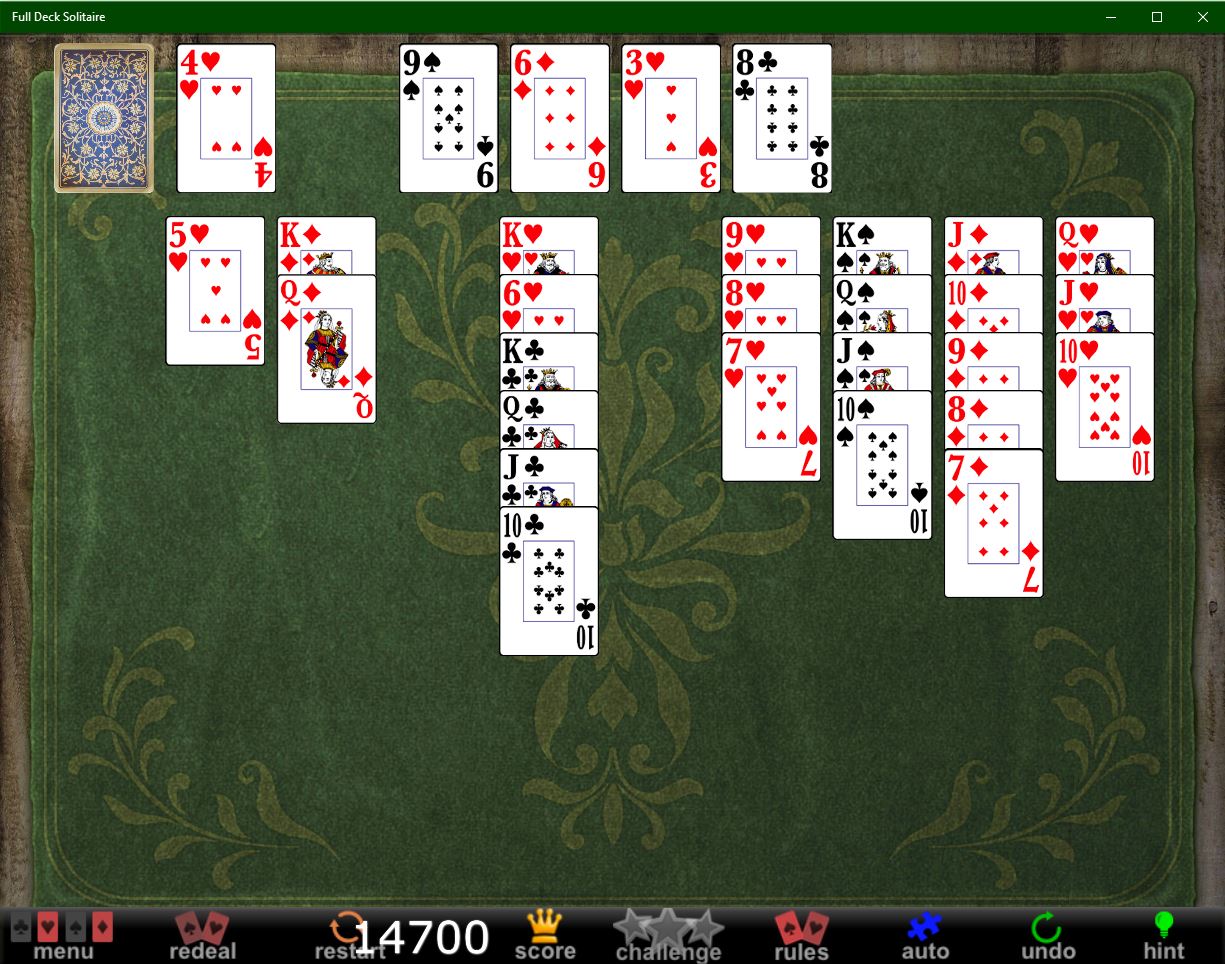
Thank God for solitaire. Okay, I also like Bubble Witch (although that’s getting a little too tough for mindless clicking) and I have a slot machine game (completely mindless clicking), plus the mahjong matching game and blackjack training. But when it’s time to write, inevitably, I’ve got the solitaire app open.

It’s one of those that has dozens of games, most of which I don’t play. But I have my ten or so favorites, and of those, there’s the game I play most often – Thirty Thieves. It’s not an easy game to win, but not as impossible as its cousin Forty Thieves. I win about half the time I play – and I know that from my stats. It’s not completely mindless, in that I do have to decide where and how to play my cards. But it’s pretty close. (Drat, just lost another hand). In short, it keeps my mind and my hands just busy enough that I can focus on what to write next.

The idea behind Thirty Thieves is that you try to move cards in number and suit order Solitaire2up to the foundation from where they’ve been dealt. The catch is that you can only move one card at a time (okay, need to undo that last move) and you can only go through the stack once. But you can put cards in any empty spot, once you’ve emptied it. (Let’s see, if I put that seven here, I can put the eight and the nine there and there, then put the eight on the nine and the seven on the eight, and that’s a new empty spot.)


I try not to think how many games I go through while working on something. I think I’ve played at least 12 since I started this piece (won that last one – yay). And sometimes, I have to get away from desktop so that I’m not playing endless rounds of solitaire. But there is something about that mindless clicking that joggles the thoughts loose like nothing else. (Okay, 14 games).

So, what helps you joggle the thoughts loose?


Acknowledging Technical Support by Karen Shughart

police motorcycle in middle of road
Photo by Jimmy Chan on Pexels.com

I write mysteries. They’re Cozies, which means they don’t include graphic violence, explicit intimate scenes or coarse language.  But they do have a sleuth who investigates the murders, and although the books are fiction and there’s a lot of sway in writing them, I want them to be at least somewhat technically correct.

There’s wiggle room, of course there is. No one is holding my feet to the fire if I miss a detail that a real detective wouldn’t. But my aim is to make the books as realistic as possible, so that’s why I decided to get technical support.

Technical support offers credibility to any work, and it’s important to me, as an author, to feel comfortable that what I’m writing has at least a semblance of investigative reality. Plus, it’s a fun way to meet competent experts in a wide variety of fields, in my case criminal justice.

Before completing Murder in the Museum, the first of the Edmund DeCleryk Mysteries, I attended an eight-week class sponsored by our county sheriff’s office. I learned all the ins-and-outs of our county’s criminal justice system, everything from investigative procedures to arrests and bookings to how a K-9 unit works. There are also a number of other services provided to the community by our sheriff’s office that have nothing to do with solving crimes; services to the elderly and children, for example, and learning about those gave me an appreciation for all the fine work our sheriffs do.  When I had additional questions, I was delighted when the sheriff and two of his undersheriffs offered to meet with me to answer those questions.

A retired commander from a sheriff’s department in another county, two retired police officers-one a professor of criminal justice at a local community college-helped me not only understand how our legal system works but also the steps in conducting a solid investigation. It was high praise, once the book was published, to get an email from one of my contacts who said the investigation in the book was “spot on”.

Now I’m working on the second book in the series, Murder in the Cemetery. I’ve kept notes and all the information from those wonderful and talented folks who helped me with the first book, but in this one I needed additional support. Our district attorney who is a former physician’s assistant, provided valuable insights and information. A possible connection to the murder with the CIA resulted in a lengthy and productive conversation with that agency’s public affairs director. A retired beat cop and friend gave stellar examples of how law enforcement agents can be compassionate.

blur close up focus gavel

Writing a book takes a lot of work. Keeping track of details, making sure the plot flows and keeping characters straight are part of the process, but  including realistic investigative procedures results in not only a better book but also one that passes the test for accuracy.


Hi . . . Missye K. Clarke, Newly-Realized Synesthete

**The title is solely from the author’s imagination, and is not looking to do disservice to those with this neurological condition or for ones familiar with Alcoholics Anonymous.**

Live Streaming from The Saturday Show on WQXR’s app: John Coltrane’s “Giant Steps.” Great song if you want an explosion of colors bouncing in your mind’s eye like blown dandelion puffs on a breeze like I have now.

Allow me to share a funny, true story. And thanks for the “Hi, Missye!” hellos for being part of this incredible platform, by the way.

My youngest son devours chocolate milk, especially if it’s a lovely blend of soft-serve and imported dark chocolate of Michelin Star grade. I found a great little seafood place in Lancaster PA called Mr. Bill’s (est. 1974), and took the last of their blueberry, strawberry, and orange cremes in stock after remembering the picture he’d showed me from online. One orange creme I snagged was his. Past tries of blueberry and strawberry milk left me gun-shy for another go; the sugar content may as well have been akin to rocket fuel-boosters for the Apollo 11 mission.

Our drinks deliciously cold hours later, I left my orange cremes be. He insisted I sip his strawberry and blueberry after saying, “It’s a liquid form of a great blueberry muffin–seriously.”

I looked at him dubiously.

“No, Mom, it’s not the sugar version of Thurgood Stubbs’ salt addiction. You’ll like it,” he pressed.

He made me laugh; I got the joke, took his container. Well . . . if Sam-I-Am liked green eggs and ham . . .

I dared a taste.

And delightfully found it to be exactly what pastel purple would taste like!

We sipped the milks again, but I barely contained my excitement.

My son: “Totally a liquid blueberry muffin. Yeah!”

Me: “I see that. But it’s what pastel purple taste like if more people could taste colors.”

He, looking at me like I’m bats (which is often): “Mom . . . are you saying you’re tasting a color?”

Me: “Well, I see musical notes in colors, too, so . . . yeah, I guess I am.”

And later that night, the orange creme, breathtakingly delicious, I tasted a lovely dream.

You’re A . . .Who?!?

A synesthete (pronounced sin-UHSS-theet, or sin-ESS-theet). It’s the medical term for one having sensory pathways crossed, which is synesthesia (from the Greek syn, meaning “together,” and thesia or thaesia for “sensation.”). According to dictionary.com, it’s an “involuntary neurological condition where the individual activates a second sensory pathway when the first is stimulated.” Apparently there’s more than 60 ways to either instigate or innately have synesthesia–one way to be part of this is to drop acid, but that’s not surprising (Sidenote: I’ve never in life dropped acid, nor will I, research or no. I’m taking zero chances of lasting side-effects, I’m scared I’ll become addicted to the substance, and/or what it’ll do to me during and after consumption. I know me–if I’d’ve had a positive, lovely trip, I’d want to do it again to get that back. If I’d’ve had a bad, negative trip, I’d be tormented for hours like I am in one of my asleep-dream nightmares. Best that door stays welded closed and moved on from altogether). There’s no real statistics in how many have this condition, because baseline science is only just putting the call out to those with such exceptions to how the senses are so crossed to be double-blind studied, or done so objectively.

In my mind’s eye since I was young, I’ve always seen musical notes in colors; the blueberry milk episode, obviously external, only recently. Until now, I thought everyone heard music this way. For others affected with this still-understudied condition, it manifests externally and has a strong run in families. Synesthetes can also become such from a stroke, blindness, or another health anomaly. In one extreme case, a British woman, according to a special about her documented on NatGeo in 2011, had to get rid of her television; any time food, cologne, or laundry advertisements aired, she could literally, just by hearing the ad described, “taste” the human and pet foods; laundry detergent, soap washes, and dish liquid; colognes and perfumes, too. But the times she found her synesthesia pleasant was during certain weather days. Sunny days, she’s reported, the sunshine tasted of lemons, pineapples, or bananas. On rainy days, she heard the raindrops in random musical notes the way wind chimes sounded on blustery days, and saw the raindrops on her patio table in sprays of colors. When she used the products she could “taste” by hearing them on ads, when actually using then, she didn’t have this sensation.

Weird, right?

I remember asking my mother could she taste the color blue when I was about four. Trying not to laugh, she said, no, honey, blue’s a color. I told her I could taste it. She asked–amusing me, probably–what did it taste like? Like ice. Or snow. Or ridonkulously really cold water, I said, and does today. As for my musical notes in colors–they range in dark blues and greens, with pops of distant bright white and silver for the A major chords. C majors are royal blues, shamrocks, bold reds, deep golds. F majors: red, bright yellows, bright whites . . . and pretty much so on.

Inspired by the NatGeo doc, my experiences and its scientific term, a character in MccGuinness/Pedregon Casebook #3 has this condition. Gregory Street is afflicted with synesthesia and a key component in helping the crew solve why former top five music competitors are homicide targets. Unfortunately, he’ll make the killer’s crosshairs in his main goal of murdering my narrator, but I wanted a way to fold in this condition with solving this crime. I just hope I do Street’s death justice not only in believability, but showing his condition with grace and dignity in the honest portrayal I’m offering. Moreover, it’s my biggest hope neurological science not only finds a way to explore, deep diagnose, and explain why this occurs, but shows its daily impact on affected individuals. Do they “taste” fire like they see the flames, hear them roar, feel its heat? Do they “hear” mud, or dirt as they feel, smell, or see it? Can they “see” petrichor–the way a geographical landscape looks and smells after a hard, fast, and intense rain? Can they “touch” sounds the way we can feel the differences in sandpaper, or petting an animal, or holding an ice cube?

Have you known someone, or maybe you yourself, have this sensory cross-stimulant? Have they shared their experiences with you? If you’re beset with tis condition, what’s your experiences been like? Do you find this condition strange in a good or bad way? I’d love to know your thoughts, so please share in the comments.