One of the nice things about my life as it’s currently set up is that I do have a certain amount of freedom to work on the things I want to work on when I want to work on them. Sort of.
I’ve got two projects I really should be working on right now. One, I’ve got several people asking about, since I’ve mentioned it more than once. The problem is, there is something wrong with the story and I cannot, for the life of me, figure out what it is. The second is a submission to a traditional publisher that the editor asked me to revise and resubmit.
You’d think I should be all over that second project, but the editor told me to take my time and I kind of want to so that I really get things right. That’s why I’ve been holding onto the first project.
The first project is the third in my Old Los Angeles series, titled Death of the Chinese Field Hands. It was a really tough one to write because it starts with one of the darkest episodes in Los Angeles history, the lynching of 18 Chinese men in one night during a riot. The murders of my character’s field hands happen after the riot, but it – and the anti-Chinese prejudices of the day – haunt the story. It was a tough first draft to write. I know the ending needs serious fixing and that will be relatively easy to fix. But there is something else that is just not working and I can’t see what it is.
I may end up switching off between the two. The distraction may be something that will help me catch the piddly little things I tend to miss when I’m reading through a project because I’m so caught up in the story. Or not. It will be interesting to see how this affects my process.
It’s all part of the writer’s journey – always something to learn. Yay!
Well, the baby finally was born. It was a long and hard labor, lasting almost two years, but in the end, I’d say it was worth it. Murder in the Cemetery, book two of the Edmund DeCleryk mystery series, has been published, and as I look back, the labor was one of love.
I thought this time it would be easier. I’d been through it before. I knew a little more about what I was doing and was comfortable working on developing the characters and plot. But I was wrong. It wasn’t easier. This time my expectations were greater, and I put more pressure on myself. I fretted more, and many times woke up in the middle of the night remembering details I needed to include or thinking about plot changes that would make the book better. I worried that my publisher, Patricia Rockwell, at Cozy Cat Press, wouldn’t like this one as much as Murder in the Museum, the first in the series. Happily, she did.
One of the biggest challenges in this book was keeping track of all the details. The plot is a bit more complex, so there are lots of them. Plus, there were recurring characters whose personalities and names I had to keep straight. When I introduced something, such as a conversation early in the book that gave hints to who the murderer was, I had to make sure I followed through to the resolution. Descriptions had to be consistent throughout. Ditto for points of view. And sequence of events, except when there were flashbacks, needed to be chronological.
During a trip Ed and Annie take to England (it has to do with what Ed discovered on the beach at the end of Murder in the Museum) a glimmer of something about the murder in this book wafts through Ed’s head. He dismisses it, but in a chapter close to the resolution, I had to make sure he remembers it. Annie also had a moment of discomfort when something niggled in her brain, but close to the end she remembered what it was, and it was a detail that helped to solve the crime.
I’m excited that the book is finished. Promotion has begun, but I’m also beginning to develop the plot for book three, Murder at Freedom Point. Whether it will be easier or more difficult to write than the previous two remains to be seen, but I know I will love the conception, gestation, labor, and what I certainly hope will be a very happy and healthy delivery.
Check out my website: https://www.karenshughart.com for a synopsis of Murder in the Cemetery, to read my blogs and newsletters, see what other books I’ve written or to purchase any of them.
I am happy to say that I finished writing my first book, Ghosts of Guatemala, a spy thriller that follows a cold-blooded assassin on a kill mission in Antigua for the CIA. It’s the first in a trilogy and readers have been giving me really great reviews!
Have you always wanted to be a writer?
Pretty much. I’ve wanted to be a lot of things, but I had gotten compliments on my writing when I was younger which helped fuel my desire, and I’ve also just had a burning love for stories and imaginary worlds for the better part of my life. I’ve been working at writing fiction since I was twelve. Every time I heard a good story or read a bad book, it only wanted me to write something of my own.
How did this book get started?
Years ago my dad took me on a road trip to Chicago. Amidst our father-son shenanigans, he proposed I write a stageplay for him. I thought he was joking. Turns out he wasn’t. Once he confirmed he’d finance the whole project (he’s a retired teacher who wants to do stuff) I agreed. We had a blast producing two stageplays, and I got to write, direct, and act in both. Both were comedies; the first was about quirky college kids and their relationships revolving around a video game in In Real Life, and the second play was a reverse romcom with a magical twist in LoveSpell. I was happy to cut my teeth on this creative work but I’d been working on long-form fiction since elementary school, though nothing that would stick or be appropriate to send off to an agent. Dad suggested we tackle a novel together – his idea, my writing, his marketing. And bam! A couple years of arguing later we’ve got a sweet sweet book up for sale. I wrote the entire thing in a single night of a fevered sweat…
Actually though?
No. It took me about two months to write the bulk of it (three if you count the third month I spent procrastinating to write a single chapter). Then waiting on beta readers, and back and forth editing, and more procrastinating…my parents sat me down and threatened to publish the thing in a week whether it was ready or not. So I made sure it was ready. The word count is around 75k, which is a little longer than the first Harry Potter book. I’m really happy with the length – I wanted something with substance but still a quick read.
Did you have any objectives when writing the book?
Yes. My first and foremost objective is to try to create a cohesive story. I forget where I read it, but a comic book creator was talking about telling stories, and they said that if the reader can’t tell what’s going on in the frame it doesn’t matter how good your story is. The most important thing is making sure the reader knows what’s going on. That’s not to say we can’t play around with mysteries, clever reveals, or unreliable narrators, but it still rings strong in my mind as the first thing I have to do as a writer. And I find it a lot harder to do that than I’d like to admit. It is a difficult thing to write a story that makes sense throughout multiple perspectives, keeping track of a timeline and time zone shifts, knowing which secrets some characters know that others don’t and what the reader knows and doesn’t, and so on. My second objective, after I think I am meeting the first, is to make a compelling story, a story that is interesting, and something that I hope readers would enjoy reading. If I complete those two things, I feel very accomplished. If I had a third objective, it would try and be unique and put enough originality into the piece that makes readers really impressed. And although I tried to do that, I was still very much invested in the first and second objectives.
Speaking of which, what makes your book unique?
I do think the book enjoys a bit of a unique spin. The most unique part about Ghosts of Guatemala is that it takes place in Antigua, Guatemala, and this setting acts as a vibrant part of the story. Most of the book is fairly typical of the thriller genre – I’ve got the CIA doing shady stuff, a cool and collected protagonist, and a bad guy we can’t help but love – which was my aim in telling a story in this genre. But Antigua gives a great opportunity to inject a ton of culture, language, geography, and history that not too many are familiar with. I try to make sure it’s not just a simple paint-job over the story. I really wanted Antigua and the city’s personality to help impact and shape the plot. Full disclosure; I’ve never been to Latin America, but my father has (for months at a time) and this is where he was integral to the creation-process. I would send him chapters and he would edit my poorly worded Spanish, or point out that buildings weren’t as high as I had written and so on. One of my favourite parts had to be completely cut from the story because I had written an awesome fight scene taking place on a beach. Unfortunately, Antigua is landlocked in the mountains – yikes.
What was it like writing this book?
If I’m being perfectly honest, Ghosts of Guatemala isn’t my kind of genre. I’m a sci-fi/fantasy guy; I’ve been reading almost nothing but swords, dragons, and spaceships for the better part of thirteen years. I’m a nerd! But I also take pride in being a chameleon in my craft. If I’m required to write in a different style, or about a different topic than I am used to, I best be prepared to do it. Simple as that. My approach was one of mimicry. I thought of every stereotype and cliché in the genre, then tweaked them or made them my own. I’m constantly reminded how hard it is to write a true cliché. By the time you spend some time with something you think is unoriginal, it’s usually become your own. I also altered my default writing technique a bit more toward something that fit this genre better – shorter, terse sentences and more exposition than I usually prefer.
Who can you trust when corruption and danger are a way of life?
The CIA never left Latin America, and is facing catastrophic blackmail at the hands of an erratic Guatemalan drug lord: the infamous patrón of Antigua – Pablo Puentes. Desperate for a swift solution, the agency calls in their black operative fixer: John Carpenter.
John is a cold-blooded professional ready for the job. But the mission doesn’t have a simple fix. Pablo has a disastrous kill switch in place. John is still haunted by the mysterious death of his best friend who died on a far too similar mission, and now is uncertain about how much he can trust his handler or his sensual partner.
Back at the agency, tensions are running hot as the stench of corruption is growing to a boiling point. If things aren’t put to rights – and soon – the entire mission will go up in flames and take the CIA down with it. Only John Carpenter can bring this drug lord to justice and get the answers he deserves.
Because this mission is personal…
“If you like the relentless tension of Daniel Silva and the gritty reality of Lee Child then you’ll love this first book in the John Carpenter Trilogy!”
Collin Glavac is a Canadian born actor and writer who lives in the Niagara region. He has written, directed and acted in two original stage plays, In Real Life, and LoveSpell. He completed his Dramatic and Liberal Arts B.A. and M.A at Brock University.
When I first started writing computers were the stuff of science fiction and cheesy space opera movies. If you wanted to write a book, you either wrote in painful longhand, talked into a recorder for someone else to transcribe or typed it yourself on a typewriter. Just to set the record straight I learned to type on a Smith Corona manual portable the summer before I entered the fourth grade and have regarded any kind of handwriting more than a simple signature as cruel and unusual punishment ever since!
Now, of course, like most everyone else I use a computer. It’s faster, it’s easier to edit (I remember in the old days when ‘cut and paste’ meant exactly that!), there’s no need for multiple filing cabinets to hold different versions of different manuscripts, you don’t have to go scrabbling for cheap or even pre-used paper to use for rough drafts, there’s no need to do a complete retype in order to have a clean copy… all in all better. A single thumb drive or dvd can hold every version and every note or bit of research on several novels. Several filing cabinets’ worth of data can be held in a small box on your desk.
So why isn’t my house neater?
I digress…
Since I still tend to mistrust technology, I not only keep dvds of my projects in my desk and in the safety deposit box, I also have them in cloud storage and… wait for it… in a paper copy. Yes, I know what I just said about paper, but this is different. I print out a copy of the final manuscript using both sides of the paper, the narrowest margins I can manage, single-spaced and in a tiny type – 8 or 9 point – not so large as to be bulky, but still able to be retyped if the unthinkable happens. This can reduce the biggest book to a manageable size. Then I drill the manuscript and put it in a 3 ring binder, along with a dvd (yes, that’s 3 copies per book on dvds), a photocopy of my contract (the original is in the safety deposit box as well as scanned to my computer), and any other ancillary things specific to the book. Usually I can get 3-4 novels or 6-8 novellas in a ring binder. It’s a lot smaller than a couple of file cabinets!
I have been writing for a long time, which means I have a lot of partials, multiple copies and extras of all kinds of manuscripts. My husband and I are living in the house where I grew up, and boxes of old manuscripts are still turning up in the garage and attic. I think they’re breeding.
Still, I hate to lose any of my work, even if it’s juvenile or unfinished or just plain unworkable, so I scan what I don’t already have copies of. Then, once assured that I do have a record or that the manuscript I just found is one of many duplicates, I split the pages in half and stack them up for notepaper.
For someone who hates to handwrite, I use a lot of notepaper. Have a quick idea for a cute or a scary scene? A great idea of a different way to do murder? A reminder of an appointment? An appealing name that may fit a character in a future project? Whatever? I scribble it down and affix it to a huge corkboard against the wall. When it starts to resemble some weird sort of scaled creature I do have to go through that board and pare it down. The paper recyclers just love it when that happens…
So, even though I am an admitted techno-naif with only the sketchiest kind of détente with technology, I have to admit that the computer has made this writer’s life much more simple. I have no choice but to do so. I sold all my filing cabinets.
I just finished the 14th Shandra Higheagle Mystery book. This book is set in Kauai, Hawaii. Yes, I had to write off the trip I took to Kauai last October. LOL Actually, it took me 40 years to get my husband to go to Hawaii with me and I happened to like the idea of setting a book there.
I enjoyed revisiting the places we went to add spice and authenticity to the book. My photos, some I took with the intention of using for the cover, and others so I could remember what I’d seen, helped me bring the island to life in the book.
While the writing, bringing in the island flavor, and discovering an actual event that brought my amateur sleuth potter to the island in a real way, it was the intricacy of the plot that kept me spellbound as I wrote the book.
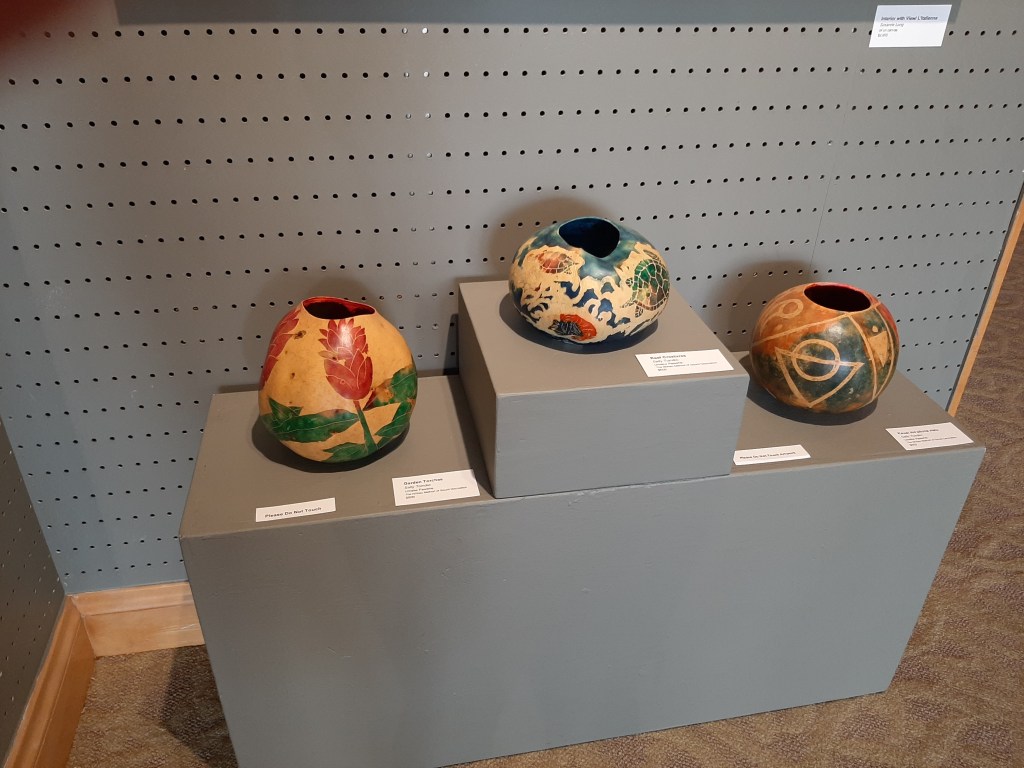
Artwork from the exhibition in my book.
As usual, I started out with my suspect chart, all part of the art world on Kauai. But as I researched and discovered more about the island, the art world became more dark and convoluted. This on an island that boasts very low crime rates. But I couldn’t help myself. The island is warm, inviting, and overpopulated with tourists.
Because of the tourists, I have my characters catering to the masses. I’m not saying what I wrote about isn’t happening on the island, but it isn’t in the statistics that I read. However, I did read about the influx of drugs back about 5 years and taking creative license, I used that information to sway the direction of the story.
I take pride in so many readers saying they didn’t know who the murderer was until it was unveiled in most of my mysteries. And so, I go at each book with the intent to drop clues but keep the reader wondering until the end. I hope I’ve done that with this book as well. We’ll see when I get my critique partners’ notes on it.
Here is the cover for Abstract Casualty, set on Kauai, Hawaii.


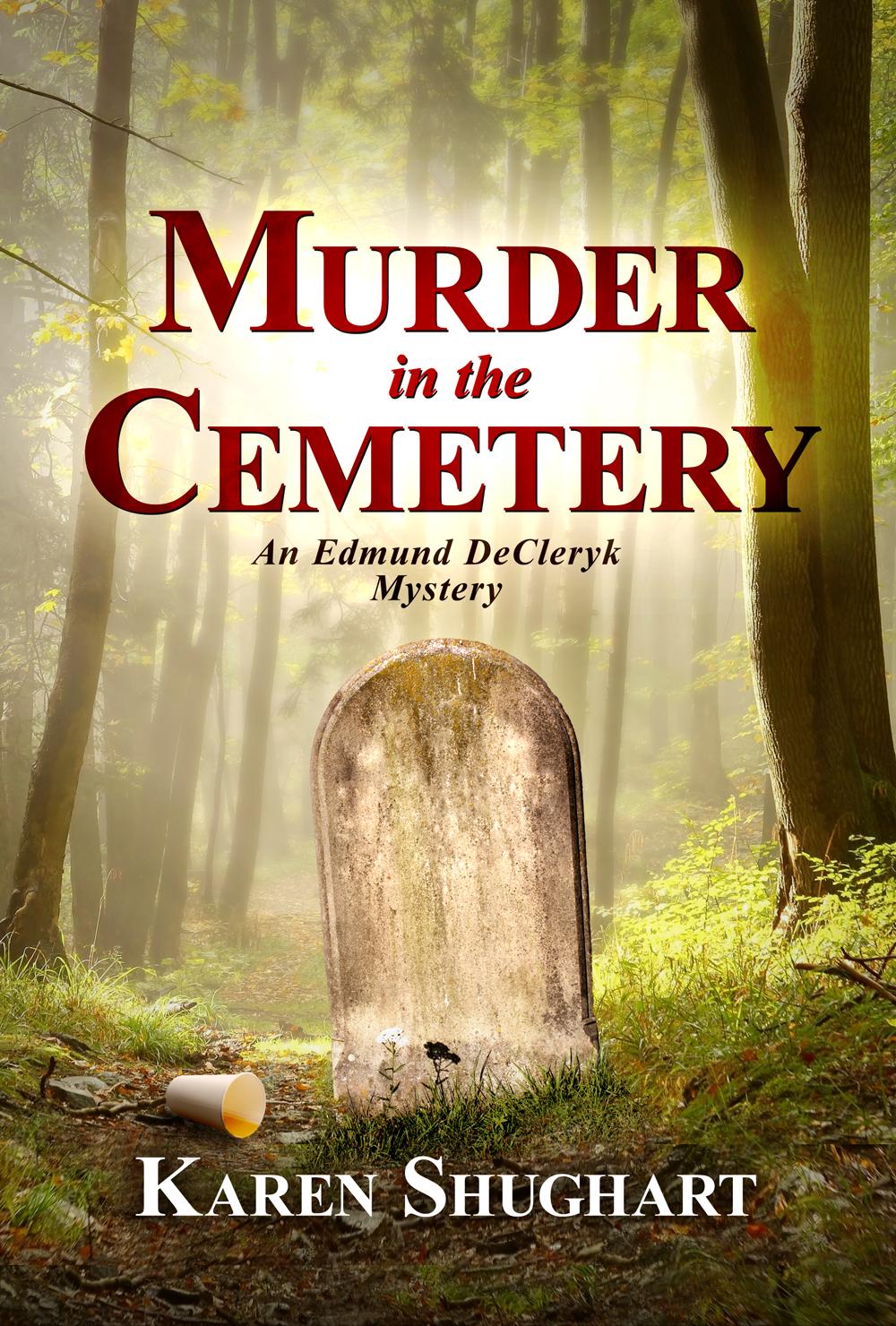 Well, the baby finally was born. It was a long and hard labor, lasting almost two years, but in the end, I’d say it was worth it. Murder in the Cemetery, book two of the Edmund DeCleryk mystery series, has been published, and as I look back, the labor was one of love.


 Ladies of Mystery
You must be logged in to post a comment.