Who’s In Charge Here?

by Janis Patterson

Every so often one of my writers’ groups will conduct a workshop on ‘how to create a character.’ I’ve taken a few of them and the methods range from a half-dozen point checklist to a six page questionnaire that goes into such depth as the character’s favorite flavor of Jello, the schools he attended, what kind of pet he had as a child…. You get the idea.

I’ve tried them all, and each time created a deep, multi-faceted character. A completely dead deep, multi-faceted character. They had all the proper points, but they never came to life on the page. Working with them resulted in all the joy and sparkle of Silly Putty. Oh, they moved from Point A to Point B when I directed them, and spoke the words I put in their mouths, but they were reminiscent of nothing so much as Gumby or King Kong – their movements were obviously stop-animation instead of really coming to life.

So I quit taking classes and went back to what I’ve always done – letting the character come to me. Almost every writer has snorted with disbelief when I tell them about the birth of my characters, but – other than my occasional forays into how-to-create-characters classes – it’s always worked for me.

So what do I do? Nothing. My characters simply walk in, tell me their name, and start fitting into the vague storyline that I’ve started with. And yes, they tell me their names. Once I really didn’t like a character’s (the hero!) name and changed it. He didn’t like it, so he shut up and refused to speak to me again until I changed it back to what he wanted some three weeks later. Then the writing simply flowed because of his cooperation.

Who said writers had complete control in their own world?

I know this technique (technique? maybe dictatorship?) wouldn’t work for all writers. Huh, it may not work for any writer besides me, but that’s the point. Even if I’m the only one it works for, it does work for me. I know the character’s-favorite-Jello system works for some people. It doesn’t work for me, but I’m glad it works for them.

What I’m trying to say is that there is no one singular this-way-only technique for writing a book. The only thing that we all should do is write a good book. How we write that book is up to us. There are many good techniques, probably some I’ve never heard of. The important thing is that each writer has to find the one that works for him. Or which ones work for him. There’s no rule saying you can only use one technique. As long as you turn out a good book, it doesn’t matter.

Artful Travels

Here’s a quote from Ian Fleming, World War II Naval intelligence officer—and author of the James Bond novels:

Never say ‘no’ to adventures — always say ‘yes.’ Otherwise, you’ll lead a very dull life.

Dull life? Not me.

Recently my life has been anything but dull. Though not the way I planned it.

When I wrote the first draft of this blog, I anticipated it would appear days after my return from two glorious weeks in Bella Italia.

Naples, Pompeii, Herculaneum. Rome, the Eternal City. The Vatican museums. The Coliseum. Florence, steeped in art, the statue of David looming over all of it. Venice with its canals and gondolas.

It didn’t happen. I had to cancel the journey I’d been planning for over a year.

A week before I was due to leave, I started getting low heart rate alerts on my Fitbit. Off to the emergency room, where an afternoon of EKGs, bloodwork and doctor consultations revealed that I needed a pacemaker. The doctors didn’t advise traveling for four to six weeks. Surgery, then home, then back to the ER with a fluctuating heart rate—again. One of the leads on the pacemaker had come loose. Another surgery, this time to replace that lead and reposition the others. I came home from this second hospital stay the day I was supposed to leave for Italy.

The travel insurance claim is in the works, and I’ve rebooked the trip for next spring. I’ll get to Italy yet.

So, why Italy? It’s the same reason that led me to Greece two years ago, and an upcoming trip to Egypt in January. History and art. I have an MA in history and all those books on my shelves. I love going to museums and wandering through galleries full of wonderful art. My favorites, the Impressionists. When I was in Paris decades ago, I went to the Louvre three times and the Orsay Museum twice. I sought Monet at the Orangerie, the Marmetton and took a trip to Giverny, where he painted and where I discovered he loved Japanese woodblocks as much as I do.

I used to say I didn’t like modern art. Then some years ago, the San Francisco Museum of Modern Art mounted an exhibit featuring Richard Diebenkorn. I went twice. Time to take a different look at modern art and understand it a bit more.

I took an art history course. I’d always thought about doing that when I was in college and never got around to it. I enrolled at the local community college and went to classes, accompanied by the weighty tome I bought in the college bookstore. I was the oldest person in the room, including the instructor. I learned a lot.

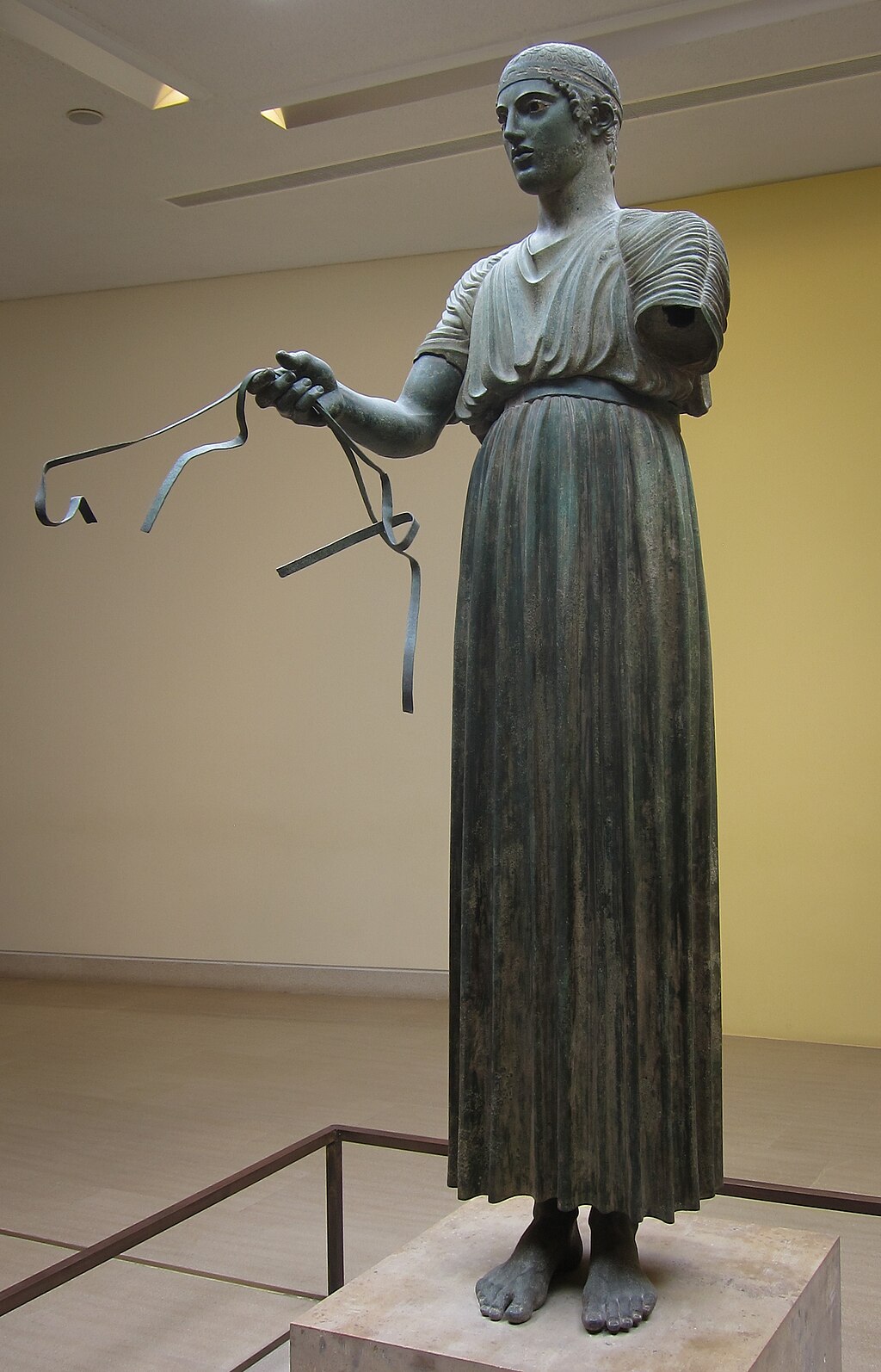
The class broadened my appreciation of art and reignited my desire to travel. Not to the land of the Impressionists, but to the ancient world. Hence the trip to Greece. I climbed to the top of the Acropolis and marveled at the treasures in the Archeological Museums of Athens and Crete. I saw the statue of the Charioteer in Delphi. On Santorini, I went to the ruins of Akrotiri, a town destroyed by a volcanic eruption in the 16th century BCE.

I could happily go back to Greece, as there is much to see and I barely scratched the surface. Italy has been rescheduled for next spring. Now I’m anticipating Egypt. Cairo and the Grand Egyptian Museum. The pyramids and the Sphinx. Abu Simbel, Luxor, the Valley of Kings. Sailing the Nile on a boat and envisioning Amelia Peabody! I can’t wait!

Later in the year, I’m planning a return to England and France. In keeping with my interest in history, especially World War II history, I’ve signed up for an Operation Overlord tour that starts in London, with the planning of the D-Day invasion, and includes visits to Churchill’s War Rooms and the Imperial War Museum. Then to Bletchley Park, where Allied codebreakers cracked the Axis codes. From there to Portsmouth and a cross-channel ferry to Normandy and the D-Day beaches.

Of course, if I’m going to England and France, I’m spending extra days in both places. Versailles, a tour of the Paris Opera, perhaps another trip to Giverny. As for England, I’m checking to see what plays and musicals are playing in London’s West End. The Museum of London, one of my favorites. The British Museum, a must. Afternoon tea at Brown’s Hotel, of course. That’s where Agatha Christie always stayed. And it’s the scene of her Miss Marple novel, At Bertram’s Hotel.

After that? Where shall I go next? Vienna? Australia? Costa Rica? Iceland? Spain? My wish list gets longer and longer!

And yes, there’s an art history plot in here somewhere. Remember, in my latest Jill McLeod/California Zephyr book, Death Above the Line, a Vermeer looted by the Nazis appears—then disappears. What happened to it? Eventually I’ll have to find out.

Home at last

My books meet the criteria for cozy mysteries: body by the second chapter; an amateur sleuth (usually female) who has a police connection like a boyfriend, relative, or friend; gory details, language, and sex implied but takes place off page; tidy ending with justice served; and there’s even a recipe for mysterious chocolate chip cookies associated with one of the series.

The amateur sleuths, a realtor in Regan McHenry Real Estate Mysteries and a downsized law librarian turned self-styled private investigator in PIP Inc. Mysteries do solve the crime before the authorities do and sometimes in spite of the authorities. The stories end with the murderer coming to justice…at least most of the time. Interestingly one of my most popular characters escaped and readers are constantly asking if the character will turn up in a future book, hopeful that they will.

So my books are cozies by definition if sometimes slightly kinky like good British mysteries, my covers and book titles aren’t. No witty play-on-word titles for me. I prefer real estate related titles for the Regan McHenry Real Estate Mysteries or harsh titles like “The Funeral Murder” or “The Corpse’s Secret Life” for the PIP Inc. Mysteries.

Pets are often another element of cozy mysteries and while my protagonists do have pets: cats for Regan McHenry and a dog and cat for Pat Pirard, they are never featured romping across a cover upending a cake or anything like that. Okay, Pat’s ginger cat Lord Peter Wimsey is on a back cover of “Dearly Beloved Departed” feigning innocence in the downing of a Christmas tree, but a reader has to have the book in hand to discover that.

I didn’t consider the idea of a typical cozy cover for the first book I wrote because when I started writing, a series wasn’t in my  mind. I had a good beginning and an ending that I liked and no idea how to connect them, let alone how to follow “The Death Contingency” with other books to make a series. Later I did modify the covers for the first series, but only to add a real estate sign and make them look like they belonged together. They still don’t look like traditional cozies.

I always considered myself a bit of a contrarian and I love British mysteries, besides, I like my edgier covers which work well with my non-cozy titles. Usually, I come up with what the title will be and a basic sketch of what the cover should look like before I start writing, so both title and cover design are an integral part of the story and make perfect sense to the reader by the time they discover who did it.

Nevertheless, I’ve always felt discomfited that I didn’t look like I belonged in the cozy genre and worried readers might skip over my books because they didn’t feel right. All that changed a few months ago when I heard someone say they enjoyed reading cozy-adjacent books. Cozy adjacent. Perfect. Now I have a home and I don’t have to apologize for my covers and titles. I’m free to use a non-cozy title like “What Lucy Heard” for my latest book.

You can see all the covers of my cozy-adjacent books, the other books I’ve written, the cookbook and anthologies I’ve edited, and read the first chapters of the mysteries at my website www.nancylynnjarvis.com or check them out in print and ebook format at Amazon https://www.amazon.com/Nancy-Lynn-Jarvis/e/B002CWX7IQ/ref=ntt_dp_epwbk_0

Guest Blogger ~ Kris Bock

Kris Bock on Two Very Different Heroines in her Mystery Series

My two mystery series have first-person (past tense) narrators, so I’m writing from their close point of view and the reader gets their thoughts. A novel, being fiction, doesn’t merely copy people from real life, of course. Still, an author might use bits and pieces of several people to create some characters, and completely make up others. We might also use personal experience – a great way to develop characters who feel authentic!

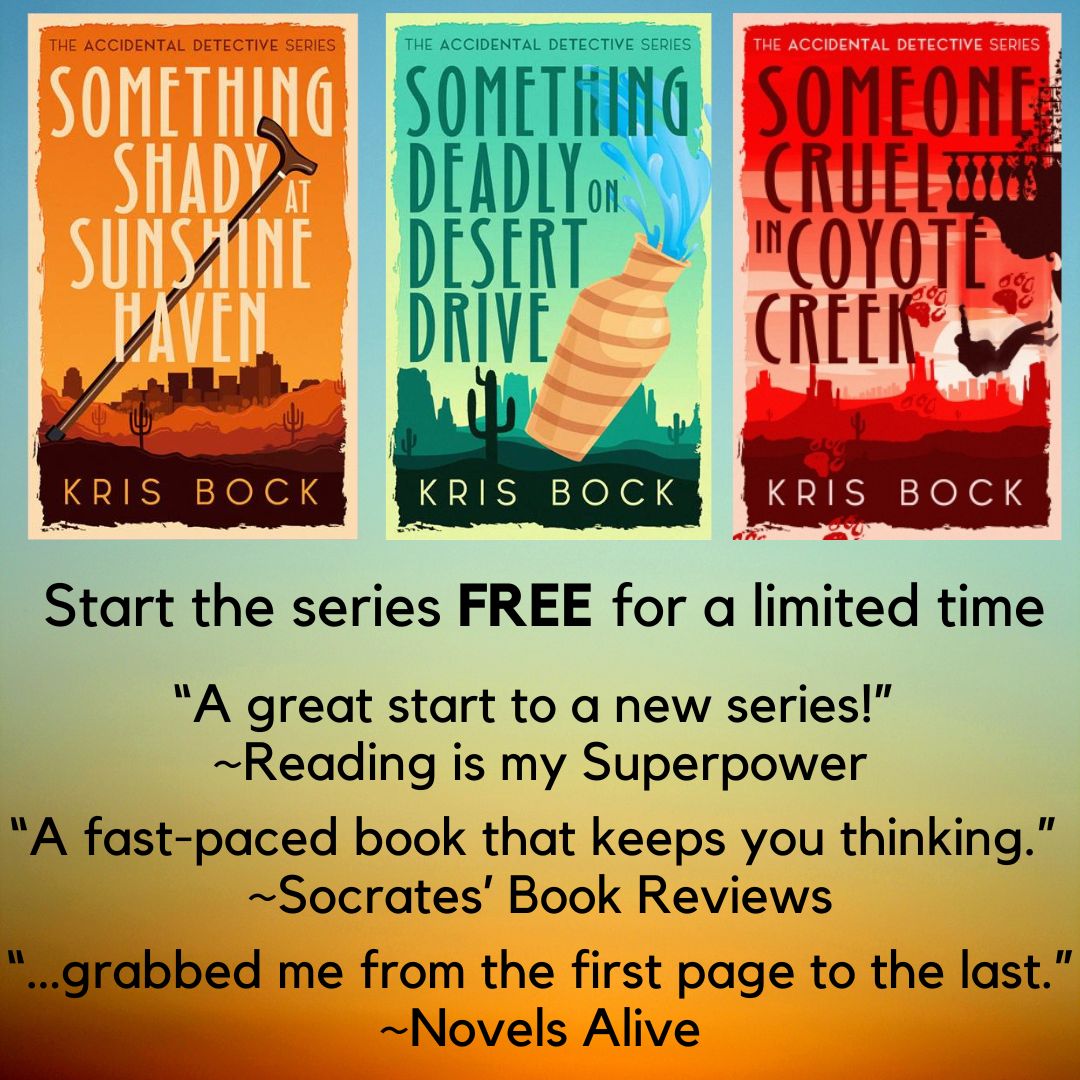
In the Accidental Detective humorous mystery series, a witty journalist solves mysteries in Arizona and tackles the challenges of turning fifty. I wrote it as I was facing fifty, and Kate has some of the same concerns, such as perimenopause and aging parents. I drew on my experience with chronic back pain, which sometimes throws off my walking stride, in order to write about Kate’s bombing injury and use of a cane.

Those things bring Kate to life, but she’s not me. I’ve been a full-time freelance writer for nearly 30 years, but I’m definitely not a war correspondent. Kate is me if I’d gone into journalism instead of other forms of writing – and if I was much more outgoing and fearless.

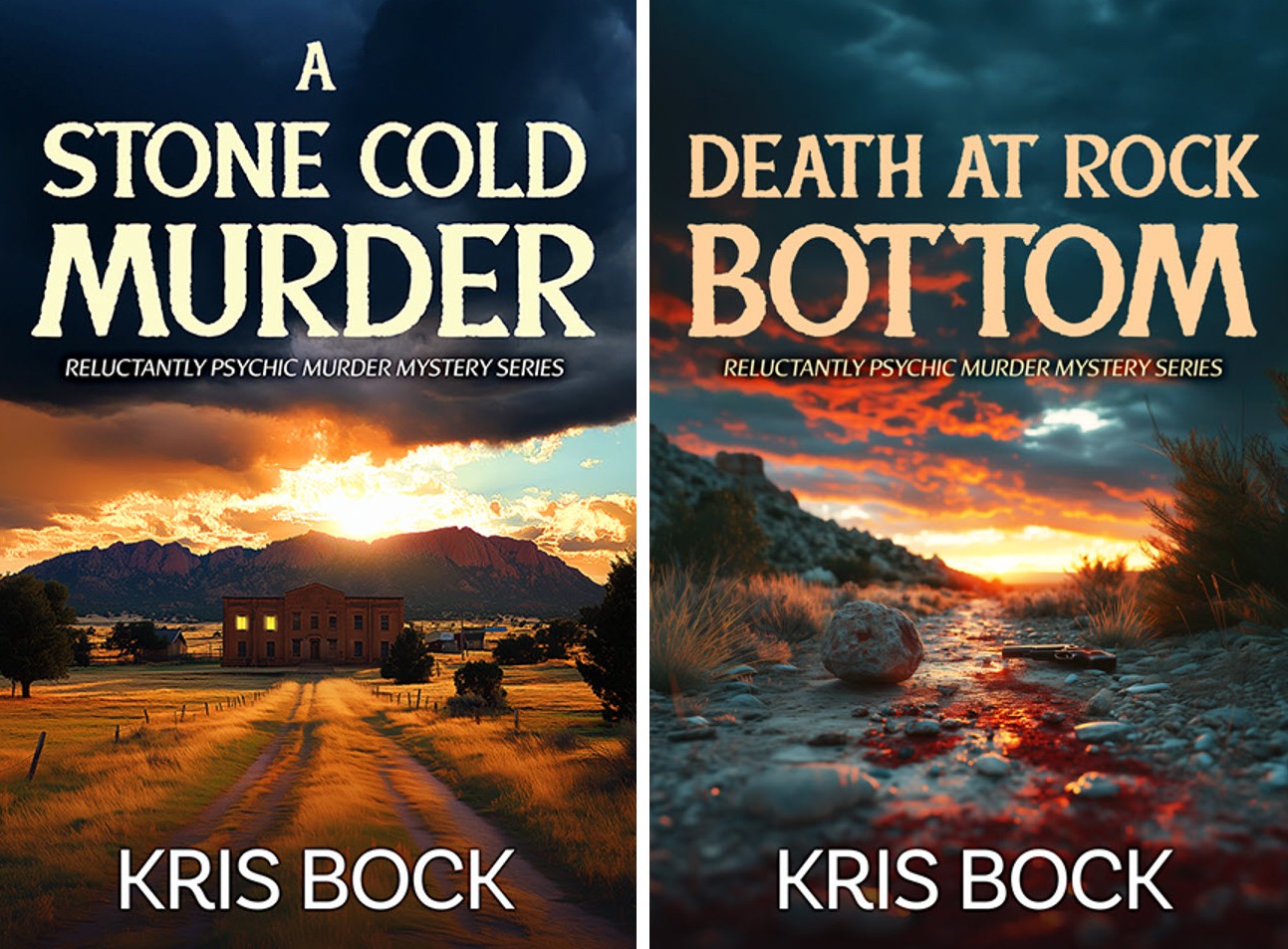
My new mystery series, The Reluctantly Psychic Mysteries, star Petra, who can touch an object and sense the emotions people have left behind. To create her character, I tried to imagine what it would be like growing up with a “gift” like hers. She avoids friendships so she won’t have to explain her psychic power or feel like she’s spying on people. Because she’s such a loner, she has many pets. She went into geology because it typically doesn’t force her to handle objects that have emotional residue from prior handling.

In some ways, she’s less me. She’s younger than I am, at thirty. I have no psychic powers. But I drew on the more anxious, cautious parts of myself in creating her, and used plenty of imagination to explore what it might be like to grow up with a challenging psychic power.

Extrovert or Introvert

Because these two characters are so different, they investigate mysteries in very different ways. Professional journalist Kate is used to interviewing people. She’s had practice seeking out the truth. People ask for her help, and she craves the adventure.

Loner Petra has childhood trauma due to neglect, abandonment, and betrayal from both family and friends. She tries to understand people’s behavior so she can protect herself. Her caution and fear mean she overanalyzes everything, but that works pretty well for an amateur detective.

Readers seem to like both characters. People think Kate is fun. They enjoy her eccentric sidekicks, including her sister, her father, and a couple of her father’s wacky friends. Many people would like to be like Kate – or they identify with her attempts to start over in midlife. Readers have said:

“I so related to Kate and her struggles to get back to her regular life. Can’t wait for the next book in this series!”

“A fifty-year-old who is wondering what she wants to do when she grows up? That’s more like it! Bock’s story offers proof positive that no one outgrows the need for more maturity and self-discovery.”

“I loved her smart world traveler, foreign war correspondent heroine. I loved reading a story where the heroine is so fascinating, as fascinating to me as the mystery.”

Something Shady at Sunshine Haven (the Accidental Detective book 1) is FREE this month at all E-book retailers!

From Isolation to Friendship

Most people don’t want to be Petra, but they sympathize with her (and often identify with her caution and anxiety). Book reviews have said:

“What truly resonated with me was Petra’s emotional journey. Her anxiety about being discovered, her cautious approach to forming friendships, and her affection for her pets (the cats! the ferrets! my heart!) made her character incredibly relatable. I found myself laughing, gasping, and perhaps shedding a tear or two.”

“What wrecked me emotionally was Petra’s struggle with trust. She’s spent her life pushing people away to protect herself, but now she has to rely on others to solve this murder. That slow, painful opening-up? The tentative friendships? I felt every second of it… Petra’s journey is one I won’t forget.”

“Petra is such a compelling lead. Her psychometry isn’t just a plot device—it’s a curse that’s shaped her entire life… And her journey from isolation to finally letting people in? Perfection.”

I’m sure most readers don’t have psychic powers. (If you do, please tell me all about it!) So why do people respond so much to Petra’s isolation? Maybe because we can feel isolated for so many reasons: neurodiversity, gender nonconformity, being artist types in a corporate world, feeling out of tune with our community’s or country’s politics … Who among us feels “normal”?

Petra masks her true self most of the time, for her safety, but she craves connections with people who understand and accept her. Don’t we all feel that way some (or much, or all) of the time?

Maybe Kate and Petra represent reasons readers turn to books: We want to identify with characters and believe they would like us too, or we want to feel what it would be like to be entirely different – or sometimes a bit of both.

A Stone Cold Murder: The Reluctant Psychic Murder Mystery book 1: Petra Cloch has the gift, or curse, of psychometry – she can sense the emotions people had while wearing or using objects. Now she’s starting a new job at a quirky private museum in smalltown New Mexico. When she picks up a rock in her new office, she feels flashes of rage, fear and death. Everyone says her predecessor died in a car crash, but what if he was murdered? If he died because of the job, she could be next.

Purchase link: https://tulepublishing.com/series/reluctantly-psychic-murder-mystery/

Readers say:

“[A Stone Cold Murder] is both heartwarming and suspenseful. For those who appreciate mysteries that offer depth, a distinctive supernatural element, and a protagonist to cherish, A Stone Cold Murder is an essential read.”

“The murder mystery is fantastic. The idea that a museum curator was killed with a rock (how chillingly ironic) and that Petra is the only one who knows? Genius. And the small-town setting? So atmospheric. The Banditt Museum feels like a character itself, full of hidden corners and whispered history.”

Kris Bock writes mystery, suspense, and romance, often with Southwestern landscapes. The Accidental Detective humorous mystery series starts with Something Shady at Sunshine Haven, which is FREE this month at all E-book retailers!

Sign up for the Kris Bock newsletter and get an Accidental Detective short story, a Reluctantly Psychic short story, and other freebies. Then every two weeks, you’ll get fun content about pets, announcements of new books, sales, and more.

Kris’s romantic suspense novels include stories of treasure hunting, archaeology, and intrigue. Readers have called these novels “Smart romance with an Indiana Jones feel.”

As for Kris’s romance, the Furrever Friends Sweet Romance series features the employees and customers at a cat café. Watch as they fall in love with each other and shelter cats. Start the series for free at all e-book retailers!

In the Accidental Billionaire Cowboys series, a Texas ranching family wins a fortune in the lottery. Who wouldn’t want to be a billionaire? Turns out winning the lottery causes as many problems as it solves.

Kris also writes a series with her brother, scriptwriter Douglas J Eboch, who wrote the original screenplay for the movie Sweet Home Alabama. The Felony Melanie series follows the crazy antics of Melanie, Jake, and their friends a decade before the events of the movie. Find the books at all E-book retailers.

Find Kris:

Website

Kris Bock newsletter signup

GoodReads Author Page

BookBub

BlueSky

Amazon US page or Amazon UK page

VILLAINOUS REWARDS

Hello, Ladies ~

Have any of you cried when you had to kill your villain? I’m not sure why, but it upset me greatly when my villain in “Chaos in Cabo” sailed off a cliff in a hail of bullets. I sobbed as I finished Alida’s story, trying to find comfort in the fact that she sacrifices herself to save Antonio, the man she loves.

Or maybe I listened to a recent reader who said, “I love that your villains find redemption, but don’t you think they should also pay for their crimes?”

Years ago, when I submitted my very first manuscript, “Murder in Margaritaville,” to agents and editors, I received the standard “No Thank You” form letter. But each letter had an interesting addition: You do write a very good villain.

Encouraged by the repeated comment, I studied how I had written my villain. Of course, as with all my characters, my villains are created with traits from people I’ve met throughout my life. From men who treated me badly to women who betrayed our friendship, I have a plethora of evil qualities to attribute to my villains.

I also learned from studying how I wrote my very first villain, Damian Garza, that his character had more depth than my heroine, Clara. Another tidbit was that I wrote Damian in third person instead of Clara’s narrative in first person. However, the biggest revelation was discovering that writing in the voices of my three main characters — the heroine, the hero, and the villain — allowed me to create more three-dimensional characters.

“Murder in Margaritaville” would never obtain an agent or publishing deal. Luckily for me, though, my fabulous friend, Paty Jager, helped me begin my self-publishing journey, and this novel became “Malice in Mazatlán.”

The words, “You do write a very good villain,” have stuck with me throughout my writing career and helped to hone my process. I always start with a title because, for me, the title guides the story. The next book in my Mexico Mayhem Series is “Lost in Loreto.” It took me a few months to decide who was lost and what had caused them to be missing. The cause, of course, originates from my villain’s actions. When the opening line appears in my writer’s brain, I get giddy with excitement to know how the story begins.

Now that I know my villain’s crime, I spend time with him or her asking those pertinent questions: Why? How? When? What? Where? At the beginning of my villain, Arlo’s story, he has no redeeming qualities at this point. But I know from experience that it can change as the other characters begin their search for the missing Gabriella.

In this series, my hero, Javier, is a character who has moved forward from “Chaos in Cabo,” but I needed to introduce a new heroine. In “Lost in Loreto,” this character was a bit of a challenge. When Scarlett Quinn finally materialized, I was thrilled with the direction the story would now take. Oh, what “fun” she’s going to cause.

I usually know the general storyline of the novel I’m writing, although I’ve had characters change the trajectory of their story, which changes everything. In “Lost in Loreto,” I knew as soon as I researched the location of the crime, fleshed out my victim, and wrote the first chapter … what awaits my villain, Arlo. And if my characters stick to their roles, I doubt any tears will be shed when Arlo receives his “punishment.”

Even though I’m back to working on my next WIP, tears still fill my eyes when I think about Alida. I know she needed to pay for her crimes in some fashion, but until I wrote her last two chapters, I didn’t know she would be the one to end her story.

I’ve written six novels and three novellas now, and I’m so thankful for the creative license that self-publishing allows me. Without anyone demanding a finished product by a certain date (except me, of course), I can work on three different books at the same time if I want to.

But I’m also thankful for the time those agents and editors took to tell me: You do write a very good villain.

Happy writing, Ladies, and may all your villains be deliciously villainous!