Bella Italia!

I rode in the gondola. Of course I did. It’s one of those touristy things I just had to do.

I was in Italy, after all. In Venice, built on 126 islands, separated by expanses of water and canals, linked by 472 bridges. Away from the Grand Canal, the main thoroughfare of the largest island, one can get lost in those narrow canals, with their pathways and bridges. Public transit is water buses, known as vaporettos.

My recent trip to Bella Italia started farther south, in Naples. I wanted to see Pompeii and Herculaneum, both cities destroyed by the 79 AD eruption of Vesuvius. On the first day in Napoli, I went to local museums. I also met some fellow travelers in the hotel courtyard who invited me to join them for dinner that evening. That’s one of the delights of travel.

The next day was my guided tour. According to my Fitbit, I logged six miles walking around the two ancient cities. Which are now surrounded by modern cities. In the distance, Vesuvius looms, looking benign—for the time being.

Herculaneum first, a rather compact footprint. It was buried under 20 feet of ash when the volcano erupted. The vast acreage of Pompeii was subjected to 18 hours of falling pumice, then a pyroclastic flow of dense, fast-moving ash that buried everything in its patch, suffocating those inhabitants who had been unable to escape. Most of the city has been excavated, but they are still digging. While I was there, our tour looked at one site that was recently uncovered. In one of the rooms, the eye is drawn to a donkey’s skeleton.

From Naples, I took a high-speed train to Rome. It took all of one hour and 10 minutes. I wish we had such efficient and comfortable transport here in the United States. Ah, that’s a subject for another blog.

In the Eternal City of Rome, I joined a Road Scholar tour, logging more miles on my Fitbit as we marveled at the Forum and the Colosseum, hiked from the Piazza di Popoli to the Spanish Steps, Trevi Fountain and the Pantheon. On the way, we passed the oldest existing aqueduct in Rome, built in 19 BC by the Emperor Augustus. It’s still in use today.

On the following day we went to the Borghese Gallery. I love the sculpture of Paulina Bonaparte Borghese, by Antonio Canova. It was considered quite scandalous in its day. And of course, all the beautiful sculptures by Gian Lorenzo Bernini.

Then a side trip to the Vatican where I saw Michelangelo’s jaw-dropping works of art—the ceiling of the Sistine Chapel and inside St. Peter’s Basilica, where I stood staring at the Pieta, now behind a glass wall since someone whacked it with a hammer back in 1972, causing serious damage.

Another day, another high-speed train, to Florence. The stunning Michelangelo painting of the Holy Family in the Uffizi Gallery. Berlusconi’s Duomo. The adjoining museum contains a remarkable Donatello sculpture of Mary Magdalene. And then the Accademia Museum, where Michelangelo’s beautiful David stands, ready to confront Goliath.

One of my fellow travelers and I went to the Pitti Palace, another museum full of paintings and sculpture. We stood on line at the entrance with three Greek Orthodox nuns from Macedonia and had a pleasant conversation, also one of the delights of travel.

Venice next, with the riches of St. Mark’s Basilica and the Doge’s Palace. We also saw something of workaday Venice, when our vaporetto went through the port, seeing boats loaded with packages and luggage. Boats pick up the hotel’s laundry every day. And at one vaporetto stop, a woman got on wearing a Post Italiane uniform, pushing a cart full of mail to be delivered.

When my tour was over and it was time to head for the airport, I traveled by water taxi, speeding over the lagoon to the docks outside the airport.

The food! Wonderful pastas and salads, delicious pizza, and I must confess that I sampled gelato everywhere. My favorite is stracciatella, vanilla ice cream drizzled with strands of chocolate. Good thing I was doing all that walking.

I just returned from my trip a few days ago. It was late evening, so I unearthed my toothbrush from my bag, took a hot shower, and went to bed. After my two-week absence, my three cats were ecstatic to see me. Unpacking could wait until the next day, after the necessary grocery run and laundry. The jet lag is kicking my butt, of course.

I do have my plot, however. Yes, there will be a novel set in Italy. The idea is taking shape in my mind.

In the meantime, I have some fiction suggestions. Pompeii, by Robert Harris, historical fiction that takes place before and during the eruption. An official from Rome arrives in Pompeii to check out problems with the local aqueduct and suspects that Vesuvius is the cause. North from Rome, by Helen MacInnes. Set in the 1950s, a playwright travels to Rome when his fiancée, a secretary at the U.S. Embassy, ends their engagement and accepts a proposal from an Italian businessman. Soon he and the other characters are caught up in deadly Cold War intrigue.

For Florence and the Tuscan countryside, I recommend Turn to Stone, by James Ziskin. It’s part of his series set in the early 1960s featuring reporter Ellie Stone, in Florence because her late father is being honored at a symposium. The event organizer winds up dead in the Arno River. Was it an accident, suicide, or murder? Ellie’s search for answers leads back to the traumatic years before and during World War II. As for Venice, Donna Leon’s Commissario Brunetti novels have been recommended but I haven’t read one, yet. I will soon remedy that.

Ciao! Here’s to pasta and gelato!

Guest Blogger ~Michelle (M.M.) Chouinard

It all started in my car, outside a veterinary office during the pandemic.

You remember how it was back then, how you had to wait outside while your beloved pet disappeared into the bowels of the building, not sure which of the two of you was more freaked out about the separation. I knew it was going to be a long visit (it ended up being over four hours, but I digress) so I had a bunch of true-crime podcasts lined up and ready to go. I started with one about The Doodler, a San Francisco serial killer who’s never been caught. As I sank into the story, the references to places in San Francisco rankled my exposed emotional nerve endings—at that point it had been close to a year since I’d been able to go pretty much anywhere, and the mental images set off a strange form of homesickness. “I’m so tired of this,” I blurted out aloud. “When this pandemic is over, I’m going to go to every single place they mention in this podcast. I’m going to do my own little tour, like a serial-killer tour of San Francisco—”

 My brain stutter-stepped over the phrase. Not so much as a concept for an actual walking tour of San Francisco—although that would definitely be awesome and I’d go on that tour in a hot second—but as a concept for a book. How cool would it be to write about someone who gave true-crime tours? Someone who knew of all the most notorious crimes that had taken place in the City, and who used their extensive knowledge of true-crime cases to help solve murders that came their way?

As I waited for my sweet kitty to return to me, my mind raced on down those mental tracks. What sort of person would find themselves making a living giving serial-killer tours? What sort of ‘wound’—life trauma they were still working through—would draw them to such a profession and keep them stuck in that world? The answer came to me in a rush: someone related to a serial killer.

I’d seen more than one interview with parents, siblings, and children of serial killers, and had always wondered what it would be like to live with that legacy. How did people treat you when you were related to a serial killer? Did they assume you must have known what the killer was doing? Did they assume there must be something in you that could do the same thing since you share some portion their genes? And what would that do to your own psyche, to wonder about those shared genes? Was it easy to dismiss any possible similarities you shared with the killer, or did little doubts always linger at the back of your brain about what might be buried deep inside you?

And so Capri Sanzio, granddaughter of the fictional serial killer Overkill Bill, was born. Or rather, she was the granddaughter of the man who’d been convicted of the Overkill Bill murders, but who’d always protested his innocence. Separating her by a generation would allow me to explore how different people in the family had been impacted by Overkill Bill, and how they dealt with that relationship differently. In Capri’s case, since she never really knew her grandfather, she’d spend her life wondering whether he’d been telling the truth or really was a serial killer, and she’d be desperate to get those answers. Except that Capri’s father, the son of Overkill Bill, would forbid anyone from ever mentioning the name Overkill Bill in the house, because of the judgment and bullying he’d had to endure his whole life because of what his father had purportedly done. He just wanted peace, to be able to move on with his own life, and despite Capri’s obsession with knowing the truth, she loved her father dearly and didn’t want to hurt him. So, they’d be caught up in an uncomfortable detente where neither of them really got what they wanted and the generational trauma simmered under both of their surfaces.

Until something came along to boil that trauma right over the top—a series of new murders that copycatted Overkill Bill’s distinctive methods. To paraphrase Michael Connelly, the most interesting mysteries are the ones where the murders involved tap into whatever trauma the protagonist is trying to avoid dealing with; so of course Capri would become a suspect in the investigation of those new murders—I’d make sure of that by making one of the victims her ex mother-in-law—and she’d have to solve both the contemporary murders and the vintage Overkill Bill slaying in order to keep herself out of jail. But, by raking up the past, she’d have to risk fatally damaging her relationship with her father.

And with that, I was off to the races, and I’ve never looked back. Writing Capri has been one of the deepest, most interesting journeys I’ve taken with any of my characters, and I quickly fell in love with her. She’s flawed, she has self-doubts, and nobody would call her choices safe—but she’s passionate about the people she loves and about getting justice for victims who can’t get justice for themselves.

And, in the process, I get the perfect excuse to write up real stops on that awesome serial-killer tour of San Francisco that I promised myself in the vet parking lot that day. 

A Tour to Die For: 

In Michelle Chouinard’s A Tour to Die For, Capri Sanzio is back, giving a true crime tour her guests won’t soon forget. After all, a tour guide who specializes in serial killers knows better than most that San Francisco is a city with killer charm.

Capri Sanzio knows that when you give serial killer walking tours for a living, unexpected situations are more common than San Francisco’s famous fog. So, when one of her guests claims to see a woman being attacked during a tour, Capri remains unphased. The police search the apartment in question and find no evidence of anything amiss, so they chalk it up to a false report from a true crime fanatic looking to be a part of a case. And Capri thinks they might be right, since lately her tours have been attracting even more obsessives than usual—as it turns out, finding the actual serial killer who committed the “Overkill Bill” murders didn’t stop the constant questions about her grandfather’s supposed crimes, it only intensified them.

But Capri would never forgive herself if someone is in trouble and she walks away. Plus, something about the whole situation has every one of Capri’s investigative journalist instincts going haywire—why would someone lie about seeing an attack? So Capri starts to dig, and when her questions lead to a body, she finds herself at the center of another murder investigation.

Buy link: https://read.macmillan.com/lp/a-tour-to-die-for-9781250910011/

Michelle (M.M.) Chouinard is the Mary Higgins Clark Award nominated, USA Today, Publishers Weekly, and San Francisco Chronicle bestselling author of The Serial-Killer Guide to San Francisco series, the Detective Jo Fournier thriller series, and the standalone psychological thriller The Vacation. She has a Ph.D in developmental psychology from Stanford University and was one of the founding faculty members of U.C. Merced. She enjoys caffeine in all forms, amateur genealogy, crafting, baking, and Halloween. She’s owned by three cats and a dog, and is held together by caffeine and dry shampoo. 

Website: http://www.mmchouinard.com

Facebook: https://www.facebook.com/mmchouinardauthor/

Twitter: https://twitter.com/m_m_chouinard

Instagram: https://www.instagram.com/mmchouinard/

TikTok: https://www.tiktok.com/@m.m.chouinard?lang=en

HOPE SPRINGS ETERNAL

I was asked recently if I write books because I want to be famous. To which I replied, “I’m already famous!” Of course, my fame is all in my mind.

But the question did cause me to ask myself why do I write? There are several answers to this question. I write to quiet the voices in my head. I love the process of crafting a story. I might be obsessed with writing …

When I wrote “Peril in Paradise” in 2004, I queried the manuscript the old-fashioned way. After sending fifty-plus query letters, I finally received a request for the first fifty pages. And, as luck would have it, I landed an agent. She sent my novel to publishers, but alas, all I received were “no thank you” letters. A few editors were polite enough to compliment me on how well I write my villains.

I hung onto that compliment as I wrote “Malice in Mazatlan” and created one of my favorite villains, Sarita Garcia.” I didn’t query this novel, and then my busy life took over, suppressing my creative drive.

You all know how I returned to writing after my son, Derrick, died, and have been blessed to crank out seven more books since those early two novels. I love that I’m still inspired to write books set in my beautiful Mexico. And, of course, writing the Stoneybrook series gives me a chance to bring my son alive as a fictional deputy sheriff. I haven’t queried any of these books, embracing my role as an indie author and happy with my imaginary fame.

I’m sure you have all received emails from AI bots offering to promote your “wonderfully written and highly entertaining” novel. At first, the emails were poorly written and ended up in my junk folder, but they eventually got better. Still, I avoided being sucked into their promise of “rising my novel to the top of the bestsellers list.”

You may remember that I still have a “day job,” which means I’m on the phone a lot with clients. When I receive a call from an unknown number, I always let it go to voicemail. At some point, I listen to my voicemails, which are usually from product vendors or someone trying to sell me something.

A couple of weeks ago, I had a voicemail from a producer for a radio show called “America Tonight with Kate Delaney.” The producer, Chris, had read “Redneck Ranch” and loved it so much that she recommended Kate feature me on the show. All I had to do was call back and schedule a time for Kate to interview me.

So, I did what you all would’ve done: I Googled the name of the radio show, and it came up as a legitimate one. The voicemail suggested I listen to an interview Kate had done with another author, which had increased her sales. The author, interviewed by Kate, also seemed legitimate, so I called Chris back.

Chris knew specific details about “Redneck Ranch” that indicated she’d actually read the book. So, as we chatted for a few minutes, I kept searching the internet for any red flags. Every now and then, I thought I detected that she had a slight accent, one that I couldn’t identify.

The kudos for my book kept coming. A particular favorite was when she said, “I think with the right recognition, ‘Redneck Ranch’ could be picked up and made into a television series.”

Hope springs eternal!

In my delirious state, thinking I could be the next Taylor Sheridan, I agreed to let Chris send an email requesting information.

Remember my “day job?” Well, I’m required to have some serious security software, and when Chris’s email hit my inbox, my laptop lit up with multiple red-flag warnings. And one word jumped off my screen, “SCAM.”

“Chris,” I said, trying to sound calm, “my security software just alerted me that your email is a scam.”

“No, no,” she said. “This is a legitimate opportunity.”

“And how much exactly does this opportunity cost?” I asked.

“We have very reasonable fees—” Chris began, her accent becoming more pronounced.

“I’m not interested in paying your fake radio station any money,” I replied, a definite edge to my tone.

“We are not a—” her Filipino accent clearly discernible now.

“Goodbye, Chris.” I ended the call.

I’m glad I dodged a bullet and didn’t send any money for the fake opportunity, but for a nano-second, I had been on the verge of real fame.

I despise people who play on a person’s hope, since I believe hope is a necessary emotion to navigate life. It’s an integral part of goal setting. As in, I hope I finish writing “Fatal Falls” before our trip to Mesa on Memorial Day weekend, so I can edit the manuscript in glorious sunshine.

So, I’m happy to remain famous in my own mind, setting hopeful writing goals and basking in the glow when a real reader offers kudos for one of my books.

Happy, hopeful writing ~ Ladies

Finding the Ending

Finding the Ending

In some stories I know where the ending will be. I work toward it as I construct the plot, discover byways and digressions and facets of characters I hadn’t considered as the story takes shape. That’s one of the advantages of writing crime fiction—the writer has a pretty good idea of where she’s going to end up, still with room for surprises. But that isn’t always the case in some stories. One effort stands out in particular for me. For several weeks I worked on what had seemed to me a simple tale of a fisherman in India, “Tukku’s Dream.”

Tukku gave up fishing after losing a hand to a shark, a fairly common occurrence in that part of India. The reader follows him through a series of jobs as he tries to make sense of his new fear of the water. An unexpected call for help leads to more than anticipated. But I didn’t know how to end the story and kept writing—filling page after page with verbiage and still confused. I gave the story to a friend to read, and his response was terse. The story ended for me right here, he said, pointing to a page about half way through. And he was right. He found the ending after one reading when I couldn’t. I amputated the story at that point and sold it soon after.

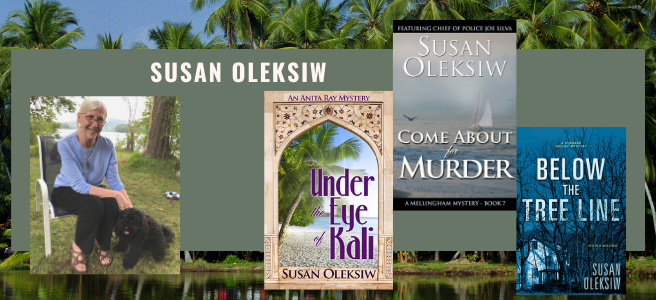
The Mellingham series featuring Chief of Police Joe Silva seemed a simple matter of giving Joe a series of crimes to investigate while I introduce the quirky, sometimes criminal inhabitants of his little town. I went along placidly, happily until I finished book number 7, Come About for Murder. And then nothing. Any ideas I had after that seemed more suited to short stories, and Joe found himself marginalized. Only then did I realize what had happened.

In book three, Joe meets Gwen McDuffy, who is guardian to two children. By the end of Family Album, love has blossomed and Joe’s chronic bachelorhood is coming to an end. In Last Call for Justice Joe visits his family and Gwen’s daughter, Jennie, plays a role, and the reader gets to know her and how she views their new family. In Come About for Murder, the focus shifts to Gwen’s son, Philip, who is presented as Joe’s stepson. By the end of the book it is clear that Joe is his father in every possible way, and the family devotion runs deep for them all. 

What I had done in the Mellingham series without realizing it was follow the earlier principle that it took seven mystery novels to tell the story of the main character. This was an idea we avid mystery readers batted back and forth in the 1970s and 1980s, and then as many beloved series expanded to far more than seven books, the idea was mostly forgotten. But there is something to it. 

The form of the mystery novel requires a lot of the writer (and the reader), so it’s not surprising that the additional theme of the series character’s personal life finds less scope in the 250 pages allotted for mystery novels back then. When the format and page length changed, the series focus did also, and we now have mystery novels over 500 pages and some over 1,000 pages, with attention shifting from the main character and family to formerly minor characters.

Writers have far more options now when it comes to length. Our preference is a personal choice, but I still look at my series as focused on one character and how she or he evolves through crises and challenges. I found the ending for the Mellingham series unless I want to shift attention from Joe onto someone else (and I don’t at the moment), but I haven’t found the ending for the Anita Ray series or the Felicity O’Brien series. 

The so-far last book in the Anita Ray series, number five and titled In Sita’s Footsteps, opened doors I hadn’t expected and I’m playing around with some new ideas. Much as I love Anita and Auntie Meena, I see problems with future books because I’ve made them somewhat static though fun and charming. In the Sita mystery, I found areas in which they can grow and evolve. The question is now what to do about it, how to take the series into this new, unexpected direction. 

I’ll figure it out eventually, and a new Anita Ray with a new and, I hope, interesting slant will appear. Right now I’m celebrating the long-lived life of the Mellingham series. Last Call for Justice, number six, will be out in paperback in August (and book club members in June). And I’m about to sign for Come About for Murder, number seven, which will appear within two years. Meanwhile I’ll think about Anita and Auntie Meena and Felicity.

Greed and AI

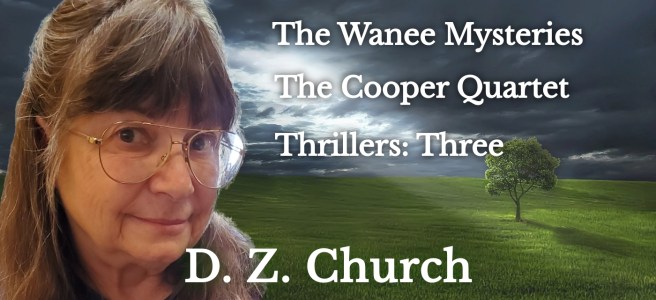
One of the reasons I set my Wanee Mystery series in the 1870s was because even as new, disruptive industrial technology was being used to better life there were those who abused it. Ultimately, it tore apart the fabric of rural life. My newest Wanee Mystery, The Orleans Lady, among other things, is a story about greed. And, so, as it is launched, I struggle with the truth that “authors” are using AI to game the system for the almighty buck and wonder where it will lead us.

Amazon recently limited the number of books an individual could load to KDP to three per day. I don’t know about you, but unless I am updating covers, I don’t have three books to add in a month, well, honestly, six months. So why the limit?

Well, because persons, claiming to be “authors”, are using AI to write as many as, possibly more than, 100 books a month, most are non-fiction books, but others are fiction. Quoting James Blatch, of the Self-Publishing Formula, “Amazon understandably wants to protect the reader experience. They are up against AI-generated novels, thousands a day, and AI-driven marketing carefully balanced to produce a small profit per title. It’s a new business model that relies on quantity over quality. Twenty-five sales of a free-to-produce AI book with an AI cover and blurb, multiplied by 100 a day, is a very profitable business.”

Besides flooding the market, what does this sort of business model do to the discoverability of non-AI-produced books? You know, the sort we shed our sleep for and studiously nurture. Sure, we all write to market in our own way, but this is a different sort of beast. It is destructive to the craft and also to the reading public. Disappointed readers may become wary of buying books not published by established publishing companies, and, so, weaken independent publishing, the very thing these scammers abuse. What if romance readers quit buying romances because they couldn’t tell the wheat from the chaff until the money was spent? Or, horror of horrors, mystery readers?

These “authors” write an AI prompt using a standard structure. Say, the venerable Three-Act structure: Act 1. Setup (Exposition, Inciting incident, Plot Point 1) Act II: Confrontation (Rising Action, Midpoint, Plot point Two) Act III: Resolution (Pre-climax, Climax, denouement). Or any other plot structure that can be used repeatedly. Which is about 15 or so — some claim.

It may be a challenge at first to get the prompt just right, but each time it is used, it is refined until the output is predictable. Then:

The “author” need only change the names, the murder, maybe the town, and AI kicks back a book in the specified length, say just enough pages to result in a $2.50 royalty. It’s run through an AI grammar checker (which does actually require one to know some grammar). Slammed into some nifty formatting software, downloaded, and loaded to KDP, where 25 people read it and discover it is poorly written, has a stale plot, and the characters seem rote. If only three of these fine books are loaded a day, the “author” earns $5,625 ($2.50x25buyersx3booksx30days) plus a month, with no costs beyond software subscriptions and, maybe, a few courses from other scammers.

I call that theft. It’s cheating your “fellow” authors and stealing from readers, whether non-fiction or fiction. Mind you, I might see some advantage to developing an AI prompt to create a synopsis from which you write a book, actually write a book (as in type in your own words), especially if you hate creating synopses and/or if you normally rely on a synopsis while writing. I might even be persuaded that taking a raw work generated by ChatGPT or Claude and refining it into a quality product could be legitimate. Maybe? But new technology always serves two gods: the one who envisions the good of it and the one who manipulates it for personal gain (usually at the expense of others).

I’m old school, I started writing books, bad, bad, bad historical love stories, when I was eight. I’m talking tales seriously reflective of the last thing read or watched on TV. Yes, I followed the plot structures from those sources. Heck, that’s where I learned the basics of plotting. But I never cheated. Every, every word came from my head and flowed through my fingers first in pencil, then pen, then typewriter and finally computer.

Now here comes AI. God save independent writers and publishers from the seemingly endless opportunities AI offers hucksters, including the fake publishers, course pushers, and marketers (agents) using AI-generated emails to lure you into their traps. I swear I get twenty a day.

I’m a guarded optimist and pray this all burns itself out. But it makes me crazy. Especially when I’m looking at the venerable blank page, searching for my next word. Sigh!

Find me at https://dzchurch.com, where you can discover more about my books and sign up for my newsletter. To order The Orleans Lady, follow this link: https://www.amazon.com/Orleans-Lady-Wanee-Mystery-Mysteries-ebook/dp/B0GGY11CM5/.