Guest Blogger ~ June Trop

Ancient Roman Forensics

As the author of the Miriam bat Isaac Mystery Series set in first-century CE Roman-occupied Alexandria, I regularly research the investigative techniques used in Roman times. In writing my latest book, The Deadliest Deceptions, a collection of short mysteries ranging from cozy to noir, I found myself focusing on Roman forensics. No, the Romans didn’t know about fingerprints and DNA, but in time, their courts accepted evidence based on blood spatters, dental characteristics, and pattern recognition.

Perhaps the most famous case based on blood spatters was “The Wall of Handprints”, in which a blind son was accused of killing his father for his inheritance. The prosecution argued that the father was asleep with his wife, his son’s stepmother, when his son stabbed him to death. Furthermore, the father died instantly without having awakened his wife, and the son left a trail of intermittent handprints and blood spatters on the wall from their room back to his own.

On the other hand, the defense attorney claimed that it was the stepmother who killed her husband. Upset that she would lose the inheritance, she framed her stepson. The lawyer successfully argued that the son, being blind, would not have left intermittent prints. Rather he would have dragged his hand along the wall. So, despite their lack of knowledge about the components of blood, the Romans used its prints and spatters to reconstruct the crime.

Julia Agrippina, a.k.a. Agrippina the Younger, used dental characteristics to confirm that Lollia Paulina was dead. Having ordered Paulina’s suicide, Agrippina confirmed her rival’s death by asking for Paulina’s head and inspecting the teeth herself. She must have been satisfied because she did not have anyone else killed for five more years.

Pattern recognition marks convinced the Roman emperor Tiberius that his praetor’s wife died by murder rather than suicide. He saw drag marks and other signs of a struggle to contradict the husband’s claim that his wife had jumped out the window while he was sound asleep. Tiberius referred the matter to the Senate, but alas, the praetor opened his veins instead.

        Roman forensics may date back two thousand years, but even modern evidence from blood spatters, dental characteristics, and pattern recognition can be wrongfully interpreted. Just not in my stories. You can depend on Miriam bat Isaac and her assistants to look at wounds, loss of body heat, skeletal proportions, blood spatters, foot prints, and disturbed foliage to assess a crime correctly.

THE DEADLIEST DECEPTIONS
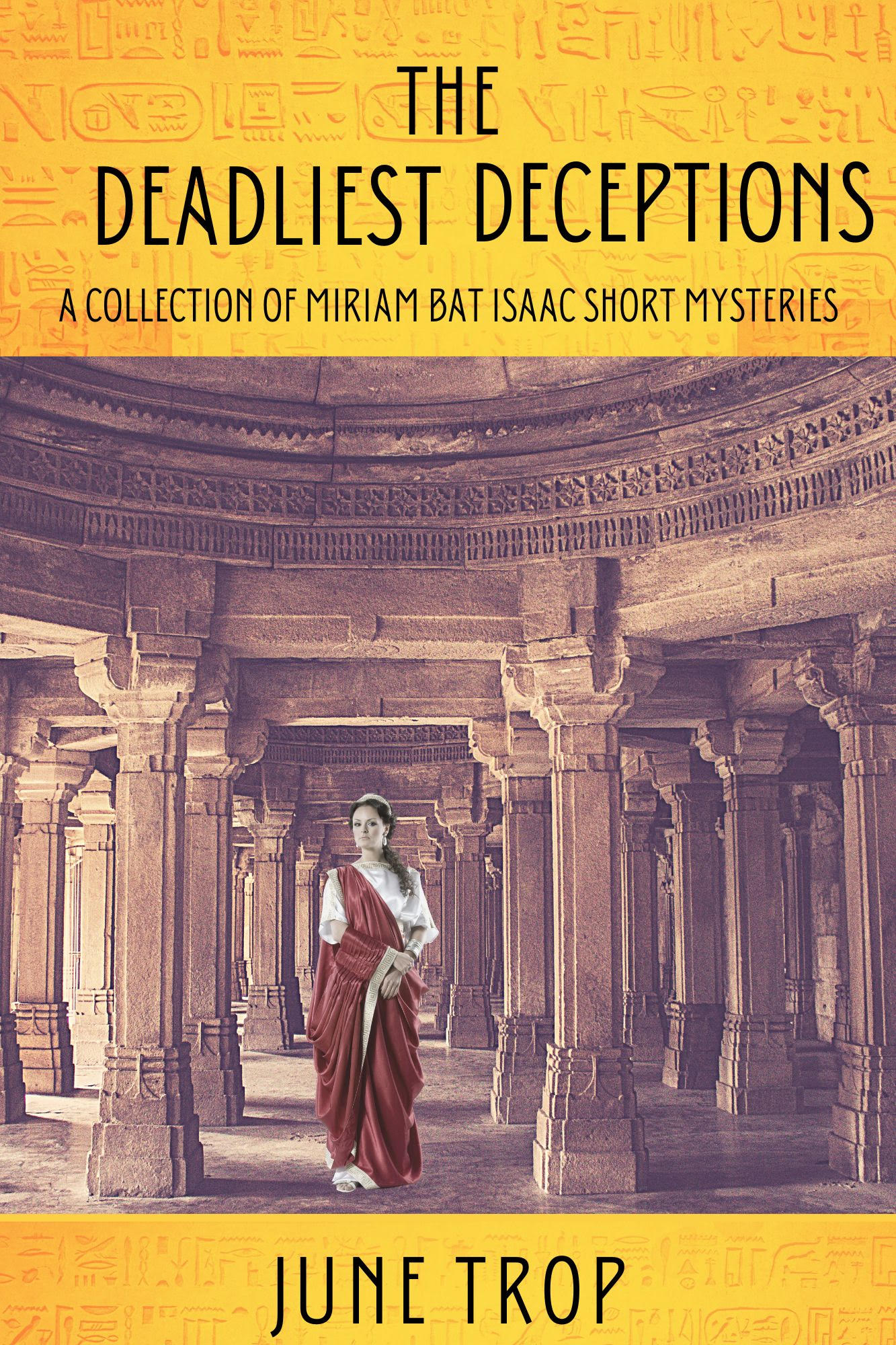
Enter the world of first-century CE Roman Alexandria and participate in the perilous adventures of Miriam bat Isaac, budding alchemist and sleuth extraordinaire. Join her and her deputy Phoebe as they struggle to solve nine of their most baffling cases beginning with the locked-room murder of a sailor in which Miriam is baffled by not just who killed the sailor but how he could have died and how the killer could have entered and escaped from the room.

But be careful as you accompany them into the city’s malignant underbelly. Whether or not you can help them solve the crimes, your blood will flow faster as you escape to that world of adventure we all long for.

BUY LINKS:

Amazon for Kindle    https://www.amazon.com/Deadliest-Deceptions-Collection-Miriam-Mysteries-ebook/dp/B0BT3W7V1B

Amazon for Paperback   https://www.amazon.com/Deadliest-Deceptions-Collection-Mysteries-Mystery/dp/1685122752

June Trop and her twin sister Gail wrote their first story, “The Steam Shavel [sic],” when they were six years old growing up in rural New Jersey. They sold it to their brother Everett for two cents.

“I don’t remember how I spent my share,” June says. “You could buy a fistful of candy for a penny in those days, but ever since then, I wanted to be a writer.”

As an award-winning middle school science teacher, June used storytelling to capture her students’ imagination and interest in scientific concepts. Years later as a professor of teacher education, she focused her research on the practical knowledge teachers construct and communicate through storytelling. Her first book, From Lesson Plans to Power Struggles (Corwin Press, 2009), is based on the stories new teachers told about their first classroom experiences.

Now associate professor emerita at the State University of New York, she devotes her time to writing The Miriam bat Isaac Mystery Series. Her heroine is based on the personage of Maria Hebrea, the legendary founder of Western alchemy, who developed the concepts and apparatus alchemists and chemists would use for 1500 years.

As an award-winning middle school science teacher, June Trop used storytelling to capture her students’ imagination and interest in scientific concepts. Years later as a professor of teacher education, she focused her research on the practical knowledge teachers construct and communicate through storytelling. Her first book, From Lesson Plans to Power Struggles (Corwin Press, 2009), is based on the stories new teachers told about their first classroom experiences.

Now associate professor emerita at the State University of New York, she devotes her time to writing The Miriam bat Isaac Mystery Series. Her heroine is based on the personage of Maria Hebrea, the legendary founder of Western alchemy, who developed the concepts and apparatus alchemists and chemists would use for 1500 years.

June, an active member of the Mystery Writers of America, lives with her husband Paul Zuckerman, where she is breathlessly recording her plucky heroine’s next life-or-death exploit.

Facebook    https://www.facebook.com/profile.php?id=100044318365389

Website       https://www.junetrop.com/

What is it about the Great Lakes? by Karen Shughart

A book I read as a child, set in the 1950s on Lake Superior, resulted in a lifelong fascination with the Great Lakes.  I can’t remember the title, I wish I could, but I do remember snippets of it: family gatherings that included winter sports and summer outings; homemade ice cream made with snow and maple syrup; berry cobblers when the sun was warm and the days long and bright.

I grew up in a city about two hours from Lake Erie, and I have happy memories of family trips there: beaches, amusement parks, and many attractions you’d find at the ocean, but without the salt or sharks. We went to the Jersey shore on the Atlantic, too, and I loved it, but for some reason I always felt drawn to that lake. Many years later, I attended college in Buffalo, NY, and when the weather cooperated spent weekends at a beach cottage owned by family friends in nearby Fort Erie, Canada.

As fate would have it, about 20 years ago my husband and I decided one weekend to explore Lake Ontario, north of where we lived in Pennsylvania.  We discovered a tiny village through the internet; found a charming B&B with water views that was a short walk to the lake, the bay, a small but bustling business district, museums and restaurants, and a quick drive to Finger Lakes’ wineries. Two weeks later we bought our house.

We never expected to live here year ‘round, we planned to use the house as a getaway, but as time went by we were drawn to the region’s many charms.  We worked diligently to restore our house, it had been built by a lighthouse keeper more than a century ago and needed loving care. There’s mystique here: shipwrecks; sightings of massive lake creatures; British ships invading our village during the War of 1812; the transporting of runaway slaves to Canada; a rumor that a tunnel under our backyard hid some of those slaves before they fled. And the brisk business of rumrunning during Prohibition.

Each season has its own appeal. Summer months we revel in the resort vibe enjoying concerts, fireworks, outdoor movies, days spent beachcombing, shopping at farm stands, and lots of gatherings on our deck. During fierce winter storms we snuggle safely in our sturdy home, fireplace burning and soup on the stove, drinking wine with friends. Spring and fall are glorious, too, with acres of fruit trees in fragrant bloom or ripened apples hanging heavily at harvest, and a clean, sweet smell in the air.

In truth, our journey here was serendipitous, and we’ve never regretted it. Like the village on Lake Superior in the book I read so long ago, it’s an enchanting place filled with warm, kind people, and a peaceful quality of life.

From the time I was a child, immersed in Nancy Drew books, I wanted to write mysteries. One night several years ago, I dreamed the plot of my first Edmund DeCleryk cozy mystery, Murder in the Museum. Since then I’ve written three, published by Cozy Cat Press, all set on our lake with backstories that depict the history of this place we now call home. Writing has been a passion for me since I was young, but I never expected that someday my dream, coupled with a fascination with the Great Lakes, would become reality.

On The Writing of Percy Cole, an Off-beat Heroine by Heather Haven

Bear with me if I’ve said this before, but The Persephone Cole Vintage Mysteries were born out of a challenge by my then-publisher to write a protagonist who looked and acted more like a real person, not a model. Could I do it? Did I even want to? Did I want a heroine who wasn’t typical of many a detective story? After I thought about it, the answer was yes! I wanted to write about a smart woman who wasn’t Mad Men classically feminine. And of course, I wanted it all. She should like herself and be comfortable in her own skin.

So along came Persephone (Percy) Cole. Percy is 35 years old and considered middle-aged by ’40s standards. She’s also a single mother, overweight, and at 5’11” is extremely tall. Sound like a winner? But Percy Cole is! Because as Winston Churchill said, “Attitude is a little thing that makes a big difference.” And Percy has attitude up the wazoo. She exudes self-confidence. She’s smart and savvy. She’s a no s–t lady. I just love her.

They say you don’t know what you’re writing until you’ve written it. Well, little did I know that by making Percy as large if not larger than many men of that era, she was able to compete in a man’s world in every way, including physical intimidation, a very ’40s-PI-Noir thing. Percy doesn’t use physical threats all the time, but she’s not above it. Her grabbing some lowlife by the scruff of the neck and hauling him off to jail is just plain fun to write about. And readers seem to like her fearlessness, her sense of self, of not compromising, which is all done with humor, style, and a touch of whimsy.

Yes, Percy’s tough to the core, but I do try to show a bit of softness through her dealings with her mother, father, kid sister, and in particular, in the raising of her eight-year-old son, Oliver, the child that gives her life meaning. Frankly, it is a rare woman who does not deal with family and family matters, no matter how tough they are. Even Wonder Woman (see linked article). Of course, Wonder Woman is a real hottie. But Percy has her moments; she has her moments. There are men who fall for this redheaded broad with her wicked sense of humor, who knows how to make her way in the world. All very enticing. All very Percy Cole.

Hotshot Shamus, book 4 of the Persephone Cole Vintage Mysteries, debuts on May 7th and at a preview price of $2.99. Yayyy!

Is April the Cruelest Month? by Karen Shughart

In the poem, The Wasteland, T.S. Eliot writes, “April is the cruelest month….”

The month of April is a time of birth and renewal, and a time of hope. April may bring showers, but we have a reasonable expectation that it will also bring spring flowers. For Eliot, at least when he wrote the poem, nothing was crueler than hope because for him it often led to disappointment. It was safer to hold on tightly to cynicism and pessimism, because then he wouldn’t get hurt.

For most of us, though, April is not cruel at all.  If you live where I do, in the north, April is a time of anticipation, a time when we believe that, as Alexander Pope wrote in An Essay on Man, “hope springs eternal in the human breast.” Hopefulness, despite our challenges and disappointments, continues to renew itself.  Even the holidays observed by various cultures and religions this time of year celebrate the themes of birth, renewal, and hope.

We rejoice when tiny buds start to swell on the trees, when we wake up to birdsong, and daylight lasts longer. We delight in the first sight of bright yellow daffodils and brilliant-colored tulips  as they stretch towards the sun.  And the sun, weak and pale in the winter, shines brightly now, warming our bodies and souls and expanding our hearts to ever so many possibilities.

Photo by Jacek Mleczek on Pexels.com

We know that when the daffodils and tulips finally end their run for the year, we have a reasonable expectation that they’ll be back next year, and other flowers will follow. When we plant our gardens, at some point we will harvest what we sow. Soon, we’ll be seeing baby birds peeping out of nests; ducklings, cygnets and goslings swimming with determination behind their attentive parents; and tiny, newborn animals scurrying about. April, the spring, symbolizes youth, but even those of us who are in the autumn and winter of our lives can feel happy, young, and energized.

In northern climates the weather in April is fickle. It rains, sometimes it snows, and at times it seems as though winter won’t quite lose its icy grip; then there are those intermittent grey, cloudy days. Regardless of what Mother Nature throws our way, I am compelled to put away the heaviest of winter clothes, clean out the closets, and plan menus around seasonal foods with lighter ingredients.  I start to make a list of things I want to do to get ready for summer. I always know the rain will stop, the snow will melt, and the grey, cloudy days will be followed by brilliant sun. If April isn’t quite what I expected, there’s always next year.

Cruel? I think not. After April comes May with more abundance,  even warmer days, and the anticipation of summer.

Karen Shughart is the author of the Edmund DeCleryk cozy mystery series, published by Cozy Cat Press

Guest Blogger~Terri Karsten

            People often ask where I get my ideas. The answer seems simple—ideas come fromthe people we meet, the things we read, the places we go, the songs we know. But the first kernel of an idea is not enough to create a novel.

So, how does a kernel develop into a book? For me, it starts when an idea won’t let go.  Characters start chattering in my head. Scenes start playing out in my day dreams. I sometimes spend years thinking about an idea before I actually start writing. Then I do a lot of research to learn more about the period. I want my historical fiction to immerse the reader in a world as real and accurate as possible. I want the reader to know what it was like to live ‘back then.’

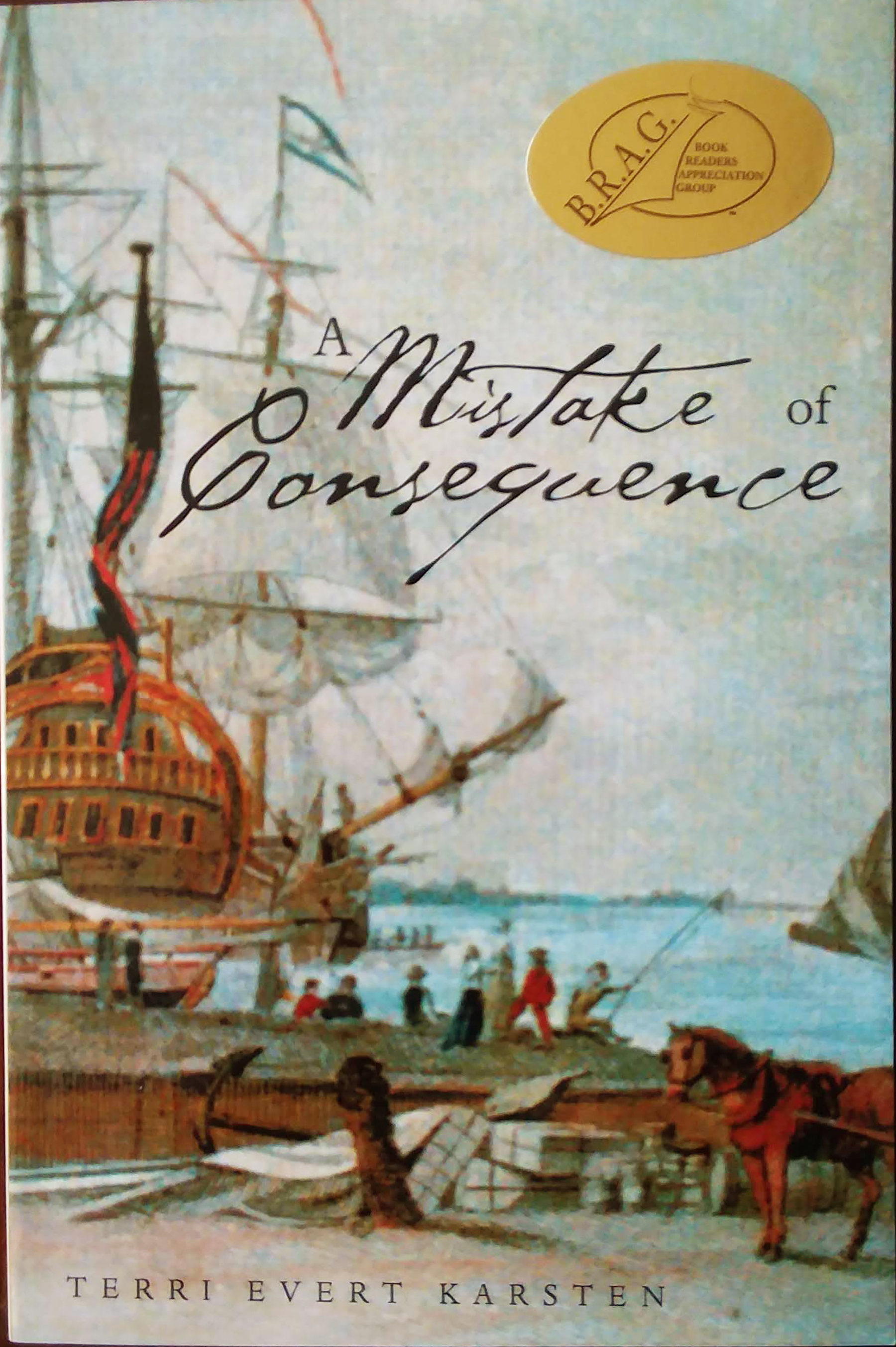
My historical novel, A Mistake of Consequence, developed in just that way. The first idea came from a college class in American Women’s Studies. We read many primary documents, including one about a young woman who had been indentured in Virginia. She wrote her father, complaining of the horrible conditions there and begging him to send ‘his poor undutiful daughter’ adequate clothing. Her heartfelt letter made me want to learn more.

My curiosity led to major research about indenture, a practice was quite common in the 17th and early 18th centuries. Indenture was a legal contract binding a person to work for a certain number of years in return for some compensation such as passage to America. The indentured person was not free to leave the contract and had limited rights as a servant.

Then I discovered that in addition to the people who indentured themselves or family members, many men, women, and children were snatched from England, Scotland, and Ireland and sold in the colonies. In spite of important differences (indenture theoretically had a termination date) the parallels to African slavery were intriguing,

            As I learned more, the characters emerged. The first I envisioned was Callie Beaton, an impetuous, young Scottish woman. Callie’s temper would lead her to the wrong place, straight into the hands of a ‘spiriter’ who kidnapped her, transported her across the ocean, and sold her. Penniless and bound in a strange place, her goal was to return home.

Callie’s story portrays one path indenture could take, but I wanted to show a broader picture. Two other characters gradually took shape, one indentured by choice, and one by circumstances beyond her control. Though both are secondary characters, their lives become entwined with Callie’s.

With these three women in mind, I still needed a plot. I always want to know how the story will end before I can start writing. For this novel, I needed a love interest, a murder victim, and at least one villain to drive the action and influence the outcome. That meant more characters taking up space in my day dreams.

My goal in writing historical fiction is to portray ordinary people living in circumstances very different from our own, but sharing the same joys, fears, and concerns about their families. I want to show that strong, resilient women had important roles in all eras. History, especially women’s history, can help people today learn from the challenges of the past.

            Gradually all these ideas coalesced in A Mistake of Consequence, a rollicking adventure in Colonial America, told from a unique perspective, that of a woman bound by custom and law, but with the courage to choose her own path.

Mistake of Consequence


It is 1754 in Edinburgh, Scotland. Callie Beaton is nearly twenty,
single, and determined not to marry anyone her grandfather deems worthy.
But after her impulsive flight from yet another unwanted suitor leads
her to the pier one rainy evening, Callie is mistaken for someone else
and dragged aboard a ship. Trapped in a dark hold and at the mercy of
strangers, Callie has no idea the ship is headed for a bustling port
city across the ocean in America.

Wracked with seasickness, unable to convince the ship’s captain she is
not who he thinks she is, and with only one scraggly dress to her name,
Callie somehow survives the horrid journey. She arrives in colonial
Philadelphia penniless, nameless, and alone in a strange place. Two men
offer her help: Ethan Asher, a handsome gentleman with a hidden past,
and Davy McRae, a charming ship captain with a dangerous secret. Neither
seems trustworthy, but when tragedy strikes, Callie is caught in the
middle and must choose one of the men to help her if she is to save
herself and her newfound friends from disaster.

In this historical romantic adventure, a Scottish lass who finds herself
in the wrong place at the wrong time unwittingly embarks on a journey
across the ocean to a new beginning where she searches for love,
belonging, and ultimately her true destiny.

Buy link:
https://wagonbridge-publishing.square.site/product/a-mistake-of-consequence/1?cp=true&sa=false&sbp=false&q=false&category_id=3

or

http://www.terrikarsten.com/a-mistake-of-consequence.html

An avid fan of all things historical, Terri Karsten lives in a hundred
year old house near the upper Mississippi River. After retiring from
teaching high school English, she divides her free time between writing
books, playing with grandkids, and chasing the outdoor life. Karsten
writes both fiction and non-fiction, and has publication credits in a
variety of magazines, newspapers and encyclopedias, including Highlights
for Children, The Winona Daily News and An Encyclopedia of Women’s
History. Her novels focus on historical fiction with strong women as
protagonists (A Mistake of Consequence, When Luck Runs Out). For more
information, visit her website: www.terrikarsten.com

Social Media links:
https://www.facebook.com/terri.karsten

https://www.linkedin.com/in/terri-karsten-7a272330/