No Time Like the Present


Several years ago, as I was struggling to find my place in the writing world, my neighbor found out I was writing. She told me, “I’ve always wanted to write a children’s book.”

“There’s no time like the present. Start writing,” I said.

She had all the same excuses I had. Her kids were still home and taking up a lot of her time. She helped out in their orchard and did the books for the farm. I encouraged her to start writing a little every day.

The next time I saw her she said, “I’m writing a book.” She was so pleased, and I was happy for her. She did everything right. She joined a critique group, and worked hard on her books, writing and rewriting them. She was patient and when someone would suggest a change in her manuscript, she would painstakingly go through it. Because she didn’t like to drive, I drove her to Eugene so she could use the college library for research. (This was before Google!)

Even though I wrote mysteries and she wrote children’s adventure books, we loved talking about writing together. I read some of her early work and encouraged her to keep writing. She was such a good writer. I knew she’d make it someday and her books would be out in the world for children to enjoy and learn from.

I don’t know how many manuscripts she finished, but she worked hard on one and when it was done, she asked me to read it. Her critique group had read it and liked it, but she wanted another set of eyes on it before she started shopping it around.  I was happy to and blown away by how professional it was. It was polished, and I couldn’t wait to tell her how much I enjoyed it and that I felt it was ready to be sent out to agents or publishers.

I remember going to her house that day. She sat in her recliner looking like she always did. I had no premonition of what she was about to tell me. After we talked a bit, I told her I thought her book was great. There were a couple of little things I thought she could change, but I knew it was ready for publication.

She smiled at me. “Lana, I just found out I have cancer.”

My heart sank. “Oh no, I’m so sorry. But you can beat it. And while you’re recovering, you can work on getting this book to agents. I’ll help you all I can.”

“No,” she said, still smiling at me, “You don’t understand. They gave me six weeks.”

I’m sure in that instant my heart stopped beating for a moment. I couldn’t accept it. I had no words to say to her. I just kept repeating, “I’m so sorry,” over and over. Then she said, “I really thought I’d have twenty more years to write.” She had just turned sixty.

I hugged her and asked what I could do for her, and she shook her head. “There’s nothing anyone can do.” I told her I’d be back to see her and if she needed anything to let me know. I said all the things you say during times like that. Things that make you feel better when you know there really isn’t anything you can do.

Then I went home and cried.

A few days later, I went back to check on her. Her husband and daughter were outside, and I asked if I could see her. Her husband got tears in his eyes and her daughter said, “Mom passed this morning.”

I couldn’t believe it. This bright, beautiful woman who had so much potential, who’d worked so hard to put her work out there for others to enjoy had passed before she had time to get her book out to the world. I know if she had lived, she would’ve had many books out by now.

My own journey has taken several more years. I didn’t take my own advice very well until I reached a certain age and thought, “I’ve got to get these books out there!”  If I could leave you with anything, it’s that there is no time like the present. If you want to write, you have to start. You have to make it a priority. Because no one knows how long they may have.

And one of the great things about writing is that there is no mandatory retirement age. You can write as long as you want. You can write one very long book—think War and Peace or Gone with the Wind—or many shorter books. But you won’t have any written if you don’t start writing now.

Go! Why are you still here reading this? Go work on your book!
The Anthology Advantage

            As a freelance journalist, writing to deadline is as natural as breathing. When editors assign a story, they provide three essential pieces of information: topic, word count, and delivery date. Miss your deadline and kiss the possibility of a second assignment goodbye.

            This is not about editors flexing their weight. It’s about the reality of publishing. In the days before online everything, a story that didn’t arrive on time meant publications had a gaping hole in their magazine or newspaper. Gaping holes are filled when editors rush around like mad, cursing the name of the writer who missed their deadline.

            When I started to do more fiction writing than reporting, I found deadlines are often self-imposed. I will finish my first chapter by the end of the week. I will write a thousand words of my short story every day for four days. I will edit the story by Monday. I also found self-imposed deadlines are often more wishful thinking than etched in stone.

I missed the rigor of deadlines I didn’t dream up. Then I discovered anthologies. Genre writing is rife with anthologies – and anthologies have deadlines. They also often have themes, the journalistic equivalent of topic. The path ahead is paved for you. Here’s what we’d like you to write about. Here’s when you have to get it to us.

I wrote my first mystery short story, “Swan Song,” in 2021 in response to a call from the Crime Writers of Canada. To celebrate its fortieth anniversary, the national association planned to publish an anthology, Cold Canadian Crime. There was a theme (“cold” in the broadest sense of the word). There was a deadline. Count me in.

Since then, I have written fourteen more short stories. Most of them have been published, mostly in anthologies. A few have been reprinted in anthologies. At least one has been reprinted in several anthologies.

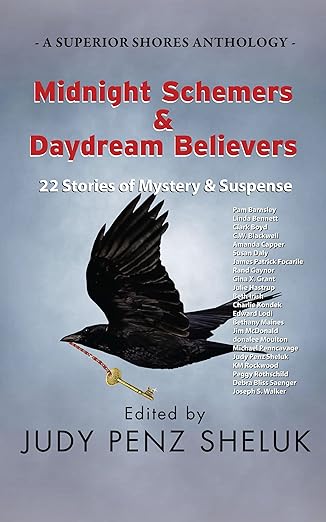
One of my recent anthology short stories is called “Maladaptive Anonymous.” In the story, the main character calls this group, somewhat disparagingly, Daydreamers Anonymous. The anthology, which will be out June 18th, is entitled: Midnight Schemers & Daydream Believers. Just as editors expect you to meet your deadline (or miss out on the opportunity), they also expect you to stick to the topic. You have lots of room to play, but the boundaries are there.

While every anthology editor has their own process, the process is usually rigorous. And appreciated. Judy Penz Sheluk, who edited Midnight Schemers, had three rounds of readers and after the first and third round we were provided with feedback – and helpful suggestions for improvements. There were also at least three rounds of proofreading. At some point, you think this is overkill until in the final proof you discover your main character has titled their head. In the published version, their head is now tilted.

 As a short story writer, anthologies bring me back to familiar ground. I am given three essential pieces of information: topic, word count, and delivery date. This helps me to focus on a theme – and to go to wonderful and wacky places with plots I might otherwise not uncover and characters I might otherwise not create. And I go there by deadline.

A Love Letter to Libraries

By Margaret Lucke

“I have always imagined that Paradise will be a kind of library.”
Jorge Luis Borges, author

A public library is an amazing place. You can choose a book or a DVD and take it home–for free. If you need a computer, you can use one there–for free. You can attend a concert, or hear an author speak, or take a child to listen to stories–all for free.

A library offers a wealth of education and entertainment at no charge. As it happens, though, it costs a lot of money to do that.

“A library is not a luxury but one of the necessities of life.”
Henry Ward Beecher, social reformer

Friends of the Library 25th Anniversary celebration

I’m on the board of my local Friends of the Library, which recently celebrated a milestone—our 25th anniversary. The library staff and another library support group honored the occasion by throwing us a wonderful party.

For nearly four decades, my town had no public library. It was the second largest city in California without one. When the state’s voters approved a bond for library funding in the late 1990s, local leaders decide to apply for some of that money. Some civic-minded folks got together and set up the Friends group to demonstrate to potential funders that building a library here had strong community support.

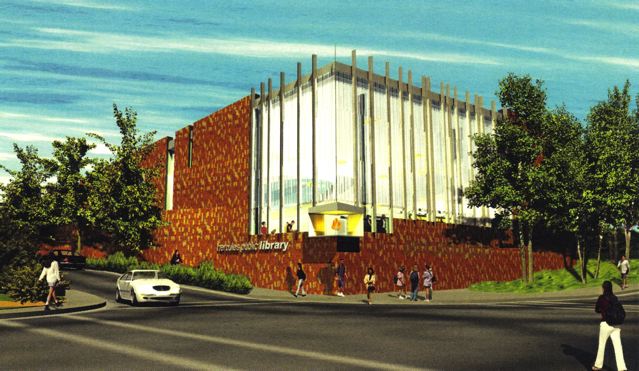
Hercules Public Library

There was a huge celebration when our beautiful new library opened in 2006. Our Friends group was proud to present to a check for $25,000, raised by sales of used books donated by the community, for the Opening Day Collection.

The enthusiasm continues. The library gets close to 25,000 visitors every quarter. Last year more than 10,400 people attended nearly 326 free programs, and patrons checked out 86,400 books and other materials. In many ways the library has brought the community together and become its heart.

Some people would have you think that in this era of Internet access and high-tech gadgets, public libraries are obsolete. Not so. They are well used though, sadly, not always well funded. The Friends are doing our bit help. To date, we’ve raised $350,000 to expand our library’s collections and support its programs.

“A library outranks any other one thing a community can do to benefit its people. It is a never failing spring in the desert.”
Andrew Carnegie, industrialist and philanthropist

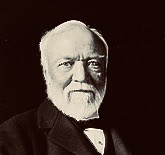
Andrew Carnegie portrait

Steel magnate Andrew Carnegie (1835–1919), one of the richest men in the world in his time, was a big believer in libraries. At age 12 he emigrated with his family from Scotland to Allegheny, Pennsylvania, now part of Pittsburgh. Though the move ended his formal schooling, he was much impressed by a local businessman who, every Saturday, opened his personal library so workers could borrow books, thus allowing Carnegie to continue his education.

Carnegie vowed if ever he had any surplus wealth he would use it in lending books to others. Years later, he made good on that promise by giving some $56 million (a lot of money in those days) to build 2,509 public libraries worldwide, including 1,679 in the United States. He shaped the concept of public libraries in this country. If you have one in your community, you have Carnegie to thank.

“The best thing about the library is that it is available not only to me, but to everyone. It does not discriminate.”
David Horowitz, political writer

Libraries are among the most democratic of our institutions. The access they provide to computers, books, films, and music is invaluable, not only to individuals but to our society. Libraries bring people together. They enlighten and inspire. They open the doors to the world.

Some years ago I was hired by two Bay Area library systems to write the documents that would present their new strategic plans to their communities. Both of the planning task forces grappled with how to define the audiences they served. One opted to list the possibilities: “The Library welcomes all members of the community regardless of culture, ethnicity, age, gender, sexual orientation, physical ability, or socioeconomic status.” The other wrestled with the question for a while until one member said: “Doesn’t ‘everyone’ mean everyone?” So their statement simply says: “The library systems … promote[s] learning and enjoyment for everyone.”

Everyone is welcome. How many of our institutions can make this claim?

“Libraries are places where the imagination begins.”
Heather Barbieri, author

Have you been to your local library lately? I urge you to pay a visit and see all that it has to offer. While you’re there, check out some books, because funding is often based in part on circulation numbers. Join your Friends group. Make a donation. Vote for tax or bond measures that will secure its funding. Your library deserves your support.

“Libraries are a public good and a civic responsibility. They are about our future as much as they are our past.”
Andrew Lopez, university librarian

The Gotta Write A Blog Blues

by Janis Patterson


Don’t get me wrong – I love blogging. It’s wonderful to be able to chat with readers and fans and people who get lost on the internet. What I don’t like is schedules. Each time I check my calendar – and every blog and everything else I do is ruthlessly noted on my calendar – I swear this time I will get my next blog done well in time, pre-schedule it and the announcement to be sent in a timely manner and have no worries or last minute rushes.


Then Life happens. You know what I mean. All the writing gurus say that if you are a writer (or want to be a writer) writing should always come before anything other than dangerous illness or death. Well, that makes a good talking point for writing teachers to use to encourage you, but in practical life it’s not much good. Things come up that you didn’t expect. Things that are not life-threatening, but which really do need to be handled. Then there’s laundry, and cooking, and cleaning, and marketing, and…


And your time for writing gets shorter and shorter.


Now there are those who say writing is not done just at the keyboard, that no matter what your hands are doing your brain can still be plotting, so that time spent at the keyboard is really just transcribing. While that is true to a point, it can also be dangerous. Once I was driving from Dallas to Ft. Smith, Arkansas. While I drove I tried to work out a really knotty plotting problem on my work in progress. When I finally had it worked out I had no idea of where I was. Turns out it was Missouri, and I had a lot of backtracking to do. So one does need to be careful when using this technique.
Back to blogs. Blogs are short. Blogs are fairly localized in focus – in my case, a subject that can be wrangled by hook or by crook to the world of writing. The only trouble is, you have to have a reasonably cogent premise, or something informative, or at least interesting to say. Otherwise all you’re doing is stringing words in a line and hoping they say something at least minimally interesting.


Like this post. Well, negative examples can be a teaching tool too!


Before I go I must share that my new anthology (shared with the fabulous Sandy Steen, Penny Richards and James Gaskin) releases on June 14th and is currently available for pre-order on Amazon. It’s called The July Fourth Murders and features four different wars and four murders on the Fourth of July, written by four authors. My part is World War One. It’s a nifty book! Go take a look.

There is more to a title than the words.

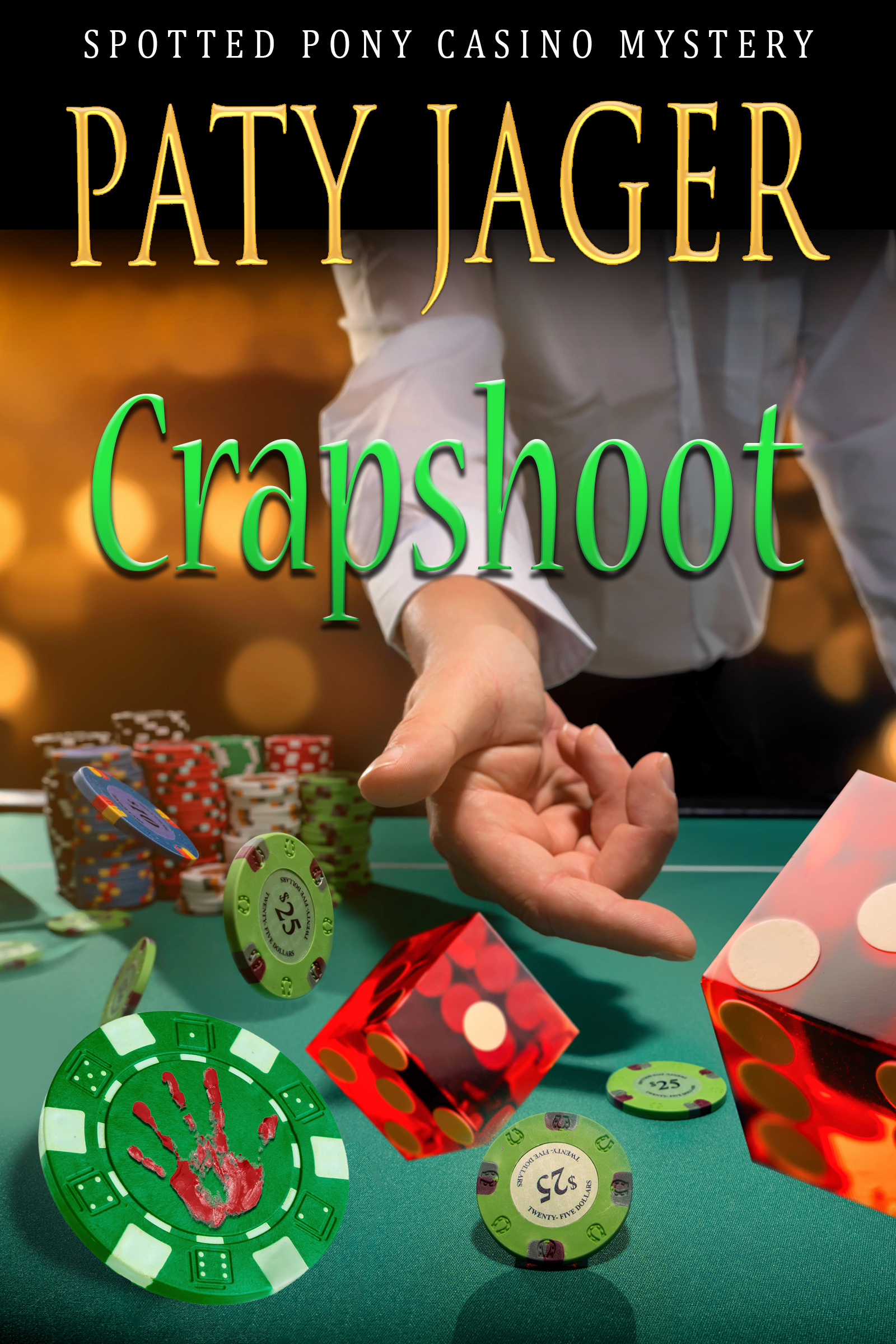
My line editor, who is in her thirties, said the title of my recently published book makes her laugh. I shrugged and told her the title is a gambling term. She said that makes sense because it is a book in the Spotted Pony Casino Mysteries, but it still makes her laugh.

Crapshoot: something(as a business venture) that has an unpredictable outcome. Webster’s dictionary.

When I came up with the storyline for book 7 in my Spotted Pony Casino Mystery series, of all the gambling terms I jotted down for titles, this term was the one that fit the best.

I’m a writer who comes up with an idea for a murder or an idea for a situation that puts my main character into a situation that will test them. This story didn’t start out with a murder. It was to be about a missing woman from the Umatilla Indian Reservation. The woman was a friend of my main character, a disabled veteran who lost her best friend in high school.

This story was meant to show how losing someone and not knowing why the cruelty happened could remain a constant enemy of the living. I wanted my main character to throw her whole being into finding the missing woman. And she does. But in the middle of this emotional trip, her nightmares come back and she becomes engaged. Talk about lows and highs! That is this story. A rollercoaster of ups and downs, and how the Indigenous community comes together to find their lost ones and to make themselves stronger.

While Crapshoot may make some people snicker or laugh, it is the epitome of this story. Each time my main character thinks she knows something, other information comes up. When she tries to rely on the right people or do the right thing, something gets in her way. It’s a crapshoot whether or not they will find the missing woman. The story takes a dark turn when the missing woman’s husband is killed. Then they discover an undercover female FBI agent is missing. And “SPLAT!” another body turns up. This is a story that I enjoyed writing to bring my character both happiness and grief. It shows more of the main character and sets her up for the next book that will knock her off her axis and make her wonder if a person can truly ever really know anyone.

So if this title makes you smile or laugh, that’s okay. Once you begin reading the book, you’ll understand the title and see the reason behind it, besides, it is a gambling term.

CRAPSHOOT

Book 7 in the Spotted Pony Casino Mystery series

 A Fentanyl death.

A missing woman.

Dela Alvaro, head of the Spotted Pony Casino security, and Heath Seaver, a Umatilla Tribal Detective, join forces with the FBI to find Dela’s missing basket-weaving instructor and put a stop to a lethal drug flowing onto the reservation.

The investigation turns deadly when an undercover FBI agent goes missing and the drug cartel’s girlfriend is out for Dela’s blood.

https://books2read.com/u/3njQ7e

In case you were wondering what gambling terms are left on my list for titles:

The Gimmick

Full House

Jackpot

Penny Ante

Luck of the Draw

Blue Chip