

The Importance of Character Arcs
Every book needs two elements—a plot and characters. Most writers understand that their story is comprised of a beginning, middle, and end. The beginning is about the Call to Action or what makes the protagonist get involved in the story’s events. In the case of mysteries, this is a murder or another crime. The middle details the steps the protagonist takes on her way to figuring out whodunit. The end is all about how the protagonist solved the crime—the finale, where the perpetrator is caught, and the denouement, where all the various strands of the story are satisfactorily explained.
What many newer authors don’t understand, though, is that the characters in a book must also have their own arcs. This is especially true in series where reader follows various characters through the course of many books. Character growth is essential. No character should be in the same emotional and mental place at the start of either a single title book or a series. When that happens in a series, the author is merely writing the same book over and over with only the names, places, and crimes changing in each subsequent story.
All recurring characters in a series need arcs, not just the protagonist. However, the arc doesn’t have to be in the reader’s face. An arc can be subtle and develop over time as the series progresses.
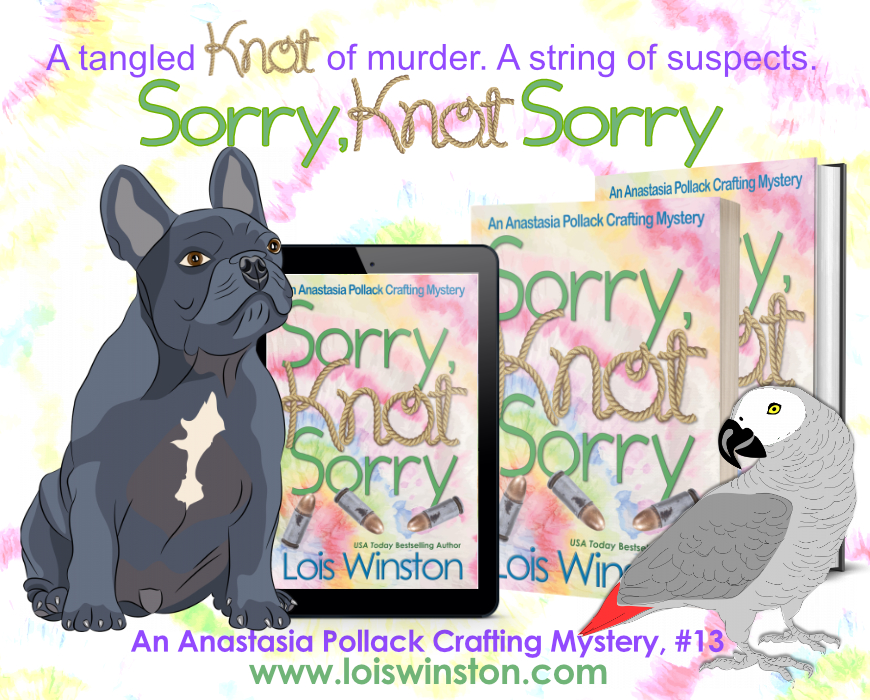
In Sorry, Knot Sorry, the recently released thirteenth book in my Anastasia Pollack Crafting Mystery Series, Anastasia’s relationship with Detective Sam Spader takes a major turn. Detective Spader was first introduced in Revenge of the Crafty Corpse, the third book in the series, when he suspected Anastasia’s communist mother-in-law Lucille of murdering her roommate at a rehabilitation center.
Readers of the series know there’s no love lost between Anastasia and Lucille. However, although Lucille has many flaws, Anastasia knows she’s all bark and no bite. So she sets out to find the real killer. Spader has continued to pop up in subsequent books in the series, and his relationship with Anastasia has grown from adversarial to one of grudging respect.
In this latest book, a man is gunned down in front of Anastasia’s home. There is little in the way of clues and no witnesses. The sheriff’s office is short-staffed due to vacations and a summer flu bug that has hit many county employees. Plus, there’s no money left in the annual budget to hire more officers. The detective admits he needs Anastasia’s help. He knows she has a way of seeing things that others often miss.
Over the course of eleven books, Spader has grown. He’s not the only one. The story arcs of many of the characters in the series have continued to develop. Some character growth has been for the better, some for the worse. But everyone changes in some way, making for a series that continues to grow beyond just the number of books.
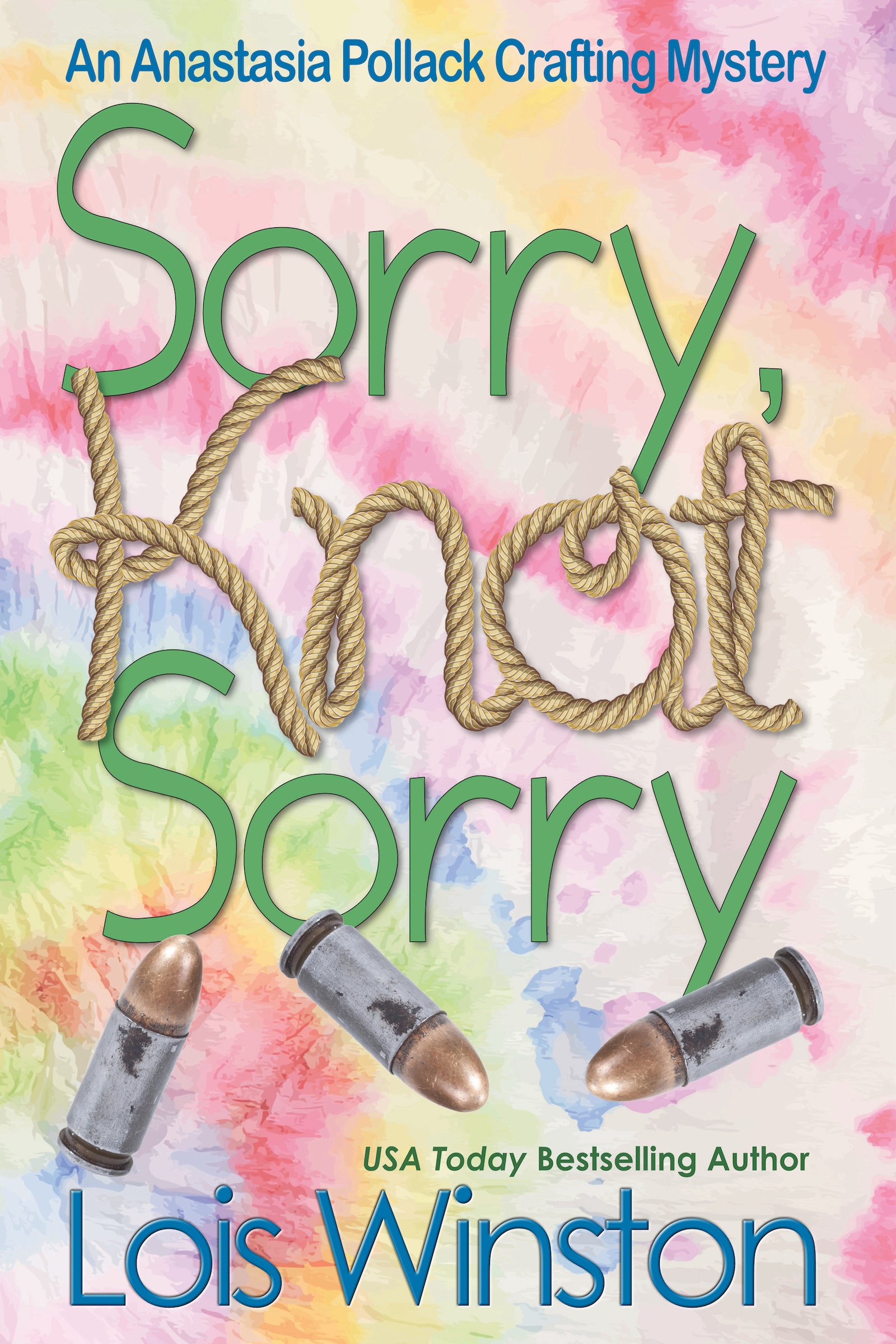
An Anastasia Pollack Crafting Mystery, Book 13
Magazine crafts editor Anastasia Pollack may finally be able to pay off the remaining debt she found herself saddled with when her duplicitous first husband dropped dead in a Las Vegas casino. But as Anastasia has discovered, nothing in her life is ever straightforward. Strings are always attached. Thanks to the success of an unauthorized true crime podcast, a television production company wants to option her life—warts and all—as a reluctant amateur sleuth.
Is such exposure worth a clean financial slate? Anastasia isn’t sure, but at the same time, rumors are flying about layoffs at the office. Whether she wants national exposure or not, Anastasia may be forced to sign on the dotted line to keep from standing in the unemployment line. But the dead bodies keep coming, and they’re not in the script.
Craft tips included.
Preorder Buy Links (releasing 6/4/24)
Amazon https://amzn.to/4a8JyVJ
Kobo https://www.kobo.com/us/en/ebook/sorry-knot-sorry
Nook https://www.barnesandnoble.com/w/sorry-knot-sorry-lois-winston/1145047275?ean=2940186076698
Apple Books https://books.apple.com/us/book/sorry-knot-sorry/id6479363569

USA Today and Amazon bestselling and award-winning author Lois Winston writes mystery, romance, romantic suspense, chick lit, women’s fiction, children’s chapter books, and nonfiction under her own name and her Emma Carlyle pen name. Kirkus Reviews dubbed her critically acclaimed Anastasia Pollack Crafting Mystery series, “North Jersey’s more mature answer to Stephanie Plum.” In addition, Lois is a former literary agent and an award-winning craft and needlework designer who often draws much of her source material for both her characters and plots from her experiences in the crafts industry. Learn more about Lois and her books at her website www.loiswinston.com where you can also sign up for her newsletter and follow her on various social media sites.


Lois, Your Anastasia Pollock books show your prowess at creating great characters. Thank you for being a guest!
LikeLike
Thanks for the wonderful compliment, Paty! And for inviting me.
LikeLike
Lois, thanks for the article. I have a MC with a lot of addictions. In my first novel, my editor said she didn’t make any progress and she was starting to look pathetic. So I fixed that but I was afraid without her addictions she’d be a regular mature adult and boring. Plus I didn’t want any recovery tropes–too overused and tired. So I left some addictions behind and kept some. On my second novel, I’m much more aware of character growth, but not so much of it that she becomes normal, not that I know about that anyway.
LikeLike
Candace, have you considered having her recover, then backslide? Or recover from one addiction only to fall into another? Or give her an entirely new challenge to overcome?
LikeLike
No, I hadn’t. Thanks for the suggestions.
LikeLike
You hit the nail on the head here, Lois–character arcs make a SERIES!
LikeLike
Thanks, Pam!
LikeLike
Thank you for these thoughts, Lois. I have a series (3 books so far) that have several recurring characters, and I sometimes find it a challenge to know what to do with them. In book 3, I cheated a little and sent one of them off to another country for a study course! One is a ghost, so she can’t go anywhere, and she’s a favorite of my critique group, so she has to show up in every book, which means she has to progress in her arc.
LikeLike
You’ve certainly set yourself a challenge creating a character arc for a ghost, Marion. Good luck!
LikeLike
Character arcs are so important to keep your long-running characters interesting. If they’re always mopey about the same thing and never change, or always blindly happy and never change – it grows old quickly.
I always say this is the difference between plot and story. The plot is the crime they’re trying to solve. The story is what changes about your character as they solve that crime and go through that experience. You need both, especially in a series!
LikeLike
Well said, Sarah! Thanks for taking the time to comment.
LikeLike
Thank you for this Lois! You are so good at this! (I’m glad Zack is out of the garage and into the house and that MIL Lucile get’s stranger in every book.)
LikeLike
Glad you found it interesting. And thrilled you’re on Team Zack. As for Lucille, you should have met my mother-in-law! 😉
LikeLike
Lois, I so agree. In all of my series, the characters continue to evolve and grow as they move through the challenges of the plots. In some cases, it’s self-growth, in others it’s change in the relationship that brings growth. Thanks for this!
LikeLike
Those are the series that keep me reading, Michele. Thanks for stopping by!
LikeLike
Lois, you’ve hit on an important subject, one I hadn’t confronted before I wrote the second and third books in my own series. It takes more thought each time to allow a recurring character to learn and grow, yet stay essentially the same person that readers have come to know and love. The challenge is real!
LikeLike
Yes, Gay, it is a challenge but one that must be taken on if we don’t want to produce the same book over and over again. Plus, I think readers expect our characters to grow and change (hopefully, for the better!) over the course of a series.
LikeLiked by 1 person
I’m not a lady but I’ve been drafting, rewriting, and editing installments of a detective series for the last few years. She often struggles between her work as a private investigator and single mother. There are sometimes cases that mirror something in her own kids’ lives.
She goes through her her first case wrapping up smoothly with her finding the victim alive to realizing many of those she finds will either turn up dead or not at all. She also navigates her kids lives and what inner turmoil their lives go through. Also, what decisions must be made after her mother passes, even to the point where she goes through self-doubt for a few installments over whether she should continue on her path.
There’s also a couple of installments where she deals with wrongly accused people who are similar to her sons as well as a recurring villain connecting her to a loose prequel/origin story hinting at how the path she chose came to be. She enlists one son to sometimes assist in her cases while the younger receives a smaller arc with mystery of its own.
Her long term goal is to get her son ready for the world after she’s gone. Whether it be she and her son arguing over a task, or getting the younger ready for his own future down the road. I would like to thank Lois for writing this guest blog and reminding me how important arcs are for supporting characters — even though that can be hard to maintain from book to book.
Justin
LikeLike
That sounds interesting! How will you try to publish? I was published for my first novel by Barringer Publishing-hybrid but I am also interested in self publishing .
LikeLike
Been sending the stories around to mystery magazines (they’re novella length). I’ve also considered Kindle and Audible.
LikeLiked by 1 person
Thank you, Justin. It sounds like you’ve already been doing a good job of creating arcs for your characters.
LikeLike
Thanks, but probably need to do more myself.
LikeLike
It is so lovely to read a post by a woman and writer I have long admired, Lois Winston. I never thought about the arc for characters in quite those words, but I do remember being told years ago when I was taking writing classes to remember that no one comes on scene without wanting something, even if it’s just a glass of water. That approach for me meant I had to give them a reason for being there, including their success or failure.
Thanks so much for dropping by, Lois!
LikeLike
Thanks for the wonderful compliment, Heather!
LikeLike
Thank you for putting the focus on secondary characters. Finding their own arcs can be challenging, but they can also contribute mightily to the story. Good post.
LikeLike
Thanks, Susan!
LikeLike
Paty, thanks for featuring me on Ladies of Mystery today.
LikeLike
I would like to learn more about publishing on Amazon digital services. I hope to read more about this from an author using the platform. I enjoyed reading this as characters do develop. For my second novel to follow “The Bayou Heist” I am developing the characters of Faith, Timothy, Geneva and we are discovering what happened to Nick and the gold bars.
LikeLike
Hi, cupcakecache! There are many books available that will answer your questions. Also, consider joining some writing organizations like Sisters in Crime. They have a chapter called Guppies that is very beneficial to those just starting out on their writing journeys. Good luck!
LikeLiked by 1 person