A Mystery Writer’s Responsibility

by Janis Patterson

We write mysteries. It is our duty to provide our readers with a good story that has an interesting plot, accurate research, believable characters, and a satisfying ending.

It is also our responsibility to be sure that in our quest for interesting and different content we don’t turn our fictional books into training manuals. Yes, we want ways of death that rise above the common and usually sordid killings that regularly adorn our daily news, but we must walk a fine line between creating an interesting fictional killing and providing an instructional blueprint for a real one.

I think this duty of responsibility is why in so many early mysteries and in a few current ones the murder weapon is a common blunt instrument or some exotic, untraceable poison, though exotic, unknown and untraceable poisons are currently somewhat out of vogue. Current mysteries seem to be grounded much more in reality than the ones from the so-called Golden Age.

To illustrate my point, years ago I attended my first NRA convention. (By the way, if your mysteries involve firearms, I cannot recommend highly enough that you attend one – the knowledge and help there are phenomenal! It will be in Dallas next month and I definitely intend on going! I’ll probably be blogging about it.) I talked to a lot of people, getting all kinds of information and contacts for my reference file (you do have a reference file, don’t you?) when I talked to this one man who was simply entranced that I was a mystery writer. Normally I’ve found that people just love to help writers, but this guy was totally over the top. He had worked both as a firearms salesman and in a ballistics lab, and among a lot of other things gleefully told me the way to have a ballistically clean bullet. No striations. No rifling. No marks on the projectile to tell which or even what kind of gun it came from. No information except the caliber. Nothing that law enforcement could trace.

I listened intently, partially fascinated and partially revolted. It was a simple process and could be done by anyone with the IQ of a goldfish. Then he asked if I’d use it in one of my books – obviously hoping that I’d put him in there too. Horrified, I said most certainly not, begged him not to tell this process to anyone else and then explained why. He was suddenly as horrified as I – apparently he had never thought that what he regarded as an interesting curiosity could actually be used to commit a real-life untraceable killing.

And no, don’t ask me what the secret is. I destroyed that part of my notes and have deliberately forgotten how. There is some knowledge that should never be shared.

So while killing people made of pixels can be both fun and profitable, we as writers owe our readers and the world in general a sense of restraint and responsibility. I truly believe that none of us would actually use some of the stuff we know to do harm to others, but we must never forget that our stories are read by all kinds of people, some of whom might wish to do harm or even read us in search of ways to do harm. Never forget that we want to entertain, not instruct. I don’t think any of us want to be an accomplice.

Pomados for the …win?

Well, hi there.

If you’re a regular reader of this blog, then you’ll know I’m a newbie, in which case, “hi, I’m Jordaina. It’s lovely to meet you”. If you’re new to this blog then “Snap, bro! Me too!”. And, obviously, it’s lovely to meet you as well.

Under the guise of getting to know each other, here are three things you should know about me:

  1. My name is pronounced Jaw-dane-a (this is always the first thing I explain because everyone gets it wrong and then people mumble it or stumble over it and it gets awkward—one guy even tried to spell it with an “f” one time. Like, what?)
  2. Kinda obvious, but I write cosy mysteries with a paranormal twist.
  3. I’ve recently given up my day job/got made redundant/was released into the wild and now I write full-time.

That’s me in a three-fact-nutshell. Sort of. Anyway, probably like every writer I’d always dreamed of fact three. Of being able to give up my job and writing full-time while sitting in a field in a sundress/looking arty in a coffee shop but I have to tell you, the reality is a lot different to the dream.

My job ended at the end of January this year and then I got mega sick for about a month. And then March just came and went and now it’s April. Two whole months have passed since I left my job … and I’ve hardly achieved anything. I had goals and deadlines, but I just can’t seem to get into a rhythm. When I had a full-time job, I’d cram my writing into whatever free time I had and get loads done. But now, I get up, have breakfast and then some weird time warp thing happens and it’s lunchtime. Like, how?

tumblr_mzffbglwoa1tne7pgo1_500

So, after a few weeks of getting nothing done, I started investigating time management techniques.


First I started with the Pomado technique. (It’s actually the Pomodoro technique, but I like calling it “Pomado” because it sounds like “tornado” … small things!) I don’t know if you’ve heard of it, but it means you set a timer for twenty-five minutes and accomplish what you can in that time. Any tasks you have you’re meant to estimate how many Pomados it will take to achieve before you start. It’s great if you have lots of different tasks but what if you spend your whole day writing? If you spend eight hours writing that’s sixteen Pomados. That’s sixteen times your writing flow is interrupted. That’s sixteen times you freak out at the loud, random buzzing. Not exactly conducive to the creative flow.

So, that didn’t work for me. Then I read in some time management book (yes, I am reading self-help books!) that an adult can’t focus for longer than forty minutes at one time and they suggested working in ninety minute blocks with a five minute break in between. Can you see the problem? Forty plus five plus forty does not equal ninety. How much faith can you have in a time management system that can’t even get their maths right? Not to mention my office is in the attic so by the time I’d made it down both flights of stairs, made a cup of tea, had a biscuit and climbed back up to my office I’d be well over that five-minute break.

Since I wasn’t vibing with that idea, I looked for other options and found some research that said you should turn off all distractions (obvious!) because, after an interruption or distraction, it can take up to twenty-three minutes to focus your attention back on that one task. Twenty-three minutes! So every time you start a new task, it takes your brain twenty-three long minutes to drag itself off the previous task and settle on the new one. So that blows the Pomado technique out of the water because that means I’d only have two minutes properly focused on that task. Although, I do like this idea … but I think that’s probably only because I could say I was “Pomado-ing”!

The craziest thing is that I LOVE writing. I LOVE it. So you think I’d find it easy to just sit down and do it but … *shakes head* I just can’t find a way to manage my time effectively enough.

Do you have any time management tips to help me? Because, at this rate, I’m going to get to the end of the year and my editor is going to ask me for those eight manuscripts that are due and … well, that’s not going to be a fun conversation! If you have some tips for me, or anything that works for you, then please let me know about it in the comments.

Until next time,

Jordaina 🙂

PS. If you’re reading this and thinking “This girl is a writer? Man, she can’t spell for toffee” then, and I probably should’ve told you this—I’m English. Yep. We spell lots of things different. (I also sometimes use this excuse to cover my bad spelling!)

Fictional Crime

thumb_IMG_1225_1024

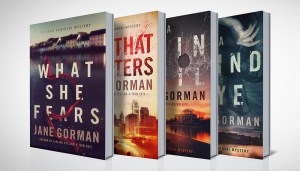
The Adam Kaminski Mystery Series are fiction. I base the stories on some true events — historical events, for example, or crimes I read about in the newspapers, or interactions I’ve had in the past with diplomats and law enforcement officers. But in the main, the stories originate in my head. No one was hurt in the making of these books.

No Animals Harmed

This past weekend, I was thrilled to once again join the Delaware Valley Chapter of the Sisters in Crime for a lecture by a local expert in crime and murder. Of the true variety.

I’m not usually a fan of true crime stories. I love reading about fictional murders, with fictional victims and fictional sleuths. Hearing about grisly murders that really took place, about a sick, twisted individual who really did kill innocents, is disturbing. Fascinating, yes, but disturbing.

IMG_3757

Our speaker this month was Sam Cox, an archaeologist at the University of Pennsylvania. Sam spoke to us about her involvement in the exhumation and identification of the remains of H. H. Holmes, commonly known as America’s first (known) serial killer.

Holmes is suspected of killing as many as 200 people. During the 1893 World’s Fair in Chicago, he ran a hotel just off-site that was later determined to have a lime pit and large incinerator in the basement — handy for getting rid of unwanted bodies.

Hearing Sam tell this story, I was hooked. Sam’s work was included in a recent series by the History Channel, American Ripper. Her team is featured in the final episode. I recommend it!

History Channel
I loved hearing her talk about the techniques they used to dig up his grave then identify the bones they found. She told us about what was actually proven in the case and what was still conjecture. She explained how the detectives at the time tracked him and the bodies he left in his wake as he ran.

As a writer, this lecture was invaluable as a source of ideas and information. We learned about investigative and exploratory techniques that law enforcement can use in identifying victims and killers. We got a glimpse behind the scenes.

As a reader, I’m intrigued by the personalities involved. The nonchalance of the serial killer, the determination of the detective who finally tracked him down.

That said, I don’t think I’ll become an avid reader of true crime stories. There’s something comforting about murder mysteries: the killer always gets caught, the hero always saves the day (well, not for the victims, but for those who survive).

I like the feeling that once you’re done, all is right with the world. And I try not to think too much about the true killers still lurking, out there, in the real world…

Adam-Kaminski-Mystery-Series

Learn more about Jane Gorman at JaneGorman.com or follow her on Facebook or Instagram.

Who Saw That?

thumb_IMG_1225_1024

Julia Kaminski, sister to the hero of the Adam Kaminski mystery series, is a photographer. A good one. She’s still figuring out how to make a living in her chosen profession. In an ideal world, she’d earn her money by showing and selling her photographs at galleries. But until that happens, she’s getting by by taking on gigs as a photographer at wedding or parties. And still holding out for her big break.

Julia’s photographs take on new meaning in book 5 in the series, A Pale Reflection. Julia finally gets a leading role, after appearing as a side character in the first four books, and jumps into the chance to use her photographic skills to help her brother Adam figure out whodunnit.

27591728_Unknown

The thing about photographs is they capture more than you might realize. You, the tourist, for example, sees a beautiful scene and snap a shot. It may only be later, as you go back to look through the photographs, that you notice someone or something in the picture you hadn’t previously realized was there. Or someone watching when you thought you were alone.

27599568_Unknown

In my family, my husband is the photographer. We just had the amazing opportunity to spend a glorious week in Rome. (Will Adam Kaminski be solving a murder in Rome in the near future? Stay tuned!).

Chuck, my husband, takes spectacular photographs of traditional scenes — statues, artwork, natural beauty and urban beauty. But he also finds joy in surprising details. For example, catching an unexpected eye.

IMG_3708

For us, it’s fun. We use these photographs to share our experiences with friends and family and to refresh our own memories of the time we spent there. And if we were trying to catch a killer, the “mouth of truth” pictured here would be a huge help!

IMG_6641

Of course, we’re not trying to solve a murder. For Julia and Adam, a photograph can mean so much more. Even the difference between life and death.

IMG_6700

Learn more about Jane Gorman and the Adam Kaminski mystery series at janegorman.com or follow her on Facebook. For some great photographs of Rome and her other travels, check out her Instagram page!

Adam-Kaminski-Mystery-Series

When Words Matter

thumb_IMG_1225_1024

I was working on my current manuscript the other day, when the idea for a short story came to me. I’m not a short story writer. I’ve tried. I did not succeed. But I was struck by the idea, wondering why it came to me. At this point, I’m more interested in the idea than in writing the actual story.

The story would go something like this: an average guy accidentally gets involved in a battle between good guys and bad guys from the future (yes, I’m a Sci-Fi fan). He doesn’t have the skills or knowledge that the future warriors do, but he has a good heart and a lot of courage. He joins the battle and helps the good guys win. They invite him to join them, to travel to the future with them, where he can have a better life. He’s thrilled. He’s got no family he’ll miss (maybe his wife just died in childbirth or something tragic like that).

He travels to the future with his new friends, excited for the life that awaits him. When he arrives, he’s processed into his new community. You know the type of thing: paperwork, blood tests, analyses to make sure he’s safe. To make sure he’ll assimilate well. Everything goes great, until they get to the final page of the questionnaire.

“What is—well, ahem, I suppose I should say what was your profession? What can you do to contribute to our society?” The future agent man asks him.

“I’m a writer,” our hero replies. “I write fiction. Books. Stories.”

Future agent man blanches. He stands, the papers he holds shaking in his hands. He glances at the two-way mirror on the wall and jerks his chin toward it in some sort of signal.

Our hero, for the first time, starts to worry about his decision. Two burly men in white suits carrying long, silver tubes enter the room.

“I’m sorry, but we can’t let you stay,” future agent man explains apologetically. “Writers are too dangerous. Too subversive. We don’t allow those types here.”

Our hero doesn’t feel a thing as he is humanely euthanized.

IMG_0894

Sometimes I feel powerless. Sometimes I feel like I’m just a cog in a machine that I can’t control. But we all have our own way of moving our little part of the machine. Maybe we can’t steer, maybe we can’t even control our speed, but for each of us there’s something we can do. For me, it’s writing.

author pic
The author in her natural habitat

I love the fact that I can build my own worlds, create my own characters, heroes and villains. Bad things happen, but they generally end well. (Alright, not for the people who get killed, obviously. But usually for everyone else!)

When I write, I need to remember to do it with intention, with thoughtfulness (my fellow Lady of Mystery, Amber Foxx, might say mindfulness). Because what I write matters.

I think my idea was connected to the fact that today is Martin Luther King Day. He was a man who knew how to use words, as well as actions. His words had power. They still do.

I’m inspired by him in many ways. One of those ways is recognizing that words matter.

To learn more about Jane Gorman and the Adam Kaminski Mystery Series, visit her website at janegorman.com or follow her on Facebook.

Adam-Kaminski-Mystery-Series