Keeping Track of Details by Karen Shughart

Well, I’m almost there. I’ve been slogging away at writing book two of the Edmund DeCleryk mystery series, Murder in the Cemetery, for upwards of a year and now I’m in the editing, polishing and cut-and-paste phase of the book. There are more details in this one than Murder in the Museum, so way more things to keep track of:

For example, in an earlier chapter, Annie DeCleryk, wife of sleuth Edmund DeCleryk, invites a friend of hers to speak at an evening event sponsored by the Historical Society where Annie works. Low and behold, a later chapter indicated that it was a luncheon event. Boy, was I glad I discovered that one!

At another point I write about an unidentified set of tire tracks at the murder scene, that’s early on in the story, but as I reached the end of the first draft I realized I’d never come back to it and explained why they were there.

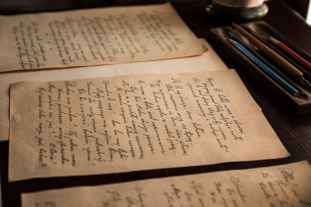
There are a set of historical letters written into the plot, they take place in the 1800s. I have them interspersed throughout the book in chronological order. At least now I do. When I scrolled through the manuscript, I discovered that in a couple places they were in the wrong order.
white painted papers

Then there are chapters. As I write and revise, I sometimes remove chapters or move them to another location. Sometimes I divide one chapter into two. I spent one afternoon making sure the chapters were in order and correctly numbered. In a few cases they weren’t.

I also try and eliminate redundancy. Ed and Annie take a trip to England, you’ll learn why when you read the book, and they discover there’s a connection with something that happens on that trip and the murder in Lighthouse Cove. I explain it fully in that chapter and yep, I had Ed explaining the same scenario, multiple times, to other characters who were helping solve the crime. You, the reader, probably don’t want to revisit the entire story more than once, so in subsequent explanations I went back and had Ed summarize.

Photo by Pixabay on Pexels.com

I was a journalist once and as a result, my fiction writing, at least those early drafts, is typically very succinct. So, then I go back and expand the plot. Once done, I usually realize I’ve written more than I need, so then I cut.  What that means is that sometimes I get rid of a chapter I’m emotionally attached to, because as much as I like it, it really doesn’t enhance the plot.

Writing a novel takes a lot of work, not just making sure the plot makes sense, but also keeping track of all the details that make a book flow the way it’s supposed to. I do that on handwritten notes, charts, notes in my computer and, also, in my head. Phew! But I’m gratified when the finished product finally goes to print.

 

The Backstory

thumb_IMG_1225_1024

I had a great event at the Longport Public Library last week, in Longport, N.J. It’s a fabulous New Jersey Shore town—I highly recommend it if you have a chance to visit! One of the things I loved about the event was having to respond to some remarkably in-depth questions about process and writing. I tend to think about these things peripherally or as I’m doing them, so it’s always valuable to have to sit back and spell it out.

IMG_3989
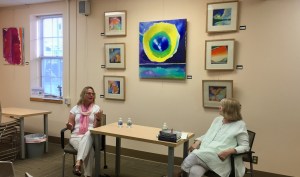
Mystery Writer Jane Kelly (right) interviews me at the Longport Public Library

One issue that came up in our conversation was the use of background information. There’s a lot of that in every book. Each character has his or her own backstory. In my books, the setting is one of the characters, so it has its own backstory, too.

The dilemma every author faces is, how much of that information do I include in the story? The trick is to find a balance, to include just enough to let the reader understand and relate to the character or the place without feeling overburdened by history.

bookcase books bookshop bookstore
Photo by Pixabay on Pexels.com

While my books focus on different cultures, they take place in present day. But that doesn’t mean there’s no history. Every place I visit today is the way it is because of its history, and I need to explore and understand that history in order to faithfully reproduce that place on paper. It takes skill to let that backstory seep through the plot, through the characters and their actions, rather than simply dumping facts and details in giant piles on each page.

I can only imagine how much harder the task of culling down the details is for someone who writes historical mysteries!

I leave so many words out of each book, descriptions and details that I write down diligently, only to cut in later editing as I see that they’re not really needed. I hope that with each book, my skill in this area is getting stronger.

Fortunately, I love learning these details of each place I visit and the places I write about. I don’t mind working through this background then cutting it — I know it’s not wasted time. Getting those facts and descriptions and timelines down on paper means that the story I write will be accurate and informed by each location’s unique characteristics.

What do you think? Have you read something that overburdened you with backstory or left you feeling like you didn’t get quite enough?

Adam-Kaminski-Series

Jane Gorman is the author of the Adam Kaminski Mystery Series. Learn more at jane gorman.com or follow her on Facebook or Instagram.


Hiding the killer in my subconscious by Paty Jager

2017 headshot newEvery mystery book I’ve written, I start out with the firm belief I know who the killer is.

I start preparing for the book by deciding where the main character, Shandra Higheagle is, what she is doing, and how she will come to either discover a body, be in the vicinity of who does find the body, or know the accused murderer.

The next step is making up my suspect chart and writing down what I know and want others to know about each suspect.

With the suspect chart comes red herrings and other characters- friends, family of the suspects and the victim.

Once the chart is done, I evaluate and decide which one would be the least likely to have killed, yet have the best motive. And that’s the character who I start out hiding the information( red herrings and quick mentions of clues that are glossed over) and plan to have be the one who dunit in the end.

Cars on winding road trough the forest aerial viewEvery book so far, the killer has ended up being someone other than I started out to write about.  I’m not sure if its because I do so many twists and turns in who it could be that I confuse myself or that I realize the person I started out as the murderer is too logical, so I do yet another twist and there is my killer! When I go back through the book to put in clues, I always see that I’d added the necessary clues without thinking about it.

All along my subconscious knew who did it while my working brain was busy workingConcept of the human brain on my initial scenario. I love that this happens because it surprises not only me but the reader.  And it means that writing mystery is what I should be doing since my subconscious seems to know my murderous mind better than I do!



Do you like stories with lots of twists and turns or do you like to know who did it and work with the sleuths to prove it?

SH Mug Art

Understanding Your Characters

Part of what makes a great story is great characters. Any reader can tell you that. Writers talk about developing characters, fleshing them out, giving them back story, making them flawed and relatable. These are all vital steps in creating great a character.

But once the character is created, I find I have yet one more hurdle that I have to jump: I have to understand my characters.

A young couple in Galway contemplate the evening

But you created them, you might say with surprise. You wrote their background, you devised their likes and dislikes, fears and dreams. What’s left to understand?

Lots.

Characters run the show. They get away from you, the writer, taking their own story in directions you hadn’t anticipated. Yes, I know that sounds ridiculous. Yet it happens to all writers.

In my current work in progress, I realized after finishing the second draft that I had the wrong killer. A different character was standing in the wings looking guiltily around, trying not to make eye contact with me. Ah-hah, I thought. That’s the real killer!

Trying to pull a fast one on me, I might add.

In several of my books I have another problem of understanding with some of my characters: I write characters who are not native English speakers.

My mother and grandmother in Warsaw

As we all know, language affects not just the way we talk but even the way we think. Writing a foreign character (foreign to me, that is) means not only understanding their native tongue enough to be able to replicate their thoughts, but also understanding the way they frame their thoughts in the first place.

A Pole, an American and an Irishman walk into a bar…. They’re all thinking a little differently and it’s my job to understand those differences.

A woman examines a grave in Warsaw. What might she be thinking?

I’m not complaining. I love that job! I spend time improving my language skills. (By the way, for anyone interested in learning French, I recommend the lessons by Paul Noble. They’re very good!). Extra bonus, it helps when I travel the world and meet new people. So it’s a good problem to have. And one that I hope I have succeeded in overcoming.

But you tell me. If you’ve read any of my books, I’d love to hear your thoughts on my foreign characters and how well I’ve captured their differences.

Learn more about Jane Gorman and the Adam Kaminski mystery series at janegorman.com.

Perfectionism and the Cut Revision

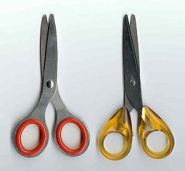
scissors

Everyone who confesses to this fault, I suspect, is actually bragging. It’s the classic answer in a job interview. “What’s your greatest weakness?” “I’m a perfectionist.” I’m going to be contrary and confess that I’m not one.

My clothes? I have no clue what’s fashionable. If an outfit is clean and has no holes in it, it’s good to go. I don’t wear makeup, and haven’t since I quit acting. If I’m not onstage, the face I woke up with will have to suffice. My apartment and office are neither neat nor chaotic, clean but on the disorderly side. I don’t worry about it other than to move my free weights out of the living room if I’m having guests. Maybe.

So much of my life has been spent in public—acting, dancing, teaching academic classes and yoga and fitness classes—that I have spent many hours being irretrievably imperfect in front of an audience. When responding honestly to a novel situation in a classroom, I’ve sometimes said the wrong thing and couldn’t put it back in my mouth. I could only try to clarify. How many times in teaching yoga have I called right left or called elbows knees? You can’t redo live performance or teaching, only do your best and have a sense of humor.

Of course, I have higher expectations of my language skills when I can revise. While I’m not a full-blown perfectionist, when it comes to word choice and sentence structure, I can get close. One reason I do my plot analysis with a printout is so I won’t be distracted by the changes I would make if I could touch the keyboard. I indicate which sentence I should cut or revise with an orange highlight and a C or an R and keep going. After I make the needed plot changes, I do the “cut revision.” The purpose of this is tightening: consolidating ideas and examining every scene for excess lines, every line for excess words. It may seem perfectionistic to do this before I send it out for the second round of critiquing, but want my critique partners to be able to tell me if the plot is paced well without the distraction of verbal clutter. (I cut four thousand words from my current WIP.)

Another reason I cut so much is because I know my editor will usually ask me to add a few lines to clarify something. We can go back and forth several times over the best way to rephrase a sentence without either of us thinking the other is too picky. I keep double-checking my research, too, finessing tiny details. As long as it makes the book better, I don’t feel pathologically perfectionistic. I know when it’s done, and then I’m ready to let go. No matter how hard we try to make them perfect, no book ever is.Amber in tree final