Understanding Your Characters

Part of what makes a great story is great characters. Any reader can tell you that. Writers talk about developing characters, fleshing them out, giving them back story, making them flawed and relatable. These are all vital steps in creating great a character.

But once the character is created, I find I have yet one more hurdle that I have to jump: I have to understand my characters.

A young couple in Galway contemplate the evening

But you created them, you might say with surprise. You wrote their background, you devised their likes and dislikes, fears and dreams. What’s left to understand?

Lots.

Characters run the show. They get away from you, the writer, taking their own story in directions you hadn’t anticipated. Yes, I know that sounds ridiculous. Yet it happens to all writers.

In my current work in progress, I realized after finishing the second draft that I had the wrong killer. A different character was standing in the wings looking guiltily around, trying not to make eye contact with me. Ah-hah, I thought. That’s the real killer!

Trying to pull a fast one on me, I might add.

In several of my books I have another problem of understanding with some of my characters: I write characters who are not native English speakers.

My mother and grandmother in Warsaw

As we all know, language affects not just the way we talk but even the way we think. Writing a foreign character (foreign to me, that is) means not only understanding their native tongue enough to be able to replicate their thoughts, but also understanding the way they frame their thoughts in the first place.

A Pole, an American and an Irishman walk into a bar…. They’re all thinking a little differently and it’s my job to understand those differences.

A woman examines a grave in Warsaw. What might she be thinking?

I’m not complaining. I love that job! I spend time improving my language skills. (By the way, for anyone interested in learning French, I recommend the lessons by Paul Noble. They’re very good!). Extra bonus, it helps when I travel the world and meet new people. So it’s a good problem to have. And one that I hope I have succeeded in overcoming.

But you tell me. If you’ve read any of my books, I’d love to hear your thoughts on my foreign characters and how well I’ve captured their differences.

Learn more about Jane Gorman and the Adam Kaminski mystery series at janegorman.com.

Perfectionism and the Cut Revision

scissors

Everyone who confesses to this fault, I suspect, is actually bragging. It’s the classic answer in a job interview. “What’s your greatest weakness?” “I’m a perfectionist.” I’m going to be contrary and confess that I’m not one.

My clothes? I have no clue what’s fashionable. If an outfit is clean and has no holes in it, it’s good to go. I don’t wear makeup, and haven’t since I quit acting. If I’m not onstage, the face I woke up with will have to suffice. My apartment and office are neither neat nor chaotic, clean but on the disorderly side. I don’t worry about it other than to move my free weights out of the living room if I’m having guests. Maybe.

So much of my life has been spent in public—acting, dancing, teaching academic classes and yoga and fitness classes—that I have spent many hours being irretrievably imperfect in front of an audience. When responding honestly to a novel situation in a classroom, I’ve sometimes said the wrong thing and couldn’t put it back in my mouth. I could only try to clarify. How many times in teaching yoga have I called right left or called elbows knees? You can’t redo live performance or teaching, only do your best and have a sense of humor.

Of course, I have higher expectations of my language skills when I can revise. While I’m not a full-blown perfectionist, when it comes to word choice and sentence structure, I can get close. One reason I do my plot analysis with a printout is so I won’t be distracted by the changes I would make if I could touch the keyboard. I indicate which sentence I should cut or revise with an orange highlight and a C or an R and keep going. After I make the needed plot changes, I do the “cut revision.” The purpose of this is tightening: consolidating ideas and examining every scene for excess lines, every line for excess words. It may seem perfectionistic to do this before I send it out for the second round of critiquing, but want my critique partners to be able to tell me if the plot is paced well without the distraction of verbal clutter. (I cut four thousand words from my current WIP.)

Another reason I cut so much is because I know my editor will usually ask me to add a few lines to clarify something. We can go back and forth several times over the best way to rephrase a sentence without either of us thinking the other is too picky. I keep double-checking my research, too, finessing tiny details. As long as it makes the book better, I don’t feel pathologically perfectionistic. I know when it’s done, and then I’m ready to let go. No matter how hard we try to make them perfect, no book ever is.Amber in tree final

Killing Time by Paty Jager

paty shadow (1)Eons ago when I wrote my  first mystery book it all started with guests on a talk show. Well, let me take a step back from there. I wrote that first murder mystery because there was someone in my life I wanted to see dead. Since I’m a law-abiding citizen, I used the power of words to kill my intended victim. 😉

It was having the demise of this person in mind as I watched the talk show that the premise of the story formed. The talk show had a woman and a man who were private detectives and they’d written a book, Be Your Own Detective. I listened to them talk about how they’d written a book that could help anyone be their own detective.

I haunted bookstores until I found the book. (This was way before you could order easily online). With the book in hand, I came up with a freelance photographer and divorced mother of two who gets a call from her ex that he is in jail for a murder he didn’t commit. The woman debated on whether to ignore her husband or make sure her children didn’t have the baggage of a criminal father. She watched a talk show and discovered the same book I did. 😉

With the book in hand she begins digging into the whereabouts of her husband when he supposedly killed a woman. (The person I wanted dead)  I used the information in the book on tailing, surveillance, paper trails and verbal seduction to come up with scenes and move the story along. The book had lots of great information in it. Some of it would still work to day and some that is dated.

I actually wrote two books with the same amateur sleuth. Some day, with lots of updating, they might become published. But as long as I can keep coming up with plausible deaths and mysteries for Shandra Higheagle to solve, I’ll be working on her stories.

higheagle-book-banner

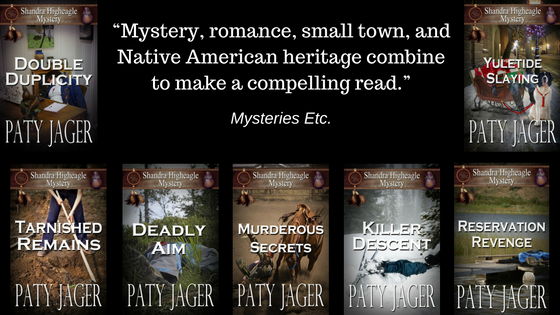
Paty Jager is an award-winning author of 25+ novels and over a dozen novellas and short stories of murder mystery, western romance, and action adventure.  This is what Mysteries Etc says about her Shandra Higheagle mystery series: “Mystery, romance, small town, and Native American heritage combine to make a compelling read.”
All her work has Western or Native American elements in them along with hints of humor and engaging characters. Paty and her husband raise alfalfa hay in rural eastern Oregon. Riding horses and battling rattlesnakes, she not only writes the western lifestyle, she lives it.

blog / websiteFacebook / Paty’s Posse / Goodreads / Twitter / Pinterest

Save

Guest Blog – Bridges Del Ponte

Diverse Voices in our Mysteries

In a changing publishing landscape, many readers are actively seeking out more diverse voices in our mysteries.  This demand may flow from our readers’ desires to more closely identify with characters in our mysteries that better reflect their own life stories.  In other instances, our audience may want to enrich their reading experiences by learning more about others’ distinct backgrounds.  The concept of writing across cultural backgrounds or “transcultural” writing may include characters and situations involving different ethnicities, races, genders, sexual orientations, religions, ages, gender identities, or geographic locations.  In creating diverse protagonists and supporting characters, here are several key points to consider when making our mysteries more inclusive.

Write What You Know.  Writers are often advised to write about what they know.  The protagonist of my new mystery series is Marguerite “Monty” Montez, a young lawyer who straddles the old world of her immigrant Portuguese family and her contemporary world as a homicide prosecutor.  My parents were the children of immigrants from the Azores and Madeira who settled in a Portuguese neighborhood in East Cambridge, MA.  As a young attorney, I later lived in this same neighborhood next door to my maternal grandmother.  Based on my background, I am able to intertwine aspects of Portuguese-American culture and generational conflicts from an intimate perspective into my mystery.  But no group is monolithic, so my take on my Portuguese-American heritage is simply my personal view, and not that of an entire group.  Think about how your own background may inform a diverse voice in your mystery.

Do Your Homework.  Whether borrowing from your own background or injecting other distinct voices into your mystery, be sure to do your research.  Nothing will throw a reader out of your story more than a diverse perspective that does not ring true.  You will need to do research on gaps in your own cultural history or your lack of first-hand knowledge about another culture.  That research may involve interacting with members of that diverse group, interviewing local or national experts, participating in cultural events, listening to relevant podcasts, attending speaker panels, and reviewing online or print sources.  The greater exposure you have to and the more information you learn about a relevant group, the better prepared you will be to channel diverse voices in your mystery.  If you have the opportunity, consider asking someone from that culture to serve as a beta reader of your work.  They may be able to provide valuable feedback by illuminating cultural nuances and helping you avoid major mistakes.

Recognize Cultural Sensitivities.  The introduction of diverse voices into your mystery can be fraught with challenges.  Some readers may raise concerns about improper cultural appropriation, superficial characterizations, and offensive stereotypes.  Yet the mystery field needs to be more inclusive by offering more diverse voices in our books.  Mystery writers are expected to imagine a broad range of characters in their fictional tales, including those from other backgrounds.  For example, the late Tony Hillerman featured Navajo protagonists and culture in his mysteries, and ultimately received an award from the Navajo nation for his culturally accurate and respectful portrayals.  As stated above, doing your homework will help to avoid potential inaccuracies or shallow representations.  But be aware that certain readers may be sensitive to your efforts to represent individuals and circumstances derived from other cultural groups.  Respect these criticisms and think about how you might address any inaccuracies in future books in your series.
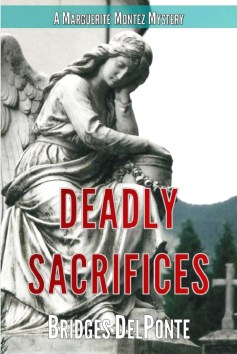
frontcover_july5_2016kindle-700x1047Deadly Sacrifices – A Marguerite Montez Mystery

You always remember your first time.  Monty’s first happened in St. Stephen’s church, directly beneath a statue of the Virgin Mary, right after morning mass.  A local soccer mom is bludgeoned to death in her suburban parish chapel outside of Boston.  In her first homicide case, prosecutor Marguerite “Monty” Montez endangers her life digging up evidence that shows the police nabbed the wrong man.  Monty’s investigation uncovers disturbing memories and fresh leads in an unsolved murder of a childhood friend in her close-knit Portuguese community.  Her dauntless search for the true killer is a wild thrill ride into a dangerous world of lethal secrets.

Amazon Print: https://www.amazon.com/Deadly-Sacrifices-Marguerite-Montez-Mystery/dp/1533376697/ref=tmm_pap_title_0?_encoding=UTF8&qid=&sr=

Kindle Version:  https://www.amazon.com/dp/B01I0VK28A

 About the Author

pontesmpic-341x450-2Bridges DelPonte has published two novels, Deadly Sacrifices and Bridles of Poseidon, three non-fiction books, several science fiction, fantasy, and mystery short stories, and numerous legal, travel, and business articles. Her mystery, Deadly Sacrifices, received a Royal Palm Literary Award (2nd place – unpublished mystery) from the Florida Writers Association (FWA) and her underwater fantasy, Bridles of Poseidon, was a finalist for a Royal Palm Literary Award (unpublished fantasy). She is a member of FWA, Sisters in Crime, Inc., and Citrus Crime Writers. When she is not tapping away on her laptop, she teaches law courses, creates educational game apps, and lives happily in sunny Central Florida. To learn more about Bridges DelPonte and her writing, please visit her author web site at http://www.bridgesdelponte.com or her Amazon Author Central page at http://www.amazon.com/Bridges-DelPonte/e/B00BW7BZYU.



Mystery and Mysticism by Paty Jager

paty shadow (1)My brother is an artist who creates his own bronze statues and patinas bronze work for other artists. When he told me about a specific piece he’d put the patina on and how it had a unique configuration, he had my attention. His words, “This would make a great murder weapon.”

That sentence stayed with me for several years.

And finally, when I decided to write a murder mystery series, I jumped at the idea of using a 300 lb bronze statue as the weapon. Only I had to come up with a plausible amateur sleuth and give her a profession. That is how Shandra Higheagle, a potter who is half Nez Perce Indian, came to be. I wanted her to have the Native American background to keep with my tag line, “Murder mystery and steamy western romance starring cowboys and Indians.”  And I wanted her to use her heritage to help solve the murders. That is where her Nez Perce grandmother came onto the scene.

Shandra’s Nez Perce father was a rodeo bronc rider who died in a rodeo accident when she was four. Her Caucasian mother and step-father kept her from her father’s family until Shandra rebelled as a teenager and spent a summer with her grandmother.  While Shandra still wasn’t allowed to let people know of her Indian heritage, she kept in touch with her grandmother. The first book opens with Shandra returning from her grandmother’s funeral and seven drum ceremony.

Where is this all going you ask?  When Shandra is suspected of killing a gallery owner and then the county sheriff’s detective turns his interest to her best friend, Shandra’s grandmother comes to Shandra in her dreams, guiding her to the evidence that will help them find the murderer.

Shandra has a hard time believing in these dreams, yet the detective believes. Her dreams cause her conflict with herself and allows her to let someone in after years of keeping herself closed off.

One of the most difficult and rewarding parts of writing these books is to come up with dreams for Shandra to have that reflect what is going on with the mystery without giving anything away.

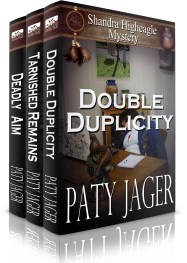
The first three books of the Shandra Higheagle Mystery series are now in an ebook box set.

Here are the shortened blurbs for the first three books in the Shandra Higheagle Mystery Series.

higheagle-1-3-box-2700px

Double Duplicity

Potter Shandra Higheagle’s Nez Perce grandmother visits her dreams, revealing clues that help Shandra uncover not only one murder but two.

Tarnished Remains

Digging up Crazy Lil’s past takes Shandra Higheagle down a road of greed, miscommunication, and deceit.

Deadly Aim

The dead body of an illicit neighbor and an old necklace sends potter Shandra Higheagle on a chase to find a murderer.

Windtree Press / Amazon / Nook / Apple / Kobo

Paty Jager is an award-winning author of 25+ novels and over a dozen novellas and short stories of murder mystery, western historical romance, and action adventure. She has a RomCon Reader’s Choice Award for her Action Adventure and received the EPPIE Award for Best Contemporary Romance. Her first mystery was a finalist in the Chanticleer Mayhem and Mystery Award and is a finalist in the RONE Award Mystery category.  This is what Mysteries Etc says about her Shandra Higheagle mystery series: “Mystery, romance, small town, and Native American heritage combine to make a compelling read.”

blog / websiteFacebook / Paty’s Posse / Goodreads / Twitter / Pinterest

patyjager logo