Picking Up Steam by Karen Shughart

I recently received an email from someone who has read all the cozies I’ve written. She said that while she enjoyed each of the books in my Edmund DeCleryk series, she thought the most recent one, Murder at Freedom Hill, was the best; with each book my writing skills have evolved, with layers added to each story. I appreciated her candor, and she probably was correct. My writing has in many ways been like a train, metaphorically picking up steam, and adding railroad cars as necessary to accommodate a growing number of passengers seeking to get to their destination.

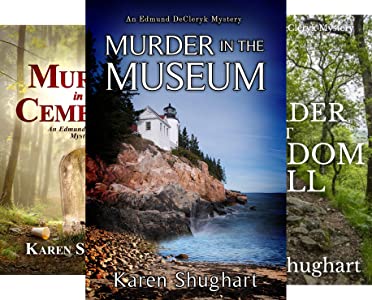
With the first book in the Edmund DeCleryk cozy mystery series, Murder in the Museum, I wrote a prologue that introduced a historical backstory that provided clues to why the present-day murder occurred. As the mystery unfolded, the backstory, spanning the late 1700s to the mid-1800s, continued with artifacts found in the basement of the museum and discovery of a memoir written by a man who, in his youth, had made terrible mistakes but who redeemed himself in adulthood. It was a short story within the book.

I continued with the historical backstory concept in my second book, Murder in the Cemetery, after deciding it would always be part of my cozies. But this time after the prologue, I conveyed it with the discovery of an artifact at the cemetery where the victim was killed, and a series of letters a lonely wife wrote to her sister while on a quest to find her husband, who had been transported to England as a prisoner of war during the War of 1812. Instead of one prologue I wrote two, the first introducing the backstory, and the second giving the reader the seasonal setting for the present day murder.

In the third book, Murder at Freedom Hill, I continued with the two prologues and the backstory-a narration for an exhibit at the historical society about the victim’s ancestors, both Black and White-who were involved in the Underground Railroad and Abolitionist Movement. Then I added a subplot that was separate from, but intricately woven into, the main story.

Now I’m working on book four, Murder at Chimney Bluffs. In this one, I continue with techniques I used before: the two prologues, the historical backstory -now rumrunning and the Prohibition era -but the backstory will also be the subplot. And I’ve added a second mystery, a cold case from decades ago that may lead the investigators to the killer.

I’m happy with the progression of these books, it keeps me interested and stretches my brain, but I confess that the writing is taking me a bit longer with each one. Now I’m compiling more notes and have added a timeline and a list of characters, many of whom are recurring; some new. As I continue to write the series I, too, am picking up steam, which will, hopefully, make each book better than the one before.

Karen Shughart is the author of the award-winning Edmund DeCleryk cozy mystery series, published by Cozy Cat Press. She has also co-written two additional mysteries with Cozy Cat authors, and two non-fiction books. A member of CWA, North America Chapter, and F.L.A.R.E., she lives with her husband, Lyle, on the south shore of Lake Ontario in New York state.

Noise Levels and Other Considerations

by Janis Patterson

This is a noisy world. There are sirens and neighbors and families and appliances… and not even noise-cancelling headphones can guarantee total silence. At least, not at my home with a house reconstruction going on to the west and the neighbor to the east – though a wonderful man in many ways – owning every gasoline-powered piece of lawn equipment ever made. His lawn is beautiful, though.

Now all writers are different. Some like lots of noise, claiming it is a stimulant, while others like pure silence as they say it frees their creativity. Depending on the time and our mood of the moment I daresay most of us fall somewhere in between.

Some writers swear by writing in different places – cafes, car parks, just about any place you can think of. Now when we have to be someplace besides our office, a writer can work almost anywhere, especially a writer under deadline. Have to take your child to ballet practice? Need to get the car worked on? Have a lunch hour at work? You can take a laptop or one of those keyboards that feeds  into your phone (I keep meaning to get one of these, just as soon as I get a phone which can handle it), or even a humble pen and paper, then make use of the time to up your word count.

Other writers believe in total silence – or as total as one can achieve short of moving to an uninhabited mountaintop in some third world country. Noise-cancelling headphones help, as sometimes does a white noise machine, but nothing can truly drown out the noise of the modern world.

As I usually do, I stand firmly in both camps. There are times I write happily in front of the blaring television while listening to The Husband tell me about his day, and other times I have on my headphones, my office drapes drawn and a sign on the door threatening a dire fate to anyone who disturbs me.

So what is the best way to write? I can only speak for myself, but as always my practice varies. If I had to choose just one atmosphere, it would be classical music (either full orchestra or piano only – no screechy strings, please) playing softly in the background, preferably of an emotion and tempo appropriate to whatever I was working on at the moment. After that, as pure a silence as could be achieved. Of course, I would – and have – made do with whatever had to be undergone at the moment.

By contrast, I have a friend – an excellent writer – who is addicted to writing in cafés. Now I admit there are advantages to writing in a café, foremost of all being to command endless cappuccinos by the mere raising of a hand! On the other hand, there is a constant swirl of people and babble of conversation, to say nothing of being the object of curiosity by the customers (“They’re real writers? And they’re working on books?”) for all as if we were some sort of exhibit in a raree show. I am no shrinking violet when it comes to being in the public eye – far from it – but not while I’m trying to concentrate on work.

However – being a fair individual and willing to experiment, I have joined my friend on occasion, and yes, despite being interrupted by spectators telling me about how they have always wanted to write a book, or have a sure-fire idea for a best seller, both broadly implying that I should stop and either teach or co-write with them (grrr) I managed to get a fair amount of writing done. Unfortunately, it wasn’t really writing – just lots of typing that, on a cool-headed reading the next day, was barely one baby step away from garbage. I didn’t try to save any of it, but I did go put on some Chopin, close the drapes and the door and try to salvage the underlying idea.

By contrast, my friend actually wrote a short story that same afternoon, one when it was polished, she sold.

How boring life would be if we all worked exactly alike!

Motivation

I’ve been working on the sixth Anita Ray mystery since July, and now have 44,000 words. That by itself should tell you that I haven’t been well focused on this one, but I’ve had two epiphanies this month. First, I know what the big crisis will be, and it’s coming up in the next 10,000 words. Second, and much more important, I don’t have to know a character’s motive until I get near the end.

This, the second discovery, surprised me. I’ve struggled with finding motivations for my characters’ behaviors beyond their conduct simply being the result of who they are, their past experiences and hopes for the future. That’s always been true of any character, but when it comes to murder or some other form of violence, I need to see something more in this person I’ve created, something that the reader hasn’t already divined by reading about him or her. 

We stitch together our fictional creations from snippets of real life. Riding on the subway or bus or train brings us into contact briefly with the oddities of our world, the woman who wears orange sandals under a plaid lumber jacket on a sunny day, her jacket covering up fabric of such color we’re dying to get a look at it but she’s buckled up tight. Perhaps the only thing about her buckled up. We overhear snatches of conversation. I still wonder about the meaning behind the casual words of two men in a cafe. She’s always been like this; it was no secret. But he married her anyway? He did. And it isn’t medical? Nope. I really want to know what “it” is. And then there was the package that arrived at a neighbor’s, which she sniffed and shook, and apparently rejected because she left it on the front step. I don’t know what happened to it after that, only that it disappeared.

I’m curious about these people’s lives but if I put them in a story as a killer, I need to know what would make them kill. Being odd or different or cryptic isn’t enough, as every writer knows. We look to the great ones in our genre—Agatha Christie in the traditional mystery, Ray Bradbury in science fiction, or James M. Cain for noir—and think about how they developed their characters’ moves and failures. The motives for crime can be limitless, but perhaps the shortest list comes from Christie: greed, lust, envy. Those cover just about every failing in life.

I’ve been thinking about these for weeks now because even though I have a murder, another crime coming up, a diverse cast of miscreants, and a great deal of stupidity, I still don’t have a motive for the inciting incident. At least, I didn’t. That was part of the second epiphany this month. The characters can have all sorts of immediate short-term motives, but the one that’s driving everything has to be larger, tied deeply and inexorably to the character’s identity. I found it this month, and it has delighted me. It was almost obvious, but not quite. 

The surprising thing to me is that I’ve written half the book without knowing why this is all happening and happening in the way it is. We watch people in life, just as in books, wondering what they’re up to. We’re waiting to cross the street when he see a man on the opposite sidewalk stop and stare in a store window; he peers, he moves closer, he looks around to see who else is nearby, and he stares even harder in the window. When he walks on, looking back once or twice, we cross the street and try to guess what he was looking at. It’s an old-fashioned tailor’s shop with the expected clutter in the undusted window—scraps of fabric, a bolt of cloth, a tape measure, a small cardboard box of pins and other notions. In the unlit interior beyond, we see nothing to catch our interest. So what was he looking at? He wasn’t wearing a fine suit, just a short jacket and slacks; and he wasn’t old enough to have known about regular tailors in this little city. But there is something in that window . . .

I stopped worrying about my characters’ motivations in this particular novel while I wrote, figuring each one would either come to me or it wouldn’t. And I have faith in my unconscious to supply the needful. But I’m also flexible, and if a better one pops into my head, I’ll go with that. This is all part of the path I decided to try with this book. I would write it without guideposts, outlines, clear (or vague) ideas of where I was going. If a character or incident popped into my head, I’d add it. I’d just keep going. It’s very liberating but also a little scary. I’m not sure what I have, if anything, but I do have a sense of things coming together. I’ll let you know in another 20,000 words or so where I am.

Setting the Scene by Karen Shughart

All the books in my Edmund DeCleryk cozy mystery series are set in Lighthouse Cove, NY, a fictional village on the south shore of Lake Ontario, with the crimes occurring in the present but are related to something that happened in the past. In book one, Murder in the Museum, a map dated 1785 discovered in the historical society museum – led by sleuth Ed’s wife, Annie – and a journal dated 1845 found at an archaeological dig in Toronto, Canada, provide clues to why the victim was killed.

In book two, Murder in the Cemetery, a relic at the cemetery where casualties of the War of 1812 are buried; long-lost letters written by the wife of a patriot transported to England as a prisoner of war during that time;  a missing artifact at an exhibit at the Victoria and Albert Museum in London, England; and a diary discovered at an abandoned farmhouse help Ed and Annie solve the case.

In book three, Murder at Freedom Hill, the crime is thought to be related to the victim’s ancestry, his forebears lived in a settlement where free people of color lived harmoniously with abolitionists who helped transport escaping slaves to Canada across the lake before the Civil War. Another heinous deed, related to that settlement, is revealed during the investigation of the murder.

But what the books also have in common is that I weave into the plot the seasonal setting.  After book one, instead of just one prologue I decided to write two, the first with the historical backstory and the second describing the season.

I continue descriptions of the weather throughout each book, it helps to construct the mood. For example, Murder at Freedom Hill begins in November, before Thanksgiving. In one of the early chapters, Ed discovers that the village mayor has been murdered. A beloved member of the community, the mayor also served on Annie’s board of directors and the two had become close friends. After conferring with Detective Brad Washington at the crime scene, Ed gets into his SUV and drives to the museum to tell Annie about his death. Lots of sunshine and a clear sky start the day, but then the weather changes:

“The brilliant sky at sunrise had made way for clouds the color of brushed pewter that hovered over the roiling silver lake. The day looked like an antique photograph: sepia; gunmetal grey; milky white and black; faded like withered grass. The direction of the wind had changed, picking up speed from the northwest, with fallen leaves swirling around the museum parking lot as Ed pulled into a spot. The temperature had plummeted- winter silently creeping in like a cat about to pounce upon its prey.”

What I enjoy about writing cozy mysteries is the ability to expand description if it fits into the plot, and the weather can either give readers a sense of doom and gloom or provide an interesting juxtaposition to an odious deed.

Karen Shughart’s cozy mysteries are published by Cozy Cat Press. She’s currently working on book four of the series, Murder at Chimney Bluffs.

My Muse and My Editor Talk About Challenges

“Yesterday my critique group was chatting about challenges we’re facing with our works in progress,” I announce as I walk into my office. “What would you two say are the biggest challenges when it comes to writing fiction?”

You two means my collaborators, my partners in crime—the Muse and the Editor who inhabit my head when I write.

“That’s easy,” says my Muse. She is lounging in the easy chair in the corner of the room, sipping from a cup of Earl Grey. “The biggest challenge is keeping her out of the way so I can let the ideas flow freely.”

“Ha!” snorts my Editor, who is sitting cross-legged on the desktop, a grammar book on her lap. “The biggest challenge is to keep her under control.”

“Control!” My Muse jumps up, and tea sloshes out of her mug. “Writing a story is a creative process. It’s all about inspiration. It’s not something you can control.”

I run to get paper towels so I can control the rivulet of tea that’s flowing across the floor.

“Writing is only ten percent inspiration,” the Editor is saying when I return. “It’s ninety percent perspiration. You do the easy part.”

Getting down on my hands and knees, I mop up the spill.

“Easy! You think coming up with ideas is easy? It’s grueling work.” The Muse clasps a hand to her brow and nearly kicks me as she flops back into the chair cushions.

The Editor blows a Bronx cheer. “Without me, your ideas would run around wildly all over the place. There’d be no coherence, no order, no story at all.”

“Nonsense,” the Muse retorts. “All you do is pester me about little stuff. ‘That word is spelled wrong. Put a comma here.’ Commas, shmommas. Who cares?”

“Who cares!” The Editor yells as she throws the grammar book to the floor. “Everyone should care. A misplaced comma can change the whole meaning of the sentence. Remember that time when—”

The Muse sticks her fingers in her ears. “La, la, la, la, la … ”

I toss the soggy paper towel into the trash. “Come on, you two, you know we’re all a team. You each have an important job to do.”

They’re too busy arguing to pay attention to me.

“You’re lazy,” shouts the Editor.

“You’re rigid,” yells the Muse.

“Airhead!”

“Stick in the mud!”

I raise my hands in surrender. “Enough! I’m getting out of here. I’ll see you two later, when you’ve settled down.”

“Wait a minute,” the Muse says. “You can’t leave.”

The Editor chimes in, “Yeah, what about our schedule? We’re supposed to be getting some writing done.”

As I walk out of the office, the Muse says, “There she goes again. Know what the biggest writing challenge really is?”

“Yeah,” says the Editor gloomily. “It’s getting the author to sit down and do it.”