
Inside the modern jail

By Sally Carpenter

This post first appeared some time ago on Writers Who Kill. The information is good for any writer who sets a story inside a modern jail. The picture of jails as long rows of cells with men clanging cups against iron bars just isn’t true nowadays. This description is from the 1980s but I’m sure it’s still relevant. Jails are moving away from “cells” to “pods.” Read on

If you write crime novels, you might set a scene inside a jail. Do you know what a modern jail looks like or how it functions?

Jails are intended for short-term housing of up to one year only. Prisons are constructed for long-term housing of many years so they are larger and have more amenities. Juveniles are housed in other facilities designed for that population.

For about eight months in the mid 1990s while I was finishing my seminary studies, I was the jail chaplain intern at the DuPage County Jail in Wheaton, Ill. At the time the jail had just finished constructing new cells with better security that allowed women civilians on the floors.

The new cells were in a tower. The basement level housed the solitary confinement cells and the upper floors had the male general population (I’ll discuss the female inmates later). The top floor was for illegal immigrants.

Security cameras monitored the hallways and the elevators. A person approaching the elevator had to wait for the deputy watching on the camera to open the door by remote control.

On each floor the cells were arranged in “pods,” now the industry standard for new jails. A few years ago I visited the Ventura County (Calif.) Main Jail as part of a Citizens’ Academy program and that facility also used “pods.” This format provides deputies greater visibility and control over the inmates.

The center of the pod was the control room encased in bulletproof glass. A deputy sat inside and watched the inmates at all times. While on duty deputies were not allowed to do anything that would distract them such as reading or watching TV (nowadays I assume that prohibition includes texting and using a cellphone).

The cells, also made of glass, were in a row racing the pod center. Each cell had a bed, sink, toilet and shower for one man. The inmates used the toilet in full view and the small shower doors provided only a minimal amount of privacy. The deputy could see every action of each inmate. A speaker system allowed the deputy to listen in as well.

Inside the pod center was a panel where the deputy could open and close the cell doors. The deputy controlled access at all times. If a fight broke out, the deputy inside the control room would remain safe as he or she summoned help.

The cells opened into a recreation room that housed a TV high on the wall as well as tables and benches that were permanently bolted to the floor. During the daytime inmates, who were not confined to their cells, could go into the rec room if they choose. The deputy watched the activity inside this room as well. At night all inmates were “locked” inside their individual cells.

The only “windows” were small glassed-in slits just under the ceilings that let in a tiny amount of sunlight. The inmates couldn’t see anything outside the building.

A glass-walled meeting room, with a table and benches, was attached to the rec room. Again, the deputy controlled access to and from this room. Once a week I came to the room to lead a Bible study for the inmates. The deputy could see inside this room although I never had any trouble from the inmates. Some inmates came to the group just to break the daily monotony but most were genuinely interested in bettering themselves.

The inmates never left the floor except to go to court or as a group to the gym (the men lined up and moved through the hallway in a line with several deputies escorting them).

Meals were prepared in the kitchen, placed in individual covered trays, and then delivered to the floors on a wheeled cart. The inmates ate in the rec room or their cells. After eating the dishes were collected and returned to the kitchen for washing.

Inmates called trustees did meal preparation and cleaning. Doing trustee work gave the men points to reduce their sentences. Many of the trustees enjoyed the job as they could get out of their cells, move around, and perform a useful task.

The deputies did not carry weapons. My supervisor suggested that I not carry my purse into the jail, so I locked my handbag in the trunk of my car. I was also told to never bring anything from the outside to give to an inmate, and never take anything from them.

A deputy told me that most of the men were in jail for one of two reasons: drugs or lack of education. The jail had a small library where the inmates could not only do legal research but also work on GED classes.

The female population was far smaller and was housed on two floors in the older section of the jail that did not have “pods.” These were the traditional-type dorm cells with bunk beds. The cell doors had steel bars, not glass. The interesting thing about the women is that they complained about their living conditions far more than the men did.

One thing I learned from this experience is how much we take our freedoms and privacy for granted. At the end of the workday I could leave the jail and drive home. The inmates didn’t have that luxury.

The chaplain program was run by the nonprofit organization JUST (justice, understanding, service, teaching) of DuPage that provided free Bibles and Qur’ans for inmates as well as worship services and educational programs. For more information, visit www.justofdupage.org.



Where to Begin by Paty Jager

paty shadow (1)I’ve started researching and writing the sixth book in the Shandra Higheagle Mystery series, Reservation Revenge. I visited the Colville Reservation where Shandra’s family lives and wrote about the visit and the woman who lives on the reservation and helps me with my research here.

Bookmark FrontDuring that trip I knew I would set a murder at the reservation and one of Shandra’s relatives would be involved. This is that book. While I’ve had a tour of the reservation and while on that tour acquired a wonderful topographical map of the reservation, I still have questions about the lake where the murder takes place and the area where Shandra’s cousin is hiding.  For these answers I’ve once again gone to my friend and fellow author who lives on the reservation.


The best part about having an author help with digging up the research is they understand the need for some of the tiniest mundane things. Like what are the plants in this area, how many police officers are on the reservation, who would be working the crime scene?

These are all questions I have to have answered before I can start writing the book. While I’m not a plotter, I need to know information about the place and who would be people my character would come across while trying to prove her cousin’s innocence.

And because this series is written from the amateur sleuth, Shandra, and the County Detective , Ryan’s, points of view, I have to have the murder scene figured out. Who was there, who wasn’t? Who was killed? What was the cause?  My main sleuths aren’t on the scene in this book. The murder happens four hours from Shandra, and she has to rely on talking to people and her grandmothers cryptic dreams.

So where did I begin this book? With a dream. A short to the point dream that unsettles Shandra and reveals there is trouble to come.

“Ella what do you want?” Shandra Higheagle pleaded as she stood looking up into the clouds that formed her deceased grandmother’s face. The droplets of rain falling on Shandra’s face were warm and salty. Tears.

What better way to start a book where the amateur sleuth uncovers the real murderer through dreams then with a dream.

patyjager logo

Paty Jager is an award-winning author of 25+ novels and over a dozen novellas and short stories of murder mystery, western historical romance, and action adventure. All her work has Western or Native American elements in them along with hints of humor and engaging characters.


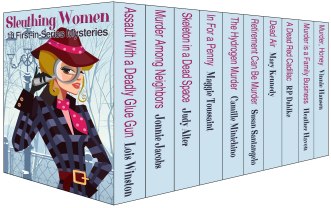
Sleuthing Women: 10 First-in-Series Mysteries

The Alvarez Family Murder Mysteries

By Heather Haven

I’d like to think the Alvarez Family Murder Mystery Series was a carefully thought out project, but I have a feeling it more or less evolved. When I started out, I knew I wanted to write a mystery series with a human and lovable protagonist, Lee Alvarez, who had a few things going for her. Not perfect, but striving. I didn’t want yet another protagonist who learned nothing, who was ostracized from those she loved, who owned one crummy black skirt and life was one, long penance. Lee Alvarez loves life. She’s funny and learns from her mistakes. Like most of us, she grows as she goes along. After all, life is what happens while you’re making other plans. Lee’s lucky in that she has strong familial support to see her through it all, even though they are often a pain in her jazzercised derriere.

It was also important for my series to include two important elements:  the recently immigrated, which is one of America’s best natural resources, and the family unit.  Hence, the Alvarez Family Murder Mystery Series, a family of detectives, was born. The first book – which took me so long to write, planets formed and decayed in the interim – I knew had to be called Murder is a Family Business to set the tone for the series. However, the Alvarez family is a little off-center. They aren’t the ‘classic’ family i.e., father, mother, sister, brother, and large dog, all driving around in a shiny SUV eating Snickerdoos. Of course, these days a family like that is harder to find than a dinosaur with feathers. Oh, wait a minute. Archaeologists are digging those up all the time from unsuspecting peoples’ backyards. That means the Ozzie and Harriet family does still exist somewhere. Helloooooo out there!

Initially, the book was represented by an agent, but it was going no place fast.  I saw an Internet ad and sent the manuscript off to an online publishing house, with no hopes whatsoever for publication. I sent it because I believe Isaac Asimov is right about Perseverance, “you must keep sending work out; you must never let a manuscript do nothing but eat its head off in a drawer.” Within three-days I had a contract for the first book, Murder is a Family Business, and two months later for the 2nd book of the series, A Wedding to Die For. So you never know. Keep sending your work out, is the lesson here. And never lose the faith.

I’m in the throes of editing the 5th book of the series, The CEO Came DOA. If the publishers and the readers are happy, I’ll just keep on writing about my wonderful Alvarez Family. They are so fun and I love it. Plus I get to be all the characters, including the cat!

I am proud to say Murder is a Family Business, Book 1 of the Alvarez Family Murder Mysteries, is included in Sleuthing Women: 10 First-in-Series Mysteries. The lineup of the other nine authors is impressive. It includes Lois Winston, Jonnie Jacobs, Judy Alter, Maggie Toussaint, Camille Minichino, Susan Santangelo, Mary Kennedy, RP Dahlke, Vinnie Hansen, and yours truly. We are a murdering lot, but fun!sleuthing women 3-D.2

Sleuthing Women: 10 First-in-Series Mysteries is a collection of full-length mysteries featuring murder and assorted mayhem by ten critically acclaimed, award-winning, and bestselling authors. Each novel in the set is the first book in an established multi-book series—a total of over 3,000 pages of reading pleasure for lovers of amateur sleuth, caper, and cozy mysteries, with a combined total of over 1700 reviews on Amazon, averaging 4 stars. Titles include:

Assault With a Deadly Glue Gun, an Anastasia Pollack Crafting Mystery by Lois Winston—Working mom Anastasia is clueless about her husband’s gambling addiction until he permanently cashes in his chips and her comfortable middle-class life craps out. He leaves her with staggering debt, his communist mother, and a loan shark demanding $50,000. Then she’s accused of murder…

Murder Among Neighbors, a Kate Austen Suburban Mystery by Jonnie Jacobs — When Kate Austen’s socialite neighbor, Pepper Livingston, is murdered, Kate becomes involved in a sea of steamy secrets that bring her face to face with shocking truths—and handsome detective Michael Stone.

Skeleton in a Dead Space, a Kelly O’Connell Mystery by Judy Alter—Real estate isn’t a dangerous profession until Kelly O’Connell stumbles over a skeleton and runs into serial killers and cold-blooded murderers in a home being renovated in Fort Worth. Kelly barges through life trying to keep from angering her policeman boyfriend Mike and protect her two young daughters.

In for a Penny, a Cleopatra Jones Mystery by Maggie Toussaint—Accountant Cleo faces an unwanted hazard when her golf ball lands on a dead banker. The cops think her BFF shot him, so Cleo sets out to prove them wrong. She ventures into the dating world, wrangles her teens, adopts the victim’s dog, and tries to rein in her mom…until the killer puts a target on Cleo’s back.

The Hydrogen Murder, a Periodic Table Mystery by Camille Minichino—A retired physicist returns to her hometown of Revere, Massachusetts and moves into an apartment above her friends’ funeral home. When she signs on to help the Police Department with a science-related homicide, she doesn’t realize she may have hundreds of cases ahead of her.

Retirement Can Be Murder, A Baby Boomer Mystery by Susan Santangelo—Carol Andrews dreads her husband Jim’s upcoming retirement more than a root canal without Novocain. She can’t imagine anything worse than having an at-home husband with time on his hands and nothing to fill it—until Jim is suspected of murdering his retirement coach.

Dead Air, A Talk Radio Mystery by Mary Kennedy—Psychologist Maggie Walsh moves from NY to Florida to become the host of WYME’s On the Couch with Maggie Walsh. When her guest, New Age prophet Guru Sanjay Gingii, turns up dead, her new roommate Lark becomes the prime suspect. Maggie must prove Lark innocent while dealing with a killer who needs more than just therapy.

A Dead Red Cadillac, A Dead Red Mystery by RP Dahlke—When her vintage Cadillac is found tail-fins up in a nearby lake, the police ask aero-ag pilot Lalla Bains why an elderly widowed piano teacher is found strapped in the driver’s seat. Lalla confronts suspects, informants, cross-dressers, drug-running crop dusters, and a crazy Chihuahua on her quest to find the killer.

Murder is a Family Business, an Alvarez Family Murder Mystery by Heather Haven—Just because a man cheats on his wife and makes Danny DeVito look tall, dark and handsome, is that any reason to kill him? The reluctant and quirky PI, Lee Alvarez, has her work cut out for her when the man is murdered on her watch. Of all the nerve.

Murder, Honey, a Carol Sabala Mystery by Vinnie Hansen—When the head chef collapses into baker Carol Sabala’s cookie dough, she is thrust into her first murder investigation. Suspects abound at Archibald’s, the swanky Santa Cruz restaurant where Carol works. The head chef cut a swath of people who wanted him dead from ex-lovers to bitter rivals to greedy relatives.

Buy Links

KindleNook  /  Kobo  /  iTunes
HeatherPhoto

Bio: After studying drama at the University of Miami in Miami, Florida, Heather Haven went to Manhattan to pursue a career. There she wrote short stories, novels, comedy acts, television treatments, ad copy, commercials, and two one-act plays, which were produced at Playwrights Horizon and well-received. Once she even ghostwrote a book on how to run an employment agency. She was unemployed at the time.

One of her first paying jobs was writing a love story for a book published by Bantam called Moments of Love. She had a deadline of one week but promptly came down with the flu. Heather wrote “The Sands of Time” with a raging temperature, and delivered some pretty hot stuff because of it. Her stint at New York City’s No Soap Radio – where she wrote comedic ad copy – helped develop her long-time love affair with comedy

Heather lives in the foothills of San Jose with her husband of 34-years and her two cats, Yulie and Ellie. She is currently writing her ninth novel.

http://www.heatherhavenstories.com/

https://www.facebook.com/HeatherHavenStories

Twitter@HeatherHaven

Email me at: Heather@HeatherHavenStories.com

Clue, Clue, Who’s Got the Clue, or How to Sneak Your Way to a Good Mystery

by Janis Patterson

Writing a mystery means walking a very fine line.

You want to play fair with the reader and give him the chance to solve the mystery. Sort of.

Readers love to play along and see if they can match/beat your sleuth to the correct solution. In almost every case (so said because there is an exception to everything) nothing makes readers angrier than the solution just coming out of the blue with nothing leading up to it. Worse than that, it’s lazy writing.

So how do you do play fair and still mystify the reader?

Be sneaky.

Put your clues out there, but make them appear to be inconsequential, throw-away things that have no relation to the case. Also put out fake clues leading to a different conclusion (some call them red herrings, but I don’t like fish), but put them out in two ways – some as inconsequentials and some as great big whacking things that might as well have CLUE in blinking neon above them.

No one said you had to play completely fair, did they?

There’s also a traditional ploy called a MacGuffin. Sounds sort of like it should be some kind of fast food, but it’s real – trust me. The MacGuffin is a lovely tool of misdirection. That’s the word I’ve been looking for – misdirection! Just like a magician, you direct the reader’s attention in one direction with one hand while the other hand – in semi-plain view – is actually doing the trick, but no one is really looking at it.

Anyway, the MacGuffin is what everyone in the book seems to want – such as everyone believes the vicar was murdered in a foiled robbery attempt to steal an ancient chalice. All the characters go rushing around trying to figure out who wanted to steal the chalice and why, while the vicar was really murdered because his tulips were certain to win the annual flower show away from the Grande Dame of the village who dislikes losing. The chalice is only a MacGuffin. Now that’s an extremely simplistic example, but in reality the MacGuffin is one of the best tools in the mystery writer’s arsenal.

MacGuffins and misdirection – use them well, and you will keep your reader happily amused and hopefully confused. Or is it the other way around?

(For those with very good memories, you know I wrote this blog several years ago. I am reposting it now because (1) it is still true and relevant and (2) for several days before this appears and for several days after I am up to my earlobes in a very intense professional conference. It seemed better to share a ‘golden oldie’ than to just cobble together something or skip posting entirely. Hope you understand. Also, because I will not have my computer available, please forgive if I am not able to okay comments until this madness is over. I promise I will then!)

Murder Without Violence

thumb_IMG_1225_1024

I had the great pleasure this past weekend to attend a meeting of my local chapter of the Sisters in Crime (the Delaware Valley Chapter). The guest speaker for the meeting is a Conservator at the University of Pennsylvania Museum of Archaeology and Anthropology (which is, coincidentally, where I earned my PhD in Anthropology). Because it is a museum of archaeology rather than fine arts, Molly Gleeson conserves artifacts and other specimens. That includes human remains.

It was a fascinating talk — as they always are at these meetings. Ms. Gleeson prefaced her talk by warning us that she was going to show us images of human remains, then admitted that for this particular audience that might not be a problem. We all write and read about murder. We’re used to human remains, right?

IMG_2463Well…maybe. A murder mystery can be many, many things. It can be light hearted and funny. It can be chic lit. It can be dark, gritty. And it can be gory, a story of violence and evil. When choosing a new book to read, a mystery reader has to know what she’s getting into — or she reads at her own peril.

Personally, I prefer not to read gruesome stories. I particularly avoid books that include rape scenes, but I generally skim through (or avoid altogether) stories with too much gory detail, too much vividly painted violence. I write the books I like to read. Relatively dark mysteries, gritty even, but with the violence taking place almost entirely off the page.

As an aside, one of the most beautiful death scenes I’ve ever read was written by the late, great Ruth Rendell (who, incidentally, did not shy away from violence when she felt it was called for). I always picture that pretty corpse floating peacefully and elegantly down the river, surrounded by wildflowers, whenever I’m trying to write my own murder scenes. I have not yet achieved Rendell’s level of artistic description of death, but I’ll keep trying.

Screen Shot 2016-03-20 at 2.05.07 PMWhich brings me back to the Delaware Valley Chapter of the Sisters in Crime. Each month, a technical speaker is invited to come to our group, to share his or her knowledge of biology, ways to kill a person, how crime scenes are handled, even about ancient methods of human preservation (mummies). To an outsider, we probably seem like a pretty gory bunch.

Quite the contrary. In our group, you’ll find cozy writers, young adult writers, and many, like me, who write traditional mysteries that are high on mystery but low on sex and violence. But one thing we have in common: we’re all well-informed on those gory topics that inform the background of our stories, but don’t make an appearance on the page.

How about you? How much violence do you want to see in the mysteries you read?

janegorman.com