On The Writing of Percy Cole, an Off-beat Heroine by Heather Haven

Bear with me if I’ve said this before, but The Persephone Cole Vintage Mysteries were born out of a challenge by my then-publisher to write a protagonist who looked and acted more like a real person, not a model. Could I do it? Did I even want to? Did I want a heroine who wasn’t typical of many a detective story? After I thought about it, the answer was yes! I wanted to write about a smart woman who wasn’t Mad Men classically feminine. And of course, I wanted it all. She should like herself and be comfortable in her own skin.

So along came Persephone (Percy) Cole. Percy is 35 years old and considered middle-aged by ’40s standards. She’s also a single mother, overweight, and at 5’11” is extremely tall. Sound like a winner? But Percy Cole is! Because as Winston Churchill said, “Attitude is a little thing that makes a big difference.” And Percy has attitude up the wazoo. She exudes self-confidence. She’s smart and savvy. She’s a no s–t lady. I just love her.

They say you don’t know what you’re writing until you’ve written it. Well, little did I know that by making Percy as large if not larger than many men of that era, she was able to compete in a man’s world in every way, including physical intimidation, a very ’40s-PI-Noir thing. Percy doesn’t use physical threats all the time, but she’s not above it. Her grabbing some lowlife by the scruff of the neck and hauling him off to jail is just plain fun to write about. And readers seem to like her fearlessness, her sense of self, of not compromising, which is all done with humor, style, and a touch of whimsy.

Yes, Percy’s tough to the core, but I do try to show a bit of softness through her dealings with her mother, father, kid sister, and in particular, in the raising of her eight-year-old son, Oliver, the child that gives her life meaning. Frankly, it is a rare woman who does not deal with family and family matters, no matter how tough they are. Even Wonder Woman (see linked article). Of course, Wonder Woman is a real hottie. But Percy has her moments; she has her moments. There are men who fall for this redheaded broad with her wicked sense of humor, who knows how to make her way in the world. All very enticing. All very Percy Cole.

Hotshot Shamus, book 4 of the Persephone Cole Vintage Mysteries, debuts on May 7th and at a preview price of $2.99. Yayyy!


Throw Spaghetti at the Wall

I want to write. That’s what I really want to do every day. Butt in the chair, fingers on the keyboard—write.

That’s what leads, in fits, starts and detours, to the finished product, be it novel or short story. Then it’s navigating through all the wickets to get the book published. But after that, I can’t just sit there and hope the book sells itself.

Marketing. Translated as doing whatever I can to make sure readers know the book is out there.

Back in the old days, before ebooks and indie/self-publishing altered the landscape, there was sort of a formula. I say sort of because it really didn’t work well.

My first nine books were published by big New York publishers. Their marketing strategy, if you could call it that, was “throw spaghetti at the wall.” If it sticks, well, it might be working.

My first novel, Kindred Crimes, got a better-than-average jump off the published writer diving board because I won a contest for the best unpublished private eye novel. That got me attention, reviews, award nominations.

The way things worked back then, I scheduled book events at local bookstores and hit most of the mystery bookstores in the western United States. I went to mystery conventions such as Bouchercon and Left Coast Crime, meeting readers, other writers, and selling a few books. All of this was on my own dime, of course.

I did have a few small book tours, mostly on the West Coast, on the publisher’s dime. The publicists booked me into upscale hotels. Nice, but I’d rather they spent less money on the hotel and sent me to more cities. At one point I suggested an East Coast excursion, because they had mystery bookstores there, too. The answer was no. Since my books were set in California, how could they possibly appeal to readers in the eastern part of the country or the Midwest? Go figure.

Then I got dropped by the New York publisher and went with a small California press. I still did my own marketing, as I always had. Over the years most of the mystery bookstores closed. I scheduled events at local bookstores when I could. A lot of the local bookstores closed. I remember someone I worked with in San Francisco asking me if my books were available on Amazon. Yes, they were. They were also available at the big downtown bookstore four blocks away. That bookstore is no longer there.

We were in the era of buy it online. Then came ebooks. A lot of big publishers thought that was a passing fad. They were wrong. I’m glad I got back the rights to those first nine books right before that, because I spent a lot of time and money converting those novels to ebooks and I sell a lot of them. The small publisher also closed and I got back the rights to those books as well.

Along with all of this came social media and using the Internet to connect with readers. In these days of self-publishing, readers have so many choices. I contribute to blogs, like this one, and sometimes do guest blogs. My fellow writer D. Z. Church and I send out a newsletter each month. I tried Twitter once and hated it. Couldn’t see the point of that, or some of the other platforms. As for Facebook, it seems most of my “friends” are other writers, mystery fans, as well as a few longtime friends and relatives. I have a personal page for pictures of my cats and the like. And an author page, where I post notices.

Advertising. I’ve done some of that in the past, but not much. Recently I did something different. I participated in the Five-Day Author Ad Profit Challenge, which is free, sponsored by the Author Ad School, which costs money. The Challenge is, well, challenging. I’ve been up to my eyeballs in categories and keywords and have been rethinking blurbs and hooks. I’ve learned a lot and hope it will be useful in building sales.

Maybe when I throw the spaghetti at the wall, I’ll hit the target.

Guest Blogger ~ John DeDakis

FICTIONALIZING PERSONAL EXPERIENCE

On the night of December 20, 1959, I was sitting in the left front seat of the Vista-Dome car of the Burlington Zephyr passenger train as it hurtled through northern Illinois on its way from Chicago toward my hometown of La Crosse, Wisconsin. 

The engineer would later tell a coroner’s jury that he was going 90 miles an hour (legal at the time) as we rounded a gentle curve at the tiny town of Chadwick.

From my vantage point in the darkened dome car near the front of the train, I could see the locomotive’s searchlight slice through the darkness, sweeping the tracks that stretched ahead of us.  Suddenly, off to my left, I saw a car speeding toward a crossing we were approaching.  The car looked like a 1949 Chevy, distinctive because of its sloped rear end.  A split second later, I lost sight of the car as it went in front of the train.

I heard a bang, the train shuddered, and debris rained onto the Plexiglas dome, cracking the window I’d been peering through. I ducked, then scrambled down the narrow stairway to the dome car’s lower level where I told my dad and the conductor what I’d just witnessed. 

I was nine years old.

The crash killed three people including a boy about my age.

Fast forward to 1994. I was doing a writing exercise recounting a personal experience—the one you’ve just read.  As I wrote, I remembered a radio news report about a car-train collision in which an infant survived.  I began wondering, “What if an infant survived the crash I witnessed and grew up wondering about her past?” 

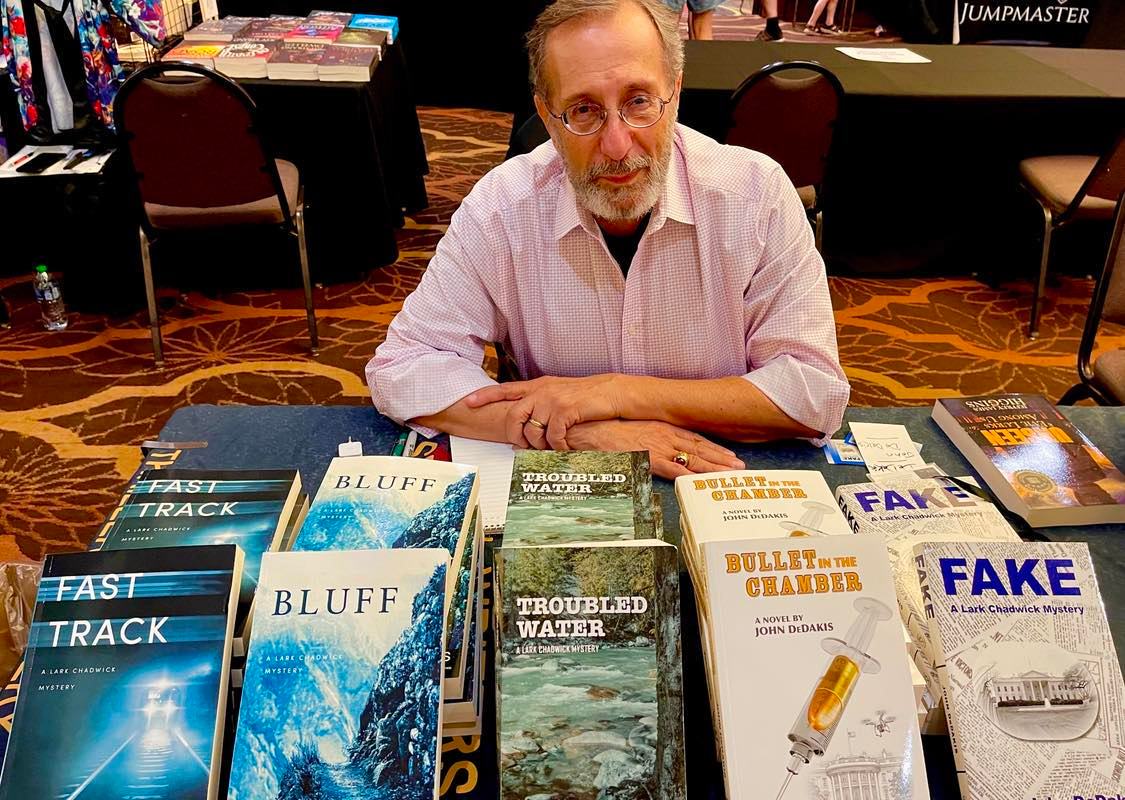
That idea turned into my first mystery-suspense novel Fast Track.

The novel isn’t about the accident.  If anything, it’s an example of how a personal experience can be the seed of an idea that can blossom into something else—something redeeming. 

Fast Track begins with my 25-year-old heroine vexed because she doesn’t know what to do with her life. She discovers the body of the aunt who raised her from infancy—a victim of carbon monoxide poisoning. (This is an echo of my sister’s suicide in 1980, but that’s another story for another time.) That trauma begins a quest to unlock secrets kept hidden for a quarter century when my protagonist’s parents died in a mysterious car-train collision.

The Fast Track manuscript went through 14 major revisions over 10 years before I found my current agent, Barbara Casey, (the 39th agent I queried).  During that process, I drew on other personal experiences to add texture to a story that includes politics, journalism, and mentoring relationships.

Fast Track is the first novel in a series that’s now five books and counting. But it all started more than 63 years ago in Chadwick, Illinois.  So, I suppose it’s fitting that I named my heroine Lark Chadwick.

Orphaned as an infant, sexually assaulted as a naïve college student, strong-willed, impulsive Lark Chadwick is vexed and trying to figure out what to do with her mixed-up life. When she discovers the body of the aunt who raised her, Lark goes on a search for answers.

She is stunned to learn from a 25-year-old newspaper clipping that she’s the “miracle baby” who survived a suspicious car accident that killed her parents at a rural railroad crossing in southern Wisconsin. Lark convinces Lionel Stone, the crusty Pulitzer-Prize winning editor, to let her do a follow-up investigation of the crash. Two of her sources are the sheriff and the town’s mayor, they’re running against each other for Congress, the election is a week away, and both men have a secret that will unravel the mystery.

Award-winning novelist, writing coach, and manuscript editor John DeDakis is a former editor on CNN’s “The Situation Room with Wolf Blitzer.” DeDakis is the author of five mystery-suspense-thriller novels. In his most recent novel, FAKE, protagonist Lark Chadwick is a White House correspondent dealing with “fake news” in the era of #MeToo. DeDakis, a former White House correspondent, regularly leads writing workshops at literary centers and writers’ conferences. He is also the host of the video podcast “One-to-One with John DeDakis” on YouTube, Facebook, and LinkedIn. Originally from La Crosse, Wisconsin, DeDakis now lives with his wife Cindy in Baltimore, Maryland.

Website: www.johndedakis.com

My adventures with AI or …

The movie War Games has been stuck in my mind for, what? Forty years? And having worked in the nascent modeling of meteorological data, I know that prediction is only as good as the data accessed and the decision tree established. By humans. Humans, too, build AI models. Meaning at some point, computers will take over. I know this, because of War Games, I Robot … the list is long.

That said, as a writer, I find creating marketing and cover copy difficult. This should be some sort of weird joke since I toiled in the advertising trade for years writing copy. But here is the issue — when writing about plums or kiwi fruit you are writing about something with which you have no emotional attachment.

Not so with your book baby. I find it disconcerting to write something like this: (Any book) is an action-packed and heart-wrenching tale of family, friendship, and loss that will leave readers captivated until the very end. I don’t want to over-hype, I worry about readers being disappointed when they aren’t captivated. I worry that someone will notice my baby has a big ____ (fill in the blank).

So, I reviewed several AI programs that touted their book marketing capabilities. Decided, I took advantage of a free trial offer from Anyword (the above is an example of the output). Here’s what I discovered. The output is only as good as the input. No kidding, the more honed your sales points are, the better the output.  Duh!

Anyword’s user interface is easy to navigate. Having selected the Amazon landing page option, I entered my bullet points. Three versions of AI-generated text popped out (you can pick fewer). Cool. I did this for my new book Unbecoming a Lady, then my series The Cooper Vietnam Era Quartet. Other than the glee of hitting a button and having words magically appear on the screen, I benefitted most immediately from some great closing sales pitches. But the landing page copy generated always required editing. Some of the text output was downright funny and once a bit scary. So, it takes time to edit the output, just as it takes time to develop the input for your book(s).

Further after three or four pitches, I noticed a pattern. The book was always exciting, wonderful, thrilling, suspenseful, ____ (fill in the hype word). You get the idea. Since the program (all AI programs) searches a database of successful like-product pitches, the text can be robotic and derivative.  In fairness, the blurbs do match every other Amazon sales pitch, including that for cat watering stations, light bulb changers, and, well, everything. Based on the language errors made in Anyword and errors seen on Amazon, I suspect AI, including Anyword, is used by many marketing firms to create pitches quickly with little editing.

In the end, your AI-generated book description is no more exotic or exciting than any other book’s. Good or bad? I don’t know. My years in advertising tell me no. This means, to stand out from the competition you will need to do more honing. And, yes, research.

My Conclusions?

Using AI to create book sales copy is freeing in that it gives you a totally non-human, unbiased swag at your book. A place to start. But it isn’t a time saver. Maybe an ego saver, if it saves you from hanky-wringing angst while writing the hype for your book baby.

Anyword has a hefty subscription fee, enough to give one pause, though it would give you the ability to endlessly redo your landing pages. And that is attractive, despite the little voice whispering: For crikey sakes, you worked in advertising. Yes, still?

As you can see, I’m undecided. Though, I admit I worry AI will soon write us all out of business. Remember, War Games haunts me.

WHEN FICTION IS TOO MUCH LIKE FACT

Recently my little town of Springville hit the national news when one storm after another caused the Tule River to flood and fill houses with water and mud. We were among those ordered to evacuate because we live near the river—however despite the rushing water taking out trees and bridges as it headed toward the lake, we were in no danger. However, the first day the only roads to get out of town were flooded and closed.

Long ago I wrote a mystery called A Deadly Feast about a storm that caused a raging river to take out a bridge and strand those who lived on the other side for several days.

Raging Water is a Deputy Tempe Crabtree mystery written several years ago about the flooding of Bear Creek which forces people living along the river to evacuate and causes a huge mud slide which makes it impossible for anyone to leave.

Both books have a great similarity to what recently went on in our small town.

This is happened before.

I wrote Bears With Us when we had an occasional bear sighting in an around Springville. At the time, my grandson was a police officer in Aspen CO and many bear encounters he shared with me. I used his expertise to add excitement to the story.

Last summer several bears decided Springville would be a great place to dine. People reported bear sightings regularly. We had two different bears who decided to visit our trash trailer on different nights looking for hand-outs. One was a big black male, the other a smaller brown bear. They didn’t bother anything else, but were scary if you came home during their visits. Believe me, on those occasions we scurried into the house. We haven’t seen them since early fall.

Since I’ve written my final and the last offering in my Deputy Tempe Crabtree mystery series, I’m no longer worried about writing fiction that predicts future events. But it was fun telling readers about it.

Marilyn