Guest Blogger ~ Valerie Nieman

Accidentally on purpose

            I sort of backed into writing mysteries.

            It’s not that I didn’t love them, at least the darker, creepier kind. Thanks to a home library of classics, I read Poe as a child and so gained acquaintance with the morbid, the gothic, and the methods of detection at a tender age. Later, I encountered Sherlock Holmes, through Basil Rathbone films and the original stories.

            But while I reveled in the clues and conundrums, I never thought I could write a mystery. How to get those clues in? How to twist a satisfactory plot?

            I first approached the genre with a novel called Blood Clay, which had the death of a child in the opening chapters but no mystery about the cause. It was a crime novel, and a study of the stranger in community, but not a whodunit.

            When I wrote To the Bones, the mystery was there from the start. A man wakes up in a pit of bones. Why is he there? Who did it? What happens when he manages to get out? Still, I didn’t think I was writing a classic mystery—more of an Appalachian folk horror novel with an environmental twist. The biggest mystery was not the man in the mine crack, but the murder of a river.

            I was lured into writing In the Lonely Backwater by the powerful voice of the main character. As soon as Maggie voiced the opening lines, I knew that I was in for a ride. And gradually the mystery, or mysteries, emerged and became clearer. I had to do a good bit of rewriting to weave in various elements, but when is that not the case?

            And Maggie herself? Well, there is a lot of her in me, or me in her, more than the usual self-identification of creator with characters. I grew up in the country and was a similarly solitary girl wandering the woods, toting around my Golden Guides to identify the rocks, insects, plants that I gathered on my treks.

            I can trace her devotion to Linnaeus and the delights of classification to my own memory of a fine high school biology teacher, and then reading the Fred Chappell story “Linnaeus Forgets,” that reawakened my interest in the Father of Taxonomy. My research, other than continued woods-wandering, included time spent at the University of North Carolina libraries with a 19th-century translation of A Tour in Lapland, Linnaeus’s fascinating diary of his early explorations and a book that comes into Maggie’s hands at a critical point.

            While the death of her beautiful cousin Charisse and the search for her killer form the backbone of the plot, the story is really a character study of a teenager struggling to shape her own life. As Chappell said in his review, “The heart of the mystery is at last (Maggie’s) own heart.”

            And the next? Maybe Maggie has more trouble….

All seventeen-year-old Maggie Warshauer wants is to leave her stifled life in Filliyaw Creek behind and head to college. An outsider at school and uncertain of her own sexual identity, Maggie longs to start again somewhere new. Inspired by a long-dead biologist’s journals, scientific-minded Maggie spends her days sailing, exploring, and categorizing life around her. But when her beautiful cousin Charisse disappears on prom night and is found dead at the marina where Maggie lives, Maggie’s plans begin to unravel. A mysterious stranger begins stalking her and a local detective on the case leaves her struggling to hold on to her secrets—her father’s alcoholism, her mother’s abandonment, a boyfriend who may or may not exist, and her own actions on prom night. As the detective gets closer to finding the truth, and Maggie’s stalker is closing in, she is forced to comes to terms with the one person who might hold the answers—herself.

Buy Links:

https://www.regalhousepublishing.com

Bookshop – https://bookshop.org/shop/ValerieNieman

B&N – https://www.barnesandnoble.com/w/in-the-lonely-backwater-valerie-nieman/1139962914

Amazon – https://www.amazon.com/s?k=Valerie+nieman&i=stripbooks&ref=nb_sb_noss

Valerie Nieman has been a reporter, farmer, sailor, teacher, and always a walker. She is the author of In the Lonely Backwater and four earlier novels, and books of short fiction and poetry. A graduate of West Virginia University and Queens University of Charlotte, she has held state and NEA fellowships.

Facebook – https://www.facebook.com/valerienieman1/

Twitter – https://twitter.com/valnieman

Instagram – https://www.instagram.com/valnieman/

Website – http://www.valnieman.com

Linked in – https://www.linkedin.com/in/valnieman/

Goodreads – https://www.goodreads.com/author/show/529629.Valerie_Nieman

Scams and Cheats and Crooks, Oh My!

by Janis Patterson

Okay, I am officially livid. How long are people going to have to put up with such blatant criminality?

To explain – a couple of days ago I went to a meeting at one of my ladies’ clubs. It’s an old club, and most of the members are older. It’s very dignified, very much hats-and-gloves proper. I love it, though I do sometimes feel that – since I am a ‘creative’ type – I’m their token artist.

I digress. It’s no secret there that I’m a novelist, and some of the ladies just love to talk books with me. This time a very nice older member whom I know slightly brought a guest of approximate the same fairly advanced age, and asked if they could talk with me. Sure. I’m friendly…

Turns out that her guest (and dear friend) wanted to know how long it should take for a publisher to bring out a children’s book. Legitimate question. I told her honestly I didn’t know too much about the children’s market, having only done one myself, but that a general rule of thumb for traditional publishing from contract to release could be a long as two, two and a half years.

The writer began to cry, and said “But it’s been over four, and I don’t have any more money!”

Uh-oh.

Not wanting to have her embarrassed, I pulled her and her friend into a small parlor and closed the door so I could get the entire story, which is one that is all too familiar. She had written a children’s book which she wanted to get published, so she answered an ad in a popular magazine. You’re all seen them – “Publisher Seeking Manuscripts – 100 years in business.”

It should read Publisher Seeking Money – 100 years of stealing.

This poor woman had signed a contract (which she didn’t remember what said or even if she had a copy of it) and every time they asked for money to cover editing, or an artist, or an artist to replace the first, or an artist to replace the artist that replaced the first, or copyright (which she never saw), or some other d*mn*d thing that made no sense to this poor woman. Of course, time and again they couldn’t go any further until they had more money. Four years and close to $70,000 (yes, SEVENTY THOUSAND, seven and four zeroes) later, they still hadn’t released the book.

By this time I was so red-eyed furious I was ready to do a violence. As gently as I could I told this woman a few truths about the publishing industry… you know – that money always flows TO the author and NOT away from, that authors should be appraised of every step in the process, that legitimate publishers get so many submissions they not only don’t have to advertise for manuscripts but instead are very picky about the submissions they receive even from agents and other industry professionals, that this company is making their money from charging authors instead of selling the author’s books, that before signing a contract with anyone you have to do your due diligence… If you don’t know about the publishing industry, find someone who does! I tried to be as gentle as possible, but by the time I was finished this poor lady was just howling.

So, you ask, why didn’t this woman do some of these things, like check the company? Well, the company really has been in business for over 100 years (which to my mind says something dreadful about their morals and the efficacy of law enforcement) and some people say it does provide a decent vanity press service. Vanity press, not a publisher presence. That difference is as big as the difference between a jobbing printer and a legitimate publisher. Or a Hot Wheels and a BMW.

Now this lady is in her late seventies or early eighties. Her husband is long dead. Her two children live at opposite ends of the country. She is pretty much on her own. She is also, her friend confided to me later, dancing on the edge of something Alzheimer’s-like.

In other words, prime picking for crooked, conscienceless vultures like this ‘publishing’ company.

I gave both ladies my phone number and said they could call me any time they had questions. I also stated firmly that she needed to let her children know what was going on, that she needed to request a copy of the contract she signed and she needed to contact her attorney. Now. In reality, there is not much else I can do, except beg everyone to spread the word –

1) legitimate publishers DO NOT advertise in magazines for submissions

2) money flows TO the author, not away from

3) do your due diligence and investigate before you sign anything – if you don’t know anything about publishing, talk to someone who does

4) contact an attorney before you sign anything

Somehow we have to stop these predators. They skirt the law and have a lot of experience in doing close-to-criminal things that if not exactly illegal are definitely immoral. The cost in human emotion and plain old money is enormous. Spread the word.

Pantsing and Plotting to the Finish

Pantser or plotter?

Well, I’m somewhere in the middle, but probably closer to pantser.

A plotter is a writer who plots before writing the book. A pantser writes by the seat of the pants. Most writers I know are a bit of both, like me.

The pantser-or-plotter question came up recently at a library event, with a question about writing process. A fellow author said that he researches his book for several months, then writes a detailed outline, which could also take several months. Then he writes the book. He needs to know exactly what happens along the way and by the time he finishes a first draft, it’s polished and doesn’t require revisions.

I’m glad that works for him. Not me. My process is messy and always involves multiple rewrites, revisions, tweaks, fine-tuning—you name it.

When I envision a book, I know where I’m going to start and where I’m going to finish. It’s those pesky middles where the hard work takes place. Often the middles get rearranged, because I discover that particular scene works better over here, and another scene needs to be moved there. Sometimes I revise a chapter to foreshadow future events, or go back to a previous chapter to drop in a clue I just discovered.

I start with a timeline, a list of events that happened before the book opens. Those past events are what leads to the current mystery. This process also helps me understand how the characters have evolved. Why is that character the way she is now? Perhaps it’s due to something that happened years ago.

The same is true of settings. In The Sacrificial Daughter, the first in the Kay Dexter series, there’s a long-abandoned hot springs resort. The locals like to hike down to the derelict building and hang out in the creek’s warm pools. There’s a scene at the old resort in the middle of the book, but the place’s back story is important to the plot.

I’ve found that in the middle of writing a book, I need to revise the timeline to incorporate everything I’ve learned since I started out. I also like to leave room for detours and blind alleys. Or, as in a quote attributed to Tony Hillerman, write myself into a corner and see if I can write my way out. Another quote, supposedly from Raymond Chandler, when I get stuck, send two guys with guns through the door.

That happened when Jeri Howard, my Oakland private eye, went to Monterey in Don’t Turn Your Back on the Ocean. I knew that one character, her cousin, was a person of interest in the death of his girlfriend. I didn’t send two guys with guns through the door, just a cop with handcuffs. I upped the ante by having him arrested.

Instead of writing from start to finish, I often jump ahead. It helps me get past places where I’m stuck. When writing Witness to Evil, Jeri was in Bakersfield, in California Central Valley, investigating a case. Then I got stuck. As in, what happens next? I knew that Jeri needed to go to Los Angeles to follow a lead, so off she went, heading south to the City of Angels. I wrote six chapters in rapid order and when I got Jeri back to Bakersfield, I had a very good idea of where I was going forward, and what I needed to go back and fill in.

So, pantser or plotter? I have one foot in each place.

Guest Blogger~ Sally Carpenter

Scots, kilts and crime

By Sally Carpenter

Thanks to Paty for this opportunity to guest on Ladies of Mystery.

When I created the main character for my Sandy Fairfax cozy series, I gave him a Scottish heritage so I could put him in a kilt. I love men in kilts. Sandy’s real name is Farmington, which has its own family tartan.

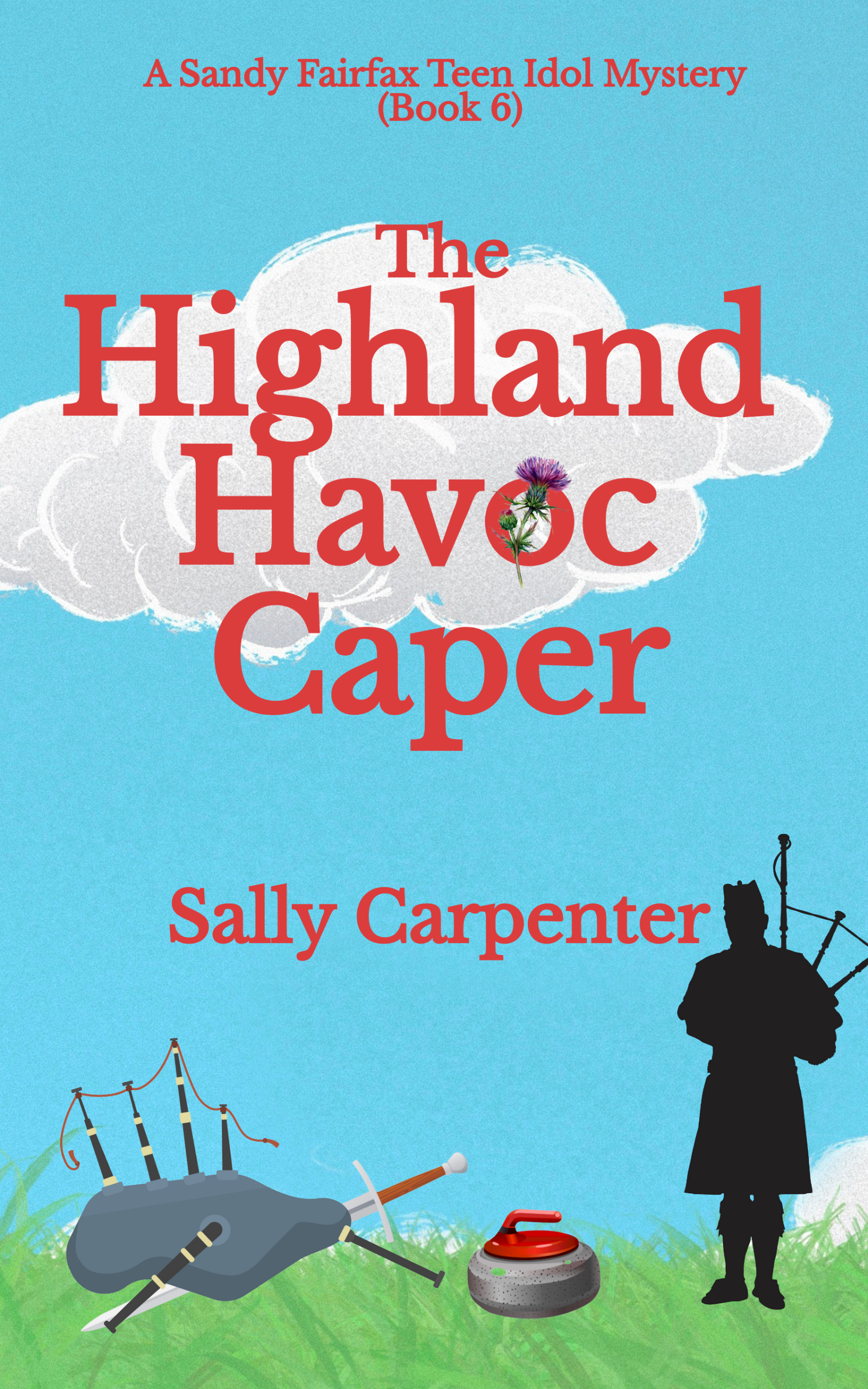
At long last the opportunity arrived. My new book, No. 6 in the series, is The Highland Havoc Caper. The story begins at the Seaside Highland Games in Ventura, California, based on the real Seaside Games in the city. I didn’t have the chance to attend the games when I was writing the book, but I pulled a lot of useful information off the event website. The games are held at the Ventura County Fairgrounds, which I’ve visited on other occasions, so I added some realistic features, such as the grounds are on the coast, providing a terrific ocean setting.

I found videos of other Highland Games on YouTube, so I was able to piece together an authentic depiction of the festivities. The event is a celebration of Scottish culture, music, dancing and “heavy athletics,” what the Scots call their sports of caber tossing, sheaf throwing, shot put using large stones and more. The sports are not for the weak of body nor faint of heart.

Sandy’s in a kilt for most of the book. I researched kilts via internet. The garment itself is a long piece of fabric that is wrapped around the body with the pleats hanging on one side. An ornamental pin keeps the kilt from flying open. A belt holds the kilt in place. Each family has its own tartan design.

The man also wears hose (knee-high stocking) held up with flashes (garters) that have small fabric tags visible under the top of the hose. Sometimes the shoes worn have long laces that are wrapped around the calf and tied below the knee.

Since kilts don’t have pockets, the man also wears a sporran, the large object hanging down the front of the kilt. The sporran is basically a purse, although I think nowadays it’s more decorative than practical. For formal occasions, a dress sporran is worn. This might have large tassels or artwork.

Women don’t wear kilts; they have tartan skits without the sporran.

In the book, Sandy tops his kilt in three different ways, depending on the occasion. When he sings during the games’ Saturday opening ceremonies, he wears a white shirt, a tartan tie and a solid-color jacket. He returns to the games the next day with a more casual look in a leather ghillie shirt that has a pointed collar, long sleeves cuffed at the wrist and leather laces at the neck instead of buttons.

For a formal dinner, Sandy dons a white Victorian shirt with a black bow tie and a tartan waistcoat. His jacket is left open to expose the waistcoat.

During the week Sandy is shooting a guest spot in a TV show in which he plays a Scottish ghost. Once more he’s in a kilt, although this one is a black tartan with the addition of a fly tartan, a sash that’s worn across the chest from the hip to the shoulder.

When Sandy’s at home or going places around town, he’s in regular clothes:  jeans, corduroys and sweatshirts.

On YouTube I also found some Scottish music that I used in the story. The phrase “You take the high road, and I’ll take the low road” is the chorus from the song “On the Banks of Loch Lomond.”

YouTube also shows Highland Fling and other Scottish dances. Sandy’s daughter takes dance lessons, so she’s in a Highland Fling contest during the games.

And we can’t talk about the Scots without haggis, that quintessential Scottish dish. Sandy’s served this at a dinner party. I asked my writers’ group if anyone had eaten haggis. Some liked it, others didn’t, and one said it’s a Scottish mainstay and I shouldn’t make fun of it. I didn’t, but I described what’s in it.

Other Scottish dishes making an appearance are mince and tatties (ground beef and mashed potatoes), neeps (turnips) and Red Kola (a Scottish soft drink).

I put in a few Scottish slang terms (nothing naughty), but didn’t write in dialect so that the reader could understand the dialogue.

I had fun with the research; crossing my fingers that I got it correct. I’m hoping my readers will enjoy this interesting look into Scottish culture and the twists in the mystery.

Former pop star Sandy Fairfax engages in a dangerous hobby—amateur sleuthing. At the Seaside Highland Games in California, he and his teenage son, Chip, discover more than their heritage. In a castle transported from Scotland, they find a body bludgeoned with a curling stone. But when they go for help, the corpse vanishes. Without a body or even a name, how will Sandy find the killer? As he and Cinnamon plan their wedding, more bodies pile up. A piper plummets from the castle tower and into the ocean. Another body is found behind a Scottish pub in L.A. And when Sandy takes a guest role on the Spook Spotters TV show, the worried dad must keep Chip safe from an amorous young actress. Whether you take the high road or the low road, can you solve the case before Sandy does?

Kindle link: https://www.amazon.com/Highland-Havoc-Caper-Fairfax-Mysteries-ebook/dp/B0BX8P1GXV

Print link: https://www.amazon.com/Highland-Havoc-Caper-Fairfax-Mystery/dp/1952579562

Sally Carpenter is a native Hoosier now living in Southern California. She writes retro-cozies: the Sandy Fairfax Teen idol series (six books) and the Psychedelic Spy series (two books). She was a finalist for the 2012 Eureka! Award for Best First Mystery Novel. She has a master’s degree in theater, a Master of Divinity and a black belt in tae kwon do. You can download free stories from her website http://sandyfairfaxauthor.com.

Bewitched, Bothered, and Befuddled Am I by Heather Haven

I’ve lost my mind. Again. I have begun a new novel on a subject about which I know absolutely nothing. Zip. Nada. I did it again. Did I not learn my lesson from the last Alvarez Family Mystery, The Drop-Dead Temple of Doom? Apparently not. But that’s a writer for ya. Or at least, that’s me for ya. I get an idea, I embrace it, I love it, it becomes mine, and I’m off and away.

It’s only when I plop myself down at the keyboard and have no idea how to start the first sentence do I realize I am in deep doo-doo. That’s what happened with Drop-Dead. My fingers hovered over the keyboard waiting for words to come to me. They didn’t. I had no idea what a Guatemalan jungle was like. I didn’t know the first thing about archeology. And, truth be told, an ancient Mayan could have risen from the dead, bit me on the knee, and I wouldn’t have had the first clue as to who, what, or why. I left my office and dove headfirst into a martini, the first of many. Ernest Hemingway may have said, “Write drunk, edit sober,” but you gotta know SOMETHING about a subject before you can write about it.

I have to do a little research for all my novels, but I had pushed the limits on this. A Guatemalan jungle? Even though I was born and raised in South Florida and have been to Parrot Jungle, it’s not the same. Archeology? Simply because I’ve streamed “Lost Cities With Albert Lin,” that didn’t mean I knew the first thing about digging anything up other than weeds. And the ancient Mayans? Ditto, ditto, and ditto.

But I had a fire in the belly. I wanted to tap into the real-life story of a young woman who is an Indiana Jones of today. I’ll call her Indiana Josie. She tromps around the jungles of Guatemala uncovering all kinds of wondrous things. And thanks to the development of LIDAR (Light Detection and Ranging), the exploration of ancient Mayan cultures has exploded. This is truly the golden age of discovery for this remarkable culture.

So began a crash course in not one, not two, but three subjects. As the world was in lockdown from Covid, even if I’d wanted to fly to the jungles of Guatemala for firsthand experience, I couldn’t have. Instead, I bled Indiana Josie dry of any knowledge she could give me. I watched every documentary on archeology, not merely as a spectator, but as a student. I read anything I could find on the ancient Mayan culture, gasping at pictures of their paintings, jewelry, and tombs. I marveled at what they had created, believing as many do, they rival the Egyptians in many ways. Eight months later, while not an expert on any of these subjects, I was able to sit down at the computer and write.

After completing the latest novel in my other series, Hotshot Shamus, Book 4 of the Persephone Cole Vintage Mysteries, I now return to the Alvarez series, with Bewitched, Bothered, and Beheaded as the next project. For whatever reason, I decided to write about a magic trick gone wrong, a dead magician, and the protagonist, Lee Alvarez, as the chief suspect. Belly fire returning. No antacids working.

Of course, I find I am in deep doo-doo again. I know nothing about the subject, nothing about magicians or their tricks. Leave it to me to have a misadventure with a guillotine trick front and center, basically starting the story off. Naturally, I can’t write a word until I investigate this. So it’s off to Vegas for a crash course in magic. I recently contacted David Copperfield for an interview. Start at the top, right? Maybe he’ll give me a few tips. If not, I’ll work my way down. I hear there’s a magician, Melvin the Magnificent, performing in a San Jose parking lot. Maybe he’ll talk to me.

Meanwhile, I need to face it. I just never learn.