A Change of Scene

As I write this, I’m living in a hotel, with my cats, because new flooring is being installed in my condo—finally! It has been six months since the great condo flood upended my life. I never thought it would take this long, but it has. Now I can see that light glimmering at the end of the proverbial tunnel. Soon my cats and I can come home!

A change of scene can be valuable when writing, in a couple of ways. I’m in this hotel room, supposedly with no distractions, unless I count the cats walking over the keyboard. But they do that at home. Surely I can focus on the book I’ve been writing (or neglecting, of late).

Changing location works in other ways. Case in point, Witness to Evil, the seventh Jeri Howard novel. The first half of the book is set in Paris, while the latter half takes place in Bakersfield, California. Talk about a change in scene! I did location research in both places, though a second trip to Bakersfield was a lot easier, since all I had to do was get on the freeway and drive.

At some point during the writing process, I found myself staring at a virtual brick wall. What happens next? I didn’t know. What I did know was Jeri had to go to Los Angeles to follow a lead. So, I put her on highway 99, headed south. Following one lead led to another and yet another. I wrote six chapters in rapid succession, taking Jeri from Los Angeles to San Luis Obispo to Fresno. When Jeri and I got back to Bakersfield, I had a clearer picture of where I was headed with that book, and where I needed to fill in information and clues.

I had another change of scene in the early stages of writing Death Above the Line. It’s the fourth book in the historical series featuring my sleuthing Zephyrette, Jill McLeod. She’s accustomed to working aboard the sleek silver streamliner known as the California Zephyr, as it makes daily runs between the Bay Area and Chicago. However, in this novel, she’s been roped into playing a Zephyrette in a film noir. In the first draft, I had Jill reporting for duty at a movie studio located in the waterfront district of Oakland. It’s an area I’m familiar with, having worked there in one of my day jobs.

But the location just wasn’t working. I had to make a change. I moved my movie studio to Niles. It’s part of Fremont now, but at the time I’m writing about, 1953, it was a separate township at the mouth of a canyon carved by Alameda Creek. And it has a movie-making history. The town was the western site of Essanay Studios, which made silent films there from 1912 to 1916. That’s where Charlie Chaplin filmed The Tramp.

I put my fictional studio in an old warehouse near the historical Niles train station. The change of scene worked. Since I’ve been to Niles many times, riding the historic train there and having afternoon tea at a favorite shop, I was able to visualize my characters moving in and out of the building, walking the familiar streets.

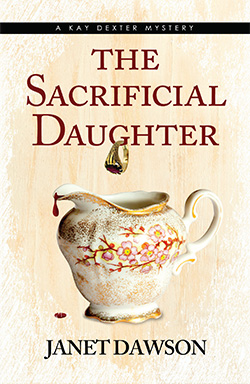
Another change of scene occurred when I was writing the first book in my series featuring geriatric care manager Kay Dexter, titled The Sacrificial Daughter. I use actual locations for my other books. For this series, however, I decided to use a fictional town set in a fictional county in the Northern California Sierra Nevada. Both the town and the county are called Rocoso, a Spanish word for rocky. This was definitely a change of scene, in several ways. A fictional setting allows me to make up the way a place looks, as well as its history, culture and inhabitants. Another way it works is that I borrowed a great deal of the location and terrain from a real place, picking up a real Colorado town and moving aspects of it to Northern California.

Whether it’s Bakersfield, Niles, or Rocoso, a change of scene invigorates my writing.

Guest Blogger ~ J.T. Kelly

I began my writing career after retiring at the age of 70. At the end of my first novel, protagonists Jack and Sara McCabe are thrilled to learn they’re going to have a baby. Fast forward four years later to my seventh novel. That child has grown to be twenty-year-old Amos, who has just graduated from college with a degree in anthropology and archeology.

Amos survived and even thrived in the sixth book, Missing Memories. So I wanted to explore an opportunity for him to spread his wings in another thrilling adventure.

 During research for book seven, I learned that archeologists actually found the bones of nine Neanderthals in a cave south of Rome, Italy. They also uncovered the remains of prehistoric predators, including the giant hyenas. Scientists decided the hyenas killed the Neanderthals and brought them to the cave for a feast.

Having lived in the area for a year, I decided this would be a fascinating opportunity for young McCabe. In the story, he’s invited to be part of the cave dig site.

Needing to find out as much as I could about the Neanderthals, I spent days poring over research about their lives 50,000 years ago. They faced a variety of challenges from nature, including freezing temperatures and volcanic eruptions. And from fierce beasts and humans. While humans interbred with Neanderthals, they also took them for their slaves.

The Neanderthals were skilled as hunters, both on land and in the sea, and were adept at making fire, carving wood and stone, making jewelry and weapons. But they were no match for the humans.

What would it be like for a modern day human to inexplicably enter the bizarre world of the Neanderthals? What could he teach them to help them improve their lives? Or would the experience be too threatening to even survive? That’s why I decided to write Ominous Odyssey. The story evolved during the writing process. It was an emotional experience for me but I was thrilled with the result.

Here’s part of a recap on the back cover of the novel:

Ominous Odyssey is a thriller and a love story. It takes place four years after teenager Amos McCabe escaped from kidnappers. Now, with a degree in archeology and anthropology, he receives an invitation to work at a dig site in Italy south of Rome. Archeologists discovered the bones of nine Neanderthals. The young man can’t wait to learn more of the secrets of these prehistoric people.

The lead archeologist informs Amos there are tunnels they hadn’t yet explored. His curiosity gets the better of him. The adventurer brings his headlamp and investigates before anyone arrives for work. When the young man reaches the end of a tunnel, something terrifying happens.

He discovers he’s been transported to an alternate universe of 50,000 years ago. The explorer soon realizes there’s no way to escape. What will become of McCabe? Has his exuberance gotten the better of him? Join Amos for an adventure of a lifetime.

buy link: https://www.amazon.com/dp/B0BYGD3XZT.

I was thrilled to see this book review in Amazon Italy: “What’s unique about this international thriller is its ability to explore the unknown. The story is intense and full of suspense, with an ending that is incredible. Ominous Odyssey is not just an adventure novel, it’s an intriguing journey that provokes reflection on what it means to be human, and how we can influence the world around us.”

My works include Fair Ways and Foul Plays, Deadly Defiance, Suite Suspicion, Formula for a Felony, Diamond Destiny, Missing Memories, and Ominous Odyssey. Prior to my writing efforts, I honed my creative skills as an advertising and communications professional.

Readers find that I reference Lake Maxinkuckee near Culver, Indiana, liberally in my novels. It was a summer vacation place that holds many fond memories from as far back as I can remember. The action or crime begins in this small community and explodes in a variety of European locales.

An avid reader, I’ve enjoyed numerous authors in the mystery, thriller, and suspense categories. As a result, I hope you’ll experience the degree of fast-paced excitement that rivals many of the most popular in these genres.

To learn more about me and to send a message, visit my website at www.kellyfairways.us. There are reviews and recaps of each book along with links to purchase them on Amazon and to provide 5-star reviews. The website also provides links to social media pages.

Audiobooks, AI and Me

I am participating in a Beta test using AI voices to generate audiobooks. Interesting. And not altogether a bad experience, but a time-consuming one. Most audiobooks run about 20-26 hours, so there you go. But if it works, it makes the creation of audiobooks available to authors without the loss of an arm and/or a leg.

So, things I’m learning.

Choosing a Voice

Listen to all the voice options: male, female, American or British, then pick the narrator your reader would expect. Right now, the options are limited. I chose a twenty-something female for one book and a late-twenties-sounding male for another.

A real plus is that you can change narrators mid-stream without losing your edits.

Don’t watch the screen — Listen

The AI I’m trying out has a marker on the screen that moves from word to word with the narration. If you watch the screen while listening, the paced rhythm of the marker takes all meaning out of the sentence – dah dah dah dah. So shut your eyes and listen for the modulation in each phrase and where inflection changes the intended meaning of a sentence.

As you listen to the very human voice, it is easy to forget it is machine-produced. Yet, it can’t interpret the narrative like a voice actor or a reader would. So, you will need to intercede. Currently, choices are limited: speed a word up, slow it down, or add long or short pauses. Speeding up and slowing down words can affect modulation in unexpected ways, requiring several passes to get the inflection just right. It would be nice to be able to modulate the timbre of the voice for those occasions when a question needs to end other than on an upbeat, but it is not available.

Adding long and short pauses is critical to pacing and understanding. For instance, rapid banter, easily understood on the printed page, needs pauses between speakers to assist the listener. Without a pause, the exchanged dialog becomes a jumble, losing its spice as the listener struggles to figure out who said what to whom.

Listen to each word — Carefully.

The voice replicates standard English; is there such a thing? So, homophones are an issue. For instance, bow (beau) consistently being pronounced bow (as in bowed before the king) no matter the context. And the verb does pronounced as though it were more than one female deer.

The pronunciation pop-up doesn’t translate diacritical markings, which means you have to find a set of letters that creates the correct sound. For instance, duz gets you does and avoids a herd of deer roaming your book. The good news is you can apply pronunciation changes to all instances of the word in the text. The bad news, well, read on.

Users are warned to listen to the complete book before accepting the audiobook conversion; heed it. Else, this could happen. Crappie fish may be croppy to you and me, but not to the AI voice who happily asserted that crappy fish swam in a pond. And in what makes no sense, the voice insists that bass is pronounced base, as in bass violin, and will not say bass, as in fish. And the letters bass, which should produce the correct sound by all rules of the English language, don’t. Nor do b ass, baz, or bahz or, well, anything. English is a minefield of weirdness. But as it turns out, the AI voice is very good with French, thus beau.

Then there are em dashes? Well, imagine my surprise when the voice opined: yes, dash, she changed. Using the pronunciation feature, I tried substituting a fast uh, but that—uh — isn’t always appropriate. So, what do you do? Sometimes, I add a word to make a stutter. Sometimes, I fill in the blank with the missing word(s). It is a conundrum. If the dash is set off with spaces, the voice says dash and if it isn’t, it runs the wordstogether.

What I’ve learned — Mostly

Listen. Listen twice. Learn your options for editing, fast, slow, and pauses and how they affect pace and modulation. Watch out for homophones, some are truly unexpected – as the female deer attest. Watch also for possessives, as the voice tends to hesitate for apostrophes, Eliza s, and needs to be overridden. Watch foreign names and words, unless in French. Be chary with em-dashes, though this issue should be addressed by the programmers. For instance, the voice doesn’t have a problem with ellipses. I know. Weird, huh?

And finally, if you find errors in your manuscript while creating the audiobook, don’t be afraid to correct them. The AI I am tinkering with automatically updates the audio text along with the manuscript text. Not bad, that.

See all my books at dzchurch.com where you can also sign up for my newsletter.

MARKETING 101

I love everything about writing my books. The research and plotting. Developing characters and creating scenarios for their fictional lives. Deciding what crime my villains will spring on their unsuspecting victims. And not knowing how the book ends until I make the journey with the characters is so satisfying.

I do not, however, enjoy marketing. Seriously! There is so much to learn about running Facebook ads. And don’t even get me started about trying, unsuccessfully by the way, to make an Amazon ad. I also can’t seem to master Tik Tok or Book Tok or any kind of Tok.

My trek into the nightmare of marketing is driven by the desire to increase my book sales. So far my endeavors have been participating in book events with Northwest Independent Writers Association (NIWA), as well as doing a few on my own. I love talking to potential readers and discussing my books along with other authors’ books. And I’m really good at sales! I’ve been told I can sell someone the shirt their already wearing!

Obviously, I’m participating in writing blogs for Ladies of Mystery, but I also try to post blogs on my author’s website. And have looked into writing a blog for Goodreads to see if I can attract more readers to my books.

One of the benefits to working events with other authors is learning how to well … market. Paty Jager has been helpful beyond words, answering my questions and holding my hand as I flatten my learning curve. From creating ads to crafting a newsletter to navigating tools like Audible, Paty has provided great insight. Her patience is endless and if not for her I would’ve tossed in the towel after the first week.

Now I’m running a Facebook ad every week or so and my book sales are creeping upwards. I haven’t been able to master an Amazon ad yet, but plan to keep trying. I noticed that my eBook sales are up via Draft2Digital. In fact, the Brooklyn New York Library ordered all five of my eBooks. What?!? As did the Jackson County Library in my hometown of Medford, Oregon.

One of my favorite marketing tasks so far has been scheduling more solo book events. I’ve landed a booth spot for Donald Daze in my current hometown and the Jackson County Library has invited me to do an event in June.

Marketing might be a touch challenging, but I do love a good challenge! I would love any tips or tricks you’ve had success with, so please feel free to share at author@kimilakay.com

I’m off now to work on my current WIP, “Chaos in Cabo”, because causing chaos for my characters is way more fun than marketing!

Happy writing, Ladies ~ Kimila

Footnote: As you know, I lost my son, Derrick, seven years so with each passing child, I deeply feel the loss for the parents. Dear friends of mine lost their 21-year-old son, Jason, in a motorcycle accident a week ago. My apologies for the short blog this time, but I’ve been in Medford wrapped in the comfort of family and friends. Hug those close to you because no matter how much time you think you have … it will never be enough.

Discovering the Setting

I’m in the middle of the sixth book in the Anita Ray series, which is set in a tourist hotel in a South Indian resort. Over the years the area has grown from a tiny fishing village with a few hotels just up the coast to one of the most popular destinations for Westerners eager for the sun and sand, not to mention the sunsets and the fishing boats bobbing on the horizon at night. I know the area well, having visited it for the first time in 1976 and several times in the 2000s. 

The pathways laid out in the early years are now paved walkways through marsh with little pools covered with lily pads. The paths have been widened in some areas to allow shop owners to hang out rows of brightly colored silk saris and blouses. When I think there’s no more room for another restaurant or shop, I turn a corner and spot five square feet turned into an open-air cafe with the owner stirring a pot on a two-burner cooktop, ready to serve the foreigners sitting on stools before a board table. The food is good, the price is right, and the cook’s son works in one of the high-end hotels. Much of Kovalam has spread on what was once paddy fields that came down to a low berm fronting the beach. All those are gone, and only the rare private home remains, hidden away beneath tall palms.

A reader often tells me they know “exactly where I am” in an Anita Ray story, and that’s because I do too. I have a strong sense of direction in India (and elsewhere), a deep understanding of India (after years of graduate school), and a personal love of the region. All of that informs the Anita Ray stories. What I don’t have is a sense of place in any story if I haven’t been there, walked through a public park, found a typical cafe for the area, and visited a municipal building—perhaps a library or town hall. I can make up a lot of it, but I need to experience the “feel” of the place. 

The Joe Silva series, in seven books, takes place in a small coastal New England town. I know these towns well, having grown up in one. The rocky coast speaks of the “flinty” Yankee, and the harsh winds call to mind the ever-present threat of hurricanes and other storms. Winters may be changing because of climate disruptions, but the birds still come, the land demands careful attention, and life for the fisherman is never easy.

One of the reasons I enjoy reading crime fiction is the other landscapes I get to explore. I’ve been through the Southwest and lived for a brief time in Tucson, so I appreciate any writer who can take me into that world of mountains and deserts, long straight roads, and small adobe houses with gravel yards. The openness of Montana and Wyoming brings out the best in some writers, and I look forward to their stories and landscapes.

Regardless of where we grew up or now live, we are creatures of our environment, and the best fiction uses that sense of place, what is distinctive and unique about one location, to propel the characters and their story. This, for me, is the reward of a reading a novel with a rich, fully developed setting. I come to understand both people and place, and know a part of the world I may never visit a little better.