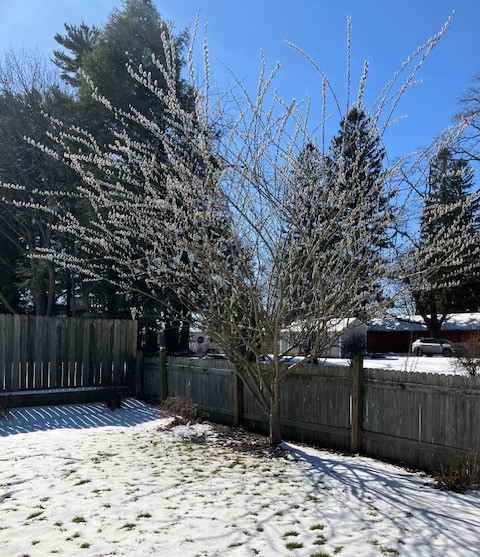
Here on the south shore of Lake Ontario we had a mild winter, and now we’re having an early spring. In February that rascally groundhog didn’t see his shadow, so he probably wasn’t surprised when our daffodils started peeking up from the ground, that green leaves emerged on our hydrangea bushes, or that lush catkins swelled the branches of our pussy willow tree. Robins began hopping about in search of worms, and we awakened to the cooing of mourning doves much sooner than expected. Geese obviously know things we don’t, we spied multiple V-shaped processions flying high in the sky, heading north to Canada, about a month early.
February was also a wild roller coaster ride – a day or two of sub-freezing temperatures with power outages, the result of vicious wind and driving rain or blowing snow — followed by a day or two of sweater weather, bright sun with temperatures in the 50s, 60s and on some days, 70s, Repeat, and repeat. Thank goodness we have a generator.
Now it’s March, the month that in our neck of the woods we call Mud Season. The reason for the name is that the several feet of snow we typically get each winter melts in a rush in a day or two, flooding our streets and making for swampy grass and a mucky beach. This year it never happened, we hardly had any snow. It’s odd, but then again, we’re not complaining. I’m still clipping sprigs from the rosemary plant I grow in a pot on our deck, usually by now it’s turned brittle and yellow.
In the past I’ve never really loved March, we often travel south for warmth and sun, but this year we decided to stay home and put a positive spin on it. March, like its cousins June, September and December, spans two seasons, with winter ending earlier than expected and signs of an early spring everywhere.
The air smells softer, a sweet perfume of ripening earth, and instead of washed-out blue, the sky is now the color of a robin’s egg. The lake, more often than not, is cobalt with frothy waves of white instead of pewter and silver. The days are longer; and we often awaken to a coral-pink sunrise and cheerful birdsong. Instead of heavy coats and boots, we don sweatshirts or sweaters and sneakers for our daily walk.
This year, it’s as though a switch has been flipped weeks earlier than we expected. We’re enjoying it and the opportunity to spend more time outdoors as we anticipate the slow and steady movement towards the vibrant days of summer.
Karen Shughart is the author of the award-winning Edmund DeCleryk cozy mystery series, published by Cozy Cat Press. All books are available in Kindle, Kindle Unlimited, paperback, and Audible and at independent and chain bookstores and gift shops. She is a member of Crime Writers Association of the UK, North America chapter; F.L.A.R.E. ( Finger Lakes Authors and Readers Experience) and AllAuthor.
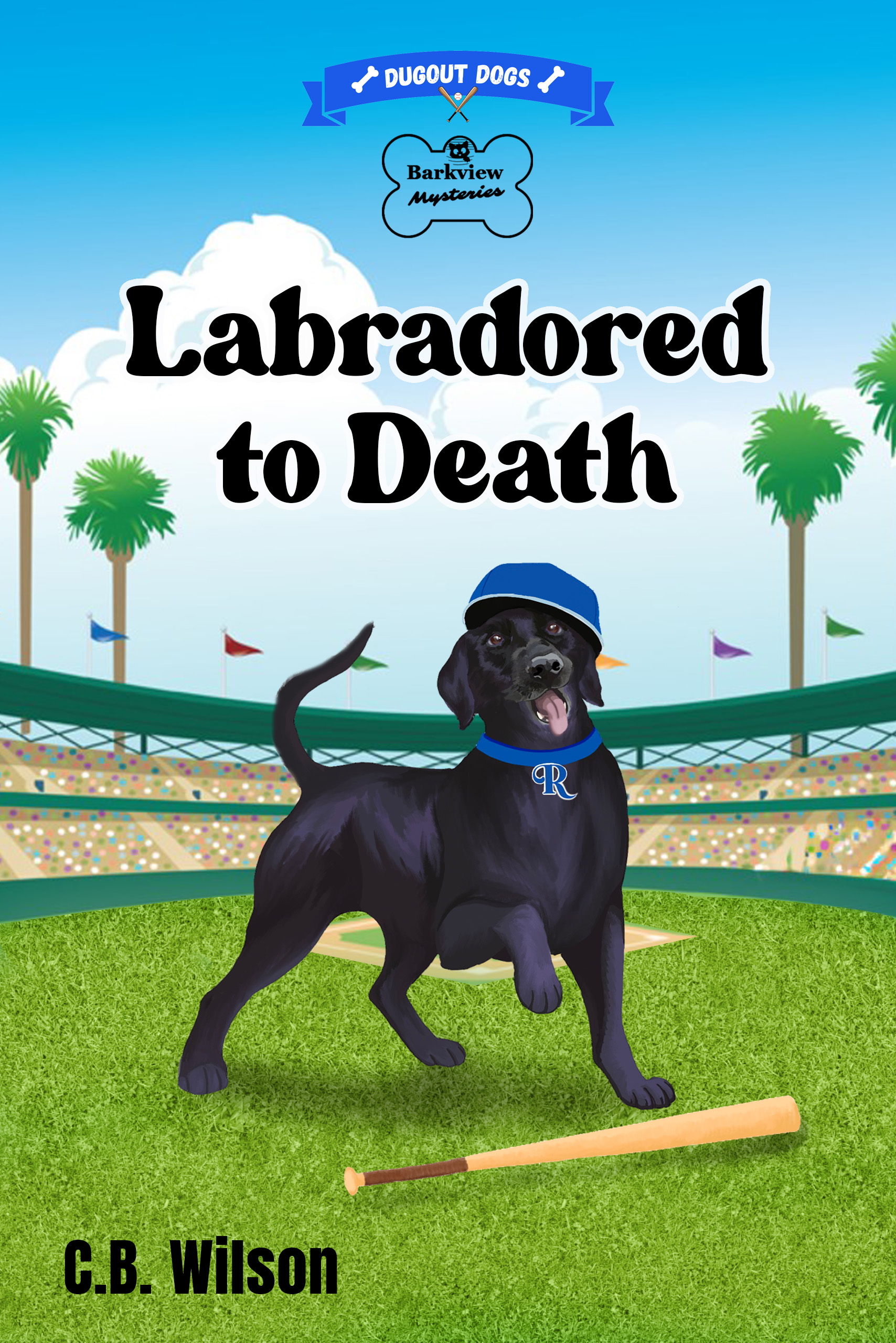
Research is a crucial part of writing for many writers. Some love it, while others hate it. Some writers enjoy it so much they go down that rabbit hole and never get around to writing the story. Others dread it, afraid facts will irrevocably change the story. I fall somewhere in between. Research inspires me. In my latest book, Labradored to Death, Barkview Mysteries book 8, not only did the focus of my book change but a spin-off series was born. You see, I fell in love. (Don’t tell my husband.)
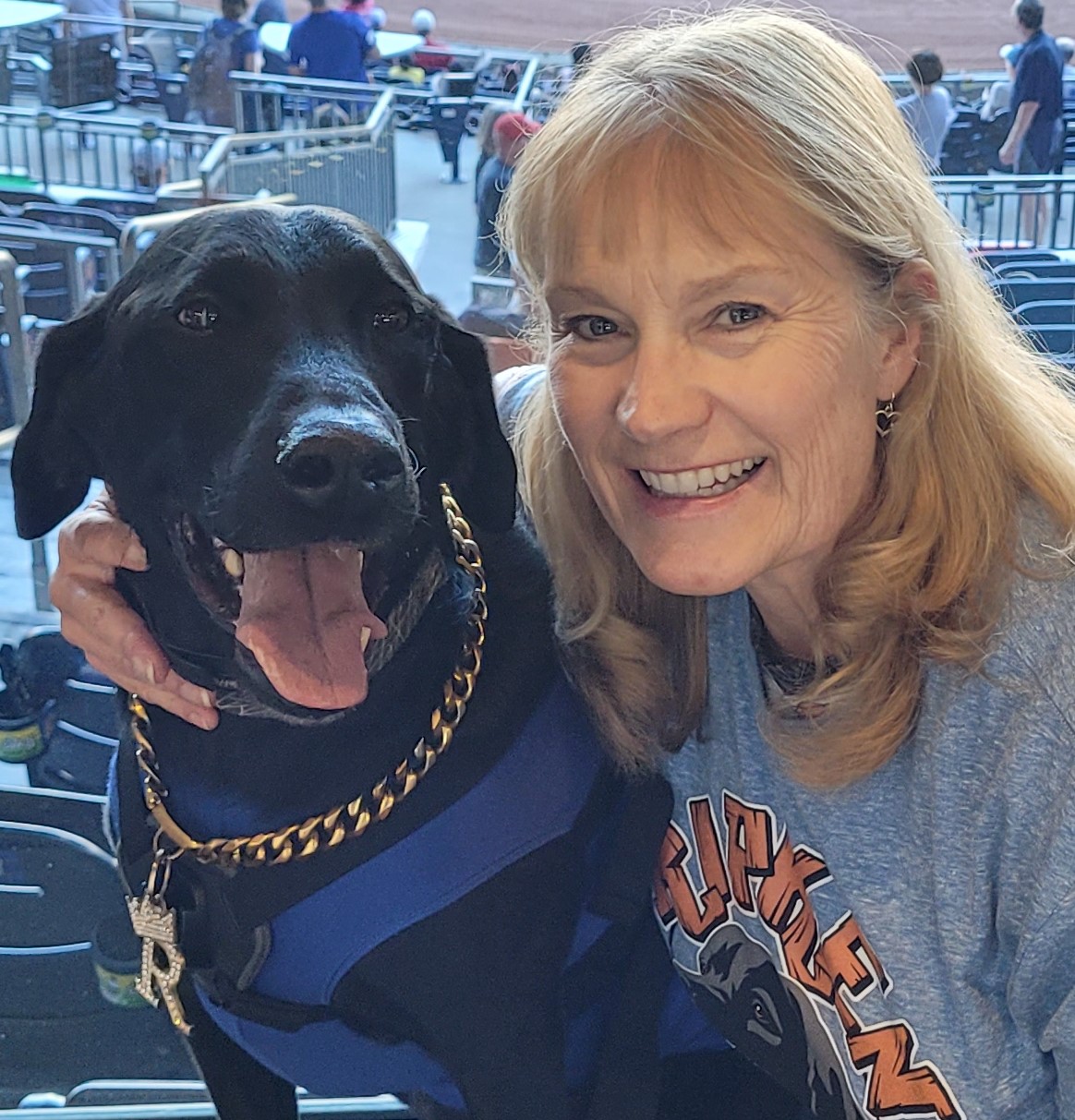
I must admit that I’ve never been a big baseball fan. Sure, I enjoy a sunny afternoon at the ballpark once in a while, but the 7th inning stretch was my cue to scado. Then I met baseball’s bat dogs! These dogs are the new bat boys and work in about ten minor league baseball stadiums. Ripken, Finn, Rookie, Brooks, Turbo, and Miss Lou Lou Gehrig, to name a few. These dogs are amazingly well-trained athletes. I know. I had the pleasure of spending a game on the baseball field with Ripken, the Durham Bulls’ bat dog.
I confess I am starstruck by the black Labrador Retriever. Here’s what happened: It was the bottom of the second. Score 0-0. No hits. Durham Bulls are at bat. The batter hits a double. The crowd cheers. Ripken runs past home plate and down the first base line to retrieve the hitter’s discarded bat. The ENTIRE stadium comes to its feet, chanting, “Ripken, Ripken!”
The dog didn’t even take a bow. He glanced up at the crowd, bobbed his head (Yes, he did), and returned the bat to the dugout. It was exciting. I was ready for more. Unfortunately, the Bulls weren’t a hitting machine that night. However, they did win 3-2. The real surprise came after the Lab left the field. I figured it was time for a well-earned treat. Not a chance. Ripken barely made it off the grass before fans surrounded him. (Brought a whole new meaning to paw-o-graphs.) Is it any wonder the dog’s a fan favorite? With 500,000 social media followers, Ripken, the bat dog, is Durham’s dog.
Talk about a game-changer. Ripken’s story needed to be told. I started by going back to school—puppy school, to be exact—and learning what it took to train these special bat dogs. Black and yellow Labs, Golden Retrievers, and German Shepherds all make popular candidates. The first skill a bat dog must have is the desire to retrieve.
I won’t get into how to train a dog to retrieve. If the skill is natural, that’s the easy part. To be a bat dog, not only does the dog need to learn to fetch the bat, but he also needs to learn NOT to return with anything except the bat, which is problematic. Who knew the baseball diamond had so many distractions? A successful bat dog must ignore everything from shin guards and baseballs to unwanted food items. The dog must retrieve JUST the bat. Every time. Without fail. Did I tell you the bat likely has sticky pine tar on the handle? (ICK! I don’t even want to know what that tastes like.) Wait a minute. The dog must also remain laser-focused while 20,000+ people call out his name.
Have all the above bases been covered? (Pun intended!) Now, get ready for ambassador duty. That’s right. Bat dogs are required to sit for selfies, pets, hugs, and baseball cards while being mobbed by hundreds of fans coming at them from every angle. To say this job isn’t for every dog is an understatement.
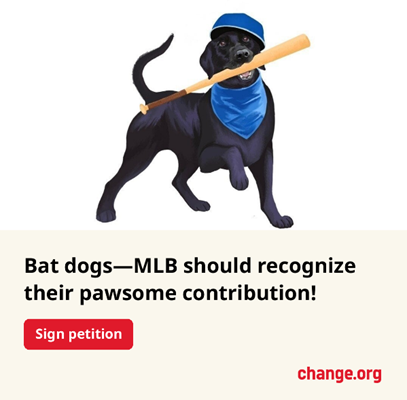
It takes a special dog—a one-in-a-million star. So, why are these dogs ONLY used in the minor leagues? They are all fan favorites. With millions of social media followers, why is Major League Baseball dissing these talented athletes? It looks like a serious case of dog-crimination. I hope Major League Baseball does some research and comes to the same conclusion about the bat dogs’ contributions. Please encourage them by joining me in signing a petition that I will send to Ron Manfred, the commissioner of Major League Baseball, to encourage them to include these pups in major league play. You can find the petition on my website at www.cbwilsonauthor.com.
:Labradored to Death
A daring heist, an epic fire, and a dog who holds all the cards.
Has America’s pastime gone to the dogs? Bat boys replaced by bat dogs! Cat Hawl, KDOG’s editor-in-chief, has a bone to pick with professional baseball. When a million-dollar baseball card is stolen and a celebrity bat dog’s collar is discovered at the crime scene, she learns exactly how high the stakes are.
Barkview’s iconic candy company, Canine Caramel, teeters on bankruptcy while stolen sports memorabilia flood the market and sabotage strikes the baseball museum. The evidence neatly leads to the missing baseball card. Or is it just a diabolical misdirection?
With the town full of die-hard baseball fans, Cat and the fearless bat dog must uncover a conspiracy before the seventh-inning stretch.
QUOTE:
***** Its quirky humor and intelligent banter give it the feel of a Nancy Drew and Miss Marple murder mystery hybrid with an even more exciting conclusion. Reviewed by Essien Asian for Readers’ Favorite
The award-winning author of the critically acclaimed Barkview Mysteries series, C.B. Wilson’s love of writing was spurred by an early childhood encounter with a Nancy Drew book where she precociously wrote what she felt was a better ending. After studying at the Gemology Institute of America, she developed a passion for researching lost, stolen and missing diamonds–the big kind. Her fascination with dogs and their passionate owners inspired Barkview, California, the dog friendliest city in America.
C.B. lives in Peoria, AZ with her husband. She is an avid pickleball player who enjoys traveling to play tournaments. She admits to chocoholic tendencies and laughing out loud at dog comics.
Unfortunately we live in a sound bite age – if you don’t get their attention in X amount of seconds you don’t get it. Time was when authors were advised that you had the first chapter to hook the reader (agent, editor or customer). Then it went down to the first five pages. Then the first page. Then the first paragraph. Now people are leaning toward the first line. Logic would dictate that it would stop there, but in this crazy publishing world I wouldn’t bet on it. With a sad fatalism I’m waiting for a list of sure-fire attention-getting first words. Where things will go after that I don’t even dare speculate.
So what do you do? You grab their attention from the first. Now I’m generous, so I personally work under the three sentence rule. You have three sentences to intrigue them enough to read on. Almost every classic novel violates this rule… some of them adhere to the old ‘first couple of chapters’ convention, which means many if not all would never make it to the shelf today. Of course, novels, conventions and writing styles have changed over the years; what was loved and lionized years – decades – centuries – ago is dead weight today. After all, how many modern people read really old books today for pleasure? (I know some do, and good on them, but we’re talking about modern, short-attentioned modern genre readers.)
So what is it about first lines? People say, you have your cover blurb – why won’t that make them read the book? Well, sometimes it will. It and the cover will usually get the reader to look and pick up the book, but the first sentence(s) will make them want to read the rest. (And like all other things in this more than slightly mad business, this is a generalization. Nothing is ever absolutely certain!)
How? is usually the first question. What do you do to hook the reader? What formula is there to make sure that first line makes them want to continue reading?
The first thing you do not do is start off boring. Don’t talk about the weather, or the pretty scenery, or how much you like your new red dress… unless of course, this is so strange or so much of a clue or whatever that it almost turns out to be the turning point/crux of the story. That’s an individual story call.
Some people just start writing and eventually go back to edit; others end up cutting the first thousand or so words to get a good beginning. Every writer at one time or another has been told “Your story starts in the middle of the second chapter – cut everything before that and lard the information into the story later on.” Other writers can craft a winning first line almost from the get-go. Still other writers come up with a sterling first sentence and then create a story to support it. Even other writers… well, you get the idea. Writing is a highly individualistic enterprise and everyone’s process is different. There are requirements about the finished product, but the process is up to the individual writer.
Back to first lines. Do start off in the middle of something exciting. The hero is caught in the middle of a wildfire or is being stalked by a hungry tiger or is hiding from a gunman – or is being made love to by the most beautiful woman in the world whom he has never seen before. Make his emotions your own. Make the reader wonder (1) how did he get into such a situation and (2) how is he going to get out so much that he has to keep reading.
Once the reader is engaged you can tell the rest of the story – either from that point on or going back to the beginning to tell how he got there or whatever timeline the story demands.
Let’s face it – it doesn’t matter how good and outstanding your story is, or how you present it, the reader is not going to read it unless you hook their interest, and one of the primary tools for that is the first line.
Like most writers, I don’t like the marketing and promotion side of writing. These days we don’t just sit down and write a book, send it off, and hope a publisher likes it. Especially not if you are an Indie author.
Back when I first started writing novels 30 plus years ago that was the process. Write, edit, send a synopsis and first three chapters to agents and editors and then write the next book while you waited sometimes over a year to hear back. If you did get the nod from an editor or agent then it was revisions and after 18 months to 2 years your book was published.
I was lucky to get picked up by a new small publisher who not only helped with editing but taught me a lot about publishing my book. When I had that down, and with a nudge from other author friends, I took the plunge into being an Indie author. And while being with the small press I had to do all my own marketing and promotion, I didn’t do near enough.
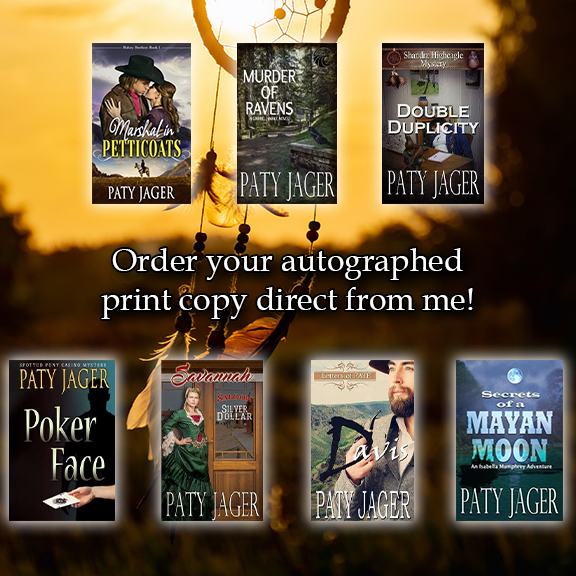
Now, fast forward, I have 55 books, half that are western romance and half that are murder mystery. My heart has always been in writing murder mystery and I feel as if the romance books were what I used as my stepping stones to getting to the genre I love to read and write.
With my murder mystery series, I have been promoting the heck out of them and learning new things as I add more print books and now audiobooks into the mix.
Just when I think I’ve figured out Amazon ads or Facebook ads, or using other promotional third parties, I find out that I messed up with this or with that. I had a promotion scheduled and I thought I’d changed the price of the audio box set. Well, I didn’t so there went the money I paid for the promotion down the drain and the graphics I made to promote the sale will have to be used later when the price finally is changed on all audiobook channels. With this headache, I can see why so many indie authors with audiobooks are selling them direct. It is something that keeps swirling around in my head and I’m thinking strongly about doing it so I can send people to my direct store to purchase audiobooks that I want to put on sale and to get audiobooks for a fairer price all the time.
I have my print books on a direct store and it would only take adding a link to the audiobooks to make it happen. Well, after I upload them to Bookfunnel. That would be another 2-3 hours a day for a week to get them all uploaded. That will cut into my writing time. I have scheduled to write three more books this year. If I don’t get to putting words in the document instead of uploading audiobooks to different vendors and now Bookfunnel, I’d have this book half way written instead of just starting. But once I get them all uploaded I will only have to upload each new book.
“Sigh” Just as I need more energy to do more promoting and marketing, I’m, finding my creative and productive energy doesn’t last as long as it used to.
I have also decided today, after realizing how many more audiobooks I need to upload to Kobo and Bookfunnel that I will from here forward, sit down at the computer with only my book document open and get my word count written before I do promotion or upload audiobooks. It will be the only way I’ll get my book goal accomplished this year.
But it is all worth it when I hear from readers how much they enjoy my books and I receive word that a book is a finalist in a contest. After contemplation I thought I’d put Damning Firefly in the wrong category, I guess not!
Why is it that, when crime is so appalling, crime fiction is so appealing?
Both as a reader and a writer, I’ve always been drawn to mysteries and tales of suspense, and I suspect that most of my fellow Ladies of Mystery would agree. We’re not alone. Reliable stats are hard to come by, but I’ve from what I can find, mysteries and thrillers account for almost a third of all fiction sales. They’re entertaining to read and rewarding to write.
Here are some the reasons why I’m a fan and why I choose to write these kinds of tales.
1. Crime fiction offers great storytelling. I’m not a fan of fiction where a character, lost in thought, takes 200 pages to pour a cup of coffee. I want books where something happens, preferably something of significance to the characters involved. Crime novels satisfy because they have a plot and a purpose, a beginning, middle and end. They resonate with storytelling traditions that have captivated listeners and readers for thousands of years. What makes me happy is a good story well told.
2. Crime fiction brings order from chaos. Mysteries comfort me with the illusion that there is order and logic in what is really a disorderly and confusing world. (As evidence of this, I offer you the year 2024.) Real life is filled with loose ends, unresolved problems, capricious twists of fate, and wrongs that go unrighted. In crime fiction I have the satisfaction of seeing order restored and justice prevail.
3. Crime fiction answers the question: Why? One thing that distinguishes humans from other animals is the ability, and the compulsion, to ask why? Too often real life fails to provide the answers we crave, but as a fiction writer I must come up with explanations for what happens in my story. As I do, I sometimes gain insights that help me make better sense of the world and the people who share it with me.
4. Crime fiction imposes few boundaries. Crime fiction grabs people because it deals with life-and-death matters—the kinds of fundamental issues everyone must wrestle with. But life and death are such vast subjects that the genre offers an unlimited canvas. As a crime writer I can create intimate, personal stories or ones that are global in scope. I can examine the nature of people’s relationships with themselves, with each other, and with society. I can probe the depths of goodness and evil. I can set my stories against whatever background I choose and populate them with characters from any walk of life. Crime fiction is a framework that accommodates any theme, subject, or question a writer might want to explore.
5. Crime fiction lets me taste the lives I’d like to lead. Who doesn’t sometimes long for a life that’s a little more exciting or colorful or adventurous than the one we actually lead? Through our heroes and heroines, crime writers get to experience those lives. When I’m writing, I can be a younger, thinner, braver person. I can travel to new locales, fall in love with ideal companions, and take revenge—on paper, of course—on the kid who snubbed me in junior high or the boss who fired me without cause. I can explore the dark side I normally keep hidden. I can take risks I never would in real life. I can rescue other people, maybe even save the world.
6. Crime fiction is challenging and fun. For me, mysteries and thrillers are reliably fun to read. But fun to write? Okay, not always—some days I’m blocked and frustrated, ready to tear out my hair. But I love the way writing crime fiction lets me be creative. It challenges my cleverness, wit, and problem-solving skills. Instead of solving a puzzle, I get construct ones that will, I hope, baffle readers. I dream up characters and have the thrill of watching them come to life on the page. I can’t think of anything I’d rather spend my days doing than write.
Those are my reasons. Why does reading or writing crime fiction appeal to you?







 Ladies of Mystery
You must be logged in to post a comment.