IF ONLY…

Whew! I finally finished the rough draft of my latest book, IF ONLY. This is a crossover novel with characters from both my Sam Westin Wilderness Mysteries and my Neema Mysteries. When readers kept asking when the next book in these series would be published, I got the wild idea to write one mystery that would fit into both series, thereby making my life easier.

I must have been drinking when that inspiration struck, because as it turned out, nothing could have been less easy.  Now, if you have different series but similar locations and goals, writing a crossover novel might be relatively simple. But the only way I could figure out how to make a wilderness adventure story (Sam Westin series) fit together with signing gorillas (Neema series) in two different locations was to write each story separately, and then stitch them together.

Well, I sort of forgot that I’d have to keep strict track of the passing time in each story so I could switch back and forth without making readers feel like they were on a time-travel merry-go-round. That was a bit of a nightmare, somewhat similar to when I cook and try to get all the dishes to be done at the same time. (You don’t want to watch me when this happens.)

And then there was the issue of figuring out a mystery that can be happening in one locale that will have something to do with the mystery in the other locale. If I wrote thrillers, I could have come up with scattered terrorist cells or something like that, but neither of these series include those kinds of books. A terrorist cell in the mountains of North Cascades National Park seems implausible, and terrorists having anything to do with captive signing gorillas even more so. The issue I finally came up with is illegal migrants seeking asylum in the United States.

I’m not going to give away how I wove the plots together, but I hope the resulting story will be satisfactory to readers of both series. I called the book IF ONLY, because it’s about having the bad luck of being born in a violent, poverty-stricken country instead of in a relatively safe, prosperous one like ours. And it’s also about the wonderful and horrific things that can happen when wilderness lovers choose to take the trail less traveled.

Some may conclude, especially since my novel Borderland included issues at the southern border, that I believe our borders should be open to all. That’s not true. But I do believe the United States should have a reasonable immigration program, and there are parts of our country that need more workers. I would personally like to see a program in which immigrants would be assigned to such areas and such work for five years, and in which communities and employers would agree to sponsor immigrants and ensure affordable housing and at least minimum wage salaries, and agree to periodic inspections and interviews so that abuses don’t take place on either side. But so far, nobody has let me run the country.

Many times while I was writing this novel, I thought to myself, if only I hadn’t planned to do a crossover novel, I could be out hiking right now. And there’s still a long way to go from rough draft to publication of this novel.

I See Characters

Every writer puts a bit of the people around them into their characters. We can’t help it. A friend has a quirk that we like and we give it to a character. A relative has a situation that would make for a great subplot, we use it. Even though we are writing fiction, bringing in the bits of real life that we see brings those fictional characters to life.

Last month while working at a NIWA (Northwest Independent Writers Association) booth selling my book and those of other authors in the organization, some unusual characters came by and talked to us. One of my strengths is being a good listener. Only there does come a point with some people when even I started getting antsy and wish the person would move on. Either physically or with their topic.

One person who has stopped by our booth the last two years that I’ve been there is a man who likes to discuss how the government is listening into everything that is going on and how he believes the aliens will soon return to save the planet. He gets very adamant about why he lives off-grid and how we are all being tracked. I’m thinking someone with his perspective on life will show up in one of my books.

Another young man, well, young to me, I believe he might have been late twenties or early thirties. He had a British accent, wore his hair in a shoulder-length bob, and had on a typical t-shirt a male his age would wear and then he had on a skirt that was tight enough across his hips that you could tell he was male if his voice hadn’t given him away. He had a dog on a leash. As he talked to us, he constantly pushed the hair away from his face, adjusted his glasses, and kept his dog from wrapping the leash around his legs. He was quiet, talked a little about the books and how he’d thought about writing, but he didn’t have a clear vision of what he wanted to write.

The third person who captured my attention and sent a chill up my back was a woman. She walked up to the booth dressed in a long flowy skirt, matching sweater, and a silk scarf around her neck. She looked like the wife of a businessman or a professional herself. Her smile was wide, her eyes lit up with the smile and she said, “Hello. I’m here to spread love. Elon Musk and I are building a world filled with love. Come join us and together we can make the world a better place.” I smiled and said, “That’s nice. The world could use more love.” She asked about a couple of the books, then reiterated that she and Elon needed help to spread the love. I nodded and smiled and then- the creepy part. Her eyelids started fluttering, her eyes kind of rolled up, and her smile disappeared. When she stared at me anger simmered in her eyes and she said, “I know where the bodies are buried. I do. I know where the bodies are buried.” I had no words for that response from her. Then as quickly as she’d changed, the smile was back and she said, “I have more love to spread, ” and walked away.

I was speechless for a few minutes. The other member of NIWA who was in the booth with me had been on the phone while I was talking to the woman. I sat down, grabbed a pen and a piece of paper, and wrote down everything she said and how she looked.

And that woman is a secondary character in my September release, Down and Dirty, book 6 in the Spotted Pony Casino mystery series.

It is encounters like this that give writers the fodder for their stories.

The Cocktail Party Question

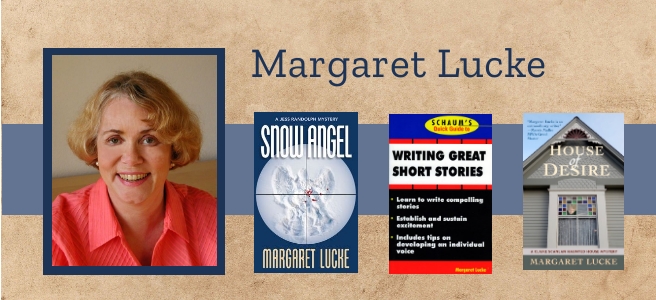
by Margaret Lucke

Here’s a scene you’ll probably recognize. You’re at a cocktail party or a reception or some other event that involves standing around with a glass in your hand and making small talk with strangers. You’re chatting with someone you’ve just now met, and one of you says, “So, what do you do?”

The other one replies, “I’m a (fill in the blank). How about you?” After a brief exchange, you each nod politely and start looking around for someone else to talk to.

Some years ago, mystery novelist Linda Grant told me how she gave this standard, stilted conversation a new twist. Instead of mumbling, “Oh, how interesting,” when the other person named a profession, she would follow up with this: “Tell me, in your line of work who might you want to murder, and why? And how would you go about doing it? What weapons would you have at hand?”

The first response would be shocked silence. She could see the thought flickering in her companion’s eyes: What kind of nutcase are you?So she would smile and add, “Hypothetically of course. I’m looking for ideas for my next book.”

Then would come the sly grin. “You know, there’s this guy in the sales department . . . “

Almost everyone could come up with a person who would make a good murder victim, so long as it was only on paper. A backstabbing colleague, an overbearing boss, a customer who refused to pay a legitimate bill, a coworker who made everyone’s life hell by shirking responsibility or constantly cracking his knuckles. The types of victims and the motives for killing them seemed fairly universal.

What varied were the weapons—and it turns out that most of us have some at our disposal while we’re on the job. The car mechanic can tamper with the victim’s brakes. The clerk in the clothing store can wrap the silk sash from a dress around a person’s neck. The chef can chop a death cap mushroom into an omelet. The carpenter and the gardener can choose from several tools with sharp blades. The writer can bash someone over the head with a computer printer—and don’t think we’re not sometimes tempted.

At the time when Linda told me about her Cocktail Party Question, my husband and I owned a small printing business. The next day when I went to work I spent a few minutes doing a quick inventory of available tools for murder. We had cans of chemicals that were toxic or flammable, equipment that could be rigged to malfunction in ways that would cause its operator great bodily harm, a large paper cutter appropriately known as the guillotine. I found myself fingering the edge of the X-Acto knife blade. Very sharp, but too small to do the job? Maybe if it were pushed at just the right angle into just the right soft and vulnerable place on the body . . .

When I’ve taught mystery writing classes I’ve used the Cocktail Party Question as an icebreaker on the first day, pairing up students and having them ask and answer it for each other. At first all they can talk about is how weird the teacher is, but then they get into it, stretching their imaginations and beginning to see new possibilities for plots and characters.

Now it’s your turn. Choose your weapon as I pose the question to you: In your line of work, who might you want to murder, and why? And what weapons does your profession provide that could help you accomplish that dire deed?

Who knows, you now just might have the seed of a good mystery novel.

* * *

Speaking of mystery writing classes, I’m going to be teaching one of those this fall for UC Berkeley Extension. Ten Wednesday evenings from September 11 to November 13. It’s on Zoom so you can join from anywhere. If you’d like inspiration and information on crafting crime fiction, from cozies to thrillers, or feedback on your work in progress, this class could be for you. Check it out here: https://tinyurl.com/mysterywriting2024

My Apologies…

There’s no blog today, a fact for which I am very sorry, however between several unexpected events it could not be avoided. I apologize and promise to do better. Sometimes these things just happen, not the least of which is this week’s release of 50 BLOGS ON WRITING AND THE WRITING LIFE BOOK TWO. I apologize. I hope all of you are staying cool and hydrated in this summer heat. Please take care of yourselves. See you next month…

Sitting on a Porch, Rocking

I was recently in New Mexico, where I spent several days in Lincoln and nearby Fort Stanton, in the mountains in the southeastern part of the state.

I call it location research. I look at places, landscapes, and buildings, poking around in old buildings and imagining what they looked like 150 years ago. Did this valley have that many trees way back when? Was that building there during the time of my novel? If not, what was in that spot, and what did it look like? I need to figure out what a character might see when exiting a store or residence.

That’s why I also went to Santa Fe, where I spent productive hours in the Fray Angelico Chavez Library at the New Mexico State Historical Museum. My time in the document and photo archives at the history library gave me access to maps and old photos of the places for my work in progress, a historical novel taking place in New Mexico in the late 1870s and early 1880s. It involves the Lincoln County War and yes, Billy the Kid puts in an appearance, along with a number of other historical figures.

While in Lincoln, I stayed at the Wortley Hotel, now a bed and breakfast. The original hotel was built in 1872 and in operation during the troubles in Lincoln County. I spent a lot of time sitting on the front porch of the hotel, rocking, watching the passing parade of people visiting Lincoln. I mean, the whole town is a New Mexico state historical monument. I also watched the birds, watched the flowers, watched the light change. When I sat on the back porch of the hotel, I heard water rushing by in the nearby Rio Bonito, in addition to the clucking chickens from the proprietors’ coop down the hill.

I walked the historic grounds of Fort Stanton, a well-preserved frontier fort, though it has been amended, remodeled and tinkered with since it was founded in the 1850s. Since my protagonist is the daughter of an Army officer stationed at the fort, I wanted to see what the officers’ quarters looked like, keeping in mind that they were rebuilt in the 1890s, with a second story and kitchens added. However, during the era I’m writing about, the kitchens were in separate buildings out back. That’s important information to have when my protagonist is cooking dinner. Fortunately, when I toured the unit that’s open to the public, I found an architectural drawing showing how the old quarters looked.

Talk about history. This particular unit had been occupied in the 1880s by Lieutenant and Mrs. John J. Pershing. Recognize that name? They called him “Black Jack” Pershing, perhaps because he commanded African American troops known as Buffalo Soldiers. He’s the one who led an expedition to Mexico in 1916, going after Pancho Villa, and when the United States entered World War I, he was named commander of the American Expeditionary Forces.

While at Fort Stanton, I learned that the landscape around me looked very different way back when. Now the pinon and junipers dot the rolling hills around the fort, but back then it would have been grassland. The photos I got from the history library underscore that.

I also learned about the murder in the dining room at the Wortley Hotel, back in the bad old 1870s. What? I’d never heard that one. It seems the victim was a Buffalo Soldier stationed at the fort, which was home to several units of the Ninth Cavalry. The soldiers would often come to town and have a meal at the Wortley. At that time, the hotel dining room had a big table and people sat down where there was a vacant seat. In this case, a white patron took offense at a black soldier, pulled a gun and killed him.

After Fort Stanton was decommissioned in the 1890s, it became a hospital for people with tuberculosis. That era lasted for decades. Then, in World War II, the fort housed German prisoners of war. The information gained about this is outside the focus of research for my current WIP, but full of potential for historical mysteries. My little gray cells are already thinking about plots and characters, even as I sit at my computer.

And I’m recalling how good it felt to be sitting on that hotel porch in Lincoln, NM, rocking, watching the world, and the birds.