Thankful Thursday

I loved the last mystery I read, but I don’t remember who the killer was. I do remember being deep in the story because the author took me on a wonderful journey. The book was set in the 1940’s, and she did such an amazing job of immersing me in the story world. The setting, characters, and storyline were so exquisite that the solving of the crime seemed less important.

Now, I know that those of you who read mysteries for the puzzle might have a different take on this, and sometimes I do too, especially when I’m totally surprised by the killer. But at times, the story journey is so special that the ending is inconsequential.

Today, I’m thankful for all the writers who’ve gone before me. I was a huge fan of Mary Higgins Clark’s books. When I sat down to read one, it was like sitting down with a good friend while they told me something that happened to them. I would get so engrossed in the story I didn’t want it to end. I read her books straight through and was sorry I did because I had to wait a year for the next one.

A few years ago, I took a class on writing from Robert Dugoni. It was such an amazing class by a wonderful writer and teacher. The class was small, maybe twenty people, and I still think about what he taught and how fortunate I was to be there. Robert talked a lot about finding the heart of the story. At the time, I was new at writing novels and even though I loved what he said, I didn’t know how to apply it to my work.

Now, after publishing three mystery novels, I feel like I have a better understanding of what he meant. The main character in my Hood River Valley Mystery Series is a woman detective, Liz Ellisen. Liz is the driving force of the story, but as I thought about this, I asked myself, what about her draws the reader in? What makes them ask for more books about her?

Liz puts her heart into solving crimes, and she wants to find justice for the victims. She can be strong and tough, but she can also be tender and loving. And even though her own life hasn’t always been easy, she wants to make the world a better place for others.

I recently had my books for sale at a holiday bazaar. A lady came in and bought three copies of my latest book, one for each of her sister’s for Christmas. She said, “I loved all of your books, but this one is my favorite.”

As with most writers, I hope that my books get better with each one. But I’ve found that some people like my stand alone novel, which was my first published novel, better than the series. And other people like the series best. It’s such a thrill when someone buys my books for their friends or family because they enjoyed them so much.

I feel that finding the driving force of the story is also about finding the heart of the story. Thank you to Robert Dugoni for sharing that. I would love a sign to put up in my office that says, “What is the heart of this story?” I’m hoping I’ll remember to dig deeper to really find what drives my characters and in so doing, find a way to connect to my reader’s hearts.

So this Thanksgiving I’m thankful for all of the writers, teachers and readers who have brought me such joy over the years. I’m also thankful to each of you for reading this blogpost and to Ladies of Mystery for inviting me to write a post on the blog.

Happy Thanksgiving. May your heart be full of love and may we all find the heart in our stories.

My view as I write. Yes, sometimes it’s difficult to concentrate, but not today. Today it was pouring rain and the mountain was hiding. Blessings, Lana

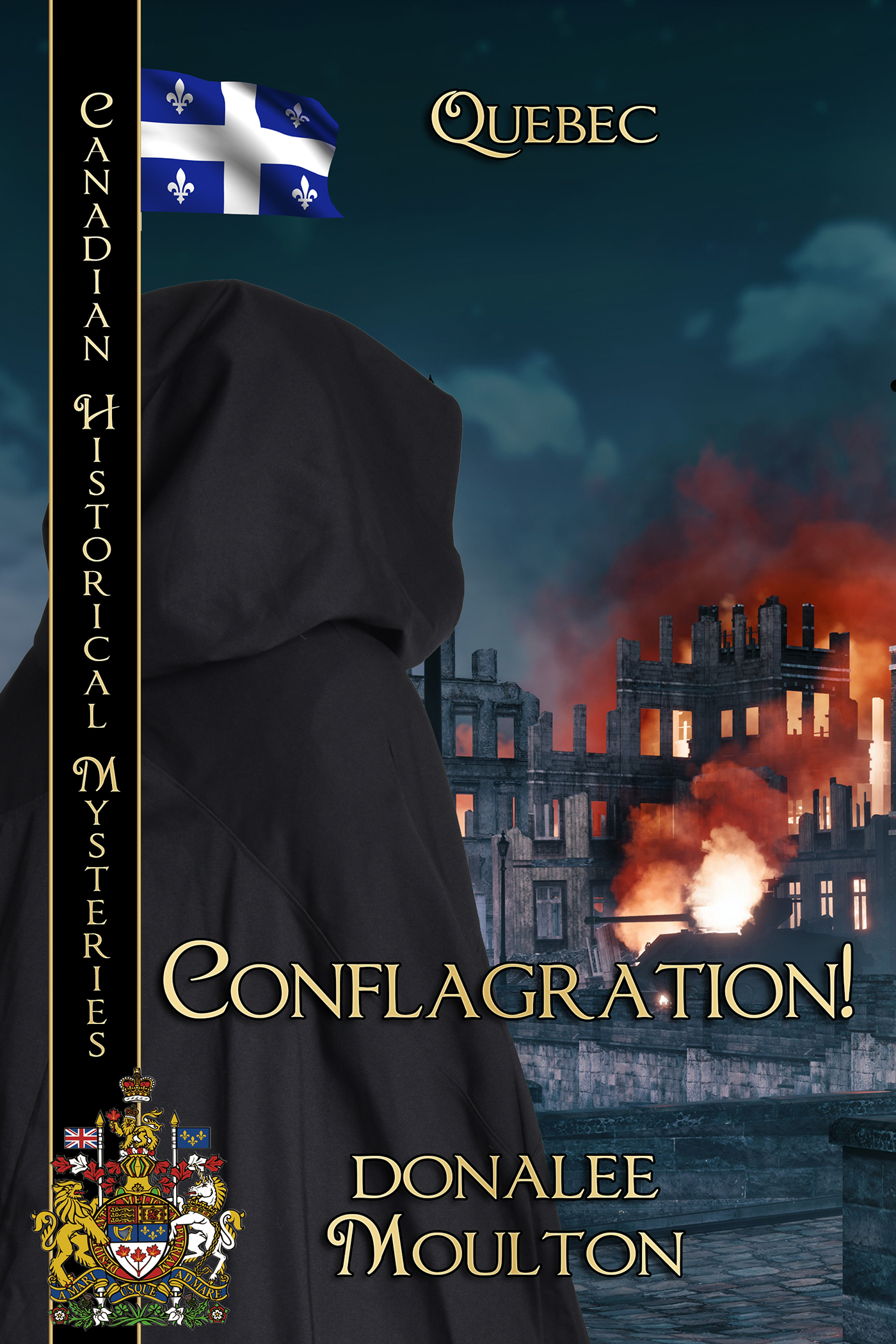
Inside Conflagration!

cover of book Conflagration!

Mud is everywhere. It defines Montréal in April. The snow continues its laborious melt, the ice in the St. Lawrence jostles the shoreline, the clouds hover relentlessly close to earth, and everywhere there is heavy, wet, sticky muck. It adheres to the sides of shoes, the bottoms of coats, and the brims of hats whipped to the ground by winds, there one minute, gone the next.

I look down. My boots are caked in grime, a primordial ooze from the earth, from under the sea, from crevices unknown. I will spend much of this evening cleaning heels, toe caps, and outsoles only to have more mud adhere tomorrow. These caked brown scars are visible reminders that I am not at home. Not at home in this town. Here I have no roots, no history.

Home is Acadie, another world away in another part of New France. My home, admittedly, has mud, but it is the mud pigs roll in to cool their skin, the mud farmers use to build dykes, the mud kids make patties with under the spring sun. Montréal mud is a nuisance, a bother, a reminder of life’s inconveniences.

I am feeling sorry for myself. I am missing my family. It happens. I accept the ache, acknowledge its origins, and move forward, literally through more mud. I remind myself of Madeleine, my wife. She makes life in here bearable. She makes life breathable.

The afternoon sun hides behind clouds. But even in disguise, its demise for the day is evident. Soon it will be dark. I need to push onward, deliver these papers, and make my way home before nightfall. Before the mud becomes invisible, and treacherous. The ground is still hard and much of it frozen; mud will not break a fall, but it will cause one. I need to be careful. For Madeleine.

* * *

François de Béréy’s home is large by Montréal standards. Indeed, it is large by any standard. It rises three floors in the heart of the merchants’ quarter on rue Saint-Paul where it announces its presence to fur traders and aspiring businessmen without saying a word. It sits across from the Hôtel-Dieu de Montréal, the town’s convent and hospital. Three sisters in full habit are outside getting, I assume, a much-needed break from the rigors of tending to the ill and the injured. Immediately, I feel guilty for my selfishness, for a little mud. I nod at the three nuns acknowledging their presence and, I hope, their worth. The three women nod back.

I turn away and knock on the door in front of me. A young servant girl answers. She is about seventeen, dark brown hair pulled back in a bun, pleasantly overplump. She wears a white apron. Her head is bowed. “Philippe Archambeau pour Monsieur de Béréy, s’il vous plait.”

The young woman scurries off. She is back in a few seconds. She ushers me into the foyer. She does not look at me.

My business is over as quickly as it began. Documents delivered, and my day is done. The sun is struggling with the horizon, and losing. I would like to be home before it cedes the daily battle. I hurry down to the street. Two women are talking at the bottom of the steps, a servant and a Panis slave. They turn their backs to me and continue their conversation. As I walk past, I hear only one word: conflagration.

The Panis woman, likely, I thought, from a tribe south of Montréal, turns in my direction as I pass. It is a vacant look; I doubt she even sees me. But I see her. In two days, I will put a name to her face: Marie-Manon.

* * *

A heavenly aroma greets me as a walk through the front door. We live several streets away from the merchants’ quarter, on rue Saint-Antoine, closer to where I work as a court clerk. Madeleine knows somehow today was a long day and a hot beverage will be welcome. The tea, a Bohea blend infused with orange peel, is a special treat. It helps to warm my chilled bones and reassure my feet they will work tomorrow. Madeleine places my boots at the front door. I will tackle them later. Supper is hot and satisfying, smoked ham with potatoes, cabbage, and onion. More tea follows the meal. As does conversation. This is our time. Madeleine listens with her ears and her heart. This is my favorite time of day.

And I talk about mud. My wife knows I am not really talking about mud but about Montréal, this town that is my home and not my home. “There is mud in Acadie,” she says gently. She pats her stomach, almost absently, and reminds me that soon this town will also be the home of our first child.

“I’m sorry.” It’s the least I can say. What I can do is make our conversation what it should be and what it usually is: meaningful.

“I was in the lower town today.”

Madeleine smiles. “I bet it was muddy.”

“I saw a Panis slave. My guess, she is from the Fox Nation. Sold to someone here.”

“You see slaves every day. Yet you remember this one.”

“You are, as usual, right. I saw several slaves today on rue Saint-Paul alone. And a young servant girl. It all disconcerts me still.”

I am familiar with slaves. We have slaves in Acadie, but they work the farms, the field, the land as we all do. They seem part of the landscape. Perhaps they do not feel that way. I say this out loud to Madeleine. She does not dismiss the notion as odd as it may be in this town of 3,000 people that includes hundreds of slaves, maybe more.

“Do these slaves look differently to you? Do they act differently?”

They do not, and they do. “It is the vacant stares, the abbreviated eye contact. It does not sit well in my heart.”

“Another cup of tea will solve that.”

I will come to realize that what I see is the look of those imprisoned. It is the face of those who have no means of escape. Later I will associate it with the wall that surrounds Montréal.

I hate that wall. It closes me in. It is supposed to make me feel safe. It doesn’t.

* * *

Madeleine is sleeping. She sleeps a lot these days. I understand her body needs this even though she fights it. My mother also slept when she was with child, my brothers and sisters.

I take the last of the tea, reheated on the hearth. Madeleine would not approve. She would make a fresh pot, and we would talk. Tonight, she sleeps, and I look at the stars. They are the same stars I see in Acadie. And they are not.

From my front door, from most front doors, the wall is not visible. It is as if it does not exist. But we all know it surrounds us. Or almost surrounds us. For nearly twenty years, Gaspard-Joseph Chaussegros de Léry has planned, managed, and propelled the building of ramparts literally designed to protect Montréal from its enemies, primarily the British. New France’s chief engineer will see this wall finished, this town cocooned in stone.

The wall is flanked. Anyone who dares attack Montréal will know what faces them before they ever arrive at these ramparts. That is deliberate, and doable in large part because the town lies on moderately flat land. Curtain walls and strongholds and drawbridges and posterns span 3,500 metres. We are fortified in black limestone and grey crystalline.

The wall speaks to the power of France, and to the consideration of our King, Louis XV, and his famous great grandfather before him. It exudes authority.

It also promotes the trades. Montréal is flourishing inside these ramparts. The wall requires stone fitters and masons. Sawyers and blacksmiths and haulers are also needed. There is enterprise in the rise of these enclosures.

The wall speaks as well to those who seek to make money. It says, “You are safe here. Your business will thrive.”

With the wall comes commerce, particularly fur trading. Businesses spring up around this endeavour. Indeed, Montréal is a trading post. Where there is trade, there is community and the shops, markets, and supports needed to bolster and enshrine a town. In the time since the wooden palisade that once circled Montréal was replaced with this new wall, approximately 400 houses have been constructed. And the wall is not yet finished.

Of course, prosperity requires judicial overwatch. Our courthouse bustles with the legal business of business. It also punishes, as it must, those who dare to defy the King’s laws. I know this firsthand. I sit each day in that courthouse. I record the testimony of those who walk through its doors. Many faces are familiar. Many are unknown.

None will leave as great an impression as the twenty-five who will walk through its doors in the next twenty-two days.


Guest Blogger ~ Susie Black

How I Develop My Characters and Plan My Mysteries

By nature, I am a people person, so, developing characters is where I begin when planning a story. Once the characters are created, the plot is built around them, not the reverse. So, how do I develop my characters? I have kept a daily journal chronicling all the interesting, difficult, and oddball people I have encountered as well as the crazy situations I’ve gotten myself into and out of during my apparel sales career.  The journal entries are the foundation of my mysteries. All my characters are based on people I have encountered in my career as a ladies’ swimwear sales exec. I take the characteristics, quirks, traits, and personalities of these real people as the foundation and then build upon them to create the cast members I want in the tale. Basing my characters on people I know has given my cast a ring of authenticity and that believability has translated into memorable characters readers root for or boo at, but either way, invest in.

To illustrate my character development technique, I’ll detail how I created Holly Schlivnik, the protagonist of the Holly Swimsuit Mystery Series. Holly Schlivnik is based on me. She is the me I always wanted to be and more. She is fearless, loyal to a fault, and smart. 

Holly is infused with me in every respect- from her physical description to her personality to her life experiences, career, family, friends, the kind of car she drives, and where she lives.

Physical Description:

Holly is slim as I am and is my height- 4 feet 8 inches to be exact. I have made the consequences of her height lack of it, a key component of the messes she gets herself into and the adjustments she’s had to make in her everyday life to accommodate her height. These situations add to her personality and turn into some of the funniest schticks of the series. She has brown eyes and short brown hair like mine.

Personality:

Like me, she is funny, sarcastic, stubborn, wise-cracking, and irreverent.

Idiosyncrasies, and inherited traits:

I inherited a fear of death from my maternal grandmother that we both overcompensated with the nervous habit of laughing, often inappropriately. I incorporated this idiosyncrasy into Holly’s personality and made it one of the main characteristics that identify her. I also inherited my grandmother’s rapier wit and a love of perfume and jewelry. I blended these into Holly’s personality as well.

Family: My dad was a ladies’ apparel manufacturer’s representative and I started my career working for him and so is Holly’s dad. I got into the rag biz by accident and so did Holly.  Holly also started her apparel career working for her father. My parents were complete opposites who had a very successful marriage and so are Holly’s. Holly’s parents, bigger-than-life maternal grandmother, and siblings were all based on my family. 

Religion: Like me, Holly is Jewish and the traditions and history are woven throughout the series and add to the richness and authenticity of each story.

Love Life: While I lived in the South, I did have two men in my life one of who I have introduced into Holly’s life.  Unlike Holly, I have never had a personal relationship with a police detective.

Pets: Sigmund Freud, Holly’s wildly popular standard poodle/psychiatrist and amateur sleuth, is based on the personalities of my own two springer spaniels. While he can’t talk, like my two hounds, Siggie gets his point across. He shakes his head yes and no, rolls his eyes, barks if he disagrees with Holly, and has been known to pull her in the opposite direction if he doesn’t think Holly is going the right way.

Health and habits: To keep my girlish figure, I am a dedicated walker I walk three miles every day- and have made Holly’s daily walks with Sigmund to the Washington Street Pier an important part of her routine. “Pop,” the senior citizen fisherman she has befriended and shares morning coffee with on the pier has helped her solve several murders.

Hobbies: I have been an avid stamp collector since my pre-teen years. In book number six, which was recently released, it is revealed that Holly is a stamp collector. She encounters someone tangentially involved in a murder while at her stamp dealer’s store.

Car: I have owned convertible cars throughout my driving career. I incorporated my love of convertibles into my stories by having Holly drive a bubblegum pink classic convertible passed down to her by her mother. 

Home: I lived on a houseboat in Marina del Rey for ten years. I loved living on the water in a houseboat and amalgamated that into the series by having Holly live on a houseboat in Marina del Rey, California. I have used Holly’s houseboat and marina locale as an integral part of Holly’s personality as well as the site of her adventures and misadventures as an amateur sleuth. 

Age: Holly is on the shady side of her twenties when she is promoted from a sales rep to a management position. This is the same age when I made the leap from sales rep to executive management.

Friends and colleagues:  Like me, Holly is in a traditionally male-dominated industry and is one of the very few females in a management position. I surrounded her with a group of female professional colleagues and friends who supported her and mentored her like the ones I was fortunate enough to have had to do the same for me. The Yentas are based on that group of wonderful women.

Career:

Holly is the same successful ladies’ swimwear sales exec based in the Los Angeles apparel center as me. 

Employment: Ditzy Swimwear and Mermaid Swimwear are based on two swimwear companies I worked for.

I have created a fictionalized me that has been fun to bring to life. Fortunately, unlike Holly Schlivnik, I have never discovered a murdered person or hunted down a killer…at least, not yet!

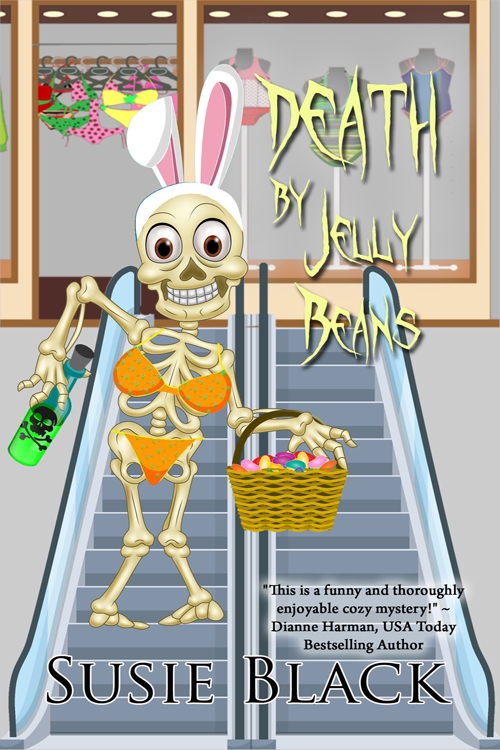
Death by Jelly Beans

“Brings a whole new meaning to the rabbit died.”

Mermaid Swimwear President Holly Schlivnik discovers the Bainbridge Department Store Easter Bunny slumped over dead and obnoxious swimwear buyer Sue Ellen Magee is arrested for the crime. Despite her differences with the nasty buyer, Holly is convinced the Queen of Mean didn’t do it. The wise-cracking, irreverent amateur sleuth jumps into action to nail the real killer. But the trail has more twists than a pretzel and more turns than a rollercoaster. And nothing turns out the way Holly thinks it will as she tangles with a clever killer hellbent on revenge.

https://www.amazon.com/Death-Jelly-Beans-Swimsuit-Mystery/dp/B0D88FNBSS

https://www.barnesandnoble.com/w/death-by-jelly-beans-susie-black/1145804565?ean=2940186124580

https://www.goodreads.com/book/show/212700868-death-by-jelly-beans?ac=1&from_search=true&qid=PWl56Hmfkz&rank=1

https://www.bookbub.com/books/death-by-jelly-beans-holly-swimsuit-mystery-book-5-by-susie-black

Named Best US Author of the Year by N. N. Lights Book Heaven, award-winning cozy mystery author Susie Black was born in the Big Apple but now calls sunny Southern California home. Like the protagonist in her Holly Swimsuit Mystery Series, Susie is a successful apparel sales executive. Susie began telling stories as soon as she learned to talk. Now she’s telling all the stories from her garment industry experiences in humorous mysteries.

She reads, writes, and speaks Spanish, albeit with an accent that sounds like Mildred from Michigan went on a Mexican vacation and is trying to fit in with the locals. Since life without pizza and ice cream as her core food groups wouldn’t be worth living, she’s a dedicated walker to keep her girlish figure. A voracious reader, she’s also an avid stamp collector. Susie lives with a highly intelligent man and has one incredibly brainy but smart-aleck adult son who inexplicably blames his sarcasm on an inherited genetic defect.

Looking for more? Contact Susie at:

Website: www.authorsusieblack.com

E-mail: mysteries_@authorsusieblack.com

Book Bub: www.bookbub.com/authors/susie-black

Facebook:    https://facebook.com/TheHollySwimsuitMysterySeries

Good Reads: https://www.goodreads.com/search?q=susieblack&qid=MDCXK0T4FC

Instagram:   Susie Black (@hollyswimsuit) • Instagram photos and videos

Linkedin: https://www.linkedin.com/in/authorsusieblack-61941011

Pinterest:  https://www.pinterest.com/hollysusie1_saved/

Twitter:    http://twitter.com/@hollyswimsuit

Falling In Love With Your Characters

by Janis Patterson

Don’t worry – this isn’t a post about romantic love, though show me a woman who writes romance (as I do sometimes) who doesn’t get all hot and bothered over writing the perfect hero. Just imagine… you can create the perfect man with muscles, a twinkle in his eye, a rugged but handsome face, sensitivity, strength… the perfect Build-A-Hunk kit.
That said, however, we all know there are many kinds of love, so for this post, at least, let’s forget the idea of hearts-and-flowers romantic love.


Do you believe writers should love their characters? I do. Now I will admit that any competent professional writer can create a believable character on technique alone, without anything empathetic or sympathetic or even liking between writer and character. I’m not talking about whether this character is a villain or a hero – we’ve all either written or read a story where the villain is the most likable character. I’m talking about a deeper connection – an instinctual, inner knowing how the character feels/reacts opposed to declaring through technique how the character will feel/react.


Personally, I am all for the empathetic (it’s more than that, but we need to give it a codeword for this essay) approach than the purely technique-driven format. You and the character – perhaps all the major characters, and yes, it’s possible to jump from head to head – almost meld into one. You know what he is going to say. You know what he is going to do. It is almost as if you were doing it yourself.


By contrast, the technique way is very one sided. You have created a character, maybe even using the old trick of the character interview – a questionnaire which you answer as your character. This is supposed to give you an insight into the character’s mind and being. There are the standard questions of name and age and eye color, but some are so detailed they go in to truly deep (and in my opinion useless unless there is a direct tie-in to the plot) question such as the maiden name of the character’s grandmother and his favorite flavor of Jell-O. My personal reaction is this creates a Frankenstein-like character – everything is there, everything works, but it isn’t really alive.


Most of my writer friends look at me askance when we talk about character development. Many of them use some version of the character interview model, whether or not they use a written sheet of questions or just keep the information in their head. Some brainstorm with other writers. I’ve never heard of anyone using my method, which really isn’t a ‘method’ at all.


I get a wisp of an idea – a situation, a relationship, sometimes a thing – and start to build from there. Then the characters come. They just walk in, tell me their names and a little something about them (but not everything, as they like to keep surprises for me for later in the book, mischievous little creatures that they are) and the story starts to grow.


And they are not always little darlings, either. One hero in particular had a name that I just hated, so in a moment of hubris I decided that I was the writer, I was in control, and I could change his name to something I liked. Except I couldn’t. He shut up and for at least a week refused to talk to me. The story died. Oh, I wrote every day, and then spent the next morning tearing up what I had written the day before.


Finally I caved and gave him back the name he liked – the name I hated – and from that moment on the book was one of the easiest I’ve ever written. I liked the book, but I didn’t like that character, which was a shame, as he was a great protagonist – strong, smart, courageous, with just enough flaws to make him totally human. My readers loved him and I’ve gotten requests to put him in another book.


Perhaps the reader won’t realize the difference between an empathetic and a created character, and with a skilled writer they shouldn’t be able to, so some people will ask if it makes a difference. To the writer it makes a lot of difference, the difference between being a collaborator and a puppet master. Each technique has its adherents, and a writer can use either or both according to his need. Thank goodness there are no hard and fast rules in how to write – other than the obvious dictate to produce the best book you can.


Now you know I can’t go without a commercial, and this is a good one – Christmas is coming, and I’ve got news of a great sale for you! I have blogged for years with a wonderful group of women mystery writers called Ladies of Mystery and this year to celebrate the season we’ve put together a bunch of 29 books about Christmas. Some are mysteries, some are romance, some are on special sale, some are not, but they’re all good stories by proven and popular writers. The sale begins 15 November, so you’ll have a good long time to read and enjoy a bunch of Christmas stories! Go take a look – here’s the link:

Ladies of Mystery Catalog

Hope everyone has a wonderful Thanksgiving!

Life has made changes in my writing style.

When I started writing to get published over 30 years ago, I would sit down and knock out words for an hour or two a day. That was when the kids were in school and I’d finished all my outside and household chores. Back then I hadn’t attended more than a college class on fiction writing and a community Ed class on writing for hire.

I had one children’s story published in a parenting magazine and I was working as a freelance reporter for first the Redmond Spokesman and the the Bend Bulletin. These didn’t pay much but they showed me I could write.

The first novel I wrote was a murder mystery. I’d read the first three Kinsey Millhone Mysteries by Sue Grafton and felt I could write a mystery novel. I loved the main character and enjoyed writing about a divorced mother of two who made her living with freelance photography helping her ex-husband prove he didn’t kill someone. I used a book I’d heard about on a television talk show that would help you be your own detective. Great premise! I did my homework looking through the tombs of agents in the books you couldn’t take out of the library and thought I’d found the right one.

Back then I didn’t know you didn’t pay them to read your books. I was already working on the second book in the series when I received the rejection letter that said mystery books in first person didn’t sell. I stood open-mouthed as I read it. But the very books that had set my muse on fire were in first person and they were selling well. I changed the book into third person and resent it, without any money, and never heard back from the agent.

In the meantime, I’d heard on a television talk show ( this was back in the day when I watched television as I cleaned, folded clothes, and did all the household chores) that homemakers were writing romance books and making money. I started writing a historical romance. I attended what I realized, after the fact, was a literary writer’s event. The two workshops I wanted to take were reasonable and I could stay with my parents. I went to the first class and enjoyed learning more about writing. The second workshop was with an editor from New York. We were to read a section of our work to her. The first person started reading and I thought, wow, where is the plot in this? Then the second one read and I was completely lost. Then the third had the moon as the protagonist. I was clearly feeling like I didn’t belong in this group. Then it was my turn and I started reading from my historical romance. Everyone leaned back and stared at me. The agent stopped me and asked if I’d heard of RWA. I hadn’t and then she told me to come see her after the workshop.

From the RWA organization I learned the craft of writing. I learned to make my characters flawed and likeable. I learned how to use villains and tragedy to draw the reader in. I learned about suspense and crafting a good hook. During that time, I wrote every week day. I became published in historical Western romance. After I became published I wrote seven days a week, for three to four hours. I decided to make this a career.

Ten years ago I decided to get back to writing mystery books. That’s when I started writing the Shandra Higheagle Mystery series.

I have written at least 2-4 hours every day since I became a published author.

Until this year.

This year I decided to indulge in life more. Which had me not writing for days, weeks, even a month when I went on my Europe trip.

I take that back, I did write every day because I kept a journal of my trip. But I didn’t work or even think about the next book, which is unusual for me. I usually have two books in my head, the one I’m working on and the next one. I had neither for a whole month.

When I returned, I set a goal for myself. To finish Gabriel Hawke, book number 13, titled Wolverine Instincts, this month. The plan on my whiteboard is for it to publish in January. Right now I’m thinking late January and possibly early February. However, I am writing my 3k a day on this book since November 1st and my goal is to have it ready to go to critique partners and beta readers by the first of December.

This is the second book this year that I’ve given myself a month to get written. I was able to get that book written in the month, but there weren’t two book-selling events and a holiday during that month.

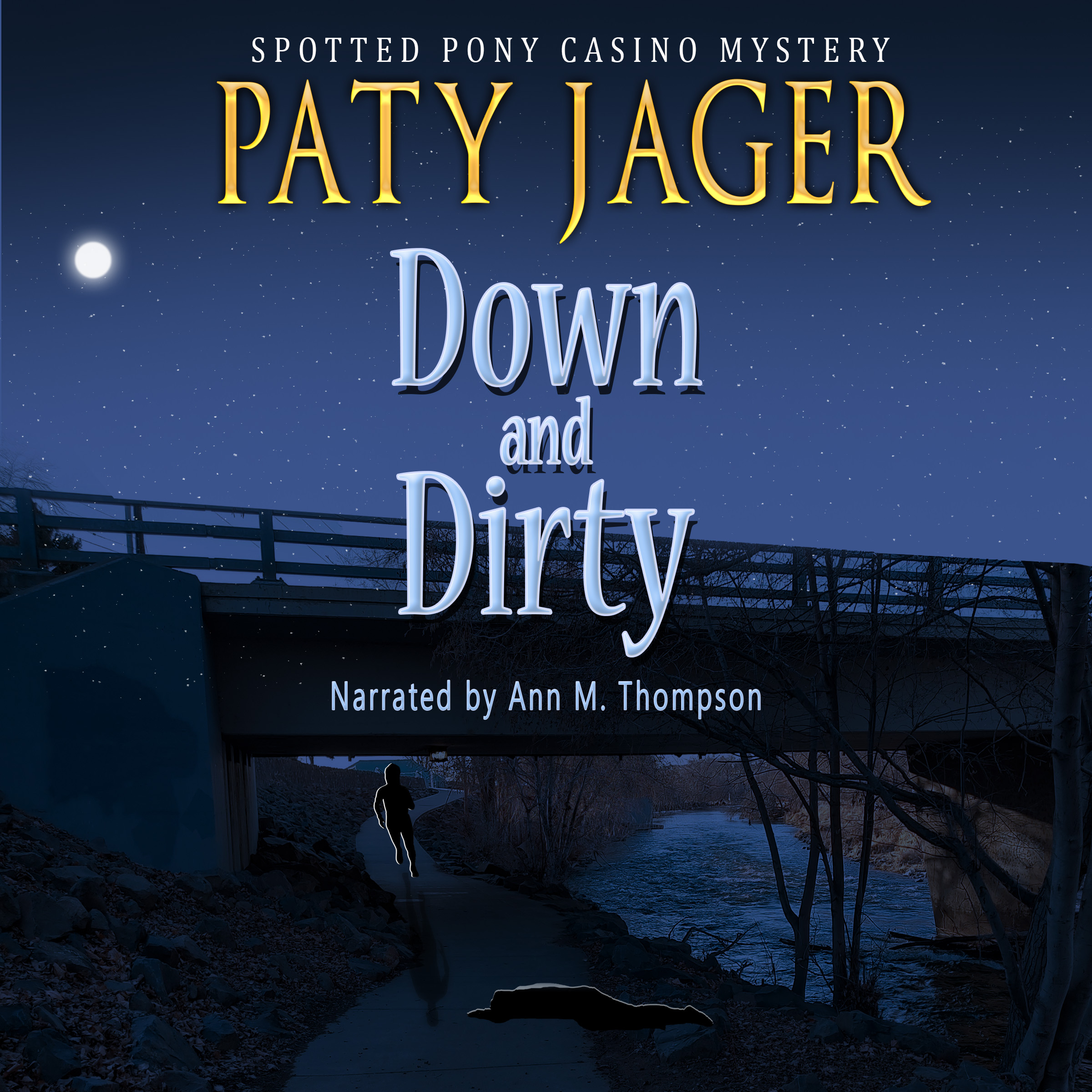
My character Dela Alvaro in the Spotted Pony Casino mysteries is a disabled veteran. The audiobook for Down and Dirty will soon be available. But today, on Veterans Day, you can download a free copy of Poker Face, book 1 in the series using this link from Bookfunnel. https://dl.bookfunnel.com/xlsrf57q4l

Thank you to all Veterans!

And don’t forget that starting November 15th through December the Ladies of Mystery have our Cavalcade of Books available for you to get deals or gift books to people on your Christmas list. Each of us is offering three books, some at special prices just for you! Ckick HERE to see what’s what, once again starting November 15th!