Clues, Clues Everywhere, or The Truth Hiding in Plain Sight

by Janis Patterson

What is a clue? I can hear all of you now saying “Duh! A clue is something the sleuth notices that helps solve the crime.”

Okay, that’s right – as far as it goes. The problem is, how do we make a series of clues that will help solve the crime that is neither so blatant that the story is over on page 19 or is so esoteric that the reader doesn’t understand it even after the crime has been solved and the clues explained?

I remember reading an Ellery Queen mystery (sorry I don’t remember the title – I was only seven or so) where the deciding clue was based on a particular letter of the Phoenician alphabet. The murder was cleverly done, as I recall, but the idea that both the killer and the sleuth (Mr. Queen) would be in the same rather mundane place at the same time and both know the Phoenician alphabet so jarred on my infant sensibilities that I remember it to this day. As I recall the setting was a house party at a rich man’s mansion, but I might be wrong about that.

Adding in clues is sort of like adding garlic to a casserole; too little and it is flat and uninteresting, but too many and it is unappetizing or perhaps even unswallowable.

In my opinion, the best clues are the ones that grow out of the characters and the storyline in an almost organic process. The truly best clues are the ones that sometimes even you don’t know are there.

An example. Years ago, when I was writing my first Janis Patterson mystery THE HOLLOW HOUSE I knew from the beginning who the murderer was going to be, but as I am a pantser, not much else. The story was ticking along quite well until about five chapters from the end, when I suddenly realized that my pre-determined murderer could not have done it. I floundered around for a while, then all of a sudden ‘Wow! Of course! So-and-so did it.’ And I wrote on, for another half chapter or so before once again it came to me that my new murderer couldn’t have done it. Truth is, from that first realization to the climax I changed the murderer some five times. Finally, as I was desperately trying to decide who did it, I suddenly realized who it was – someone I had never considered.

I don’t know why I had never considered this person, but it was perfect. The only bad thing was I knew I’d have to go back through the whole book and put in clues pointing to this person. Sigh. However… when I did start through the book, the clues implicating this person were all there already. I think I added two.

So – clues not only have to be there, they have to be subtle. How did I do it? I don’t know. The creation of a book, in case you hadn’t noticed, is very much akin to magic.

One way, I believe, was put forward by some famous mystery writer years ago – sorry, but I don’t remember which one. He said that the best way was to make everyone capable of being the murderer, then exonerate them one by one, just like your sleuth. I know there are those mystery writers who pre-plot every clue, and there are some who do it very well. Joy go with them. I can’t do that – I would be so bored that the book would never be written. I guess I have to be as much of a sleuth uncovering the truth as my detective.

Commercial : For those of you in the Denver area and those of you going there to attend the Historical Novel Society conference, I will be there both at the booksigning and presenting a paper on Egyptology and Elizabeth Peters. Ms. Peters (aka Barbara Michaels and Dr. Barbara Mertz) was an incredible author and a friend. She is very much missed.
Life Would Be Boring Without Mystery by Paty Jager #mystery #cozymystery

The creaking door, missing papers, an unusual scent hanging in the air…Mystery is all paty shadow (1)around us every day of our lives. It could be the phone call you answered to find no one there. The new cat hanging out in your back yard. Or something that’s gone missing at work. Mystery is what keeps life interesting and always testing our brain.

Life would be boring without mystery.

Growing up I was an avid reader and my favorite books were those that had a bit of mystery to them. In junior high I devoured the Nancy Drew and Hardy Boys series. Even the Walter Farley books I read had mystery to them even though I initially picked up the books for the horses.

When I first started writing historical westerns I couldn’t keep the mystery out of the stories. It was building the mystery in the story rather than the romance that made the plotting interesting to me. I recently had a conversation with the editor who published my first westerns. When I told her I was writing mysteries and loving it, she said, “I always thought your voice leaned toward mysteries.”  That kind of validated my decision to write mysteries.

My other interest is Native American cultures, specifically, the Nez Perce. I grew up in Wallowa County, the area where the Chief Joseph band or Lake Nimiipuu as they call themselves, summered and wintered. Of course this was way before I lived in Wallowa County, but they were always on my mind growing up. I found it unfortunate that the only time the Nez Perce were allowed in the county was during Chief Joeseph Days a rodeo weekend where the locals benefited from the history of the county yet the people who lived there before them it was the only weekend they were allowed to return.

A lot has changed in the thirty years since I moved away. The Nez Perce have purchased land in the county. They have a yearly powwow, Tamkaliks, the weekend before Chief Joseph Days, and they have put up interpretive centers as well as are now monitoring the salmon runs in the county. I’m happy they are having voices into how the county is moving forward.

My interest in the Nez Perce and my love of mystery is combined into the Shandra Higheagle Mystery series. Shandra Higheagle is a half Nez Perce artistic potter. Her father was a rodeo bareback bronc rider. He was killed in a rodeo accident when she was four. Her mother remarried and Shandra was told to keep her Native American heritage a secret. However, her paternal grandmother a shaman in the Nez Perce Seven Drums society made sure Shandra was drawn back to her roots.

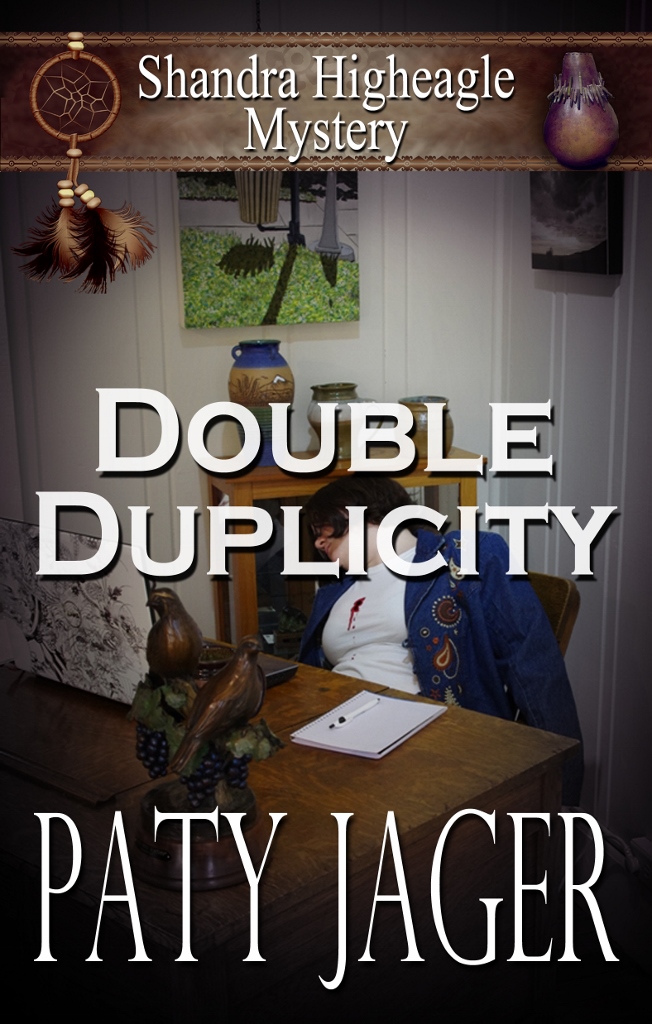
The first book, Double Duplicity, starts with Shandra returning from her grandmother’s funeral. Shandra finds a murdered art gallery owner after seeing her best friend, also an art gallery owner, hurrying across the street. When Shandra is dropped as a suspect, she begins digging to find the real killer before her friend becomes the scapegoat. Her grandmother comes to her in dreams, directing her to clues that help Shandra and a detective find the real murderer.

Double Duplicity (652x1024)Double Duplicity: A Shandra Higheagle Mystery

Book one of the Shandra Higheagle Native American Mystery Series

Dreams…Visions…Murder

On the eve of the biggest art event at Huckleberry Mountain Resort, potter Shandra Higheagle finds herself in the middle of a murder investigation. She’s ruled out as a suspect, but now it’s up to her to prove the friend she witnessed fleeing the scene was just as innocent. With help from her recently deceased Nez Perce grandmother, Shandra becomes more confused than ever but just as determined to discover the truth.

Detective Ryan Greer prides himself on solving crimes and refuses to ignore a single clue, including Shandra Higheagle’s visions. While Shandra is hesitant to trust her dreams, Ryan believes in them and believes in her.

Can the pair uncover enough clues for Ryan to make an arrest before one of them becomes the next victim?

Buy Links:

Windtree Press http://windtreepress.com/portfolio/double-duplicity/

Amazon  http://authl.it/2ng

Kobo  http://store.kobobooks.com/search?Query=Double+Duplicity

Nook http://www.barnesandnoble.com/w/double-duplicity-paty-jager/1120790322

Apple https://itunes.apple.com/us/book/id942249867

Paty’s contacts:

www.patyjager.net

Writing into the Sunset

Newsletter: Paty’s Prattle

Paty’s Posse: Facebook Street Team

Paty’s Facebook Fan Page

Kindle Author Central Page

Dying for a Deadline

IMG_1610By JL Simpson

Last year I decided to take on a new role. Not only was I going to be the author of my Daisy Dunlop mystery series, but I was also going to be the publisher. Gone were the days of typing ‘the end’ and then sending it off to someone else to do all the other stuff. Now I needed to sort out an editor, a cover artist, learn to format the finished masterpiece, set up accounts with Ebook retailers and finally to upload and publish the books. The feeling of power when you’re master of your own destiny is amazing. I can give books away, change the price, advertise where I want, and do my own thing with the plots, provided the readers still enjoy the story.

This was all positive stuff. I love power, it’s a heady drug. But with the positive comes a couple of negatives. The first, if my books fail I only have myself to blame, and the biggest negative of all, no one is cracking the whip. I don’t have anyone to set deadlines for me, and that can be a real problem.

From my experience people fall into two categories, those who are self-motivated and 19386145_snormal people. Self-motivated people are the ones who set their own goals and meet them. You seem them out running as the sun’s rising. Meanwhile, normal people are flailing an arm out from under the bed covers in a desperate bid to hit the off switch on the alarm clock whilst mumbling “coffee” into the pillow, hoping their spouse will rise to the challenge and get the much needed caffeine fix they require to jump start their brain.

19117412_sSelf motivated people nibble on a salad, whilst normal people inhale doughnuts swearing they’ll get back to dieting next week. Self motivated people stride down the confectionery aisle at the grocery store without so much as a sideways glance, because chocolate is not on the list. Self motivated people have organised desks, tidy houses, color co-ordinated wardrobes, their whole lives are planned, and everything runs like clockwork. They don’t forget to pay a bill, or realize they are out of milk after the stores are shut for the day. They’re not the ones running around the shopping mall on Christmas Eve looking for gifts.

If you want to be an Indie Author then you need to keep working. I’ve just read a book called, “Write, Publish, Repeat” and it’s brilliant. It says the way to success is to keep getting books out there. The more books you publish the easier it is for readers to find you. So you might think, seeing as I have only two books to my name, I’d be writing up a storm, but you’d be wrong.

I have the curse of being a normal person. My desk is cluttered, as is my mind. My house is clean but untidy, my color co-ordination is hit and miss. I forget my glasses. I lose my keys. I even forgot my son when he was a new born and left him parked at the meat counter in the supermarket until the girl at the checkout asked when my baby was due.

My day job is deadline driven. As a tax accountant their are lodgement dates that need to 36965961_sbe adhered to. Miss one of those and the tax office let you know about it. At work I’m organised and regimented because big brother is watching. With my writing no one is watching. I used to write to publisher’s deadlines. I used to have a critique partner who read along one chapter at a time telling me to hurry up and write the next, but her career took off and I was lost in the madness of it all. Now it’s all down to me.  Time marches on. Days, weeks, months fly by with little progress.

I may never stick to my diet, wear clothes that go together, tidy up my desk, empty my inbox, remember my sister’s birthday, but if I ever want to make something more than an on-again off-again hobby of writing I simply have to get a grip. And the best way to do that is set a deadline. I know that if I’m ever going to focus and finish book 3 in my Daisy Dunlop Series I need to set a publication date and book an editor. Maybe I should set a date for just before Christmas, but that still leaves the question, ‘which Christmas?’

JL Simpson

Where mystery and mayhem collide.

Website  | Facebook | Twitter | Goodreads | Amazon


The Strongest “Link” in the Chain

By Sally Carpenter

A seasoned writer knows how to roll with the punches when obstacles arise. William Link, co-creator of what many consider the finest TV mystery series ever, said, “Columbo would probably never been created if there hadn’t been a writers’ strike.”

In 1960, shortly after Link and his long-time collaborator, Richard Levinson, had started writing for TV, a strike prevented them from working on filmed programs. But instead of biding their time beside a Hollywood pool, they shifted gears and penned a spec script for live TV, which wasn’t covered under the strike.

Their story, “Enough Rope,” had a quirky cop named Lt. Columbo. “The Chevy Mystery Show” produced the script in a one-time airing, with Bert Freed playing Columbo. The cop kept stealing the show from the murderer, the central character, so much so that the director made Freed tone down his acting.

Link was unhappy with the production but he and Levinson were undaunted. They felt “Enough Rope” would make a good stage play, so they left TV to revise the script into “Prescription: Murder.” The play toured America with Thomas Mitchell as Columbo and Joseph Cotton as the killer. During curtain calls Mitchell received more applause than Cotton, the star.

The producers wanted to put the show on Broadway but Link and Levinson refused because they were not allowed to make needed changes to the script. It seemed that Columbo might not live to solve another case until Universal Studios announced it was interested in TV movie projects.

The duo adapted “Prescription: Murder” into a teleplay. But Mitchell had since died; who would play the detective? According to Link, Peter Falk, who was not on the list of actors under consideration, called and said he would “kill to play that cop.” And TV history was made.

Often the death of one-half of a writing team will end the other’s career, but Levinson’s passing in 1987 did not stop Link from working. He continued writing for TV and stage.

And Columbo lived on as well.

The original series ended in 1978 but new “Columbo” TV movies ran sporadically from 1989 to 2003. According to Link, a new script had been under development, a mystery set in a “Big Brother”- type house, but Falk’s ill health and the network’s perception that an audience no longer existed for the show ended the detective’s TV run.

But that didn’t stop Link from writing about the cop.

Columbo returned first circle to the stage with Link’s script “Columbo Takes the Rap,” which premiered at the 2007 International Mystery Writers Festival in Kentucky.

In 2010, he published a book of short stories, “The Columbo Collection.” I had the honor of meeting the author at a book signing held at a tiny, indy mystery bookstore (since closed) in Thousand Oaks, Calf. Link was soft spoken and getting on in years, but polite and charming. He was impressed at my knowledge of the “Columbo” show (I’ve watched the episodes numerous times).

I asked how he and Levinson wrote together. He said Dick sat at the typewriter and put down the ideas as they talked. Levinson typed with his two index fingers only and pounded the keys (I used this quirk for a character in one of my books). Link said Dick’s death was probably timely because he didn’t believe his friend would adapt to writing with a computer.

Oh, and one more thing. I just learned that Link and I share the same birthday! How mysterious . . .

Factual information is from: “The Columbo Phile” by Mark Dawidziak (1989, Mysterious Press). Quotes are cited from the forward of “The Columbo Collection” by William Link (2010, Crippen & Landru Publishers).

Amber Foxx Interviews Amber Foxx

AmberMysteriousOn my other blog, I enjoy doing Amber in tree finalinterviews and coming up with questions for the authors whose books I’ve reviewed. So, when it came time to write this introduction, I knew what I had to do: talk to myself.

Q: How did you decide to become a writer?

A: It never occurred to me not to write. I grew up in a word-loving environment. My parents owned—and often played—audio recordings of Shakespeare’s plays, and they frequently brought my sister and me to live theater as well. As a child, I wrote stories influenced by Nancy Drew and poems inspired by Dr. Seuss, and had a short story published in a teen magazine when I was twelve. I think I got paid twenty-five dollars for it.

Q: Do you write full time or do you have a day job?

A: I have two day jobs. I’m a college professor and a yoga teacher. Those jobs overlap, since I’m in Health and Exercise Science, and I teach yoga as part of my course load as well as off campus.

Q: One of the characters in your first book, The Calling, is a professor from New Mexico who practices yoga. Is Bernadette Pena based on you?

A: No, though I do have some things in common with her. When I was working at a college in the South a few years ago, I taught some courses on alternative medicine and non-Western healing traditions. For many of my students, it was their first opportunity to explore scholarly research on things like shamanism, Ayurveda, herbal medicine, energy healing, and other practices. One of those courses on made its way into The Calling. Its potential to disrupt assumptions about the nature of reality fit perfectly into the plot.

Q: Is your protagonist, Mae Martin, based on you?

A:  Mae is modeled after a good friend I met through my work as a fitness director and yoga teacher in northeastern North Carolina. Aspects of The Calling were inspired by some of her life experiences. I admired her combination of practicality and spirituality, and her intense determination to be herself in a situation where few people supported her.

Q: Did you set out to write genre-blending mysteries? You’ve had favorable reviews in which reviewers seem to have a hard time finding the right genre label for your work.

A: When I decided to write mysteries without murder, I wasn’t thinking about stretching the genre so much as being true to the stories I wanted to tell. I’d tried writing a mystery with a dead body in it but half-way through, I realized I couldn’t keep putting Mae in that situation. It didn’t feel right for the character or for me. There are ways people hurt each other, short of killing, that lead to layers of secrets in families and friendships. Phenomena such as psychic ability fill life with mystery as well. As long as there’s something that the protagonist doesn’t understand and neither does the reader—and solving for that X in the equation is central to the plot—then the story is a mystery.

Q: You mentioned psychic ability as if it were a real thing. Do you think it is?

A: Yes. I could take up pages with my personal experiences, and at every college where I’ve taught, students have confided some remarkable psychic events. And then, I’ve lived in Santa Fe and in Truth or Consequences. In both places, not only are art, music, dancing, and eccentricity part of everyday life, so are psychics and alternative healers.

Q: Is that why you moved the series from the South to the Southwest?

A: That’s one reason. In the new location, Mae “fits in” better because she doesn’t have to try to fit in anymore. It’s hard to feel like a nonconformist in New Mexico. There’s not much to conform to. The other reason is to move the plots in new directions. Living in a place where her gift is more readily accepted, Mae encounters new kinds of mysteries, as people ask her for answers only a seer could find. The setting also lets me bring in some of the stranger aspects of “the woo-woo,” with a questionable health-nut psychic in Shaman’s Blues and everyone from a celebrity modern shaman to an artist who claims she channels angels to a medium who speaks with dead in the upcoming June 15th release, Soul Loss.

Q: Thanks. Is there anything else you’d like to add?

A: Just this:

http://amberfoxxmysteries.wordpress.com

https://www.facebook.com/pages/Amber-Foxx/354071328062619

https://www.goodreads.com/author/show/7554709.Amber_Foxx

http://amberf.booklikes.com/

https://twitter.com/AmberFoxx4