A Time to be Bold

thumb_IMG_1225_1024

Romance is in the air. We celebrated Valentine’s Day yesterday, a day for lovers to be together, for friends to celebrate friendship, for admirers to share their feelings. For many, this is a day to be bold. Romance requires a certain amount of boldness.

In the best romantic stories, the hero(ine) must fight for his or her love. Whether overcoming insurmountable obstacles to be with the one they love or fighting for the heart of the one they love, the heroes and heroines of classic romance understand the need to be brave. The need to be bold. Romance is not for the weak of heart.
Knight

Characters in a classic murder mystery have a similar need. A need to be brave, a need to be bold. The detective must determine not only who has the means and the opportunity, but also who has the motive, boldly digging into lives that the suspects would prefer to keep private.

Each character in a mystery must be bold, to face the inevitable confrontation with the detective, to face the other suspects without succumbing to fear, and to deal with the secrets that always lurk just below the surface of their own lives.

And of course the killer must be bold. Bold enough to hide the truth, to lie and to misdirect. Bold enough to be a worthy opponent of the detective.

I’ve hit that point in my work-in-progress when it’s time for me, as an author, to be bold. I’m putting the finishing touches on the last draft of What She Fears, book 4 in the Adam Kaminski mystery series.

It’s the last draft for now. I’m sending it off to my editor and it will come back with pages of notes, changes, revisions, additions, deletions. Some minor. Some that will require rewriting a significant portion of the text. As a writer, I dread this step. Not because of the suggestions — those will no doubt improve the work.

NJ Summer

No, my fear is in sending this text, a text that up to now has only been seen by my eyes, out to be read by someone else. Someone out there. Someone whose interest lies not in complimenting me or praising me, but in tearing my work apart, exposing its weaknesses and highlighting its flaws.

I’m not alone in this, and I gain strength from knowing that everyone who has written their heart and soul onto a page understands this feeling. With every new draft I share, every new book I release, I swallow my fear, tuck my doubts out of sight, and bravely go where every author has gone before. It is a time to be bold.
IMG_2039 (1)


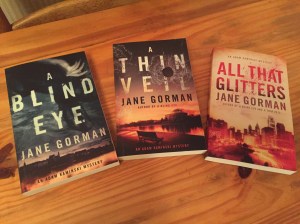
Visit janegorman.com for information on all of Jane Gorman’s books.
Writing About Something I Know Little About

This is something that I often do. I’m working on my next Deputy Tempe Crabtree mystery and it has a lot to do with wild fires. I’m not a firefighter, except for one retired fireman married to my cousin, I have none in my family. (Cousin’s hubby wouldn’t be helpful because he fought city fires.)

Fortunately, I have a friend who is also in my critque group who has been a volunteer fireman for years and often works on the big forest fires around the state. Believe me, I’ve truly picked his brain.

I’m good at this because of course, I’ve never been a resident deputy sheriff either. Living where I do, we’ve had several I’ve become acquainted with over the years. In fact, I wrote an article for the newspaper about the woman who inspired me to write about a female deputy sheriff. As for the real-life deputies who came after her, the first was a layed-back guy who had some traits that I borrowed for Tempe. Even the more gung-ho type we have now was kind enough to let me see inside his truck so I’d know what one looked like.

And for all of us writing about murder–I doubt that many of us have known a murderer personally or what really makes one do what the or she has done. But it hasn’t stopped any of us from writing about murderers and the acts they commit.

What I think that says for all of us is that we’re good at researching what we want to know and have incredibly lively imaginations. And of course, we’re counting on our readers to be transported to the world that we’ve created.

What else can you think of that helps you to write about people and subjects you really don’t know much about?

Marilyn who also writes as F.M. Meredith


The Mystery of Romance – or is it the Romance of Mystery?

by Janis Patterson

Last weekend I was fortunate enough to be included on the panel at the public library sponsored Romance in Bonham, a nice county seat town a little over an hour away. The ladies of the library hold this event every other February, and it’s great fun. After the panel discussion and the book signing and everything is all over they provide the panelists and the family members they bring along a down-home potluck lunch. Always some of the best ‘lady food’ I’ve ever had! (Wish they’d do a cookbook…)

Although this is a romance-centric event, I brought several of my mysteries and was slightly astonished at the interest they generated. Apparently there is a growing interest for more mystery in romances – or more romance in mysteries. Both of which, I think, are a very good thing. For far too long readers and writers both have been pigeonholed into fairly rigid and unforgiving categories. Mystery was mystery. Romance was romance. Romantic suspense was a step in the right direction, but unfortunately it was soon codified into so much a percentage romance, so much a percentage mystery/adventure by most traditional publishers.

Now, almost in the manner of a superhero, self-publishing has started to break down the artificial barriers between genres, allowing them to become just stories with all kinds of elements. Want a mystery with lots of blood and danger and nary a kiss between characters? It’s out there. Want an exciting mystery where a couple falls in love while evading the bad guys/saving the world/whatever? It’s out there. Want a tender romance where a couple falls in love happily ever after while solving a usually gentle mystery? It’s out there. Want any combination of the above? Or just about anything else, including vampires, shapeshifters talking cats or kung-fu knitters? Even all at once? It’s out there.

I don’t know if the traditional publishers – the kind one finds on the shelves of your local bookstore, if there are many of those left – have twigged to how complete this revolution of thought is, but the virtual aisles of electronic/print on demand publishing are full of proof. You can find almost any permutation of any storyline now. Self and small publishing have opened up the world of stories, and readers/writers are no longer bound to restrict their desires to the small and rigid genres the trad publishers have decreed will make them the most money. True, in the days when traditional publishing reigned supreme and controlled not only content but distribution, print runs were enormous and had to be done ahead of release, then stored in gigantic warehouses. The publishers had to look to what would give the best return on their not-inconsiderable investment. Now, though, in the burgeoning world of electronic and print on demand self-publishing, such considerations are no longer the end-all and be-all of what’s available. Niche markets that were too small to interest the trad publishers are now flourishing and expanding.

And that’s all to the good. Choice is a good thing, and genre-blending is a good way to expand reader interest. If there is a downside, it’s that the freedom of self-publishing has opened the floodgates to an unbelievable amount of pure dreck. There are people who believe that not only putting down X number of words is writing a book, but that doing so will guarantee them fame and fortune. We can only hope that their number dies off quickly, because this wave of badly written, badly conceived and badly formatted messes is reflecting badly on self-published books as a whole. There are self-pubbed books (usually written by veterans – or perhaps we should say survivors – of the trad publishing industry) whose quality is unquestionably equal to or better than anything from the Big 5, but they are shadowed with the prevailing belief that all self-published books are rubbish. That’s a misconception that only time and persistence can alter. But it will, it surely will, and writers and readers the world over will benefit from it.


Researching a Mystery by Paty Jager

SH Mug Art (2)

I’m not a forensic coroner or a lawyer or even a law enforcer. I’m the wife of a rancher and I write murder mystery.

As I write this next book in my Shandra Higheagle Mystery Series I’ve come across questions that have required answers by professionals. When I start a book I know how the victim will die and where. But I ultimately need to know what their injuries would look like say if they fall off a cliff or are stabbed with a blunt object or shot at close range with a small caliber gun.

These are all things coroners have seen and can tell me. But how do I get a coroner on speed-dial or in my case speed e-mail? I’m part of a yahoo loop that is filled with every kind of occupation a mystery or murder writer might need expertise about. The yahoo loop is crimescenewriter@yahoogroups.com

That’s how I connected with a coroner who not only answered my question I put on the loop but also emailed back and forth with me as I asked more questions and what-if’s. She has lots of knowledge and being a budding writer is willing to help out fellow writers.

Writing the opening and how the victim is killed and what is discovered went well, knowing I had the correct information and knowledge. Then I brought in some secondary characters and a sub-plot. For the sub-plot I needed some legal information. I turned to my niece who is a para-legal and what she couldn’t answer she knew where to send me to find the information. After my niece and I discussed the issue I wanted brought up in my book and how I wanted it dealt with, she suggested I contact a law enforcement officer.  I happen to have one in the family. 😉

I sent off an email explaining what I wanted to do, how would it be handled, and after some back and forth ,that element of the sub-plot was worked out.

Writing mystery books is my favorite writing experience. Not only do I have to puzzle out a mystery that will keep the reader thinking, I have to make sure the forensics and laws will work in the story and enhance the overall realness of the crime and the killer.

Have you read books where you could tell the writer hadn’t researched the laws or forensics? Did it bother you while reading the book or is that something that doesn’t bother you?

~*~

Award-winning author Paty Jager and her husband raise alfalfa hay in rural eastern Oregon. She not only writes the western lifestyle, she lives it. All Paty’s work has Western or Native American elements in them along with hints of humor and engaging characters. Her penchant for research takes her on side trips that eventually turn into yet another story.

You can learn more about Paty at:

her blog; Writing into the Sunset

her website; http://www.patyjager.net


From Smith-Corona to Apple: my love-hate affair with computers

By Sally Carpenter

To a writer, computers are a necessity, our instrument if you will, just as a saxophone is to a blues musician, a brush to a painter or a costume to an actor.

But do we love our computers? In museums one can see the typewriters of famous authors, but has any author put her computer on display? We seldom have a chance to get “attached” to a computer, as we must purchase a new one every few years to keep up with technology.

Few of us want to return to the days of carbon paper and Liquid Paper (except Woody Allen who still writes his screenplays with literal cut and paste) but has all those electronics really us smarter?

Here’s a brief history of my experience with computers.

 In high school I was trained as a touch typist, learning not to look at the keys or the paper in the roller as I typed. So I can’t look at a computer screen when I compose. It slows me down and stops my thoughts.

I earned my bachelor’s degree with a portable manual Smith-Corona. Later I moved up to an electronic typewriter with a memory so I could backspace and make corrections without erasing. Now that was cool.

The first computer I ever saw was in 1976. It was a small grey box that operated by inserting five-inch floppy discs. At the time I didn’t think it was an improvement over the typewriter.

The computer lab in the basement of the college library had big, bulky computers that ran on FORTRAN or some such program. One had to type long, complex commands to make it work. Printouts were barely readable dot matrix on long rolls of green-and-white striped paper with sprocket holes along the sides. One had to tear the pages apart and remove the holes. How cumbersome.

For a while I did temp work in various offices. Computers had not yet been standardized, so every business had its own unique word processing program. I hated having to learn a new system with every assignment. I remember the Wang software. To run spell check, one had to first completely exit out of a document.

On one assignment I became proficient in WordPerfect. I liked it so much that when I bought my first computer–a Brother DOS–I set it up with WP. The commands were made by holding down two keys at once–the alt, shift or control key along with a number or letter key. For a fast touch typist (I can do 75 wpm) I could keep my fingers on the keyboard and not slow down to reach for a mouse. I loved the clickety-clack of the keys. I wrote a slew of fiction as well as graduate school papers on this machine.

I’d still be using that workhorse except for one thing–the Internet. DOS cannot support the web. For a while I used a second computer a laptop with Windows for web surfing and email but I continued writing on the Brother. However, the laptop constantly broke down and when the motherboard gave out after only 2.5 years, I was through with it.

I finally had to give up the Brother about the time I started writing mysteries because many publishers (and now, all) were only taking electronic submissions. A friend gave me his old antiquated iMac when he upgraded. Now I could write, send emails, and use the web on one computer-sort of. The machine is limited in its web capabilities and can be ghastly slow with emails, but it works.

And when I can upgrade to a modern computer, I’ll be going for retro. The QwerkyWriter is a keyboard that hooks up to any tablet or monitor but looks like a manual typewriter keyboard with “clickety clack” and a “return” lever that’s the “enter” key. Everything old is new again.