What’s Old Is New Again

by Janis Patterson

I don’t have much time to read, but for various reasons not long ago I agreed to review a few books. Two were okay – nothing to write home about, but at least grammatical and spelt correctly, with not-totally-stupid plots. The third… well, to call it puerile and sophomoric would be flattering it. If I hadn’t promised a review on it I wouldn’t have gotten beyond the third page. How can anyone think such a train wreck of a book is ready to be released is beyond me. Either they are supremely ignorant or totally ignorant.

Once my duty was done, though, I needed to clear my mental palate, and thought that something classic might soothe my outraged sensibilities. So I picked up a Mary Roberts Rinehart (one of my all-time favorites) mystery.

I really only intended to read one, but found out that’s sort of like eating a single peanut or potato chip. I happened across an omnibus of all of her long fiction on Amazon – and free, yet! It was a mixed blessing, though. It did contain books I had never heard of, but as I steadily munched through them I noticed a wildly varied level of editing quality. Some were wonderful; some were obviously edited by a set of drunks to whom English was not a first nor even a second language!

That’s neither here nor there, though; in the face of Rinehart’s genius even the editing errors were nothing more than a mild annoyance – and those of you who know how completely inflexible I am about proper spelling and editing will doubtless find that statement amazing if not downright incredible. But in the case of Rinehart’s genius it really doesn’t matter. No matter how badly they are misspelt they are some of the most fascinating books in the language.

Rinehart wrote in a number of fields, including short pulp fiction (by which she supported her husband and family during a time of need) as well as novel-length romance and mystery. I write romance and mystery myself and know how difficult that can be; she made it seem easy.

Her books will not, however, appeal to everyone. Contemporary to the time they were written – just before and just after World War One – they reflect both the style and the ethos of the era. No conscious, mad scientist style murders, no lascivious young lovers experimenting in athletic sex. Most characters are repressed, if anything, obsessively proper and yearning for respectability. A kiss on the hand becomes as emotionally satisfying as a two-chapter roll in the hay out of a modern romance novel. Solving a murder becomes not only a legal imperative, but a moral one as well. What’s worse is her writing style is equally dated, reflecting the usage of the times, and done – most of the times – in a measured and omniscient voice, now sadly unpopular, but one which I have always liked. She wrote from 1908 to the mid-1950’s (she died in 1958) – at least, those are the most accepted dates.

With all these drawbacks, why is Rinehart so prized and such a delicious read?

Two reasons – characterization and plot. Her plots are convoluted and impeccable and delicious. During her career she was called ‘the American Agatha Christie.’ I personally think in many cases she is the superior. Her characters are spot on. There is no endless repetition of hair or eye color, descriptions of physical flaws or rippling whatevers; to be sure there are descriptions, but minor ones, and usually at the beginning of a book. Her characters are not just compilations of attributes, but living, breathing people. I would know them if I met them on the street. Two of the ones I remember the most are a Belgian spy during the trench warfare of World War One, suave, outrageous and highly courage, and the other a teenaged girl of the pre-war period, who can and does cause chaos without ever trying.

Not only was Rinehart a gifted writer, she was an amazing woman. Married to a doctor, mother of three sons in an era when women were not supposed to be much else, she paid her own way (with a car, no less) to the Front in France during the War, where she not only acted as a war correspondent but drove food and supplies for the soldiers to obscure and remote outposts. She also became a well-known New York literary hostess.

It isn’t often I have such public fangurl moments, but it’s better than when I cry with regret or shake with anger that such a consummate craftsman is lost in the dust of history. Now, if you will excuse me, I am only half-way through THE AFTER HOUSE, and just have to find out how she’s going to work her way out of this tangle!
Killing Off a Series by Paty Jager

book hangingI’ve been contemplating when to end my Shandra Higheagle Mystery series.

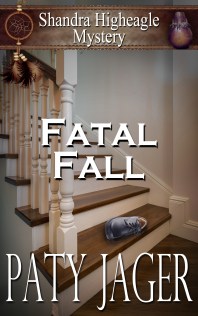
Book eight, Fatal Fall, released recently. Book nine is in the planning stages, and I feel I could get another five or six books out before the story/characters go stale.

However, I’ve already had people asking me when am I ending the series.  My comeback, “Why, are you tired of the characters?”  I’m not tired of writing about Shandra, Sheba, Ryan, Lil, and the cast of characters who live in Huckleberry and Weippe County. I do worry about the people who complain, you can’t kill anymore people off in that small area.

But really, this is fiction. Is it that hard for a reader to suspend belief that so many murders could happen in an area and with the same amateur sleuth being involved?

I have taken Shandra to the reservation a time or two and plan to have another story or two set there. She and Ryan are going to a police conference and an art show in two different books. Kind of like Jessica Fletcher moving to New York or going to book related events out of Cabot Cove. 😉

The other reason I am contemplating the demise of the series, is because I want to introduce the amateur sleuth for the next series in one of the Shandra books before the Higheagle series ends. But I want to wait until the last or next to last book.

And yes, it will be another Native American character. I am still working out the details of him, where he lives, what he does for a living, and how I can connect it to multiple murders without getting into the “too many deaths” in one small area.

How do you gauge when a series has run it’s course?  Have you read a series or two that went on too long? Do you think there is a magic number of when a series should end or is it best to leave it up to the story and characters?

I would love to hear readers and writers thoughts on these questions.

Books 1,2, & 3, Double Duplicity, Tarnished Remains, and Deadly Aim are out in audio book.

Here is the info on Fatal Fall:

Fatal Fall 5x8Book eight of the Shandra Higheagle Native American Mystery Series

Avarice…Family…Murder

When the doctor is a no-show for her appointment, Shandra Higheagle becomes wrapped up in another murder. The death of the doctor’s elderly aunt has everyone questioning what happened and who’s to blame. Shandra’s dreams soon tell her she’s on the right path, but also suggests her best friend could be in grave danger.

Detective Ryan Greer knows not even an illness will keep Shandra from sneaking around, and he appreciates that. Her insight is invaluable. When she becomes embroiled deeper in the investigation, he stakes out the crime scene and waits for the murder to make a tell-all mistake.

But will he be able to act fast enough to keep Shandra or her friend from being the next victim?

Universal Link – https://www.books2read.com/u/bQZ5d7

SH Mug Art (2)


Mystery of the Muppets

How the Muppets inspired my current work-in-progress.

Last year I checked out the DVDs of “The Muppet Show,” first season, from the library. I hadn’t paid much attention to the show when it first aired, but I had the urge to revisit it. The DVDs have a fun feature that the viewer can turn on to allow little pop-ups of trivia and fun facts about working the Muppets.

As I watched the show, I thought how my series character, Sandy Fairfax, would have made a terrific guest star. He can sing, dance, and act. He’s easy going and has a great sense of humor. He’d fit right into the wacky world of the Muppets.

This year my publisher put out a call for submissions for an anthology of short stories by the various Cozy Cat Press authors. That sounded like just the ticket for another Sandy mystery, this time as a guest start on a kids’ TV show with its own nutty set of possibly murderous puppeteers.

To research the art of puppetry, I drew on my own experience. In the early 1970s my school district built a brand new high school (which has seen been replaced by an even newer facility). This school had a working television studio. The senior TV production class, which I took, produced a program that was aired to the local elementary schools via closed circuit TV (which nowadays would probably be uploaded as streaming video).

At the time “Sesame Street” was still new and all the rage, so our studio had a small puppet stage that we used in our shows. The puppets resembled the basic Muppet form: a foam head with a cloth body and thin, flexible arms.

When operating the puppets, we wore white cloth gloves to product the puppet material from our skin oils and sweat. But in my research on how the Muppets are worked, I didn’t find any indication that the puppeteers wore gloves. My guess is that with the long hours of taping a TV show, the puppets were of and off their hands so often that dealing with gloves all day would be cumbersome.

Like “Sesame Street,” we had rod-arm puppets, so called because a long black plastic rod was attached to one arm. We put one hand inside the puppet’s head to work the mouth and use the other hand to manipulate the arm with the rod. That gave the puppet a more realistic look than to have both arms hang limp.

I believe the school had one or two human hand puppets. These puppets had arms/hands that resembled sleeves and gloves. Puppeteers could put one hand inside a puppet arm and use their fingers to make the puppet pick up objects, write, and make more natural hand movements. Obviously these puppets are more difficult to operate.

Rowlf the dog and the Swedish Chef are human hand puppets. Jim Henson moves the mouth and provides the voice of both moppets and another puppeteer (Frank Oz for the chef) works the hands. This requires tremendous coordination between the two persons and the ability to work closely together.

How do the Muppeteers see what their puppets are doing when they’re standing behind a solid wall or cramped inside a sofa or box? Jim Henson developed a solution to this problem with tiny black-and-white TV monitors placed on the floor behind the stage. The puppeteers keep their eyes on the monitor, not the puppets. Thus they can watch their performance in real time, exactly how the home viewer would see them.

I learned a trick in working a puppet’s mouth. The natural tendency in making a puppet “talk” is to move the four fingers inside the head. But this makes the puppet’s head jerk back and appear to have whiplash. The correct method is to hold the fingers level and move only the thumb. This drops the jaw, the same way humans speak. You’ll see this jaw-only movement in the Muppets, except when Kermit gets agitated, in which case he flails his arms around and his mouth opens all the way, flinging his head back for comic effect.

What I remember most about the TV class is that it led to my first piece of published writing! The company that sold the puppets to the school put out a newsletter with scripts the customers could use. I wrote a short, silly sketch about puppets waiting for the school bus to arrive. My script was published and my “payment” was a free puppet. The school kept the puppet, but I picked it out—a bunny.

In writing my short story I read books about how “The Muppet Show” was made and a well-illustrated bio of Henson. Some of this information I incorporated into my story, although I should make a disclaimer that all of the Muppeteers are fantastic people and would never stoop to do the evil deeds committed by my characters. But my story wouldn’t be as fun if my characters were all as nice as Kermit the frog.


A Disappearing Post

Whatever happened to my post that was supposed to appear on Monday, I have no idea. However, I’m sure it was my fault. I really don’t understand exactly how Word Press works.

Frankly, I don’t even remember what I wrote about.

I’ll try again with my latest news. Finally I’ve finished my latest Deputy Tempe Crabtree mystery and sent it off to the publisher. It’s not a long book, in fact it’s rather short, but I had so many interruptions and other chores to do, it took me a long time to finish.

Here’s the official blurb for A Cold Murder.

A horrific snow storm traps Tempe and her husband in the lodge of a summer camp along with the caretakers and seven most unpleasant people—one becomes a murder victim. And to complicate matters, the ghost of a former camper makes contact with Tempe.

I have no particular ideas for promotion–though I have several events lined up that will fit in perfectly–mostly library visits, but also a big book fair. Whether or not I’ll do another blog tour I’m not sure.

Family has played a big part in my life lately. Just learned that another great-granddaughter will be joining us soon.

Hopefully, by next month, I’ll have some special to write and do it on the correct day.

Wishing you all some great reading this summer.

Marilyn

Me at Dana's, quilt

Someone asked me recently, “What have you done with your hair?”  My answer, “Nothing.”

Daily Practice

      About five years ago, I made a commitment to write daily. How many words? It doesn’t matter; the act itself does. Sometimes I put in hours, sometimes only thirty minutes. Now that I’ve retired early from academic work, I look forward to many days as a full-time writer. However, while I was packing, downsizing, moving across the country, unpacking, and doing all the paperwork of setting up in a new place, I only had time to write a paragraph each night before going to bed. So why did I bother?

One, it kept me in touch my work in progress. Even the briefest engagement with it feeds the underground springs, the aquifer of ideas. As long as I make that daily connection with the characters, they stay alive in my mind and show up to join me, in a way, while I’m doing things like walking or running that tend to promote creative free flow.

Skill is the other reason I keep the daily commitment. Like practicing yoga daily, writing keeps my verbal skills flexible and my imagination in shape. In one of my brief writing sessions while on the road, I came up with some lines I love so much I’m afraid they may be darlings I’ll have to kill. Nonetheless, they gave me insight into a character’s thinking about relationships and intimacy, an “aha” moment inside his head.

I take breaks from individual books. I’m working on Book Seven while Book Six is being critiqued, and then I’ll get back to revisions on Book Six while Book Seven rests. The separation from each story helps me see it with fresh eyes, but so far I don’t want a break from writing.

Do you take some days or weeks off between projects or do you write daily?