Confessions About the Covid Crazies

by Janis Patterson

How are you surviving the Covid lockdown, which – thankfully – is finally fading away?

While my office is in my home and I don’t go out too much in normal times (which, please Heaven, are finally coming back!) just the idea of not being able to go out or have any place to go to have driven me crazy. Crazier.

For the first time in many years I am not face-up against a deadline, usually multiple deadlines, which come racing at me like an express train. Well, I do have one, but it isn’t until October, and the way this year has been going who of us is positive there is even going to be an October this year?

And that’s why this post is so frightfully late. I forgot until last night, when the lights were out, our goodnights said and The Husband had drifted off to sleep. Suddenly I remembered and sat bolt upright, gasping at my unprofessionalism. Dragged from sleep he wanted to know what was wrong, but when I told him he merely snorted and said to go back to sleep. The sad thing is I did, which is very unlike me. This lockdown has activated my inner sloth – I chose the sloth as my spirit animal a few years ago when a prolonged bed rest was dictated while recuperating from a surgery, and the wee little beastie has played havoc with my work ethic ever since.

One good thing about this lockdown is that The Husband is only working half weeks – 2 ½ days – and this makes a perfect rehearsal for when he retires in the not-too-distant future. One thing I’ve learned – he is ignorant of the writing process, as I do 95% of it when he’s not here. Plus, he’s a science person, not a word person. I’ve been writing in our den for years, and not too long ago made the decision to turn the guest room into my office, a task about which I have been distressingly dilatory. I need to get on it NOW, so when he does retire fully I can retreat in there. I’m working on it every day, and trying to decide whether or not I can install a moat.

Plus, during this time of plague I have been slowly morphing from a writer who works at home into a housewife, a strange and alien creature I have never been before. I’ve been excavating the dining room (verb chosen deliberately) and for the last three days sorting through ancient tax papers that go back to 2007. So far The Husband has taken two enormous tubs of old papers to his office to shred in their commercial shredder.

I won’t bore you with tales of the strange wonders I’ve found during this time of excavation, but I did find my iron which I lost several years ago. It’s a fine example of cleaning making more work for you, because now I’m going to have to go to the trouble of losing it again, and do you know how hard it is to lose an iron?

Well, the clock is ticking (yes, we still have one that ticks, a Seth-Thomas kitchen clock that was a wedding present to my father’s parents in 1899) and I need to get this posted. I hope you all – assuming you have read this far – are safe and well and all in your world is good. Please take care of yourselves and believe we will get through this. At least, I hope so, because housework is making me crazy! Crazier.
Expanding my Horizons by Paty Jager

“You can’t make everyone happy.” One of my least favorite sayings but so true.

I took two trips last year that were experiences I’d never had before. I finally saw a tropical island for myself and I traveled to another country by myself – Iceland. I loved the trips and wanted to use what I experienced to write books with my characters enjoying the same places.

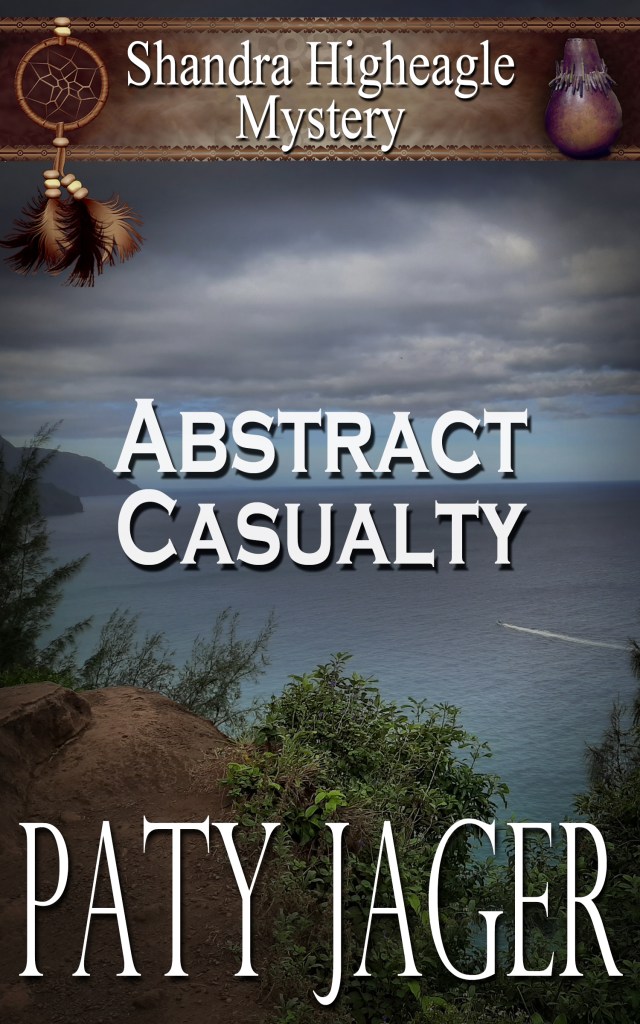
I set Abstract Casualty in the Shandra Higheagle series in Kaua’i Hawaii. I had a great time reliving my time there while writing the book. And the fun I had finding a way to get my character to the island in a realistic manner. Some readers loved it and the new experience, others wrote to me and wanted Shandra back in her fictional county in Idaho. They missed the secondary characters they’d come to know.

For those readers who love going back to the same place, Capricious Demise is set back in Weippe County, my fictional county in Idaho. I finished the first draft and will be releasing it in July.

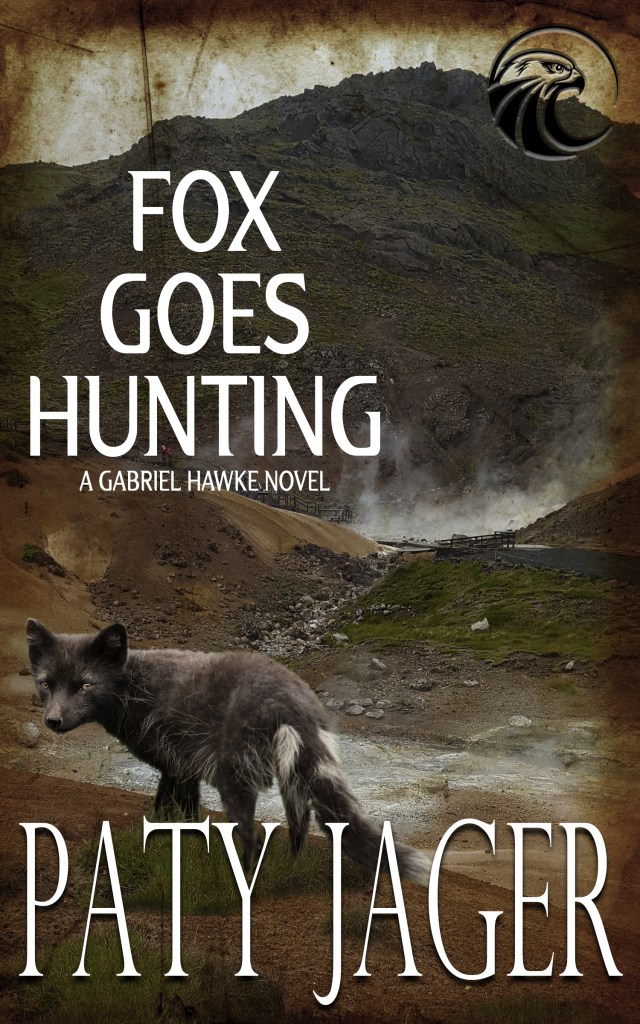
This month, June 1st, the 5th Gabriel Hawke Novel, Fox Goes Hunting, released. My critique partners, beta-readers, and proof reader, loved it! I already received one 2 star review. The reader didn’t like that Hawke wasn’t tracking as much and they couldn’t pronounce the names of the characters. This book is set in Iceland.

I loved bringing things into the book that I saw and learned while in Iceland. I hope to capture a broader range of reader by going “International”. Yes, there are typical Icelandic names for characters from there. It is also set during an international Search and Rescue conference so I had secondary characters from around the world.

Yes, both books set in real places took twice as long to write. I had to make sure distances, towns, places were correct. I wanted to make sure I gave a clear picture of where they went and what they saw.

When I write the Shandra books set in a fictional place, I can make things up as I go, though I did make a map of the county when I started writing the series, so I do keep things in the same place every book. But if I want to add a business, I find a block that I didn’t put a business in already and add it.

The Hawke books are set in a real place, but I made up fake towns in place of the real ones to keep anyone I might have grown up with in that county to think I am talking about them. 😉

While I know there are some readers who don’t like the unexpected, I believe writing outside of my comfort zone and incorporating other places and cultures into my writing helps me grow as an individual and hopefully gives my readers a glimpse at a culture they might not get a chance to experience first hand.

Guest Blogger – Jeannette de Beauvoir

Diamonds Are a Girl’s Best Friend

We’re all attracted to things that sparkle. From the moment we’re born, our eyes follow shiny objects. And because everyone likes them, precious stones and gems have acquired a substantial monetary value.

And therein, naturally, lies crime.

In the nursery rhyme, the “little star” twinkles “like a diamond in the sky,” but diamonds are no little stars: they’re big and bright and can be very, very dangerous. Blood diamonds cost countless people their lives and limbs. Diamonds are stolen and imitated, fought over and killed for, and still every February we buy them, give them, and receive them as delicate, beautiful expressions of love.

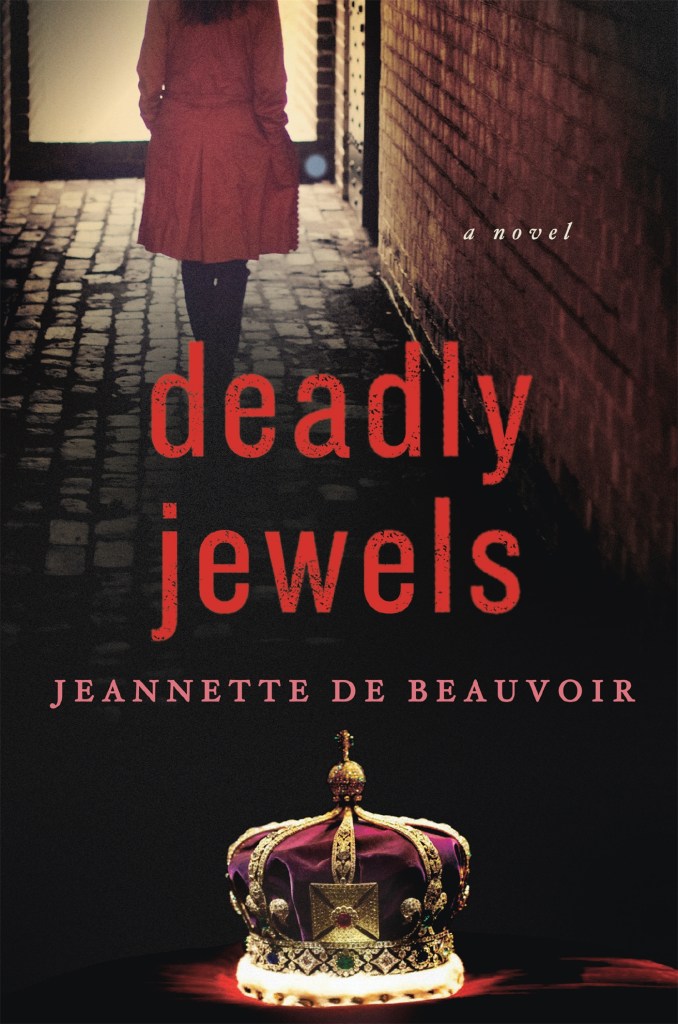
One of my novels, Deadly Jewels, deals with a diamond theft during World War II that has repercussions in the present day, its unfinished business echoing up through the years. And you might think that it was easier to steal diamonds back then, but you’d be wrong: unlike other crimes, which seem to be more and more blocked by technological advances in loss prevention and law enforcement, it seems that jewel thieves are alive and well and very much at it.

One of the things that we say about murder is that we only know about the failures—a successful murderer being, of course, one who is never caught because murder is never suspected. The same cannot be said for heists: we know only too well when and where they occur, and sometimes even by whom.

And I have to say that the history of heists isn’t without some humor.

Take the so-called Pink Panther gang, some very serious thieves from Eastern Europe who earned their nickname following the theft of a £500,000 diamond in central London—they hid the stone in a jar of face cream, a move learned from watching The Return of the Pink Panther. That’s right: Inspector Clouseau taught them. They’ve been enormously successful and are responsible for what are considered some of the most glamorous heists ever.

A science museum isn’t the first place you’d think of as a backdrop to a diamond heist, but that happened in the Netherlands during an exhibition called The Diamond: From Rough Stone to Gem. Thieves got away with $12 million in diamonds and jewelry after smashing a window to get in (they weren’t picked up on video and none of the guards saw or heard anything) and accessing six of 28 alarmed cabinets in the main jewelry room before escaping. That one still has a lot of people scratching their heads.

In 2013, thieves netted $136 million in diamonds belonging to an Israeli guest at the Carlton Intercontinental Hotel in Cannes—the same hotel that was the setting for Alfred Hitchcock’s 1955 jewelry heist film To Catch a Thief.

I could go on and on—really, I could—but you get the point. There’s something about diamonds that brings out the James Bond or Marilyn Monroe in all of us. And the mystery not only of their attraction but of the lengths to which people will go to steal them is one of endless fascination—for this mystery writer, anyway!

DEADLY JEWELS

When Martine LeDuc, publicity director for the city of Montréal, is summoned into the mayor’s office, she’s pleasantly surprised to find the city is due for a PR coup: a doctoral researcher at McGill University claims to have found proof that the British crown jewels were stored in Montréal during WWII.

Martine is thrilled to be part of the excavation project, until it turns out that the dig’s discoveries include the skeleton of a man with diamonds in his ribcage and a hole in his skull. Is this decades-old murder leading her too far into the dangerous world of Canada’s neo-Nazi networks, or is there something going on that makes the jewels themselves deadly? Is history ever really completely buried?

With pressing personal issues crowding into her professional life, Martine needs to solve not only the puzzle of the jewels, but some more recent crimes—including another murder, a kidnapping, and the operation of an ancient cult in Montréal—and do it before the past reaches out to silence her for good.

https://www.amazon.com/Deadly-Jewels-Novel-Jeannette-Beauvoir-ebook/dp/B0140MQVX8

Jeannette de Beauvoir is the author, most recently, of The Matinée Murders. A member of the Mystery Writers of America, Sisters in Crime, the Author’s Guild, and the National Writers Union, you can find out more (and read her blog or sign up for her newsletter) at her website. You can also find her on Amazon, Facebook, Instagram, Patreon, and Goodreads.

She doesn’t own any diamonds.

Writing A Cozy Is Not As Warm And Fuzzy As It Sounds by Heather Haven

Several nights ago I finished Casting Call for a Corpse, Book 7 of the Alvarez Family Heather cartoon-smallest copyMurder Mysteries, labeled a fun detective cozy. Fun or not, I actually didn’t finish it. My little pea-brain just likes to think I did.  What really is finished is the initial creative stage. I immediately emailed this ha-ha magnificent work of literature off to the content editor. She will return it several weeks from now noting a bazillion errors, mistakes, misquotes, and/or things that made no sense or didn’t work for her. I will sob for a while, and then will make the corrections or clarifications. I will then send it off to the line editor, who will also find a bazillion things wrong, such as grammar, language, syntax, names, dates, you know, that sort of stuff.  Sobbing, I will do the corrections and pretend that I knew ‘whom’ went there instead of ‘who’ but I was so busy being creative, doncha know, it got by me. And Paris? So in France. Did I write Spain? Whoops. After that, the manuscript will go to the Beta readers. Repeat any and all of the above.

Meanwhile,  I will need to come up with an elevator pitch condensing an 86 thousand-word story into under 25 words. Then I will write several back cover blurbs in varying lengths. But whether the blub is 2 sentences, 2 paragraphs, or 10, it has to be so exciting and pithy, it just makes anyone who picks up that book want to buy it. What is saving my sanity is I no longer have to do the publicity for this little gem. I am paying someone else to do that. Which is good. Because I will be too busy sobbing and being fed up. I will have had it with the stupid story, the stupid book, the stupid series, not to mention the stupid writing process. But soon, as follows the night the day, it will be up and running. And so will I.

I will be running on to my next novel, Spring Thaw, Book 2 of the Snow Lake Romantic Suspense Novels. And I can’t wait to get started!


Guest Author – Camille Minichino

Puzzled by Crime

Since we’ve been sheltered in place, sales of jigsaw puzzles have soared. As trusted a source as NPR recently reported an increase of more than 300% over last year’s sales.

It’s not hard to figure out why people have turned to puzzling in a time of great confusion and uncertainty. If you’re focused on finding that piece of blue sky over Tuolumne Meadows in the Sierras, or the jacket of the woman ice skating in Rockefeller Center, you can hardly give in to fear or anxiety at the same time.

Other puzzles, too, are having their moment. Newspapers offer extra crosswords, acrostics, and entire supplemental sections with Sudoku, logic puzzles, and picture puzzles for kids.

Some say humans are designed to solve problems, and puzzles fill that need, especially ones that come with a clear set of rules and an unambiguous solution.

Am I ever going to talk about cozies?

Yes, here it comes.

Cozies are primarily puzzles. That’s not to say that the other elements of fiction are unimportant. Cozy readers expect all the basics of a good story: engaging characters, sparkling dialogue, appealing descriptions, riveting suspense, and a satisfying conclusion.

What cozy readers don’t expect are graphic details that take away from the essential puzzle. Does that mean that cozies make light of murder, for example? A case can be made that the touch of humor often found in cozy mysteries takes away from the seriousness of the matter. But the theory behind cozies, to my mind, is that readers already know that murder is horrible, that it’s brutal, violent, no matter the weapon, and that it takes an enormous toll on everyone around it. We don’t need to dwell on those aspects. We choose to dwell on the puzzle that connects the motive, the victim, the killer, and the clues.

The amateur sleuth featured in cozies is making a red velvet cake with her hands, while her mind is figuring out the clues. Instead of forensic details and images of internal organs being weighed in the pan of a laboratory scale, we’re treated to her aha moment—the oven timer goes off and she realizes that Mr. Victim in the Library could not have been killed before two o’clock in the afternoon. Puzzle solved!

The cozy sleuth usually has a threat to her life when the killer realizes how smart she is, how she’s been able to put all the pieces of the puzzle together. But the cozy reader knows the danger is there only to provide another opportunity for a clever move, as if the whole story were being played out on a chess board. Quite satisfying.

Murder is brutal in real life, and there are subgenres in crime fiction that deal with that—noir and horror, for example, and what are called thrillers.

At the moment, we seem to be living in a medical thriller. Maybe we’d rather leave that behind as we read. If so, cozies are there for us.

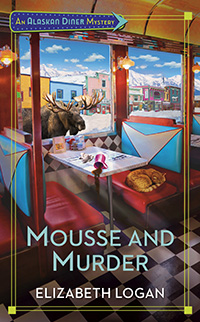
MOUSSE AND MURDER

A young chef bites off more than she can chew when she returns to her Alaskan hometown to take over her parents’ diner.

When Chef Charlotte “Charlie” Cooke was offered the chance to leave San Francisco and return home to Elkview, Alaska, and take over her mother’s diner, she didn’t even consider saying no. For the past year, she’s built a comfortable existence, spending her days making sure the restaurant runs smoothly and that her cat, Eggs Benedict, is appropriately pampered. But soon life at the diner starts feeling a little one-note.

Determined to bring fresh life and flavors to the Bear Claw Diner, Charlie starts planning changes to the menu, which has grown stale over the years. But her plans are fried when her head chef Oliver turns up dead after a bitter and public fight over Charlie’s ideas—leaving Charlie as the prime suspect.

With her career, freedom, and life all on thin ice, Charlie must find out who the real killer is, before it’s too late.

Buy links are at https://www.penguinrandomhouse.com/books/622413/mousse-and-murder-by-elizabeth-logan/

Camille Minichino is a retired physicist. She’s the author of 28 mystery novels, plus many short stories and articles. Her 5 series feature a physicist, a miniaturist, a college math professor, a postmistress, and a chef in a fictional town in Alaska. She teaches science at Golden Gate University in San Francisco and writing workshops around the SF Bay Area. Her latest series, the Alaskan Diner Mysteries, written as Elizabeth Logan, debuts with “Mousse and Murder.” All her names and numbers can be found at www.minichino.com, and at https://www.facebook.com/camille.minichino