
Guest Blogger – Daniella Bernett

How Do I Kill Thee?

Murder is a shocking and terrifying taboo. The very word sends an icy frisson slithering down one’s spine. And yet, it is an occupational hazard for a crime writer. On a cerebral level, the taking of a human life is fascinating. It is a serious business, requiring cunning and sangfroid mingled with passion, anger or fear. A certain degree of luck is necessary to pull off a murder without getting caught. The faint of heart would be riddled with remorse and horror at this deadly transgression.  

Setting aside the moral considerations, I find it deliciously thrilling to plot a murder. The omnipotent power to kill is a dizzying prospect. Murder is an art form, if one thinks about it. The killer must be creative. But how does an author choose from the plethora of methods available? Your character is the key to unlocking this mystery. Therefore, an author must first delve into the murderer’s psyche to thoroughly understand why he or she came to make the fatal decision. Is he or she an assassin, a spurned lover, a business partner who has been swindled, or an average individual pushed to the brink in an extraordinary situation? Once the author has sketched this character profile, the pieces will fall into place and the story will begin to flow. The author must have absolute trust in the murderer. He or she will guide you down the evil path and determine if the victim expires quickly or suffers a slow, lingering death.

In most cases, murder stems from a rupture in an intimate relationship. This personal animus is likely fueled by emotion and an overwhelming thirst for revenge. Consequently, this means inflicting pain. The thrust of a knife into the heart, stomach or between the ribs would do the job nicely. With stabbing, the murderer and victim must be at close range. Generally, stabbing ensures that the killer’s face is the last thing the victim sees in this world, satisfying a desire to mete out punishment. For this reason, the murderer in one of the books in my series featuring journalist Emmeline Kirby and jewel thief/insurance investigator Gregory Longdon slashed the throat of an unscrupulous man, who had derived malicious glee from ruining other people’s lives.

Meanwhile, shooting also would induce pain. With this method, the author has the option of killing someone instantly, forcing the culprit to hastily cover his or her tracks. This provides an opportunity to sprinkle red herrings through the story. Conversely, the dark deed can rattle the murderer to the point that he or she is no longer thinking clearly and makes mistakes. Another possibility is that the gunshot does not kill the victim outright. It may cause a grave wound, presenting the murderer with a chance to finish off the victim another way. Let’s say by poison, for example.

Ah, poison. To me, it’s so sinister and tantalizing. I believe I share this view with my hero Agatha Christie, who masterfully eliminated dozens with a soupçon of poison. Some poisons are tasteless and odorless. Then there is cyanide, which smells like bitter almonds, while arsenic, when heated, gives off an odor resembling garlic. Depending on what your story dictates, poison can work instantaneously or the victim can waste away little by little. Russian spies, and Putin in particular as a former head of the KGB, have a penchant for using poison to dispatch enemies, defectors and anyone who dares to oppose them. As a result, poison was my weapon of choice in another novel. The story dealt with a defector who recklessly pitted Putin against Russian mafia boss Igor Bronowski. At the same time, both had unsavory entanglements with a ruthless British entrepreneur. All were obsessed with a flawless blue diamond. I will confess that two victims succumbed to poison in the book. However, poison is not the exclusive domain of the assassin. An author can wield it perfectly well among those who have a personal score to settle. On this point of the professional versus the amateur (for want of a better word) killer, an assassin can employ stabbing or shooting in a pinch for expediency’s sake.

A lethal arsenal would not be complete without strangulation, drowning and smothering. But all three may prove troublesome because they require a degree of strength and the victim will most certainly put up a struggle. A murderer wants death to come swiftly with a minimum of fuss to have time to disappear before the body is discovered. On the same token, bludgeoning someone to death with a heavy object could prove messy, since several blows would likely be needed thus causing a good deal of blood to be shed. Of course, an author may want to employ bludgeoning for precisely this reason to set the stage for the murderer’s ultimate undoing. For in the haste to flee, he or she may miss a trace of blood.

Allow these diabolical musings to steep in your mind. After a while, you’ll come to realize that it’s criminally good fun to acquire a literary taste for murder.

OLD SINS NEVER DIE

Never look back…Treason is deadly
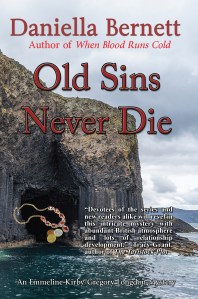
While in the Lake District, journalist Emmeline Kirby and jewel thief/insurance investigator Gregory Longdon overhear a man attempting to hire international assassin Hugh Carstairs, a MI5 agent who went rogue. They race back to London to warn Philip Acheson of the Foreign Office and Superintendent Oliver Burnell. But it’s a devil of problem to prevent a vicious killing, if the target is a mystery.

More trouble brews as Emmeline pursues a story about shipping magnate Noel Rallis, who is on trial for murder. Rallis is desperate to keep the negative publicity from exposing his illicit schemes, especially something sinister called Poseidon. Lord Desmond Starrett, whose dark past made him easy prey for blackmail, is getting cold feet about their dubious partnership. Hovering in the shadows of this ugly secret world is a Russian mole buried inside MI5. Scorned prima ballerina Anastasia Tarasova makes the fatal mistake of threatening to reveal all she knows. The hunt for the answers takes Emmeline and Gregory up to Scotland, where they learn that the truth has lethal consequences.

Buy Links:

Amazon: https://www.amazon.com/Old-Sins-Never-Die-Emmeline/dp/1644372762

Barnes & Noble: https://www.barnesandnoble.com/s/old+sins+never+die+daniella+bernett/

Daniella Bernett is a member of the Mystery Writers of America NY Chapter and the International Thriller Writers. She graduated summa cum laude with a B.S. in Journalism from St. John’s University. Lead Me Into Danger, Deadly Legacy, From Beyond The Grave, A Checkered Past and When Blood Runs Cold are the books in the Emmeline Kirby-Gregory Longdon mystery series. She also is the author of two poetry collections, Timeless Allure and Silken Reflections. In her professional life, she is the research manager for a nationally prominent engineering, architectural and construction management firm. Daniella is currently working on Emmeline and Gregory’s next adventure. Visit www.daniellabernett.com or follow her on Facebook at https://www.facebook.com/profile.php?id=100008802318282 or on Goodreads https://www.goodreads.com/user/show/40690254-daniella-bernett. Old Sins Never Die, the sixth book in her series, was released today.

Social Media:

Facebook: https://www.facebook.com/profile.php?id=100008802318282

Goodreads: https://www.goodreads.com/user/show/40690254-daniella-bernett

BookBub: https://www.bookbub.com/profile/daniella-bernett

What I Do When I Hit the Brick Wall

Once, when I was whining about how difficult it was to be discovered as an author, my mother remarked, “Well, you must like hitting your head against a brick wall.” (Such support, right?) Of course, she meant that I could do much easier things instead of trying to publish novels.

It’s always hard to be an author, and at least for me, with all the Covid restrictions these days, it seems even harder now. Although I long to escape to another world and another life, most days my brain seems incapable of creating that fictional place and story.

When I speak to high school students about the writing life, I ask them to name the most important trait needed to become a successful author. They guess aspects like “good grammar” and “imagination,” which are important, but not the most important. The correct answer is “self-discipline.” Nobody makes a novelist work forty hours a week. There’s usually no guarantee of payoff for all the hours we put into assembling words into stories. We have to make ourselves sit down and write and edit and finish a book. And then most of us have to make ourselves market that book, too. So, as we toil away at our computers and rearrange endless Post-It notes or Scrivener outlines, it’s all too easy to hit the wall and simply not want to continue.

I smash into that dang wall on a pretty regular basis. I get stuck on plots. I decide my writing is total crap. I’m almost always certain I don’t have a clue how to market a book.  Sometimes I don’t even how to finish the freaking story.

But I know I want to try. So, I back up from that wall, bandage my injuries, then take a long solo walk or paddle my kayak around the bay. Some evenings, I’ve been known to have several glasses of wine and feel sorry for myself. But I allow myself only a day to wallow in self-pity. The next day, I suck down several cups of good coffee and get to work on employing these techniques for getting over or around that invisible barricade.

To help with writing:

  • I read a mystery that I love that is similar to what I’m trying to write, and make notes about what happens in each chapter. This must be a book that I’ve read at least once before, because I don’t want to get so involved in the story that I can’t see the structure. I’m not going to copy the plot or characters, but taking notes about the structure allows me to see how the author built the story. Then I can often see where I am going wrong, usually by telling too much too soon, or straying off on some tangent that kills the suspense.
  • I watch a movie in the same genre and take notes of the scenes to accomplish the same goal I described above. Again, this should be a movie I’ve seen before, so I don’t get too wrapped up in what’s going to happen next.
  • I read an instructional book on writing mysteries. Yes, I know all this stuff, but I need to be reminded over and over again.
  • I brainstorm with another writer, asking for criticism of my story and for any and all ideas for improvement, no matter how wacky. It’s easy to lose all objectivity about your own writing, and it’s also easy to fall into a rut, so you need to seek out the ideas and opinions of others. I generally don’t end up using most ideas presented to me, but brainstorming sessions open my brain to new possibilities.
  • I practice writing the short description for the story that will go on Amazon or on the back of the book. This is always an agonizing exercise for me, but it often causes me to focus on what the heck the story is really about.

To help with marketing:

  • I Google other authors who are similar to me and look at what they do on social media and their author websites and such.  Since I am an indie author now, I mostly look at other indie authors, because traditional publishers have larger advertising budgets and more marketing opportunities than most indies do.
  • I ask other mystery authors at my level (or slightly above) and in my genre which marketing techniques and advertising sites have worked for them. I write mysteries, so it won’t help much to ask a nonfiction author or a romance or fantasy author; I’m seeking ideas on what works for marketing mysteries.

The process of writing, editing, and marketing a book takes a long time for most of us. I meet many writers who finished writing a story but did not bother to proofread or polish it, uploaded the rough version to the internet, and then got frustrated and bitter when that effort did not result in massive sales. I call this group “hobby writers.” They aren’t yet professional authors. Professional authors know that writing and marketing books is work, and they are willing to put in the days to push on when they hit the wall. The process doesn’t necessarily get easier with each book, but we know that when that barricade inevitably looms in front of us, we will find a way to get around it.

My Own Version of Justice by Paty Jager

This year, I’ve been banging the keyboard and getting projects done…until last month. It seemed like every time I got in a good day, or two, of writing, something came up and I went days without getting a word down on my WIP (work in progress).

This month, I’m determined to get the 6th Gabriel Hawke book written and out to my CPs (Critique Partners) I’ve had this story idea in my head since I did my ride-along with a State Trooper before I started this series.

It’s something that happened in real life but I’m putting a different spin on it. On the ride-along, the trooper pointed out a campsite and said, “See that burnt spot?”

I did. It was a campfire ring of charred rocks and grass three feet around the ring.

“A vehicle rolled over the fire with a man in it. It was written up as an accident.” The trooper looked over at me. “What do you think?”

“There is no way it was an accident,” were my words. The area was flat. A vehicle even if knocked out of gear wouldn’t have rolled the distance the vehicle was parked away from the fire.

“The victim was drunk. His wife kicked him out of the tent and he went to sleep in his vehicle. They say, he must have bumped the gearshift and it rolled.” He glanced at me again.

I shook my head. “Why was it pronounced an accident? I don’t see how it could have been.”

“All the investigators wanted to call it a homicide but the District Attorney said we didn’t have enough evidence and didn’t want us digging into it any further.”

I could hear the dismay in his voice. He clearly felt someone had gotten away with murder. And that is why my book, Turkey’s Fiery Roost, is about Hawke tracking down the killer.

Writers, do you like to use real life murders/criminal activity to spur ideas?

Readers, do you like knowing that writer’s try to write their own form of justice when putting together a murder mystery?

One & Done: Writing Stars Sometimes Do Align

When you first put eyes on the man you knew who’d be your husband. The opening notes of a song that strums your soul, still gives you chills when you’re reunited years later. How a perfect canvas sky at sunrise or sunset leaves you spellbound. The awe you hold in a composer, a painter, or any other artist getting a project right on the first go, the first shot, the first time out.

I’ll let you on a little secret. Don’t tell anybody.

It. Does. Happen.

Let me explain.

Sometimes when you draft a scene, a character sketch, a chapter or chapters, whichever your writing project is under your fingertips, you can–and do!–get it right on the first try. I’m here to exclaim, take back, and boldly proclaim: IT HAPPENS!!! The magic pixie dust found you that day, took a liking to you, and left you some of its glittery jet wash in its fumes.

Here’s a few instances–

We Are The World,” co-written by Lionel Ritchie and Michael Jackson, both completed the song’s lyrics and melody in 2.5 hours, and recorded the song in a single session.

Sir Paul McCartney, in writing the 007 Live and Let Die theme, had movie execs wait five days for the work–when he’d written the music in a scant 45 minutes. According to the anecdote relayed in Casey Kasem’s American Top 40 countdown, “I didn’t want the movie brasses to think this was easy, but it was.”

Alanis Morrisette wrote her 1990s hit “Ironic” in an hour.

The blind guy who hit a hole-in-one on his only try.

Chapter 18 of JERSEY DOGS called “A Little Rusk Nikk’ed Us.”

Woodstock, 1969.

Any MLB team’s first try for, or breaking a century-long drought, at a World Series win.

And countless times when people played the lottery on a sole instance, and hit the number big.

So don’t tell me when you bang out a first draft of anything it’s impossible to get it right ON the first go, in the first go. Granted, this is a diff’rent post from calling that first one-and-done draft novel perfect; it ain’t. The book’s likely purple prose-y, your story’s taking forever to get to the point, it’s adverb- or passive voice-heavy, etc. You know who youse are :).

BUT . . . some chapters, or sentence phrasing(s), scenes, or certain word choices ARE perfect in the middle of that first draft crapstorm you can pluck free that which resonated most, and build around this in the coming revisions.

An article in the September 2019 issue of The Writer, “Stop Trash-Talking Your First Draft” puts it brilliantly: “You wouldn’t call your firstborn a sh*tty first draft, would you? Of course not! Even if the baby may have correctable health problems or non, that child is imperfectly perfect, period. Anyone saying to you that child is a crappy first draft, you’d say they’re abominable human beings. The first breaths of life in that early writing draft isn’t any different.” (paraphrasing mine.)

Whether you’re a veteran author or a brand-new writer ten minutes ago, the first draft is part of the writing process. But if the end result isn’t called the horrific names the first draft gets, why should the first draft be treated like a bastard at a family reunion? This reference is a great piece I can’t encourage to be read enough. Feel empowered when you come away from it–I’ll betcha you do, as you should. I did–and if anyone knows how much a hardass I am, I was a wet and snotty cottonball after the piece. (Forget you read that “wet and snotty cottonball” part–I’m a hardass, rememeber?)

So write the first draft with abandon! Come to its defense, warts and all; who else will if not you? The article also questioned when did it become sacred to trash the first shoots of life in a brand-new piece to begin with. It ruminates Anne Lamott’s Bird by Bird had much to do with the first draft getting the hot pile of bat guano label, but maybe, the article’s author muses, it might be time to put this line of thought in the trash. I could not agree more. Also paraphrasing mine: Just because Bird rode high on the writers’ reference bookshelves and bestsellers lists, doesn’t mean its apologia is airtight–or shouldn’t be questioned, revised, or even abandoned altogether if its information isn’t applicable or merited anymore.

First-run tries do periodically knock it out the park. Is this a fluke? An oddity? Chance? Absolutely. But trashing the first drafts have gotten the sacred cow status in the writing world–and perhaps your writing lives–long enough. The initial piece may be in rough shape, but you got the damn thing OUT in the first place. The potential the work holds is enough to NOT tag it as crappy, even if it isn’t in a no-need-to-edit perfect place on the first doggoned try.

I’ll let you in on another inside baseball secret: Every word above this paragraph virtually poured out of me for this month’s post on the first go, easy to align my thoughts on the article’s topic, only an edit or two for clarity, continuity, and relevance. But, as that damn bitch called The Muse mule does, when Bessie’s out of steam, she’s not moving for anyone until she’s good and ready. Then it hit me. Rather, Bessie, my mule of a Muse, kicked me (is this her helping me plow another 40 acres of a blog post? You decide. **smirk**) to bookend this aspect of my writing life in a way I didn’t think plausible. The second reason this post couldn’t be more timely: this article vindicates me to my now disbanded online critique group my first Casebook got ripped to hell for. I told that group at the time I knew I was instinctively right to defend the book’s parts that fit when the self-righteous–and traditionally published in the group–mob tried to justify their words in tearing it down. But that’s another blog post for another time.

Create? Yes. Re-Create? Sh*t, No!

Let’s revisit and unpack our “We Are the World” by USA For Africa example–can that magic be re-created? No, unfortunately. Or when you first read Harry Potter, saw the movies, had your first child, or found your car unicorn. Can you re-create that exact perfect first draft moment with all its magical elements falling into place where they should, as they should? Nope. This is why you don’t see Lionel Ritchie, Quincy Jones, J.K. Rowling, et al trying to re-do what sheer dumb luck, fantastic timing, and a lot of Tinkerbell’s dust helped that magic come together, and hold together, in the first place. Imagine trying to re-create Ferris Bueller’s Day Off. The Back to the Future, Toy Story, or the Indiana Jones flicks. If anything, somebody should’ve told Michael Wang this 1 Corinthians 10:23 lesson before taking the thought of creating Woodstock 50 in mind: Just because you can do something, dun mean you should do it.

“When it’s perfect, be it from the onset or after many rounds of revisions, then let it go. If you keep tweaking, you’ll tweak the perfect out of it.” —Julia Cameron, The Artist’s Way, 25th Anniversary Edition (paraphrasing mine)

If Cameron’s second-to-none resource is helping you to be okay with finally silencing your mother’s words, the inner editor and outer critics, naysayers, and downright haters of first drafts for being in that pole position, then be okay with it. Don’t even let Anne Lamott tell you diff’rent. Think about it: How much pressure is on her to defend her position?

The defense rests.

I attended a NYC 2011 workshop where Reed Farrell Coleman spoke on a similar topic. He knew a would-be author a few years prior revising his book’s opening chapter–both hands on the wheel, please, or swallow your hot beverage before reading on–27 times.

You read correctly. Twenty. Seven. Times.

But this was made more bittersweet because, Coleman said, this author had been one of the first detectives on scene hours after the Twin Towers were still hot ash, hot rubble, and chaos. He’d been diagnosed with Stage IV lung cancer as he drafted the novel, so Coleman point-blank told him, “Dude, you don’t have time to revise this much. Take the best of the suggestions and move on; the opening’s gonna be what it’s gonna be!”

The author took Coleman’s advice and moved on. But he died before ever completing his book. How much time he’d lost on something that didn’t need that much fussing about to begin with, and sadly, the world will never know what would have been.

This is what Cameron means about tweaking the perfect out of the imperfect, and this includes first time tries being right . . . the first time out. You, Dear Author, need not diss the WIPs in the zygotic stage of life. Let it go. Be proud you get to watch it fly–or cradle it to the next world with dignity and grace in one hell of a send off.

As always, you got this.

~ Missye

* * *

You’re still here?

Um . . .why?

The piece is over. I mean, I know you want more of me–or wished the Toy Story franchise ended at TS3 like I do, or more Pottermore following Harry and the wizarding gang all growed up–but sorry, ain’t got that for ya. I’ll be back next month, Lord willing, with another scintillating, firestarting post. Go feed your cat or clean his box, since he’s giving you that stink-eye felines perfected waiting on their humans to tend them.

No?

Sigh.

I didn’t want to do this, but . . . this goes dark in 3 . . . 2 . . . 1 . . .

The Great Printer War

by Janis Patterson

Normally I am very soft-spoken. Normally I am temperate in my language. Normally… but nothing about this situation has been normal, not even my language.

Years ago I bought an inexpensive little b&w laser printer – nothing fancy, as at the time I did very little printing. Most of my work and documents etc. were done on-line. A printer was a luxury, so I got a cheap one. It came with a decent-sized cartridge and I got almost two years of printing before the cartridge expired. I bought another; it was more expensive by a few dollars, but…

Another year or so and another cartridge, for a few dollars more… (sounds like a title, doesn’t it?) and as I still did very little printing I went ahead and paid.

Until last week, when the current cartridge ran out and to my horror I found that the cartridge (which is fairly small) cost almost twice what I originally paid for the printer itself! To my mind that is just wrong, especially since lately I am printing so much more than before!

Well, on our last two trips to the computer store to get things The Husband needed I had been looking around and fell in love with one of the Epson ink-tank color printers. It is supposed to do everything – copy, print, scan… the whole nine yards. And while Epson makes three versions of this kind of printer (with escalating features and prices) I decided I could afford the least expensive. I mean, it’s an investment, isn’t it? My cheap old one was a number of years old, so who knows how much longer it would last, and even if it did the cost of three cartridges would almost pay for the new printer plus a year’s supply of ink… and just think of the colorful things I could do – holiday letters, birthday greetings, handouts for my ladies’ club… You agree, don’t you? Well, please do even if you don’t, because I did it and I need validation. So I bought the printer.

Except I didn’t. The computer store didn’t have one, just their mock-up floor model. Same thing with the office supply store where we’ve shopped for years. Both offered to have one delivered to me, but could give no idea of when. So, muttering angrily, I went online. Amazon could get me one in just six weeks. The on-line version of our computer store felt sure they could get one to me in just five weeks. The printer’s manufacturer was out of them in their store, and had no idea when they’d get more!

Finally, my muttering growing into a full growl, I checked online at a national we-sell-everything store and found they could get me one in two and a half weeks. Knowing when I was licked, I jumped on it and sent them my money.

Mirable dictu! Three days later they said they could get one delivered to my front door in two days. I was delirious with joy. Until the thing arrived. I unpacked it, removing all the tape and packing materials (some of which were in the oddest places!) and put it on my desk. Then the unholy circus of installation began.

I am not a computer person. I am a writer. I put words down one after another. I speak several languages with wide variations of fluency, but computer-tech stuff flummoxes me, especially when it is written by someone who is not only a computer genius, but to whom English is obviously no more than a third or fourth language. Translating what the manual (manual? a two-sided cheat sheet that came with the machine) said into sensible English took longer than unpacking the thing. Even when the directions were fairly clear, there were no indications if you should be doing whatever was the next step on  your computer or on the printer screen. AAAAUGH!

Fortunately the loading of the ink reservoirs (something I had feared because I am a klutz) was easy as pie. Priming the print heads was automatic, and topping off the tanks with the remaining ink as easy as the first filling.

Then came the bad part. I had to download programs and sync with my wifi, and that is when both computer and printer turned against me. I finally gave up trying to connect the devil device with the wifi and went with my standby plug USB cord. Then I had to make the computer recognize that there was a new printer attached, something it most definitely did not want to do. The instructions were of no help, not even telling me on which machine each action had to be performed.

By now I was in full swear mode, turning the air blue with such fluency it was a wonder that my mother’s ghost did not come back to wash my mouth out with soap. The Husband, who is equally or even more than a techno-naif than I, stood by and very wisely did not say a thing.

After about twenty minutes of following vague instructions down rabbit holes and clicking on all sorts of improbable things, the new printer shook itself with a growly groan and began to spit out perfectly printed test sheets.

Why? How? What had I done? I have no idea. I would swear that I had done the same thing at least three times before, but nothing had happened until that minute. Maybe the cyber-gods had taken pity on me; I don’t know and really don’t care as long as the (several expletives deleted) thing works!

In these days where even the smallest home computer seemingly can do everything but the dinner dishes, why do we have to go through these trials? Why can’t everything be set where when you get a new piece of hardware you just plug it into the wall socket, then plug it into the computer and presto! everything works. Seems like I remember something from years ago called Plug ‘N’ Play. What a wonderful concept! All the owner should have to do is put in the proper plugs (even I can do that!) and the two machines start to talk to each other and then start to work. Does such a wonderful idea still exist in the real world? It should. It really should.