Unplanned Adventures

Most of my favorite experiences in life have been unplanned adventures. There’s nothing I appreciate more than a good surprise, and they make great fodder for writing, too. Here’s one of my favorite unplanned adventures that I will never forget.

When I was a teenager in Oklahoma, I had a horse, and so did many of my friends. I’d worked hard and saved all my money for years and carefully planned on how I would buy and board my horse in a nearby pasture, and as a teenager, I finally accomplished my dream to have a horse. My mother always thought riding was a reckless activity, and she told me that if I hurt myself, I couldn’t complain to her.

One day I was a guest at another girl’s horse farm, and we decided to go on a trail ride. I was given a big white gelding to ride, and we set off, with me in third place behind my two friends. Near the beginning of the trail, our horses needed to jump a log that lay across the path. It wasn’t more than a foot thick, so no problem. But after my horse leapt over it, he started acting wild, wanting to get off the trail, and as I held him back, he reared. “Hey,” I yelped at the owner, “What’s wrong with this horse?”

When she glanced back, she said in a casual tone, “Oh. I forgot. That’s the beginning of the jump course, and he’s trained to finish every time he starts. So please, just let him go and ride him around the course.”

This is definitely NOT me

Uh. Two problems with that. 1) I’d never ridden a jumper, and 2) I was riding in a western saddle, which is definitely not designed for leaning forward against the horse’s neck, which is needed on jumps, especially high ones. But I figured, what the heck, this horse clearly knows what to do.

And he definitely did. He cantered into an arena that was close by, and we soared over the first few relatively small jumps. I was only hanging on; the horse was the expert. Then we approached the final pole jump, which was about five feet tall, my own height. Yikes. I will always remember thinking that it would be a miracle if I ended up in the saddle on the other side. The horse rose up beneath me, launching himself in a nearly vertical position, and I did my best to lean forward over the saddle horn. Then he came down on the other side in just as vertical a position, but forelegs first, of course, and I tried to sit back.

When we first touched down, I whacked my little finger on the saddle horn, and I’m pretty sure I broke it. But I remained in my saddle, and the pain was nothing compared to the thrill of riding that horse. After the ride, the owner showed me a whole gallery of photos of that horse in action; he was a champion jumper. I splinted my little finger at home and said nothing to my mom. But I smiled for days.

Now, when the weather is damp, my little finger is often very stiff, but that reminds me of the day I accidentally rode a champion jumping horse.

My “Little Gray Cells” Are Getting Full

As Hercule Poirot, one of Agatha Christie’s prominent characters, was often to say, his “little grey cells” were working. I have been feeling of late that my “little gray cells” or brain is getting too full to handle much more. LOL

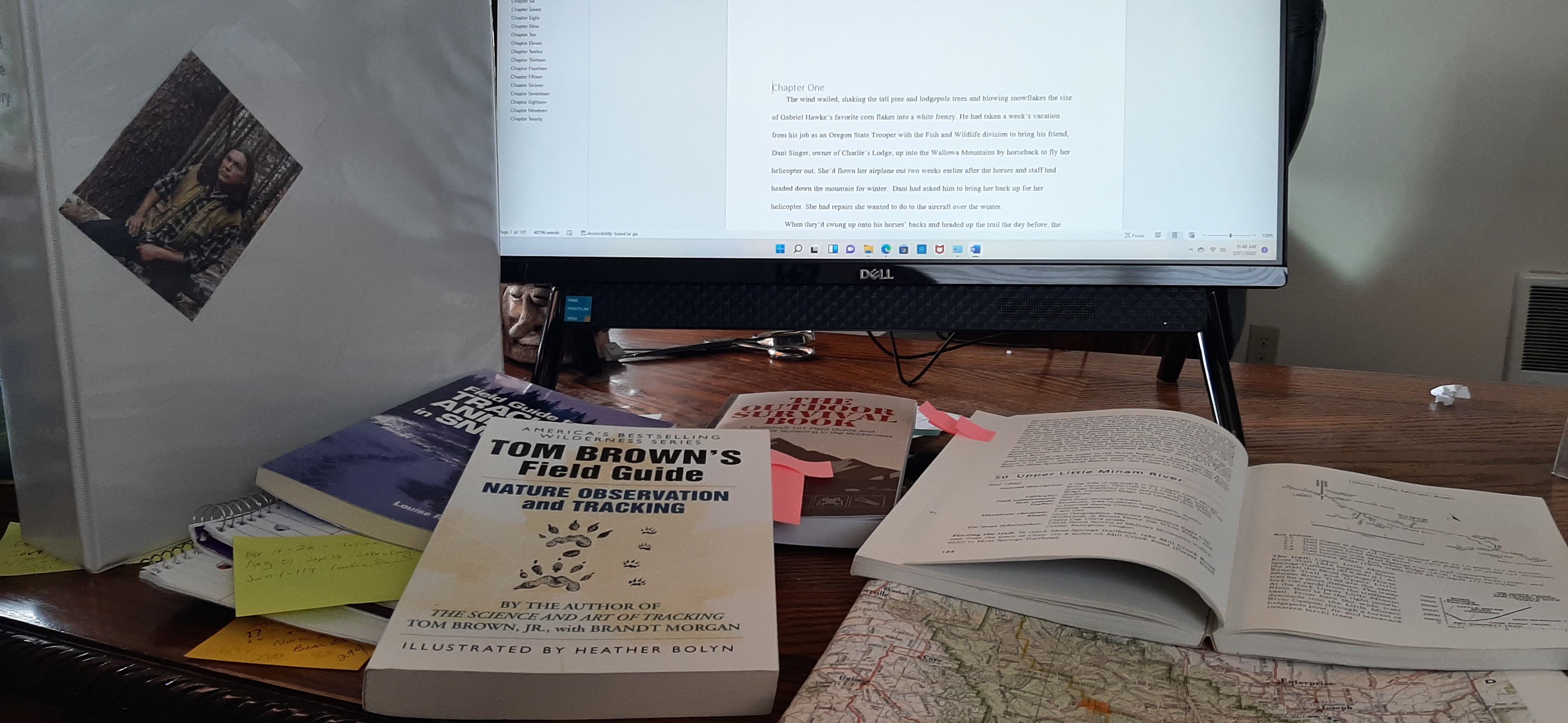
Between the research I’ve been doing for the latest Gabriel Hawke book I’m writing, which is set in the winter in the mountains, to the research for Dela Alvaro, a lower limb amputee, I feel like I finish one book on a subject, only to pick up another book and read about something else I need to know for the book I’m writing or plotting.

While I sound like I’m complaining, it is the research I love the most about writing a book. Well… maybe that’s a second to coming up with an interesting or unique way to kill someone. They are close in what I enjoy most about writing a murder mystery.

I have been using Tom Brown’s Field Guide to Nature Observation and Tracking, The Outdoor Survival Book, Hiking Oregon’s Eagle Cap Wilderness, Field Guide to Tracking Animals in Snow, and the Oregon Gazetteer, not to mention Google Maps and numerous sites I’ve pulled up on the internet to answer questions. These are all for Owl’s Silent Strike, book 9 in the Gabriel Hawke series.

My character has to take care of a broken leg on his significant other in three feet of snow. Care for another person’s frostbite on their feet and keep all three of them away from men with AR rifles that Hawke believes are after the man he found wandering on the mountain. So you can imagine I had to also research caring for a compound fracture and frostbite.

I also was lucky enough when I started this series to make friends with an aviator who is always willing to help me with aircraft questions as Hawke’s significant other is a pilot. He helped me figure out why she wouldn’t be able to fly the helicopter, they came after, off the mountain.

There are some books, like this one, that I feel like I put in twice as much time with the research as I do actually writing the book. I hope all of this effort pays off in the incidents sounding plausible and realistic.

I have also been filling my head with as much information as I can about a lower limb amputee for my character, Dela Alvaro, in my Spotted Pony Casino Mysteries. I found a book the other day titled AMPossible. It’s written by a lower limb amputee who also counsels other amputees. It has all the nuts-and-bolts information about how a person feels after the amputation, from emotions to physical and what to expect. It has been very helpful for knowing how to portray my character.

All of this and the research I will continue to do for each book as it comes along is why my “little gray cells” are getting full. It’s no wonder I forget the little things. Where’s my phone? What did I do with that letter? What was I supposed to do when I finished writing?

The Truth About Idleness

by Janis Patterson

Perhaps one of the hardest things about writing is to convince non-writers that you are actually working when you’re just sitting and staring into space. Of course, part of the problem is the popular perception that writing a book consists of sitting down with pen and paper (for the romantics) or laptop (for the pragmatists and those with bad handwriting) and in a few days dashing off several thousand words, which are (1) sent to an agent grateful to receive them who sends them to a (2) publisher, who immediately responds with a large check and (3) a few weeks later the book – nicely printed and with a gorgeous cover – appears in all the bookstores while the author (4) is on a magical country-wide book-signing tour.

If you believe that, let me tell you the one about Little Red Riding Hood.

Yes, the above scenario has happened – but so rarely it isn’t even statistically viable. In the acting world it is called the ‘Cinderella syndrome’ – or by the more cynical, ‘deus ex machina.’ There’s nothing intrinsically wrong in wishing for a fairy tale publishing experience, but it’s foolish to believe in them and idiotic to expect one.

Writing is work. Writing is not only work, it is full-time work, because some part of your brain is working on your story while your hands and head are busy cleaning house or working at your day job or even while you sleep. Creation is a full-time business.

Which is why it is so irritating that when the writer does get a few minutes where nothing physical has to be done and can sit and deliberately think about his story (without actually being at the keyboard) the non-writers around either tease or castigate him for being lazy. One of my favorite quotes is from Robert Louis Stevenson in “An Apology for Idlers” (Cornhill Magazine, July 1877) – “Idleness so called, which does not consist in doing nothing, but in doing a great deal not recognized in the dogmatic formularies of the ruling class, has as good a right to state its position as industry itself.” So, for writers especially, sitting and (visually) doing nothing is actually work.

Last summer I was fortunate enough to visit the home of Francis Parkinson Keyes (pronounced, I learned, as K-eyes, not like the things that open locks) in New Orleans, even though I had vowed never to set foot in that benighted city again. It was an old house (late 1700s) in the French Quarter, which meant it sat right on the street with only a narrow strip of flower bed in front and some beautiful curving stairs up to the front door. A wildly popular mid-20th-century novelist, Mrs. Keyes usually wrote in what she called her office, a converted parlor at the front of the house. She was interrupted so many times by fans who wished to meet her (and had the gall to come and knock on her front door!) that she eventually converted the former servants’ quarters in the back of the house to her office, turned the parlor back into a parlor and had her maid say she wasn’t at home.

One incident which the guide recites is of how Mrs. Keyes was sitting in her parlor office, thinking (i.e., working) when a fan walked up and knocked on the door. Mrs. Keyes answered the door and when the fan (a culture vulture clubwoman) said that she had just come to tell Mrs. Keyes how much she liked her work, Mrs. Keyes – understandably miffed at such an intrusion – politely told the woman that no, she cannot invite her in for tea and a chat about her books because she is working. The woman then became huffy, saying that she was doing no such thing, she herself saw Mrs. Keyes just sitting and staring and that surely a short interruption of an hour or so to talk to a fan was more important than doing nothing. Later in one of her memoirs Mrs. Keyes said that she doesn’t understand why people – women especially – can’t understand that an interruption in the mental process of writing is just as devastating as interrupting the cooking of an angel food cake for an hour or so and expecting it to come out perfect when the cooking process is finally completed.

My own dear mother, who was not a writer herself, never grasped that, and with every interruption would say, “I’m just going to take a minute…” As she was a skilled seamstress, I once in frustration grabbed a spool of thread and said the thread was representative of an idea. Then I pulled out a foot or so and cut it, moving the ends apart. “That’s what happens when there is an interruption,” I said. “The thread is changed and can never be the same again.” “But I just took a minute,” Mother would reply. She never got – or never acknowledged – the concept.

There have been pundits who declare that the preparation for writing – researching, plotting, experimenting with ideas, etc., including simply staring into space thinking – accounts for 90-98% of the total time necessary to write a novel. The 2-10% left is for sitting at the keyboard, which is merely transcribing. My own personal percentages vary, but nothing changes the fact that most writing is done in the head.

When other people allow it.

While I love people and am very social and outgoing, I do understand and sometimes envy those writers who have the good fortune to be able to lock themselves away – either in an office with a lock on the door or a private island – and do their work, even if it does seem to be nothing but staring into space.

Gumshoeing

Last month, I wrote about the tools of the trade that I use to create my fiction. That got me thinking. What tools do my fictional characters use?

When I was writing Kindred Crimes, the first in my series featuring Oakland private eye Jeri Howard, I wasn’t using a cell phone, and neither was Jeri. I was using a computer, a clunky dual disk drive model, and I thought it was a major step up from the electric typewriter.

Jeri and I have made our way into the 21st century. She uses her cell phone for everything from directions to looking up information, and for talking with people, of course. As for computers, like many real-life private investigators, she uses them for research. In addition to news archives, there are many paid databases that one can access by purchasing a subscription. Jeri also uses government records that are available online.

For example, in the book I’m writing now, The Things We Keep, Jeri goes onto the California Department of Justice website to check the missing persons database. I did this myself, so I could describe it accurately. And it certainly gives flavor to the narrative.

But it isn’t all Jeri at the keyboard, looking at the screen, or Jeri on the phone, interviewing someone. That would be boring for the reader and the writer. At one point in Water Signs, Jeri says:

I could just as easily interview Rachel Leverson over the phone, but whenever possible, I prefer to do so in person. That allows me to gauge reactions, facial expressions and body language. It also gets me out of the office.

Interviewing people face-to-face gives Jeri more information than pixels on a screen. In the world of my fictional private eye, there’s no substitute for shoe leather. But it really does help that Jeri can make a call without looking for a phone booth.

Kay Dexter is the protagonist of my novel The Sacrificial Daughter. She is a geriatric care manager and has access to all the tools that software and the Internet can provide. Her clients are mostly elderly people and their families.

Once again, there is no substitute for face-to-face contact. A client might be minimizing problems or feelings and Kay might not pick up on that over the phone, but she can usually read people when she’s with them. As for those online tools, there’s a scene in the book when Kay is doing research in the library at the local historical museum. She’s looking at files and photocopies, because not all the information the museum has is digitized. Those online records frequently go back only so far.

Kay uses her powers of observation as well. Some valuable items have gone missing from a client’s home. While doing an errand for another client, she visits a local antique mall:

I turned and glanced at the glass display case on the booth’s back wall. What was that? I moved closer to the case. On the top shelf, I saw a sterling silver sugar and creamer. They looked exactly like the ones I’d seen in the china cabinet at Betty’s house, right down to the floral detail on the handles.

I also write a series of historical mysteries set in the early 1950s, featuring Zephyrette Jill McLeod. Computers? Not happening there. For Jill to solve mysteries onboard the train, and off, it’s strictly person-to-person sleuthing. Jill’s job, when she’s aboard the California Zephyr, is to observe the passengers and help with their needs. Jill notices things and she files them away in her mind, ready to access the information. Along with her ability to talk with people and tease out information, these are her biggest assets as a detective.

And that’s gumshoeing, on the ever-changing streets of the Bay Area where Jeri sleuths, to the fictional mountain town where Kay oversees clients, to Jill’s shiny train as it streaks across the west.

So You Wanna Write Funny? by Heather Haven

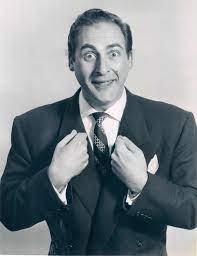
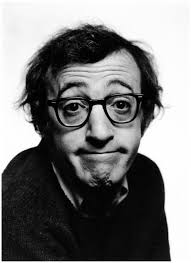
In my far-off youth and for as long as I can remember, lurked inside me the heart of a comedy writer. I wanted nothing more than to be writing funny quips for people, like Woody Allen did for Sid Caesar on Your Show of Shows, back in the fifties. I wasn’t around then, but I’ve seen most of the kinescopes interviews with Allen and Caesar and was mesmerized. Just to make it clear, I wasn’t nearly as impressed by Allen’s foré into his own comedy shows, record albums, movies and even less impressed with his romantic encounters. What got me where I lived was him writing words for performers that made an audience laugh. I couldn’t imagine a greater existence.

One of my very first jobs as a writer in New York City was for No Soap Radio. As the name implies, we wrote funny ads and commercials for radio, had a ball and got paid a weekly salary! Does it get any better than that? Of course, the weekly stipend was so little I often had to decide if I would pay my rent or the phone bill, but by golly, I was a comedy writer. It was a short-lived chapter of my life, maybe a little more than a year, but the things I learned from that group of comedy writers have held fast for the rest of my writing life.

The art of comedy is serious business and you’d better know your business. You’d better know timing, delivery, and what the funny words are. By funny words – and most people don’t think about this – these are words that automatically cause people to smile or chortle. For instance:

Orange? Not so funny. Kumquat. Funny.

Move? Not so funny. Jiggle. Funnier.

Glasses? Not so funny. Spectacles. Funny. Or maybe more funny. Testicles? Whoa. Never mind. But in comedy, expect the unexpected. It often gets a laugh.

But back to words, if you don’t have the words in the right order, with the right rhythm and cadence, it’s probably not going to work. I’ve known comics to work on a one-line joke for weeks until they get it right.

Speaking of comics, have you noticed they often talk in violent or military terms? “I slaughtered ‘em last night” “Man, that audience was murder” “Go out and kill ‘em, pal,” phrases like that. There’s a reason for it. If you don’t get that laugh, you might as well be dead. Comics are very serious about their laughs.

Same with authors who write a funny mystery series. That corpse better be laughing when he hits the ground. Otherwise, I don’t sleep so good at night.