Back to Normal for Mystery Writers—Mostly.

The big mystery cons are ready and waiting for writers and fans to enjoy mingling, meeting authors and readers, and enjoying being together.

I have wonderful memories of the Bouchercons and Left Coast Crimes I attended over the years. Sometimes going to one of these events was like attending a family reunion. Often I was greeted with a big hug by someone I’d met the year before, and we’d have a wonderful time chatting.

There were also several smaller mystery conferences I attended that are no longer happening. My favorite was Mayhem in the Midlands, which happened in Omaha. I met so many wonderful people there, fans and authors. It’s where I first met Wm. Kent Krueger and his wife. And it’s where my husband and Kent vied for the best actor at the mystery dinner and play. Sometimes Kent won, and other times it was my hubby.

Once Kent’s wife and my husband were on a panel with Jan Burke’s husband and another spouse I don’t recall right now. The moderator asked great questions, and it was a hilarious panel.

My husband and I had a wonderful time hanging out with the most interesting people, and also traveling to many places in the U.S. we’d have never visited if it had been for these mystery events.

Now, hubby and I no longer fly, and I am only planning on attending one writing conference, the one put on by the Public Safety Writers Association in Las Vegas. (My daughter will drive me there.) This conference is small, attended by many still active and retired persons in all different types of law enforcement and other fields of public safety who are writing or aspiring to write, and mystery writers. The speakers and panels are a mixture of writing and publishing, and law enforcement information. Four publishers are expected to attend. https://policewriter.com/

What was once my normal, attending many mystery cons during the year, is no longer possible for several reasons, but I encourage those of you who can. And my advice to those of you who attend one or more event, don’t merely hang out with those you know, reach out and talk to everyone. Yes, I always did and shared some wonderful conversations and meals with interesting people for all parts of the country. You might become friends with a reader who will become one of your biggest fans.

Marilyn who also writes as F. M. Meredith

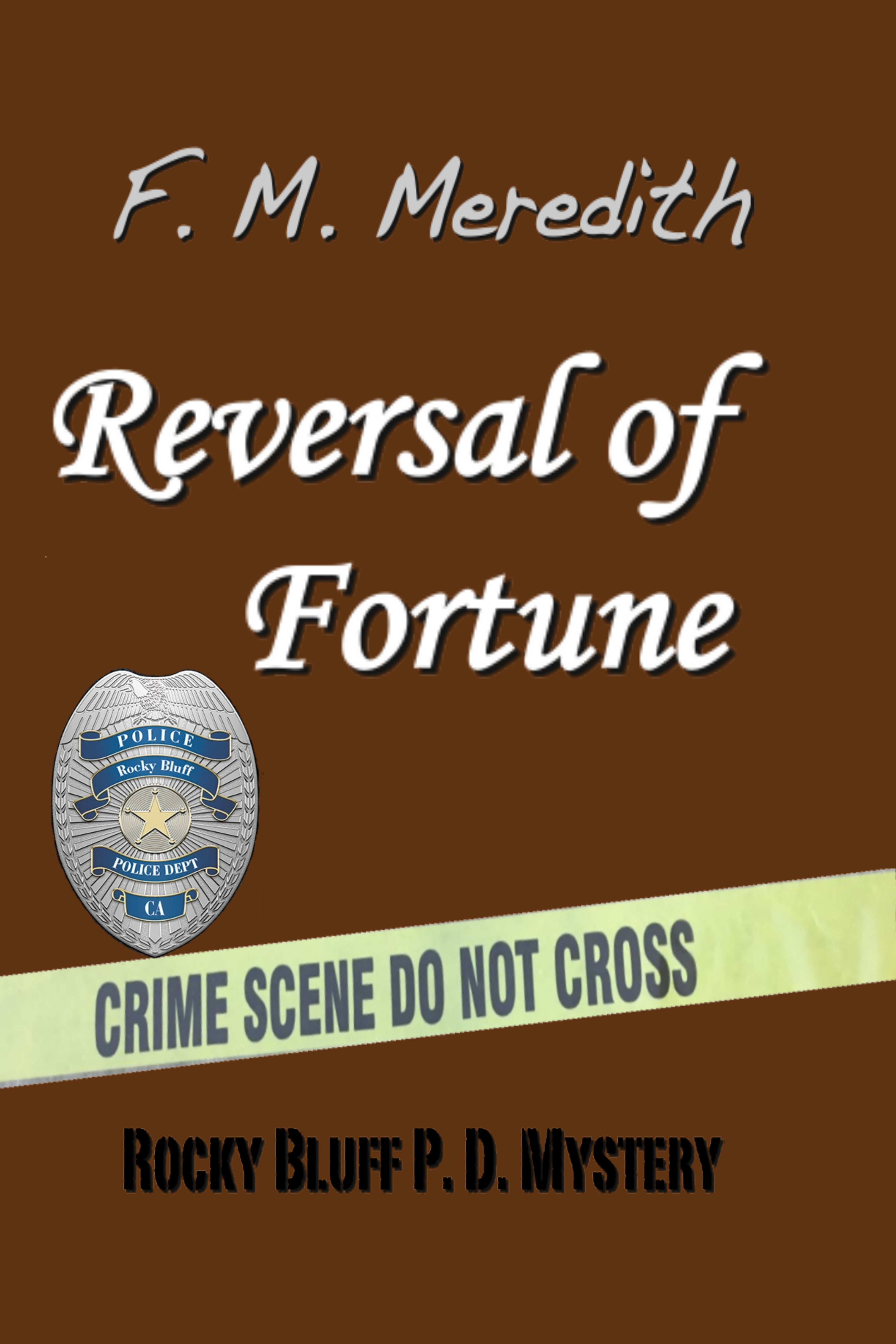
The latest and last book in the Rocky Bluff P.D. mystery series if Reversal of Fortune. And I’ve received lots of help for this series from folks I’ve met through the Public Safety Writers of America.

Guest Blogger ~ Joanna Fitzpatrick

When Do You Know You’re Going to Write Not Just One Mystery But a Series?

My first foray into writing mysteries was when I sat cross-legged around a Brownies’ campfire and told scary stories between bites of melting marshmellows. I held the girls’ attention with tales of monsters putting hairy arms through car windows and grabbing the bare necks of young girls cowering in the backseats. I loved adding details that made the other Brownies squirm.

Then as Virginia Woolf famously said, “life interrupted.”  My dream of being a writer was put on the back burner where it simmered for many years. The next opportunity to become a writer did not happen until, at age fifty, the record company I worked for was sold and I invested my windfall in my first love‑‑Literature.

After achieving a bachelor’s degree at SUNY, I was accepted at Sarah Lawrence College where I earned an MFA in creative writing. My thesis was a memoir on growing up as a Hollywood hippie. 

My first published book was a historical novel based on the life of the short story writer Katherine Mansfield.  My second novel The Drummer’s Widow was a contemporary novel about an older woman reinventing her life after her husband’s sudden death. I thought my third novel would be another genre. Or maybe return to that widow’s story in New York.

This was my state of mind when my husband and I moved to a mountaintop ranch in northern California for creative peace and quiet. The ranch’s tack room was converted into my writing studio. But I had severe writers’ block and I couldn’t find the nerve to begin another novel.

Then, remembering my writing teachers always telling me to write what I read, I signed up for an online mystery class at Stanford.

My great aunt Ada Belle came down from the heavens and offered her career as a painter for inspiration. In the 1920s, she’d lived in a women’s artist colony in our local town, Carmel-by-the-Sea. My research into this historical village opened a rich vein to explore as a storyteller. Characters started showing up in my studio and we worked together to plot a mystery. The Artist Colony became my third novel.

And now it’s published and I’m back to that dreaded moment when you’re between books and wondering if you really have the stamina to write another knowing how steep the metaphorical mountain is to climb before you reach the top and say “The End”. Or maybe not the end if I write a sequel, but is it too late to do that?

I’ve been told by those in the mystery-writing trade that if you’re going to write a sequel then you should know that before you start the first book. But recently I was speaking to a well-respected writing coach who said, “There are no rules other than write what you want to write as it is you who will have to devote a massive amount of time to get the job done.”

“Stop procrastinating!” added my amateur sleuth Sarah Cunningham. She is dying to step out from the written pages of The Artist Colony to solve a new mystery.

With this literary encouragement, I started making scenes in a small medieval village in southern France where I spend my summers. How marvelous to stroll on its cobblestone streets accompanied by my characters; sleuth Sarah, her Irish companion Rosie, and the ever popular dog-tective Albert. There are many unlit narrow streets where murder and mystery beckons me.

Ah yes, I can feel my heart quicken with suspenseful plots and spicy characters. I guess it’s time to get to work on that sequel.

*****

I’d love to hear from other mystery writers as to when they decided to write a series? From the beginning or, like me, after you finished one mystery and you and your readers missed your characters so much that you brought them back to life again. And a question to mystery readers? Do you want to know before you start a mystery whether there are going to be sequels? And will it influence your decision to read the mystery if it’s a one-off rather than a series?

In Joanna FitzPatrick’s gripping new novel, set in 1924, Sarah Cunningham, a young Modernist painter, arrives in Carmel-by-the-Sea from Paris to bury her estranged older sister, Ada Belle. En route, she is horrified to learn that Ada Belle’s suspicious death is a suicide. But why kill herself? Ada Belle’s reputation was growing: her plein air paintings regularly sold out, and she was about to show her portraits for the first time, which would have catapulted her career.

Amazon https://www.amazon.com/Artist-Colony-Novel-Joanna-FitzPatrick/dp/1647421691

Barnes & Noble https://www.barnesandnoble.com/w/the-artist-colony-joanna-fitzpatrick/1138488960?ean=9781647421694

Bookshop.org https://bookshop.org/books/the-artist-colony/9781647421694

Bookbub: https://www.bookbub.com/books/the-artist-colony-by-joanna-fitzpatrick

JOANNA FITZPATRICK was raised in Hollywood. She started her writing habit by applying her orange fountain pen and a wild imagination to screenplays, which led her early on to produce the film White Lilacs and Pink Champagne. Accepted at Sarah Lawrence College, she wrote her MFA thesis Sha La La: Live for Today about her life as a Hollywood hippie. Her more recent work includes two novels, Katherine Mansfield, Bronze Winner of the 2021 Independent Publisher Book Award (IPPY) in Historical Fiction, and The Drummer’s WidowThe Artist Colony, Gold Winner of the 2022 Independent Publisher Book Award (IPPY) in Mystery, is her third book. Presently, FitzPatrick divides her time between a cottage by the sea in Pacific Grove, California and a hameau in rural southern France where she begins all her book projects. 

Author website: www.joannafitzpatrick.com
Facebook: www.facebook.com/JoannaFitzPatrickauthor
Twitter: https://twitter.com/Fitzpatrick_jo
Instagram: https://www.instagram.com/joannafitzpatrick.author/

The Pull and the Pain of Creative Passion

A few days ago, I went to the Van Gogh Immersive Experience, which is an amazing traveling exposition of Vincent van Gogh’s paintings and life history that brings the artist’s paintings to life with sound and video. I watched crabs crawl out of picture frames and across walls, rivers splash off the canvasses, and spirals of stars roll across the night sky, just to name a few special effects. The show is a testament to technological wizardry as well as to art, and I am still awed by the creativity involved to put it together.

Appreciating the beauty and creativity of the show as well as reading about Van Gogh’s short life and his obsession for making art has me thinking about creative passions and how they affect those of us who have them—writers, artists, and musicians, for the most part. Van Gogh made more than 2000 sketches and paintings before he shot himself at age 37, but he was only able to sell only one painting in his lifetime and lived in poverty, supported by his brother. Van Gogh felt compelled to paint, but his work was unappreciated by those around him.

I won’t pretend that I am capable of that level of passion for writing, but I do understand both the pull and the pain of possessing a creative mind. Like so many writers, I’ve often been asked how much money my books earn or how many copies have sold, and like the majority of authors, I don’t make a living solely from my books. When I am not with writers, I’ve learned not to complain about the difficulty of marketing books or the frustration of smoothly knitting together a complex plot. Some of my family members have compared writing to banging one’s head against a brick wall, and some have suggested that my life would be easier if I would just quit writing.

But just like Vincent van Gogh couldn’t stop painting, I don’t think I can stop writing. I don’t know who I am if not a writer. To pay the bills, I’ve had a lot of jobs, but being a former technical writer or a private investigator doesn’t feel like enough of an identity for me. When I hear an especially clever comment from a friend, watch a hummingbird pluck fluff from a cattail for its nest, or feel the icy surprise of sleet on my face while hiking in the mountains, I want to capture that moment in writing. I occasionally make art, too—watercolors and acrylics—and I’m forever trying to capture a prism of sunlight on water or the texture of peeling tree bark in brush strokes, if not in words. My brain is often away on a solitary adventure instead of inventorying the groceries in my refrigerator.

The problem with being a creative person is that our passions are often dismissed as unimportant hobbies. Too many people are willing to pay more for a cup of Starbuck’s coffee than for a book.

So, Vincent, I get you. I’m sorry you didn’t live to see the appreciation that the world has today for your passion. Millions of us understand that a creative mind is both a blessing and a curse. Rest in peace, and thank you for being you.

It’s All in the Details by Karen Shughart

Even in fiction, it’s important that some details are correct, especially in a murder mystery when describing an investigation and its resolution when the killer is captured. While the plot, setting, and characters can be a complete figment of the imagination, there’s got to be some accuracy when describing the measures taken to solve the crime.

Our communities offer many resources to those of us who write mysteries, among them sheriffs and police personnel, district attorneys, public defenders, prosecutors, and judges. Having access to these experts and being willing to learn from them adds a level of authenticity to our stories, and hopefully results in more reader satisfaction.  I’m fortunate that these professionals have been available to me when I’ve had questions.

Photo by Sora Shimazaki on Pexels.com

There’s wiggle room, of course, but when investigators on TV are trying to solve a crime and get DNA results in an hour, that’s not how it really works. Although technology has evolved, and today it’s possible for a speedier turnaround time- sometimes in as little as six hours-I try and stick as much to the facts as possible.

I’m working on Murder at Freedom Hill right now, the third is the series of Edmund DeCleryk Cozy mysteries.  In the last two books, the crimes were solved without my needing to provide precise details of what followed after the murderer was apprehended. This time around it’s a bit more complicated.

I’ve realized as I’ve been writing this book that my knowledge of some those procedures is a bit rusty, and I wanted to clarify the steps that must occur from arrest to sentencing, the difference between probation and parole, and the circumstances that permit the defense attorney to make a deal. A few weeks ago, I met with our county’s district attorney.  We spent about an hour together, and after, I went home and revised some sections of the book for clarity, although I must admit that I fudged a few of the details to mesh better with the story.

 The women and men who work at various levels of law enforcement and in criminal justice professions are a valuable resource to those of us who write mysteries. They help provide a framework that allows us to create a book that weaves fantasy and reality into a believable plot.

Guest Blogger ~Mike Nemeth

The Bonds of Marriage

I’ve become fascinated by how far the bonds of marriage can be stretched before they break, like English toffee pulled apart by scrapping children. The inspiration to write a novel in which the main characters struggled to maintain their relationship under extraordinary pressures—Parker’s Choice—came from the senselessly shattered marriage of my best friends. Served with a side order of genealogy and a dash of corporate fraud, the fate of Parker’s marriage to Paula is baked into in a delicious murder mystery. A murder mystery, I found, is the perfect MacGuffin for a story about fragile relationships.

Parker is a prison-smart, professional data scientist who grew up immersed in his mother’s secret surrounding his birth father. Work and marriage are handholds for him as he seeks a stable life, but travail is the crucible in which his true identity is forged.

Three years ago, Parker took the blame for Paula’s assault with a deadly weapon and went to prison in her stead. Upon his parole, he finds Paula unwelcoming, ungrateful, unrepentant, and ensnared in an alcoholic spiral. He takes a high-paying job and moves Paula to suburban Atlanta, away from her support structure, only to find that his boss has hired Parker precisely because an ex-con can be coerced into committing corporate fraud. Parker’s comely Nigerian-American colleague, Sabrina, coaxes Parker to expose the fraud, but that would lead to his dismissal, entanglements with the authorities, and more discord at home. When the body of his worst enemy is pulled from the Chattahoochee River, Parker is certain that Paula committed the murder, but the cops make Parker their prime suspect. Parker shuttles Paula to an alcohol rehab facility in Florida to protect her from the cops, then becomes irresistibly infatuated with Sabina as they contrive to derail the fraud. On the run from cops and crooks, Parker and Sabrina travel to Columbia, SC, St. Petersburg, FL, and the New Orleans French Quarter in search of clues. In a creepy, decrepit cemetery, they find the link to Parker’s long, lost birth father and that breaks both cases wide open. Then Parker has a choice to make—protect his family or unmask the criminals.

From a writing perspective, I followed a simple, time-tested rule—I continuously asked myself: How can I make things worse for Parker? That was fun, but as a result, I exerted increasing pressure upon their marriage. No spoilers here, but Parker and Sabrina become terrific amateur sleuths.

Parker’s Choice has received two Firebird Awards, one for romantic mystery/suspense, and another for diverse and multicultural mystery/suspense. It can be found wherever books are sold.

Parker’s Choice is a tasty murder mystery served with a dollop of romance and a dash of corporate fraud.

Parker has been to prison for a crime he didn’t commit, and he’s not about to let that happen again. He’s thrilled to land a good job after being paroled, until his boss threatens to fire him if he doesn’t facilitate a fraudulent scheme that will cost thousands of Americans their jobs. To complicate matters, a woman’s body is pulled from the Chattahoochee River and Parker fears his estranged wife, Paula, has committed the murder, but the cops make Parker their prime suspect. His clever and alluring Nigerian-American colleague, Sabrina, shames Parker into helping her expose the fraud and they find themselves romantically attracted to one another as they search for the “smoking gun” that will thwart the fraud and expose the murderer—the identity of Parker’s elusive birth father. On the run from cops and crooks, the last piece of the puzzle falls into place when Parker is ambushed in a frightening New Orleans cemetery. Then Parker has choices to make.

“A razor-sharp mystery with twists aplenty.” Kirkus Indie Reviews

Buy links: amzn.to/3elgUag (bit.ly compressed link for ebook)

ow.ly/cng050E2zNE

amzn.to/3FixaCT (paperback)

Mike Nemeth, a Vietnam veteran and former high-tech executive, writes mystery novels in which his characters face moral dilemmas. He is the author of three previous novels including The Undiscovered Country, which won the Augusta Literary Festival’s Yerby Award and the Beverly Hills Book Award for Southern Fiction. The book inspired songwriter Mark Currey to compose the song Who I Am. His latest work, Parker’s Choice, won a Firebird Award for thrillers and American Fiction Awards for Romantic Mystery and Diverse and Multicultural Mystery. His pieces have been published by The New York Times, Georgia Magazine, Augusta Magazine, Southern Writers’ Magazine, Deep South Magazine, and the Writers’ Voices anthology. Creative Loafing named him Atlanta’s Best Local Author for 2018. Mike lives in suburban Atlanta with his wife, Angie, and their rescue dog, Scout.

Social:

Twitter:@nemosnovels

Instagram: @nemosnovels

Facebook: FB.com/mikenemethauthor