Last Character Development – Dela Alvaro

After a reader asked me how I developed my characters, I decided to share how I came up with each of my main characters in my mystery series. Today, I’ll explain how Dela Alvaro of the Spotted Pony Casino Mysteries came about.

In the beginning, Dela was actually a main character in a short story I entered in an anthology contest. The story didn’t make the book, but the character stuck with me. At the time she was from a tribe in California because the story had to be set in that state.

Dela Alvaro

As I wrote the short story, her life became clearer and clearer to me and I could see her as an Indigenous person from NE Oregon. When that idea stuck and I had been interviewing a Umatilla woman who helped me with my Stolen Butterfly book in the Gabriel Hawke novels, I knew that Dela would be head of security for a fictional casino. She made her debut in the book Stolen Butterfly, helping Hawke find a missing woman.

From there I spun off her own series. Using the information I gleaned from the Umatilla woman about tribal police and casino security (she had been a security guard at the real Wildhorse Casino), I sketched out my fictional casino, imagined her duties and how she could use her position to help with police investigations.

She was raised on the reservation by a single mom. Dela was told her father died before she was born and he was Hispanic. She believed this until the day she discovered a photo of a Umatilla man who looked a lot like her. A man no one wanted to talk about. Not wanting to cause her mother, a school teacher on the reservation, any unhappiness, she talked it over with her high school boyfriend who also had a missing father. Another thing they bonded over.

To give her a strong need to protect Indigenous women, I had Dela’s best friend in high school found murdered along the interstate when she should have rode home from Pendleton with Dela. Her guilt over her friend makes Dela’s desire to find missing and murdered women’s attackers her first priority. She must save others to atone for not saving her friend.

After that happened, she joined the army and left the reservation. Leaving behind a worried mother and a heart-broken boyfriend. But she needed to leave to think and become stronger. During her time in the Army, she became an MP and would have made it her career if a bomb hadn’t ripped off her lower right leg and filled her with shrapnel.

She returned to her childhood home to recuperate and had the opportunity to get a job as a security guard at the casino and worked her way up quickly when they realized her skills. She had wanted to join law enforcement but with her disability she would have been restricted to desk duty and that isn’t her style.

To her dismay she discovers that a Special Ops officer she butted heads with and had a crush on is an FBI agent stationed in Pendleton. Their lust for one another is palpable but they both know that they aren’t meant to be together and argue instead. Then Dela’s high school sweetheart returns to the reservation and wants to rekindle their relationship. It works. Heath has always been the person she could talk to and who would listen and trust her judgement. He joins the tribal police.

Together, Heath at the tribal police, Quinn at the FBI, and Dela with her good instincts and contacts in the casino security and surveillance, the three make a formidable trio when someone at the reservation is killed or threatened.

That is how I came up with Dela. By sitting down and thinking about her strengths, you read about above which could also be her weaknesses. Her other weaknesses are : Action before thought, feeling she isn’t a whole person, and taking in strays.

The action before thought is how Heath makes her a complete person. He is methodical and can keep her from reacting without thinking. Because of her loss of limb and inability to have children she feels she is damaged. While she acts and talks tough she has a soft spot for anyone or thing that needs help. Her strays are the three-legged dog she named Mugshot and Jethro, the donkey she was asked to take care of by a neighbor and was nearly killed and suspected of killing the woman’s husband.

I hope this gives you an idea of how I put together Dela Alvaro.

Right now I have a special- get all three first in series mystery books bundled together for FREE in ebook or audiobook. It’s my gift to readers this holiday season.

Here are the links:

Mystery audiobook bundle  https://books.bookfunnel.com/Holidayaudiobundle

Mystery ebook bundle https://books.bookfunnel.com/holidayebookbundle

Merry Christmas and Happy Holidays to you all!

I’ve always been facinated with juries

So, it’s not surprising I finally got around to having my newly downsized law librarian and self-proclaimed private investigator, Pat Pirard, get hired to work with an attorney on jury selection in what seems like an open-and -hut murder trial.

I always wanted to be seated on a jury, but during the selection process the question would always come up, “Are there any police officers in your family?” I was an only child, but I had cousins, two identical twins who were raised like my brothers who were both cops. Yes, I loved both of them, probably worshipped them because they were three years older than me, but I would try to explain that one became a police officer because he was a bit of a bully and probably enjoyed the power he had over others when he was in uniform and the other twin was knocked unconscious with his own billie club while trying to reason with a suspect during an arrest. He joined the police force to serve and protect (he was also deathly afraid of spiders.)

I figured knowing such different cops well made me especially qualified to be neutral and listen to the facts in a trial rather than being swayed by police testimony. Unfortunately, I never persuaded the judge and was always dismissed before I was sworn in to a jury.

My degree in behavioral science may have contributed to my fascination with juries, too. I was one of those people who had a professor who hired acting students to rush into the classroom unannounced and do outlandish things before rushing out again and then asking us to write down answers to questions about what we had just seen. In a classroom of thirty students, none of us agreed on everything we had witnessed. That experience taught me that firsthand witness accounts aren’t necessarily a recitation of facts, but can sometimes be influenced by a witnesses’ perception of what was happening.I relished the idea of studying the body language of witnesses during testimony and knew some of the tricks about watching where their eyes went as they recalled what happened to judge whether they were recalling an incident or making it up as they testified. I devoured articles about how to spot a lie. I wanted to use what I learned, but never had a chance.

One time when I was called for jury duty, but not called to the jury box, I returned to the courtroom and took notes about how the attorneys used their preemptory challenges to remove jurors. I was so fascinated by their logic—which struck me as being the reverse of what I thought it should have been—that I came back for the entire trial to see if it made any more sense to me.

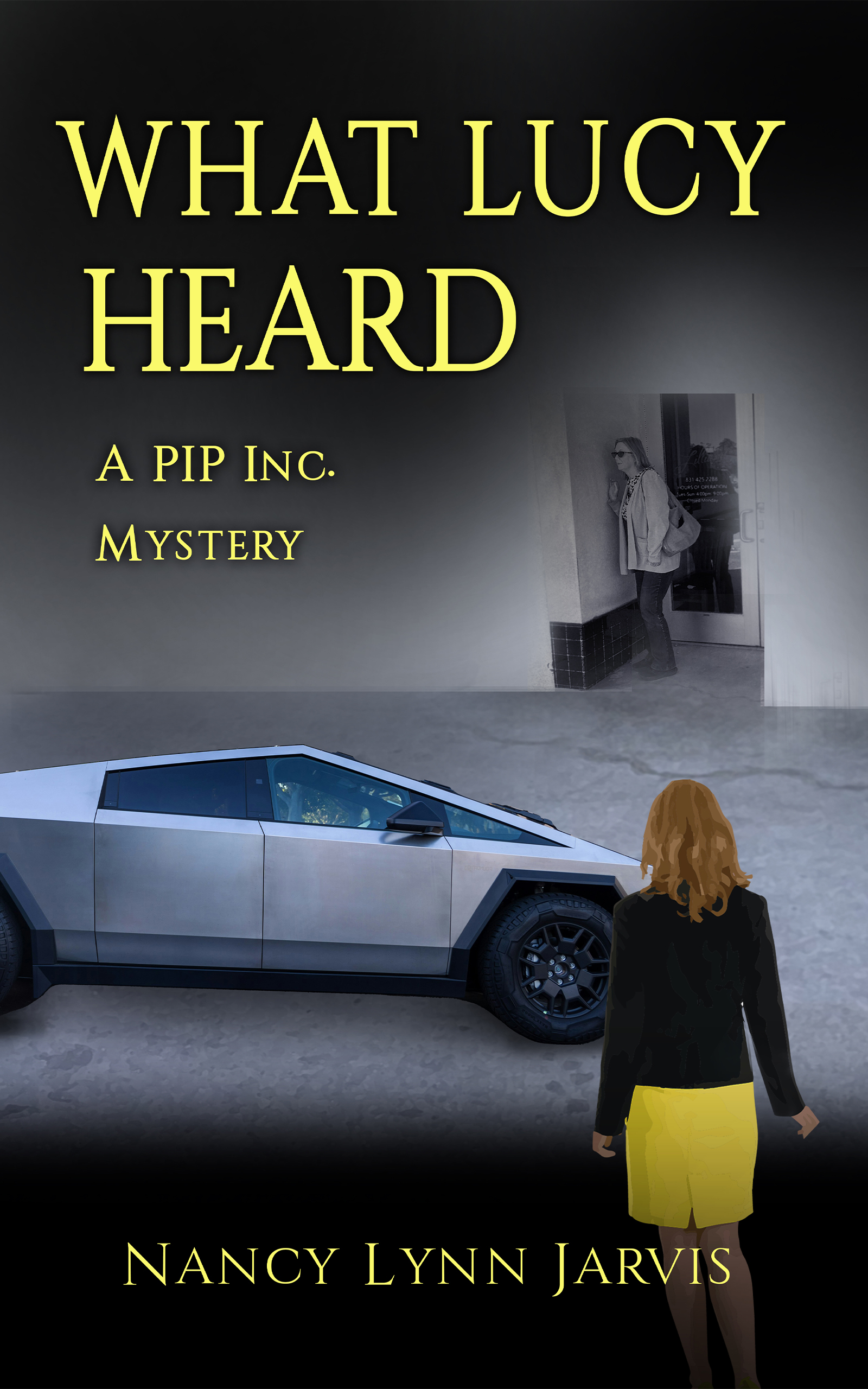
What’s the cliché, “if you can’t do, teach?” I think writing about an experience you haven’t had works as well so I always wanted to incorporate jury selection in a mystery I wrote. In “What Lucy Heard,” I finally got my chance.

My protagonist, Pat Pirard, is modeled on a real person also named Pat. Both Pats were the Santa Cruz Law Librarian for many years, both carry a 357 Magnum gun and know how to use it, and both are unlicensed private investigators.  I rely on the real Pat for information about some of the tools she uses in her investigations, not to mention her myriad ideas based on cases she’s worked, but it took me until this year to finally ask her if she’d ever done any jury selection. The response I got was not the one I expected. She said, “Oh, yes, and never again.”

“Why, what happened?” I asked.

“It was a murder case. I wanted to meet the accused and decide if I believed his story before I agreed to work on jury selection. When I met him, I believed him, and went to work. I used every idea I had about jury selection—some of my ideas were unconventional—but they worked and he was acquitted. The only problem was that after the trial, I began to have doubts about his innocence. I didn’t sleep for four months worrying about what I had done until the real killer was caught and confessed. Never again. I can’t take that kind of stress.”

Oh, what fun! I was flooded with ideas about what to look for in a potential juror and Pat shared her secrets for her work about who to fight to seat and who to challenge. The real Pat’s experience took place before the incursion of social media into everyone’s life so I added some research using it. Of course I changed details about the murder, the accused, and the motive for murder, but starting “What Lucy Heard“ with jury selection and the impact Pat’s work had on the trial outcome was a joy for me to write.

Tidings of Comfort and Joy: Old Books

I have a lot of books. I love to read. I suppose that’s why I became a writer. I want to tell the stories as well as read them.

No, I haven’t read all the books on my shelves. I enjoy the anticipation and the possibilities of reading them, someday.

Yes, I’ve read many of my books. There are old favorites I read over and over. With the advent of the internet, I discovered I can buy books that I read long ago, for the pleasure of having those books on my shelves, whether originally written for children or adults.

The recent airing of Ken Burns’s The American Revolution has me thinking of that era. However, the American Revolution novel on my shelves takes place in England. The Reb and the Redcoats, written by Constance Savery, was published in 1961. Charlotte Darrington, her brothers Joseph and George, and her little sister Kitty live in a manor house with their mother and their grandparents. Their father, a British officer, is fighting in the colonies. Uncle Laurence, also an officer, has recently returned from the war. The Reb—Randal Everard Baltimore—is a prisoner of war billeted with the family, a 15-year-old boy who was captured aboard a ship while carrying war dispatches from America to France. He’s escaped several times and is now kept under lock and key. A friendship grows between the Reb and Charlotte. It’s a fascinating book, letting the reader glimpse the Revolution from the point of view of English loyalists. I highly recommend it.

A longtime favorite by Phyllis Whitney also sits on my shelves, a book that early on fed my fascination with Japan. Whitney was born in Japan and spent her early years in Asia. The book I love is Secret of the Samurai Sword, published in 1958. Celia and Stephen Bronson arrive in Kyoto to spend the summer with their grandmother, a writer. They soon learn that the ghost of an old-time samurai supposedly haunts the garden. The artist who lives across the street, Gentaro Sato, is sure that it’s the spirit of one of his ancestors. Sato doesn’t like Americans. He’s determined that his Nisei granddaughter, Sumiko, who has come from America with her mother to stay with him, will conform to Japanese tradition, whether she likes it or not. Stephen and Sumiko’s cousin Hiro camp out in the garden, determined to see the ghost, but the figure disappears. It’s left to Celia to find out the truth.

Anya Seton wrote two books that sit on my shelves, read and reread. One I discovered because it was in a Readers Digest Condensed Book. It’s Devilwater, which is a fascinating look at the Jacobite Rebellions of 1715 and 1745, and the American frontier in the intervening period, when one of the characters travels to Williamsburg and points beyond. The other Seton book that I frequently revisit is Avalon, set against the background of Anglo-Saxon England, with Vikings expanding their influence to Iceland and Greenland. Both the Seton books are grand historical novels, the kind of books I love, rich with characters, story and details.

I’ll finish this short list of books that bring me comfort and joy with one that I’ve read so many times I swear I have it memorized. My mother had a copy on her shelves, and I first read it way back in my junior high school years. I was dismayed when she loaned it to someone who never returned it—an unpardonable sin, in my opinion.

The book is Désirée, by Annemarie Selinko. Published in 1951, the book takes the form of a diary written by Désirée Clary, the daughter of a silk merchant from Marseille. The book begins in 1794, some five years after the start of the French Revolution, and the naïve 14-year-old has just met an upstart named Napoleon who professes to love her, though he throws her over for a more advantageous marriage with Josephine. Through the course of this historical novel, we get a fascinating picture of France during and after the Revolution, with Napoleon’s reign and his wars thrown in for good measure. And through the years, Désirée observes it all and finds a man who truly loves her.

Ah, books, so many books, so many possibilities—and so many pleasures!

Grit, Grits, or Gritty? by Heather Haven

The meaning of the word grit when used to described a person states “courage and resolve; strength of character.” At least, that’s what the Oxford Dictionary says. I like to think I have grit. But I don’t like the word so much. Grit. Naw. Not a great word.

Now grits. I can get behind grits. And often do. Back to the Oxford Dictionary: “A dish of coarsely ground corn kernels boiled in water or milk.” I like my grits in the morning with bacon and eggs. I like cheesy grits. I like buttery grits. Some people like their grits plain, just a little salt and pepper. I can do that, although I really prefer them with lots of butter or cheese. Whoops! I think I said that.

Moving on to the Merriam-Webster Dictionary on the word gritty. When applied to a person it means “Having strong qualities of tough uncompromising realism. A gritty novel.” Unfortunately, I don’t write gritty. I write cozy. I rarely read gritty, either. I like happy endings or at the very least, ones with justice. And I don’t like too much suffering, especially with an animal. If a novel gets too gritty for me (or a movie) I give it a toss. I try to protect myself.

I didn’t used to be like that, but I learned my lesson the hard way. After reading The Pawnbroker at sixteen years old, I didn’t sleep for three nights. I cried all the time. It’s the story of a WWII concentration camp survivor and it was beyond tough to read. In my teens, this book taught me that I don’t have the “4th wall” that most people do. I was traumatized by the book but in a way, it was a good thing. If I had any childish illusions about sadism, concentration camps, and human suffering, this book dispelled them. It also turned me into an adult overnight. I have never been the same after reading it. That is the power of a novel. That is the power of the written word.

Now in all fairness, The Pawnbroker was beyond gritty. But I find the older I get, the more precious life becomes. The more I respect goodness, kindness, and generosity of spirit. I’ve also been through enough gritty things in my own life that I don’t want to spend time reading about other’s grittiness. Plus, if I want to be scared out of my wits, despondent, or depressed I have but to turn on the six o’clock news or step on a scale.

So, I think I’ve covered the three words, grit, grits, and gritty. And give me grits every time.

Guest Blogger ~ MM Desch

Why I Wrote an LGBTQ (Medical Thriller) Mystery

Every mystery writer knows that moment when life hands you a story, though mine arrived with the bureaucratic charm of a DEA agent on an ordinary afternoon in my Phoenix psychiatric practice. I suppose I should have expected it, having recently qualified to prescribe buprenorphine for opioid addiction treatment. The universe has peculiar timing, particularly when you’re drawn to the psychological complexities of LGBTQ characters navigating medical mysteries. Maybe it’s because I’ve spent years watching people navigate the collision between who they are and who the world expects them to be, and writing LGBTQ characters in medical crises lets me excavate those psychological fault lines in ways that feel necessary, especially these days.

The agent’s unannounced inspection was routine, professional, even cordial once I explained that I hadn’t actually used this newfound prescribing capability yet. But as we sat in my office, surrounded by the everyday detritus of psychiatric practice, tissues strategically placed, diplomas asserting competence, that one plant I somehow hadn’t killed, my writer’s mind began its familiar excavation. What if I had been prescribing buprenorphine? What if some had gone missing? What if someone in this very building was orchestrating a diversion scheme with the methodical precision of a chess master?

That afternoon planted the seed for Tangled Darkness, though it would marinate in my subconscious for years before finally demanding to be written.

The premise crystallized when I combined that DEA visit with my experiences serving on Arizona’s Medical Board committee for impaired physicians. I’d witnessed how addiction could transform brilliant medical minds into ethical contortionists—people trained to heal suddenly finding themselves entangled in webs of their own making. The stories I heard were psychological case studies in how desperate circumstances can rewrite even the most carefully constructed moral code.

But the real catalyst emerged from a pattern I’d observed: the more ethical and scrupulous a physician was, the more vulnerable they became to exploitation. Their conscientiousness could be weaponized against them with surgical precision. This paradox fascinated me, the idea that integrity could become a liability. What if someone filed a false complaint against an innocent psychiatrist? What if that psychiatrist harbored a secret history that made the accusation both plausible and devastating?

Enter Dr. Leslie Schoen, my protagonist. She’s ethical, competent, and living with the transparency that recovery demands—her wife Izzy knows about her journey with alcoholism, and they’ve built their relationship on that foundation of honesty. Which makes the secret she’s now carrying so much more corrosive. When a Medical Board complaint lands alleging that Leslie has stolen opiates from her clinic, she can’t bring herself to tell Izzy, not when her wife is pregnant, not when the accusation feels like a knife twisted in the wound of her recovery. The irony is exquisite in its cruelty: her very status as someone in recovery makes the false allegation both plausible and devastating.

The murder element emerged from a simple question: In a medical practice where controlled substances represent both healing and profit, what happens when someone knows too much? I envisioned Damon Grady, a medical assistant caught between loyalty and desperation—his death would need to be clinically precise yet psychologically revealing, appearing as an overdose while carrying deeper implications about betrayal and survival.

My years in addiction psychiatry taught me that buprenorphine occupies a uniquely precarious position in the opioid crisis. It’s medication that can save lives when used properly, yet because it is another opioid, it’s valuable currency on the street. This duality—medicine as both salvation and commodity—became the engine driving my plot. The very safeguards designed to prevent diversion could be manipulated by someone who understood the system from within.

Portland provided the perfect setting after my relocation from Phoenix. Here was a city where medical marijuana dispensaries operated alongside prestigious medical centers, where progressive healthcare coexisted with the ongoing addiction crises. This backdrop felt like the perfect petri dish for the story I wanted to tell—where cutting-edge addiction treatment coexisted with people dying from overdoses three blocks away.

What made the premise truly compelling was layering in the psychological complexity I’d observed throughout my career. The most dangerous people I’ve encountered in clinical practice aren’t the ones wearing their pathology like a neon sign—they’re the ones whose choices feel both inexplicable and inevitable. I wanted characters who would make readers squirm with recognition, the kind of people you might defend at a dinner party right up until you learn what they’ve done.

The investigation structure allowed me to explore how medical professionals react under scrutiny. Having participated in peer reviews and committee investigations, I understood the unique terror of having your professional reputation questioned. That fear could drive even innocent people to make choices that would haunt them forever.

Writing Tangled Darkness became an exercise in precision—every scenario needed to be plausible enough that medical professionals would nod in recognition yet twisted enough to keep readers guessing. The drug diversion scheme had to be sophisticated enough to temporarily succeed but flawed enough for a determined psychiatrist to unravel. Because even the most brilliant criminals are ultimately human, and humans make mistakes—often the kind that reveal exactly who they are when nobody’s supposed to be watching.

The deeper I dove into the story, the more I realized I wasn’t just writing about prescription drug diversion or murder. I was exploring how systems designed to help us can be corrupted, how past traumas shape present choices, and how the pursuit of truth sometimes requires risking everything we’ve built. It’s a psychological-medical thriller doubling as an LGBTQ mystery. Many would say all of the above.

That cordial DEA agent who visited my Phoenix office had no idea he was launching a debut novel. But then again, the most compelling stories often begin with an ordinary moment—a routine inspection, a casual question. Sometimes the best plots are just waiting there in the everyday machinery of our lives, disguised as paperwork.

TANGLED DARKNESS

When Dr. Leslie Schoen becomes a suspect in her clinic assistant’s murder, she investigates a dangerous web of opiate drug theft while protecting her pregnant wife and confronting her own haunted past. Racing against time to clear her name, she discovers everyone has secrets—and someone in her inner circle is willing to kill to keep them hidden.

Buy link: https://books2read.com/u/bwgvYO

MM Desch brings over three decades as a practicing psychiatrist to her debut psychological thriller, TANGLED DARKNESS (Rowan Prose Publishing). With a passion for telling realistic stories about the veiled realm of psychiatric practice, Desch blends high crime and suspense with her real-world knowledge of addiction medicine. She and her wife live in Portland, Oregon, USA.

Threads

https://www.threads.net/@m.m.desch?xmt=AQGzP66VD8kcFAvY_17dS7gdkt3eKFIIEH3gikVJWaVB2vE

Facebook

https://www.facebook.com/MMDeschWriter/

Instagram

https://www.instagram.com/m.m.desch/

BlueSky

https://bsky.app/profile/mm-desch.bsky.social

Linked In

https://www.linkedin.com/in/mmdesch/

https://www.goodreads.com/author/show/51031502.M_M_Desch

https://www.bookbub.com/authors/mm-desch

Website:

https://marydesch.com/