WHAT’S IN A NAME?

casojka123's avatarcasojka

copyHave you ever read a book in which the characters’ names don’t seem to fit them? Or the names don’t stay in your mind, and you have to keep looking back to find out who it was who just appeared in a scene? When I write, characters’ names are as important as their physical descriptions and their personality quirks.

Almost everyone I know who has read the great Russian novels complains that she can’t keep track of the characters because the names keep changing. You’re not likely to refer to Levin as Constantin Dmitrich in the middle of your story, but don’t start calling John Smith Johnny or Smitty if you don’t want to lose your reader.

Charles Dickens came up with some truly appropriate names for his secondary characters, names so fitting that they are identified with their characteristics: Uriah Heep for the unctuous clerk in DAVID COPPERFIELD and…

View original post 610 more words

Short Stories v. Novels

copy The Short Mystery Fiction Society (SMFS) has been hosting an on-line discussion about whether a writer should begin by writing short stories before tackling novels. Several of the contributors think that writing short stories is a good way to hone writing skills before tackling the longer work. Others say short stories often provided material which later turned into novels, while there are some who feel that these are separate skills to master. I like to write short stories between novels, giving myself a break, developing other characters and situations, but I wouldn’t say I am an accomplished short story writer. Short stories aren’t easy to write. They require at least as much skill as writing novels, maybe more. The idea that an aspiring writer can learn how to write novels by writing short stories doesn’t seem accurate to me. Generally, the best short story writers write only those. I have a tendency to add too much extraneous material in a short story, turning it into not quite a novella but something which is too long for a story and too short for anything else. The short story writer needs to stick to the point of the story, forget the extra material that crops up, and, particularly with mystery short stories, work toward an ending that will at least slightly surprise the reader. O’Henry, of course, was the master of the plot twist, as was Saki, but those are classics, and few of us write classics. But readers often feel cheated if the story ends with a whimper, not with at least a small bang. Literary short stories are different in that they don’t need a surprise ending, but they do need an epiphany of some sort on the part of the protagonist, some change in him or her. Alice Munro, a favorite of mine, writes only short stories, and she is a master. Most of her stories take place in rural Canada, and I identify with her characters and the setting because of years I spent as a child in rural upstate New York. Her stories are long for short stories, encompassing a lot of her characters’ experiences and often their whole lives. But the main character always experiences some change, some new realization in the way she sees the world. Read them all, and you’ll see. Such writing isn’t easy to do. In my opinion, writing short stories requires an equal or greater amount of skill than writing novels. The writer can hone her writing skills on them, but in order to write them well, she needs to master that art. Still, writing a short story from beginning to end can be very rewarding. There’s no need to go back to it day after day, week after week, month after month, as with a novel. Short stories may have a dreaded middle, but it’s a short middle, unlike the middle of the novel. The dreaded middle of the novel occurs when the writer, full of enthusiasm, has set up the premise, developed the characters and setting, told the reader what the conflict is, and has the reader in suspense about how the conflict will be resolved; but there are at least a hundred pages before the beginning of the ending. We’ve all read those: the novel that starts out terrifically with great characters and an interesting plot and setting that then goes limp in the middle.  We wonder why we started reading the novel in the first place, wonder if we should just quit, but we can’t just jump ahead because something may happen that makes the ending understandable. The shortness of the story makes that middle not nearly so dangerous. Just make it a shorter story! I’ve had people say to me, “I don’t like short stories because it takes time to figure out who’s doing what and why and then the story’s over, and I have to start all over again.” Those readers like novels. They like to immerse themselves in a world where they’ve met the characters and know the setting, the problems, and the difficulty of finding the solution. Then they can luxuriate in that world for days or even weeks. Others like short stories because they can move quickly into a new setting with new characters, determine the problem and reach the climax, all in a short time. Each story is an exploration of a new experience. What do you, my readers, think? Do you read short stories? Do you like them, or do you prefer novels? Why? Let’s talk.

Short Stories v. Mysteries

copyThe Short Mystery Fiction Society (SMFS) has been hosting an on-line discussion about whether a writer should begin by writing short stories before tackling novels. Several of the contributors think that writing short stories is a good way to hone writing skills before tackling the longer work. Others say short stories often provide material which later turn into novels while there are some who feel that they are separate skills to master. I like to write short stories between novels, giving myself a break, developing other characters and situations, but I wouldn’t say I was an accomplished short story writer.

Short stories aren’t easy to write. They require at least as much skill as writing novels, maybe more. The idea that you can learn how to write novels by writing short stories doesn’t seem accurate to me. Generally, the best short story writers write only those.
I have a tendency to add too much extraneous material in a short story, turning it into not quite a novella but something which is too long for a story and too short for anything else. The short story writer needs to stick to the point of the story, forget the extra material that crops up, and, particularly with mystery short stories, work toward an ending that will at least slightly surprise the reader. O’Henry, of course, was the master of the plot twist, as was Saki, but those are classics, and few of us write classics. But readers feel cheated if the story ends with a whimper, not at least a small bang.

Literary short stories are different in that they don’t need a surprise ending, but they do need an epiphany of some sort on the part of the protagonist, some change in him or her. Alice Munro, a favorite of mine, writes only short stories, and she is a master. Most of her stories take place in rural Canada, and I identify with her characters and the setting because of years I spent as a child in rural upstate New York. Her stories are long for short stories, encompassing a lot of their characters’ experiences, often their whole lives. But the main character always experiences some change, some new realization in the way she sees the world. Such writing is not easy to do. I think writing short stories requires an equal or greater amount of skill than writing novels. You can hone your writing skills on them, but in order to write them well, you need to master that art.

Still, writing a short story from beginning to end can be very rewarding. There’s no need to go back to it day after day, week after week, month after month, as with a novel. Short stories may have a dreaded middle, but it’s a short middle, unlike the middle of the novel.
The dreaded middle of the novel occurs when the writer, full of enthusiasm, has set up the premise, developed the characters and setting, told the reader what the conflict is, and has the reader in suspense about how the conflict will be solved; but there are at least a hundred pages before the beginning of the ending. We’ve all read those: the novels that start out terrifically with great characters and an interesting plot and setting that then go limp in the middle. We wonder why we started reading the novel in the first place, wonder if we should just quit, but we can’t just jump ahead because something may happen that makes the end understandable. The shortness of the story makes that middle not nearly so dangerous. Just make it a shorter story!

I’ve had people say to me, “I don’t like short stories because it takes time to figure out who’s doing what and why and then the story’s over, and I have to start all over again.” Those readers like novels, where they can immerse themselves in a world: they meet the characters, know the setting and learn the problems and the difficulty of finding the solution. Then they can luxuriate in that world for days or even weeks. Others like short stories because they can move quickly into a new setting with new characters, determine the problem and reach the climax, all in a short time. Each story is an exploration of a new experience.

What do you, my readers, think? Do you read short stories? Do you like them or do you prefer novels, and why? Let’s talk.

Guest Author Marianne Jones

Sisters in Crime (or The Birth of a Murder Mystery)

I blame my sister. For years she has been a huge mystery fan, especially of Agatha Christie and the various British detective series’ on television. I had been pursuing the literary life since childhood, and had published a mixed bag of poetry, dramas, short fiction, newspaper and magazine articles, and children’s books. Yet I had never considered attempting a murder mystery.

And then my sister Karen said to me one day, “You should write a murder mystery set in Thunder Bay.”

Thunder Bay, Ontario, our home town, is a small city in the center of Canada, nestled at the head of Lake Superior. It’s set in the midst of some of the loveliest natural beauty you’ll ever see, but because it is geographically isolated, most people are unaware of it. Those that are aware tend to ignore it. Karen thought that made it the ideal location for a good whodunit.

At first I dismissed the idea. But Karen is nothing if not persistent. Finally, I relented enough to say, “If you come up with an idea, I’ll write it.”

Of course, you know what happened. She called my bluff. She gave me a story idea loosely based on a disastrous women’s retreat she had attended. As she described the unfortunate event, I began to visualize my protagonists, middle-aged church ladies Margaret and Louise in the middle of it. At that point I was hooked, and The Serenity Stone Murder was conceived.

Sometimes I hit a snag with the story, and would call on Karen and her daughter Kirsti for advice. Over nachos and ciders at our favourite Thunder Bay restaurant, (appropriately called The Madhouse), the three of us partners in crime plotted together.

It was especially fun to write about Thunder Bay and the surrounding area, with its familiar landmarks. The fictional town of Jackpine, where my intrepid heroines reside, was modelled on any number of the small towns in Northwestern Ontario. Having lived in one of those small towns for five years, I knew well the winter longings of their residents to come to the “big city” of Thunder Bay for shopping and entertainment.

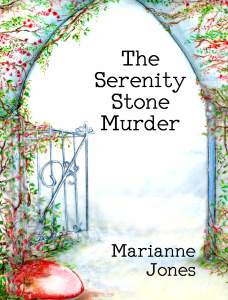
Writing CoverThe Serenity Stone Murder has been a fun ride. Happily, Stacey Voss, editor and owner of Split Tree Publishing, thought it was a great read as well. And readers from as far away as Kenya and New Zealand, have been enjoying it as well! So now there is no stopping Margaret and Louise. They’re already embarking on their next adventure—in the Thunder Bay region, of course!

The Serenity Stone Murder

What are two nice middle-aged church ladies doing at a New Age goddess conference? And what does it have to do with the mysterious death of Thunder Bay’s casino manager? Will Mary Carlisle, organist at St. Stephen’s Church, capture the heart of Thomas Greenfield, church gardener?

Find out the answers to these, and other burning questions in The Serenity Stone Murder, a kinder, gentler murder mystery set in Thunder Bay, Ontario, home of the Sleeping Giant, the Hoito Restaurant, and the world-famous Persion cinnamon bun. For those who like their mysteries served up with a side dish of humour.

Buy links: http://www.amazon.com/Serenity-Stone-Murder-Marianne-Jones-ebook/dp/B00ODELIZA

http://www.barnesandnoble.com/w/the-serenity-stone-murder-marianne-jones/1120454547?ean=9780981251684

https://itunes.apple.com/ca/book/the-serenity-stone-murder/id928612148?mt=11

https://store.kobobooks.com/ebook/the-serenity-stone-murder

Writer Bio

Marianne Jones is a retired teacher from Thunder Bay, Ontario. Her work has appeared in Reader’s Digest, Canadian Living, The Globe and Mail, and numerous literary and denominational publications. Her books include The Land of Mogan, a children’s fantasy novel, Here, on the Ground, an award-winning collection of poetry, Great- Grandma’s Gifts, a picture book for preschool and early elementary, and The Serenity Stone Murder, a cozy mystery set in Thunder Bay.

Marianne has been named International Poet Laureate by Utmost Christian Writers. Her poetry has won numerous awards, and some of them are permanently installed at Prince Arthur’s Landing at Marina Park in Thunder Bay.

Social media links:

Facebook Author Page    https://www.facebook.com/MarianneJonesAuthor

Twitter                               https://www.twitter.com/MarianneJones@Mariann36863659

LinkedIn                             https://www.linkedin.com/mariannejones

Google+                             https://mail.google.com/jonesmarianne2@gmail.com

Goodreads                         https://www.goodreads.com/marianne   jones

Amazon Author Page       https://www.amazon.com/author/jonesmarianne

Website                         https://www.mariannejones.ca

Guest Author- Zanna MacKenzie

Please Welcome British mystery author, Zanna MacKenzie.

I never thought the way I spent some of my school holidays as a child would be the inspiration for a crime scene in a novel.

When the summer rolled around and school broke up for six wonderful weeks I’d eagerly await the occasional days when I would get to accompany my dad to work. Before he retired, my dad was a contract haulier for a local quarry. He drove a 32 tonne truck. It was a monster of a vehicle. I had to be lifted up to clamber onto the edge of the wheel arch and into the cab. In the days before seatbelts and health and safety I was allowed to sit on the 2 seats on the passenger side of the cab unencumbered or even perch on the centre console (the engine manifold) next to the driver’s seat.

We would pick up and deliver huge quantities of sand and various types of stone and gravel for road building and construction. Being something of a tomboy as a child I loved all the noise and dust. I’d watch in awe and excitement as huge dumper trucks cruised past, so large they dwarfed my dad’s lorry. I can still remember sitting in the lorry as tonnes of stone cascaded into the back of it from the imposing-looking grey metal buildings where the stone whizzed around on conveyor belts. There was also a scarily (but aptly) named crusher which took the big-as-a-car sized chunks of rock and reduced them to gravel size.

At the end of the day I would dash up the steep bank which bordered the quarry as my dad and I walked home. It was just a ten minute stroll if we cut across the woods, through the meadow and hopped over the stepping stones in the stream. I would arrive home scruffy, exhausted but happy.

As a child it never occurred to me how dangerous an environment quarries were. As an adult when I felt the urge to switch from writing romantic comedies to cozy mysteries, I knew straight away where the first crime investigation was going to take place – a quarry!

In book one of my Amber Reed Mystery series, Amber – a barmaid and newspaper admin assistant who makes up horoscopes for the local paper – finds herself in a quarry in the middle of the night with handsome special agent Charlie as they try to find out just what is going on at Set In Stone. Amber gets caught up in the murder investigation because the victim is the brother of her ex- boyfriend Ennis. Now a movie star, Ennis pleads with Amber to help out by keeping an eye on special agent Charlie Huxton, sent by the Celebrity Crimes Investigation Agency to catch the killer. Ennis, harassed by paparazzi, is paranoid Charlie might be feeding news on the story to the media so he wants Amber to keep a close eye on the CCIA agent.  Whilst trying to help out her ex Amber’s life gets very complicated indeed…

CCIAOne (2)And The Earth Moved (Amber Reed Mystery Book One)

A new cozy mystery series with oodles of fun, romance and the smart, sassy special agents of the CCIA – otherwise known as the Celebrity Crimes Investigation Agency.

BOOK BLURB:

Amber wished her life was more exciting – then, with one phone call, her world turned upside down.

Now she’s got to cope with:

Her ex-boyfriend from university (who’s now a heartthrob movie star) desperately needing her help.

Getting herself caught up in the middle of a celebrity murder investigation.

Having to try and keep tabs on hunky special agent Charlie who’s in town to catch the killer – and convince him she can help him with the case.

Maybe her life just got too exciting….

Find this book on Amazon: http://getbook.at/AndTheEarthMoved

Extract:

“What kind of excitement are Gemini’s going to have this week?” I ponder, tapping my fingers against the keyboard.

I’m a third of the way through making up the horoscopes for this week’s local paper. Aries are going to get news of a fantastic job opportunity. Capricorns will receive some kind of windfall. But what about Gemini? I always like to give my Madam Zamber horoscope column an upbeat feel – after all, nobody reads their star signs to get depressed right?

My fingers hover over the computer keys as I debate on Gemini’s fate. I’m a Gemini so this one better be especially good; it’s been a rough week.

My phone, nestled somewhere in the depths of my bag, starts playing a chart tune at full volume. When I eventually find it I check the caller display and see Ennis’ name.

Ennis and I haven’t spoken for a while but I know he came home last week after he’d finished working on his latest movie, he sent me a text. He probably wants to meet for a coffee and a catch up. It’s strange; to me Ennis is, well, just Ennis. I don’t think of him as a heartthrob actor, just my ex, my university boyfriend, who I meet up with for a chat whenever he’s in Palstone.

Time for a little break from the horoscopes. I hit the answer button.

“Hi, how’s things?” I ask, leaning back in my chair.

There’s nothing but silence on the other end of the line.

“Ennis?” I sit up, instantly concerned. “Are you there? Is something wrong?”

His voice is so quiet I can barely hear him. “Joel’s dead,” he says.

“What?” I shout, leaping to my feet and earning myself a look of curiosity from the other two members of staff at The Palstone Courier.  I lower my voice. “How? What happened?”

“We don’t know yet,” he replies, his voice heavy with emotion. “But the police are saying he died in suspicious circumstances.”

I gulp. “You mean murder?”

“Look, Amber can you please come over?” Ennis says. “Now? Please? I need to ask you a huge favour.”

I grab my jacket and bag. “On my way.”

 Author bio:

Zanna Mackenzie lives in the UK on the Derbyshire/Leicestershire border with her husband, 4 dogs, a vegetable patch that’s home to far too many weeds and an ever expanding library of books waiting to be read.

Being a freelance writer and editor of business publications is her ‘day job’ but, at every opportunity, she can be found scribbling down notes on scenes for whatever novel she’s working on. She loves it when the characters in her novels take on minds of their own and start deviating from the original plot!

Find out more about Zanna on her blog http://www.zannamackenzie.blogspot.co.uk, on Twitter via @ZannaMacKenzie or on Facebook at http://www.facebook.com/zanna.mackenzie

 Find out more about Zanna at:

www.zannamackenzie.blogspot.co.uk

Twitter:    https://twitter.com/ZannaMacKenzie

Facebook: www.facebook.com/zanna.mackenzie

Goodreads – http://www.goodreads.com/user/show/10703273-zanna-mackenzie

Amazon Author Page – http://www.amazon.co.uk/Zanna-Mackenzie/e/B00BKY1A18/ref=ntt_dp_epwbk_0

Pinterest: http://uk.pinterest.com/zannamac/