Guest Blogger ~ DK Coutant

The lure of traditional mysteries…

I believe we are what we read, (not only what we eat). I write mysteries, but growing up I read mysteries…Nancy Drew, Trixie Beldon, and don’t tell my younger brother, but I borrowed his Hardy Boys. Years later, I became a psychology professor and taught at a University. I found I scored high on Need for Cognition. That’s a psychological dimension which indicates a tendency to enjoy thinking. I like to solve problems, solve puzzles, and it probably also explains my addiction to Duolingo. My guess is that most people who enjoy mysteries also have a high need for cognition. They like to think. If you want to find out how you score I’ve put a self-test at the end with a scoring key.

That same need to think, lead me into geopolitical forecasting. I like to untangle and make sense of disparate information. I’m not an expert on most of the topics I’m asked to forecast. I have dive into each new subject matter and narrow down the information to the essentials of a specific question I’m asked to forecast. (Do you want to give forecasting a try? Links here)

https://www.gjopen.com/

https://www.infer-pub.com/frequently-asked-questions#whatisinfer

The process of writing mysteries also relies on my desire to ruminate over ideas. I’ve got to devise a murder that will have breadcrumbs leading to the killer, but also diverse, and intriguing red herrings that might distract my readers down alternative paths.

To narrow down to my sub-genre, traditional mysteries, I don’t write super-bloody, violent books. I know some people love them and they are very popular. But in my geopolitical forecasting I track bloody conflicts and death rates. When I write I want to leave that behind. Sure, there has to be a death in a murder mystery, but, while not strict cozies, my mysteries are on the lighter side. For the reader like me, who believes there is enough violence and darkness in their world and looks for something complex, but fun, and not too pollyannish. I use my craft, to find happy endings…  and a balance in life. I enjoy my rainy days as much as my sunny ones.
Items That Compose the Need for Cognition Scale–6 (NCS-6)

1. I would prefer complex to simple problems.

1              2              3              4              5

1=Strongly Disagree                          5=Strongly Agree

2. I like to have the responsibility of handling a situation that requires a lot of thinking.

1              2              3              4              5

1=Strongly Disagree                          5=Strongly Agree

3. Thinking is not my idea of fun. (R)

1              2              3              4              5

1=Strongly Disagree                          5=Strongly Agree

4. I would rather do something that requires little thought than something that is sure to challenge my thinking abilities. (R)

1              2              3              4              5

1=Strongly Disagree                          5=Strongly Agree

5. I really enjoy a task that involves coming up with new solutions to problems.

1              2              3              4              5

1=Strongly Disagree                          5=Strongly Agree

6. I would prefer a task that is intellectual, difficult, and important to one that is somewhat important but does not require much thought.

1              2              3              4              5

1=Strongly Disagree                          5=Strongly Agree

To score yourself start with questions 3 and 4. They are reverse scored, so if you answered 1 change it to a 5, 2 changes to 4, 3 stays the same, 4 to 2 and 5 to 1.

After you have done that add up your score. A higher score demonstrates a high need for cognition, a lower score indicates an individual not as motivated to think and problem-solve.

(for more information on Need for Cognition:

https://www.ncbi.nlm.nih.gov/pmc/articles/PMC7545655/
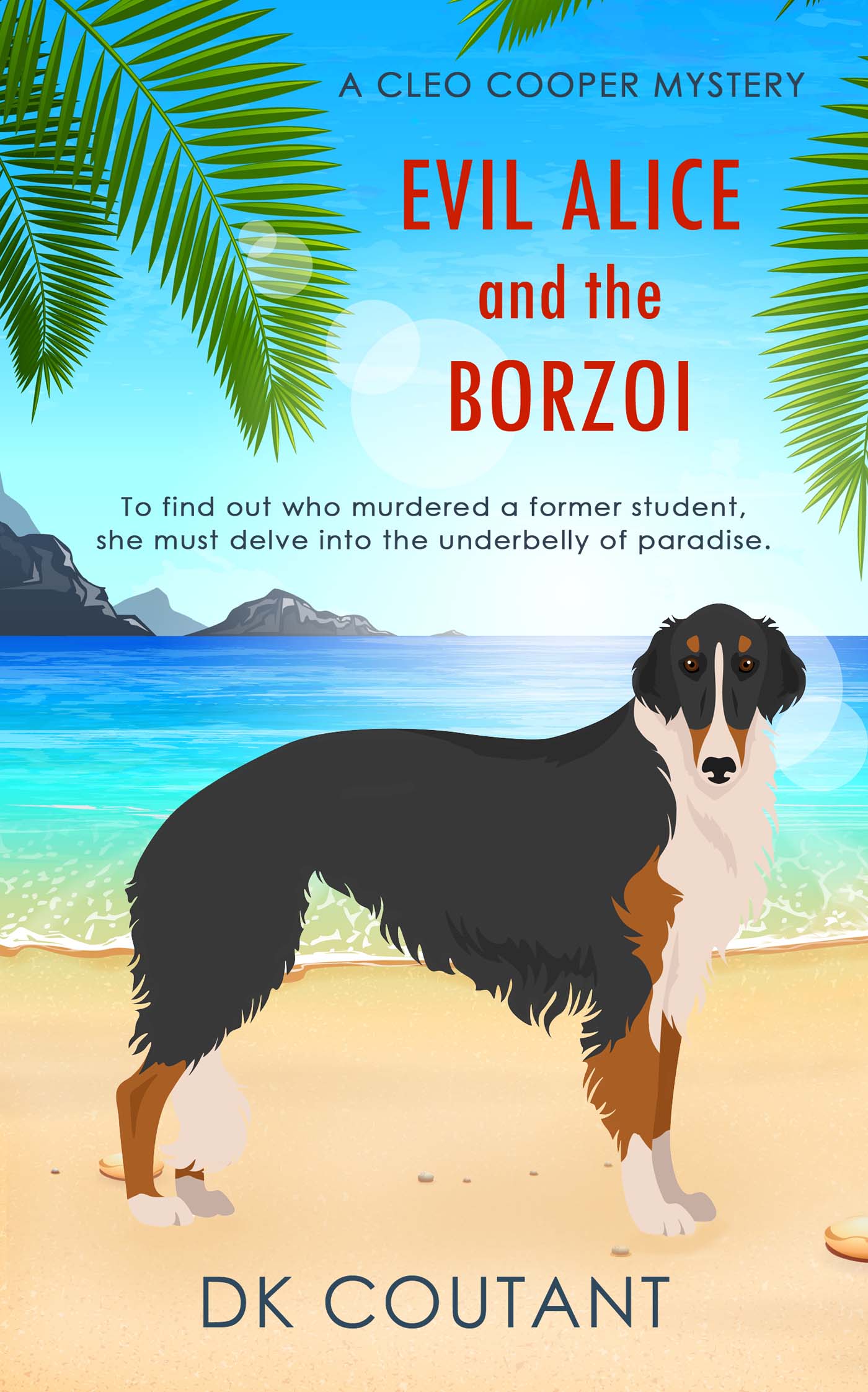
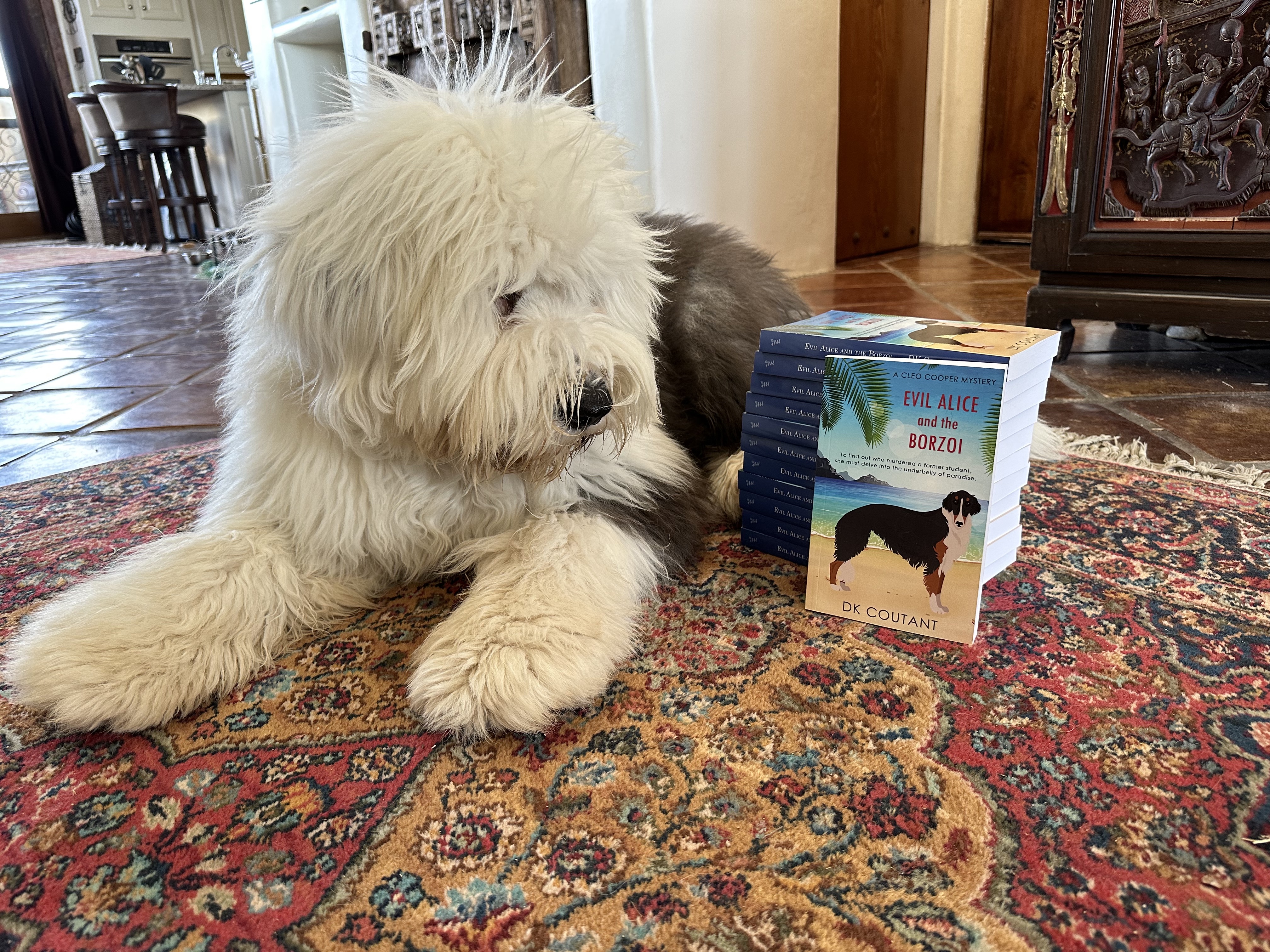
Paradise is shaken when the body of a young woman is dragged onto a university research vessel during a class outing in Hilo Bay. Cleo Cooper is shaken when she finds her favorite student is on the hook for the murder. Danger lurks on land and sea as Cleo and her friends are enticed to search for the true killer. Between paddling, swimming, and arguing with her boyfriend, Cleo discovers everything is not what it seems on the Big Island of Hawaii. But will she find the truth before she becomes the next victim?

Buy links:

https://www.goodreads.com/book/show/88564113-evil-alice-and-the-borzoi

https://www.bookbub.com/books/evil-alice-and-the-borzoi-a-cleo-cooper-mystery-book-1-by-dk-coutant

https://bookshop.org/p/books/evil-alice-and-the-borzoi-dk-coutant/19649122

https://www.amazon.com/Evil-Alice-Borzoi-Cooper-Mystery/dp/150924591X

https://www.barnesandnoble.com/w/evil-alice-and-the-borzoi-dk-coutant/1142929587

DK Coutant graduated from Davidson College with a Psychology degree, and applied her behavioral training at Sea World, training dolphins and whales. Realizing that scrubbing fish buckets might get old, she went back to school and earned a Ph.D. in Psychology. Her academic career began at the University of Southern Maine before DK made the jump to the University of Hawaii at Hilo rising to Department Chair of the Psychology Department. After many happy years in Hawaii, DK made the move out of academics to become a professional geopolitical forecaster for GJP, Inc ( https://goodjudgment.com/Inc ) and INFER  ( https://www.infer-pub.com/). Evil Alice and the Borzoi is her first work of fiction published by The Wild Rose Press.

Social Media Links:

Twitter: @dkcoutant

Instagram: @DKCandDog

Facebook: https://www.facebook.com/profile.php?id=100087049617707

Mastodon: https://lor.sh/@dkcoutant
Lost in the Cloud

I remember the days when I wrote on a typewriter. My mother had a Remington that felt like an anvil when I picked it up. When I went to college, I had an Olivetti portable. I thought I’d gone to technology heaven when I graduated to a Smith-Corona electric.

I always had a pile of manuscript pages on the desk next to my typewriter, ready for me to take a pencil and edit and then retype them.

I got my first computer about 40 years ago. I thought that was quite a step up, not having to retype pages. I could make corrections on the screen, though I printed out each chapter as I finished it.

My first printer was a dot matrix, the kind that used continuous sheets that had a little feeder strip on each side, with holes. I’d have to tear the pages apart. Those strips—well, one of my cats had a really good time with those when he got into them. Strips of paper strewn up and down the hall.

Then I graduated to an HP Laserjet the size of a TV set. It weighed about as much, too. I had that one for years before it finally died of old age. Enter the inkjet era.

I was still printing out manuscript pages, the old-fashioned way of backing up my data. I also copied files to floppy disks. Remember those? Then the floppies became smaller hard disks. Then it was flash drives. And external hard drives.

Then came the cloud, a place where one could store important data and free up space on the desktop or dispense with those disks and flash drives.

Works great. Until it doesn’t.

I recently had a hard drive meltdown. As in fried, toast, kaput. I thought my files would be safe since I was backing them up to the cloud, in this case Microsoft’s OneDrive.

But through some technological disaster I don’t understand, most of the files on OneDrive that were dated this calendar year disappeared—including the book I’ve been working on for over a year. I keep looking at OneDrive and everything on there seems to be 2022 or earlier. Except one lone spreadsheet I created on Excel in May 2023. Go figure.

After phone calls and emails with Microsoft Tech Support, the case has been escalated to the OneDrive department. Which assures me via periodic emails that they are investigating the situation and will be in touch with updates—whenever. These bland emails are meant to be reassuring.

I don’t feel reassured.

I mean, hey, the files should be there, floating somewhere in the cloud. After all, that’s the claim—store things on the cloud and your files will be safe from meltdowns and mishaps.

But no, it doesn’t look like it. I got complacent and relied too much on technology. Right now I’m longing for the low tech days when I printed out each chapter as I completed it. At least I’d have a hard copy. Or a flash drive. Yeah, that would be great. Then I could find my book.

I’m upset, since it seems increasingly likely that the files are lost in the cloud. And I do mean lost. But time spent kicking myself isn’t productive. I’ve started a synopsis of the book, memorializing what I’ve written so far. And I have started chapter one—again, reconstructing that from memory.

Say it the way Jerome Kern and Dorothy Fields did: “Pick yourself up, dust yourself off, and start all over again.”

Guest Blogger ~ Deni Starr

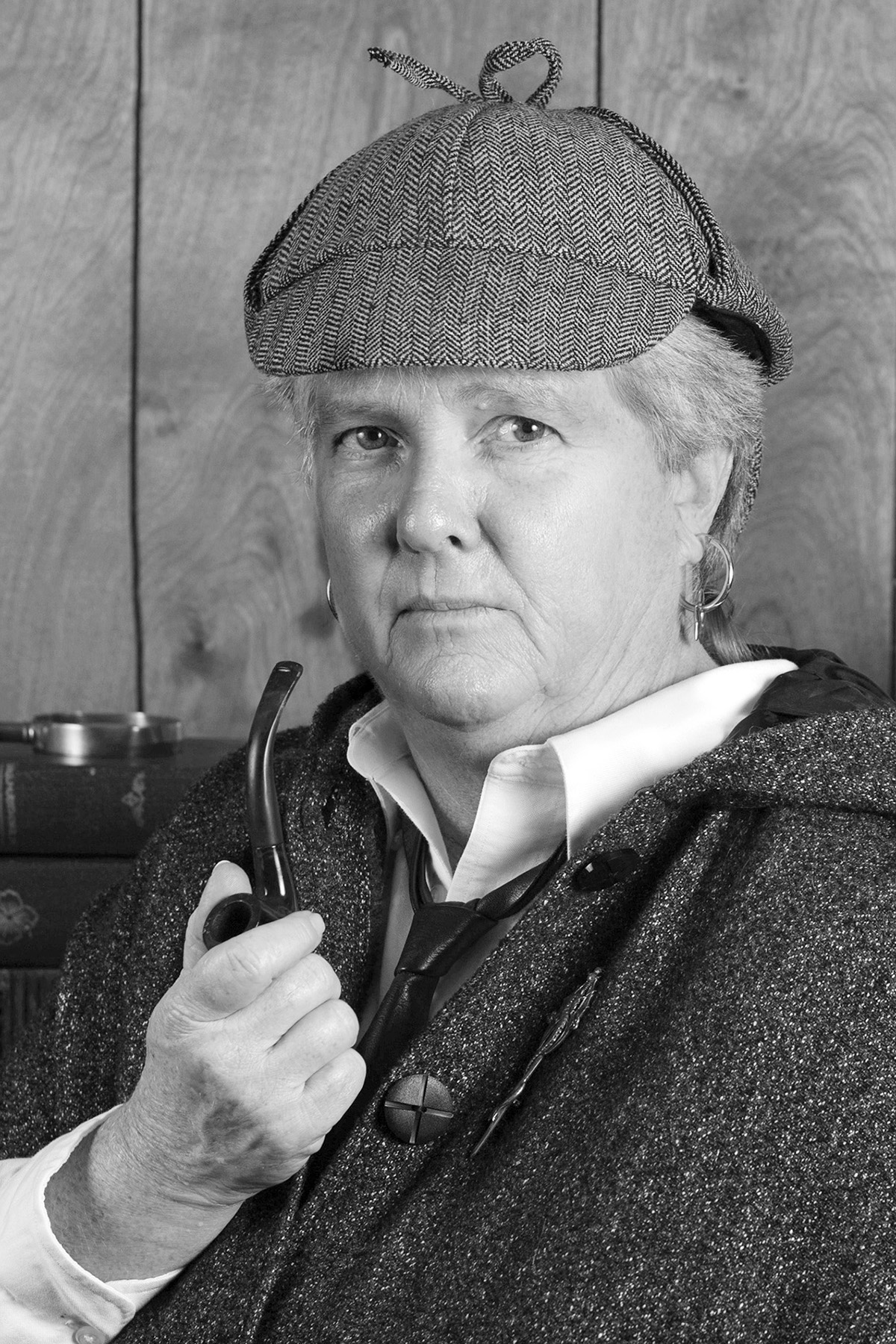
My interest in mysteries may stem from my sister’s attempt on my life when I was young, re-enacted in this photo by my father some time later. Knowing my father, he probably did ten takes of this before he got one he was satisfied with.

            I have a series put out by Silverleaf Publishing which has co-protagonists Sean O’Conner a retired boxer and his friend- then business partner then wife, Cindy Matasar, FBI trained private investigator. By book five, “Down for the Count” they are engaged and running their own private investigative service, Sean providing the money and muscle, Cindy the expertise.

            The plot for “Down for the Count” originated because I was watching a documentary, “Spotlight” about how the Boston Globe exposed child abuse by local Catholic priests and I thought this subject would be a good back story for a mystery, so I did an intensive amount of research on the history of the problem and the legal proceedings in America. I was surprised to learn that celibacy has nothing to do with it. That had been my original assumption.

            In my book, I tried to very hard to be fair, and being a former public defender who believes in presumption of innocence, the priest in my book (spoiler alert) proves to not be guilty of abusing a boy. I tried to balance that out with real victims so as to not give the impression that its common for children to lie about having been victimized, and include both unfair prejudices against priests and some documented bigotry on the part of priests, hoping to cover all the angles. Several of the books I read were by priests who want the church to fix this problem, as well as one book by a woman who was abused as a child, became a nun, and now leads a SNAP (victims of priests) support group. I also added current events since during the time that I wrote this book, there were a number of articles about a formal Seattle archbishop being accused, and a meeting of the American Bishops on this subject and some of the changes they made to address it. There was also a spate of articles regarding a dispute between a cardinal and Pope Francis because the cardinal in question felt the problem would be solved if Pope Francis would kick out all the gay priests, and there were claims that suspected offenders were being moved around so claims against them could be ignored. It was a change for me to see current newspaper articles on my subject since my former subjects have been World War I, World War II, and Victorian England. I did the research of World War II for book four of the series, “Saved by the Bell” because the villain (and I have no idea why I did this) belonged to the Arrow Cross after the Nazi’s invaded Hungary, so I checked out that history and learned about the Gold Train- a train loaded with loot stolen from Jewish Hungarians that the SS tried to sneak out of Hungary when it looked like the Russians were going to win. That train was captured by Allies and the goods redistributed, but there is also believed to have been a similar attempt made in Poland with the “Ghost Train” which so far, no one has found, which I’m thinking of using as a subject for another book.

DOWN FOR THE COUNT

Very reluctantly, retired boxer Sean O’Conner and former public defender investigator Cindy Matasar now running their own investigation firm, agree to look into charges of sexual abuse on behalf of a priest accused of molesting a little boy. Sean hates the idea, but his brother, Father John, knows Father Damien and is confident there is something wrong with the allegations. Sean has his fingers crossed that it’s a simple case of mistaken identity. No such luck

            Sean and Cindy set about interviewing men who had been in the Catholic Youth Boxing Program as boys, and other priests who coached in the program, or who will vouch for Father Damien. Just when they think they’ve locked in evidence to exonerate the ninety-year-old defendant, they receive a mysteries missive that heads them in the other direction and just when they think they got that sorted out, Father Damien is found dead in what Sean thinks a clear-cut case of suicide, an admission of guilt, but which the Church insists was an accident.

            Dogging their footsteps and filing professional complaints against them, are the investigators who are in-house with the law firm hired by the Church’s insurance company who are investigating the rest of the allegations against all the other named priests. They are supposed to be on the same team, but professional jealous is causing more than just friction. When Sean figures out that Father Damien’s death was neither suicide nor accident but murder, his rivals take credit for the discovery, leading to yet more complications and additional deaths.

            Now Sean and Cindy are in a race against time to find out who is responsible before the killer discovers that they are the one’s finding all the clues, and gets to them first.  

Buy link:

https://a.co/d/gS0tum3

Deni Starr, a native Portlander and fourth generation Oregonian, a fact she intends to mention prominently should she ever run for office, started devoting her time to writing novels after out-growing the practice of law. She has five novels published by Silverleaf Publishing featuring her ex-professional boxer, Sean O’Conner and his professional investigator friend, Cindy Matasar who investigate boxing themed mysteries set in contemporary Portland. They are “Below the Belt” “Sucker-Punched”, “Throwing in the Towel.”, “Saved by the Bell”, and “Down for the The Count”. She also has “Murder by the Sea” by Launchpoint Press

            The author attended Occidental College in Los Angeles and graduated with Honors and Special Distinction majoring in English with an emphasis on creative writing and journalism. The Author then attended Willamette Law School in Salem, Oregon, and practiced law while also obtaining her black belt in Wu Ying Tao karate. Her law practice emphasized representing women victims of gender crimes, appellate law, and indigent criminal defense. She also has a background in private investigation.

            She lives in Portland with her two dogs, Ekaterina Vitalia Dementiava, and Alexandretta Elena Dementiava, and her two cats, Mad Max and Mocha.

Denistarrmysteries.com

Deni Starr Author- FB

Narrative and Dialog by Heather Haven

Unlike the past, today’s mystery fiction has a lot more chit-chat between characters. There was a time when an author would write pages and pages of narrative describing the contents of a room, clothing, or the physicality of a character down to nose hairs. Oftentimes the narrator would describe how the characters were feeling rather than having them say the words for themselves. I’m thinking of Wilkie Collins’s The Woman in White, which may not be the first detective novel ever written, chronologically, but it certainly is one of the earliest. I can remember reading most of a chapter with nothing but descriptions of a room or an entering character before anyone actually spoke a word.

But even writing has its trends, and today the style for the most part, is to keep narrative to a minimum. It’s often described by instructors as, “Show. Don’t tell.” Speaking of trends, it has become incumbent upon the writer to use the word “that” only when absolutely necessary. No writing “I wish that I could go.” No, no. Today we write, “I wish I could go.” It may be cleaner, it may be neater, but sometimes I miss my “that.” 

But back to narrative writing. Today a description of something might go on for a paragraph or two, maybe three, and then it’s time to have somebody talk. Rarely are there rambling, run-on sentences about an overhead chandelier, unless, of course, it’s about to drop on somebody’s head and start our mystery going. Of course, there are exceptions to this rule (and YOU may be one of them). P.D. James, for instance, will turn over two, three, or four pages of a chapter to the victim’s study, even describing furniture in great detail. Carolyn Hart starts out the majority of her novels with elaborate details on the wants, needs, and secrets of every character who may be a potential suspect. And these ladies write one dang, fine mystery.

But for many of us, we like to keep the dialog rolling. That means we are extra careful with the words we choose for our characters to say. Every character speaks differently, has different word choices, and a unique rhythm or cadence. The dialog sets up who and what they are. It also helps to separate one character from another, without having to add “she said, he said.” The words in the sentence tell the reader who’s speaking. I have two distinctively different protagonists and the fact they are both women, roughly the same age, and private detectives means little. These two women are as different as a Schlitz Beer and a shaken, not stirred, extra-dry martini.

At 5’11” tall and 185 pounds, Persephone “Percy” Cole lives in lower Manhattan during the 1940s, is divorced, and has an eight-year-old son. World War II looms overhead. Percy is one of the groundbreaking women detectives of the time, lives in a man’s world, and faces that challenge readily. Whoops! Used the word “that.” Dang. Back to Percy. She is a savvy, street-smart woman, who takes boxing lessons and will sometimes punch out a criminal if they ask for it. And maybe if they don’t. She not only uses the colorful language of New York’s 1940s, she is a woman of few words and a lot of action. She uses phrases like, “Oh, yeah? Sez you.”

Enter Liana “Lee” Alvarez, the other protagonist. Lee sparkles in today’s  Palo Alto, California. She is 5’8″ with a dancer’s body, and a face reminiscent of Elizabeth Taylor in her glory days, should anyone be old enough to remember dear Liz. Lee’s now deceased father was a Mexican immigrant who made good, and her mother a blueblood from one of Palo Alto’s first families. Lee’s often torn between who she is, who she should be, and who she wants to be. But she is above all an ace private investigator, albeit in designer clothes, and a credit to the family-owned, Silicon Valley detective agency. Recently married, she has a blackbelt in Karate and can take care of herself. Lee utters things like, “Listen, I don’t mean to be rude, but if you’re going to wave a gun in my face, I’m going to take it personally.”

And then, of course, all the family members, side characters, and people I throw in and out, all have their own way of speaking and their own choice of words. From a one-liner to a major character. I can hear them in my head. Like an earworm.

Escaping the Summertime Blues

It is no secret; I have the summertime blues. I can’t seem to keep my mind on anything but the heat. And it is hot. Over a hundred here today. And likely where you are as well. There is a little cooling coming. And moisture. Tomorrow will be like a sauna. I tell myself, at least I’m not being evacuated from Rhodes.

Yet, the images from Greece make me consider books I read as a girl that filled me with images of places I couldn’t even imagine. And, yes, I blame books for leading me by the nose and eyeglasses into the world of writing.

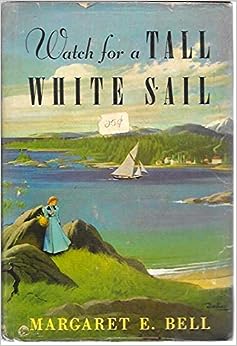
Margaret E. Bell’s Watch for a Tall White Sail took me to the Ketchikan Peninsula in Alaska at the end of the 19th Century. I read it as a pre-teen and have never forgotten it or the ending. I can close my eyes and see the peninsula as it was then, the hardship of the heroine’s life, and her ultimate joy. I checked it out of the school library then and now wish I hadn’t. The book is only available in hardback and is priced over $100 dollars. I do drool on its Amazon page from time to time, then remember the joy of the second of three books, The Totem Cast a Shadow, and wonder if it is available. Not on Amazon, but anywhere. Which is the long way round to say, I’ve been on my way to the Ketchikan ever since.

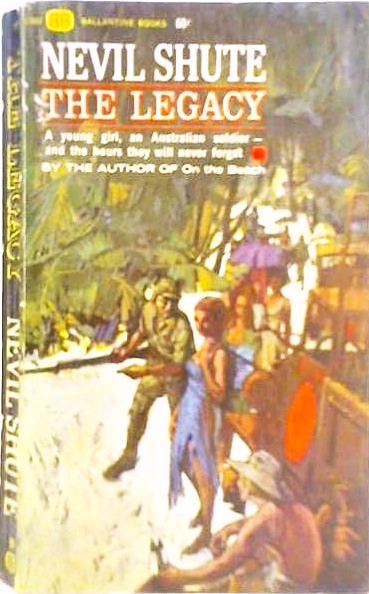
I fell hard for Australia. What I was doing reading Nevil Shute as a teen is an interesting question. My older sister wouldn’t let me near her copy of Exodus as in her judgment I was clearly too young for the contents of the pages. I snuck my mother’s copy and read it anyway which is why I am certain Paul Newman was the wrong guy to play Ari Ben Canaan in the movie. A bit off topic, so back to Nevil Shute. I read The Legacy before it became A Town Like Alice and have been on my way to Australia ever since, just like the sheriff James Garner played In Support Your Local Sheriff (a truly engaging, funny movie).

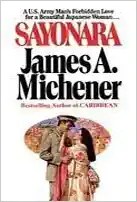
Which brings me to James Michener. Until They Sail fed my Australia problem and the movie by the same name did nothing to deter it. (Paul Newman was in that, too.) I’m not as old as it may seem, my parents used to take my older sister and me to the drive-in in our old turquoise and white Nash with the Nash seat. They picked double features expecting us to sleep during the second more adult movie. Fat chance. I still start crying at the mention of Sayonara and have yet to recover from William Holden’s bared chest in Picnic (not a Michener story but a great chest nevertheless). Inspired, I read Sayonara. I cried so hard at the ending that the pages in my copy are still crinkled where my tears dried. The Bridges at Toko-Ri, which I read when far too young, did not inspire a visit to North Korea, but Tales of The South Pacific and later Hawaii gave me the desire to see the islands. And I have. Even Lāna’i.

I pounded my way through From Here to Eternity. Don’t ask how I got my hands on a copy of it when fifteen. But I did. I am still in recovery from that book. And, yes, I have been to the beach. And, no, I did not reenact any scenes that once involved Burt Lancaster and Deborah Kerr.

All this rambling is to say, that as we write and world-build, we inspire others to travel, we help them see the world more fully, and sometimes we make them cry. And — books are a wonderful, magical way to escape the heat. You don’t have to be trampled on your way to the Acropolis or ferried from fires in Rhodes, rather you can luxuriate on Corfu or Crete or Delphi with the help of Mary Stewart. Or even on Barbados in my book Perfidia .

Check my books out at D.Z. Church – Author, Standalones & Vietnam Era Military Thrillers (dzchurch.com)