Three Hydrangeas

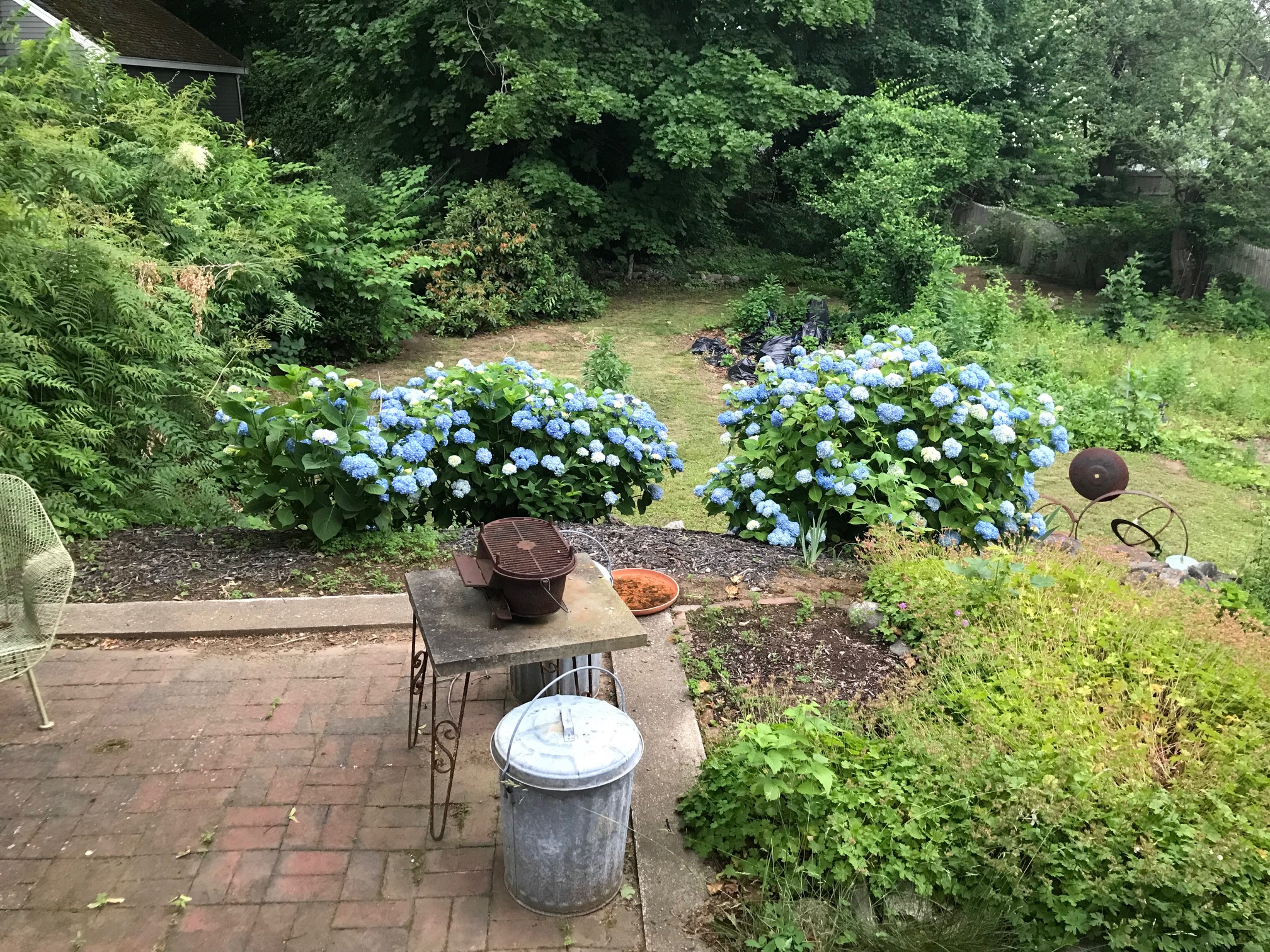
I’ve been reading up on hydrangeas—where to plant, when to bloom, what to feed. I planted three on a gentle slope in the back yard, just off the small patio, several years ago. This area gets lots of morning sun, midday sun, and some afternoon sun. I never feed them, never prune though I do remove old stems that are woody and falling off. And, like many other plants in New England, these three no longer wait for the traditional August blooming. They begin in mid June. 

All three plants have been productive since I planted them perhaps fifteen years ago, and two have reached their full height, over three feet. The third grew more slowly, and two years ago, as I was weeding out whatever had crept up through the mulch, I found an invasive plant had twined itself around the third plant. I rooted it out, and hoped the hydrangea would survive and do better now.

Last year the runt of the trio bloomed nicely, and I congratulated myself for planting it a little higher than the other two, thinking now it gets more sun instead of being somewhat sheltered between two other plants and a fast-growing false spirea, which is another object of my (unfriendly) attentions.

As the spring drifted into June, I admired the first two hydrangeas, which were getting larger and larger, with more and more blooms. I pondered the third plant, which has now arrived at the top of the slope and is only a few inches from the patio. How did it get there? 
It’s been two years since my husband died, and while I thought my life was continuing on its established trajectory, I’m beginning to see that it’s not. A few weeks after Michael died, a mutual friend, also a widow, asked me if I was now reinventing myself. The question surprised me because we’d known each other for years both as writers and as neighbors. My first reaction was, no, of course not. I’m who I have always been. But in the intervening months I have noticed that interests I didn’t pay much attention to are coming to the fore, or I’m taking them more seriously. Some of them involve fixing things myself instead of asking Michael, who loved broken things for the chance to tinker, or hiring someone. 

I’m doing a lot more photography, and looking back on four solo shows and wondering why I didn’t take the work more seriously. My newest project involves lace and exploring experimental photography, which involves poking into analogue work. I don’t feel like I’m reinventing myself so much as sprawling over boundaries established arbitrarily and no longer useful. 

So now when I look at the hydrangea working its way up the slope and getting ready to grow as large as the other two, I don’t wonder how it got here or why. It’s where it needs to be.

Battling with Bots in Phone Mazes

A couple of years ago, I deactivated my Twitter account, right after You Know Who took the company over and decided to allow any wackadoodles to post whatever they wanted, no matter how hateful or delusional. I thought that was the end of it—goodbye, Twitter or X or whatever you want to call yourself next. But somehow, my Twitter account did not go away. As a matter of fact, after two years of absence, the account now lives with someone posting as me nearly every day about magic mushrooms and referencing an account that has been suspended by X for violating its rules. A friend called this disaster to my attention.

I immediately contacted X product support and filled out the form for a compromised (stolen!) account and asked that the account be deleted. In the notes, I pointed out that Twitter no longer recognizes any of my email accounts, so I cannot get into the account, but that the Twitter feed shows the hacker posting as me, using the photo from my Facebook author page as well as my name. I received a form letter telling me to access my account and go through the deactivation process from within. I tried again, even posting my ID and photo. No such luck. Since I can no longer supply the email used for that account, they refuse to believe that it’s mine and it’s been hijacked. I was curious by why they didn’t see that every post by the hacker (probably a bot) references an account that has been suspended. Then it occurs to me: I’m trying to persuade an AI bot that a crime is being committed! As far as I can tell, customer support at X does not include human life forms, so it’s useless to add notes to prove your case; they will not be read.

When I posted on Facebook about the issue, several people referred me to an Instagram account that might be able to resolve the problem. Maybe that would help, and I will probably do it. But does it seem unreasonable that I’m reluctant to run from one social media site to another for help? These days nobody has a clue who is on the other end of any online communication.

Is everyone trapped in this increasingly non-human world every day? I recently dropped an eyecare company because they never offered any way to contact them other than going through their phone maze, and as they have offices all over the state, each time I wanted to call to ask a question, I had to spend twenty minutes wading through that morass. Our biggest healthcare system in my town is the same. You cannot call any office directly. I often hang up before I ever get answers, wondering if some people actually die wandering through the phone maze or waiting on hold nowadays.

Imagine if the 9-1-1 service were converted to AI using one of these phone mazes.

911:      Nine-one-one. What is your emergency?

Caller:  Someone is trying to get into my house! I’m hiding in my closet.

911:      Please choose from the following options: press or say 1 if you need emergency medical service; press or say 2 if you need the fire department; press or say 3 if you want the police department; press or say 4 if this is not an emergency.

Caller:  Three! Crap! The intruder just broke the lock on my front door!

911:      I understand you want the police department. Please choose from the following options: press or say 1 if you are reporting a theft; press or say 2 if you are being threatened by an armed person; press or say 3 for all other reasons.

Caller:  He’s coming up the stairs!

911:      I didn’t understand. Please try again. Please choose from the following options: press or say 1 if you are reporting a theft; press or say 2 if you are being threatened by an armed person; press or say 3 for all other reasons.

Caller:  Oh god, two! Two! Two!

911:      I understand that you are being threatened by an armed person. Is that correct?

Caller:  Yes, yes! He’s trying to open the closet door now.

911:      Press or say one if the person is armed with a gun; press or say two if the person is armed with a knife; press or say three if the person is armed with something else.

Caller:  He has a gun! Help me! Send the police.

911:      I understand that you need help. Is that correct?

BANG! End of call.

Is this the future we have to look forward to? I certainly hope not, but civilization seem to be headed that way. Will we survive the AI-pocalypse?

On the other hand, this 911 scenario would make a great suspense scene in a book. I look forward to publishing my fifteenth novel later this year, and I hope my readers do, too.

Guest Blogger ~ Laura Kelly Robb

The Audiobook Experience

Like nearly every writer I know, I proof my manuscripts by reading them out loud. With my finger poised over the delete button, I find unnecessary words that make a sentence sticky and verb tenses that don’t line up. The process turns up lines of dialogue that sound stilted, as well as gaps in meaning—those leaps in logic a reader would be unable to make without additional information.

My latest mystery, The Laguna Shores Research Club, published by TouchPoint Press in 2022, underwent the same process. The trade paperback version, further copyedited by editor Kimberly Coghlan, was praised for the readability of the prose. I was delighted when TouchPoint sold the audio rights to Tantor Media. The audiobook became available November 2023.

Listening to the audiobook taught me a few things about my editing process.  Something happens when one’s writing becomes performed sound. The story gets a new layer. All the characters gain an additional aspect through the voice the narrator chooses for each one. For instance, the character of the deceased friend, Billie, acquired a West Virginia accent, done very well by the narrator, Amanda Friday.  I had written Billie as having a slight drawl, but I meant only to alert the reader to the fact that she wasn’t a native of Washington, D.C. In Amanda’s narration, however, Billie’s soft, slow pronunciation serves to make her more vulnerable. When I first heard the full recording, Billie’s demise struck me as more tragic than in the written version.

During the process of proofing the manuscript out loud, I had not considered what a performer might add. Knowing what I know now, my instinct will be to give a potential audiobook creator more material to work with—more accents, more quirks of speech, or more variations of disposition that bubble up into the dialogue.

Another benefit that a recording can wring from the written word is to highlight the pacing. Feedback I received from some listeners pointed out that the plot began to gallop in the last quarter of the book and the ending left them breathless. Amanda anticipated the change in the rhythm of the story by speaking in the early chapters in a measured tone.  She saved her variations in intonation for the critical plot developments and final revelations. If I had realized the effect her techniques could have, I think I would have begun the suspense earlier in the book by spreading out the revelations and suspicions of the main character. I’ll be more likely in the future to take the listener as well as the reader into consideration as I structure a plot.

I found one downside to a vocal performance to be the treatment of the dialogue tags. Since we generally read faster than we listen, some repetition in a text is glossed over by the efficient reader. I often included dialogue tags for clarity on the assumption a few extra tags would not tire out most readers. In the audio, however, unnecessary repetitions can weigh down the performance. The narrator often indicates who is speaking through variations in tone and pitch, and the “he said” and “she said” tags become tiresome.  In future work, I will be more attuned to the tags and try to edit them more closely.

As audiobooks become more popular, writers may want to consider producing their own audio versions of their work. I am not familiar with the best ways to proceed, but I know more and more people are wading in. If you are interested, here’s my Mystery and Suspense magazine interview with Amanda Friday about the ins and outs of narration and her work with indie authors.

The Laguna Shores Research Club by Laura Kelly Robb

(ISBN 9781956851311; 328 pp, trade paperback)

Laila Harrow knows the best way to track down anything—or anybody—is to ask Billie Farmer. As the brains of the Laguna Shores Research Club, Billie teaches fellow members how to reach into the ether and pluck out facts.

Counting on Billie’s guidance, Laila promises the St. Augustine Museum a catalogue of Florida Highwaymen paintings that will catapult her standing in the art world. But when Billie dies suddenly, Laila is forced to pull herself out of the darkness and follow the facts. Her investigation turns up up one fact too many: Laila is at the center of a dangerous game.

You can find the audiobook of The Laguna Shores Research Club on Audiobooks.com, AudiobooksNow.com, GooglePlay, LibroFM.com, the free site that asks listeners to post reviews, AudioFreebies.com,and Audible, as well as other platforms such as Spotify. If you have time to take a listen, I would love to hear your thoughts. Reach me at Laura@LauraKellyRobb.com

After studying at the University of Toronto, Laura taught for five years in Spain. Returning to Seattle, she completed a three-week fiction class at Iowa Writers’ Workshop, and published short stories for Foliate Oak, The Nassau Review, and on the RTVE show, Nómadas. She is a member of the Mystery Writers of America. The Laguna Shores Research Club is her second novel.

Social Media Links

Website: https://www.laurakellyrobb.com/

X: @LauraKellyRobb

Instagram: @BookHardy

Adventures in Anthology-Land


by Janis Patterson


I like the anthology format – a short (ca 20K words) length which is appealing to today’s sound-bite sensibilities, several authors, which means several different stories, several different viewpoints, several different styles even if written around the same theme. This broadens the target audience and exposes every one of the contributors to readers they might not otherwise have reached.


On top of my standalone releases I do two Regency-set romance anthologies every year – one with a summer theme and one set at Christmas. Great experience, great publisher, good financial returns – everything needed to give me a totally overblown opinion of my own knowledge and powers.


At an informal gathering of some long-time (multiple decades) writer friends (all working professionals) we were talking about the market and what we could do to improve our sales. Suddenly struck with an attack of the stupids, I suggested “Why don’t we do an anthology ourselves? A mystery anthology?” (Yes, I have seen all the Mickey Rooney/Judy Garland movies where someone always cries, “Hey! We’ve got a barn… why don’t we put on a show?”)


After a lot of chatter and very little good sense, we decided to peg our anthology to underserved holidays. I mean, who needs another Christmas or Valentine’s Day anthology? Who has even seen a Labor Day or Memorial Day or St. Swithin’s Day anthology? It’s practically a virgin field.


We decided to start with July Fourth, each of us writing a story about our choice of the various wars that have defended our freedoms. I – for some unknown and unfathomable reason – chose World War I, about which I knew next to nothing. Now I know a lot, much more than is needed for a 20,000 word novella, but that’s the way things go.


Fortunately, as all of us are long-time professionals, all skilled in the mystery genre, coming up with the ideas and actually writing the stories were not difficult at all. What drew us all up short was the non-writing stuff.
Who is going to do the formatting? We all have different formatters, or do it ourselves. What about covers? Same thing. But those were small problems, easily handled.


It was the business side that drew us up short. Now we have all self-published with varying degrees of success, so the mechanical part didn’t faze us, but the financial part did. The vendors only take one name and social security number, so whomever we used would get stuck with the tax bill. There are ways around that, with a portion of the buy-in to be set aside to recompense that person, but it seemed dreadfully complicated. None of us are particular mathematical geniuses (genii?) so through the kind generosity of several other writers we got names of a couple of companies that did fee-splitting, which relieved our minds immensely. The only sad thing is, by the time we got this far it is much too late to get the July Fourth book release on track for a proper pre-release. The only choices we had were to rush it through and sell a less-than-ideal product or put it off a year so we could give it the professional send off – and offer our readers a professional product.


So what did we do? Of course none of us could face putting out a less-than-professional product, so it should be ready for pre-order next June. You expected something different? Of course, that left the question of what to do between now and then… go back to our individual projects after making a release schedule for the July Fourth anthology? Take a much-needed break from writing at all?


Hey, people, we’re writers. What on earth would make you think we would do anything so sensible?
The new anthology is titled Bloody New Year! and is centered on New Year’s Eve/Day. It will be ready for pre-order 15 November. Don’t forget to get your copy!

Rejected! (A Fact of Life)

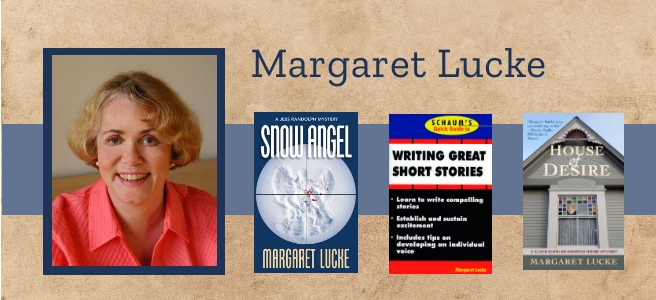
by Margaret Lucke

The other day I received word that a short story I’ve written has been turned down by the publication I submitted it to. A disappointment for sure, but I like the story, and I’m confident I’ll find a home for it. 

In the earliest days of my writing career, I read a biography of the iconic author F. Scott Fitzgerald. It mentioned that Fitzgerald received 287 rejections before he ever sold a word. He papered his bedroom walls with them. This may not be the exact figure, but it’s close, and it’s the number that sticks in my mind. 

Let’s face it, rejection is a fact of life for writers. If we let it discourage us, pretty soon we’d be writing nothing but grocery lists.

Sometimes it’s hard to accept that no means no, straight and simple. When we receive a rejection letter, we try to read between the lines. Was my story rejected because it’s awful and I’m a terrible person who should never set my fingers on a pen or a keyboard again? Of course not, though with my first few rejections it was easy to read them this way. But there are lots of reasons why rejection can happen. Maybe the editor was rejecting everything on the day she read my story because a headache or a fight with her boyfriend had put her in a foul mood. Maybe my story was the twelfth one she’d read that week to feature a four-foot-high green-haired vampire as the detective and she was weary of concept by the time she got to mine.

Being on my way to assembling my own collection of rejection slips, I took heart from this. If a literary icon like Fitzgerald could be rejected that often, and persevere and succeed, then so could I.

I’ve discovered that there are hierarchies of rejection, and I’ve received them at every level. At the bottom of the list is silence. After you submit your work, you wait …and wait  … and wait … for a reply, but you never receive one. Apparently the editor or agent you sent it to is too busy to say a simple no and assumes that if several months go by and you haven’t heard from them, you’ll figure out that they’re not interested. This is rude, in my opinion, but it has become all-too-common practice in today’s publishing world. 

Next comes the basic form letter that says, “We regret that your submission does not meet our present needs.” Maybe that’s true, or maybe the publisher words it that way because it sounds slightly better than “Are you kidding? You were really thinking we’d ever publish something this terrible?” 

Somewhat better is the form letter with the electronic equivalent of a handwritten scribble — the words “thank you” or, even better, a personal note.

At the fourth level is an invitation to submit something else “Try us again.”

If I’m really lucky I’ll achieve the fifth level, getting a comment that refers to details in the story so I know someone actually read it.

At the top of the pyramid is the personal letter so glowing and complimentary I have to read it twice to realize they’ve rejected me. Though I’ve never received one as flattering as this legendary rejection, purportedly sent to a would-be contributor by the China Economic Review:

“We have read your manuscript with boundless delight. If we were to publish your paper it would be impossible for us to publish any work of a lower standard. And, as it is unthinkable that, in the next thousand years, we shall see its equal, we are, to our regret, compelled to return your divine composition, and to beg you to overlook our short sight and timidity.”

At the other extreme, I’ve also never received rejections as chilling as these  letters, cited by novelist Lawrence Block in one of his Writer’s Digest fiction-writing columns years ago. (Note: They weren’t addressed to him; they were examples provided by publishing industry sources.) The first was brief and to the point:

“I regret that I must return the enclosed shipment of paper as unsatisfactory. Someone has spoiled it by typing gibberish on every single sheet.”

The second provided detailed instructions to the writer, who had sent a literary agent a novel that was apparently a vicious racist screed:

“I suggest you take the following steps with regard to your manuscript.  1) Go out in the back yard and dig a hole several feet deep.  2) Place your manuscript at the bottom of the hole.  3) Fill in the hole and firm the soil in place.  4) Do not plant anything intended for human consumption in that portion of your garden for at least seven years.”

These make the standard form letter look good, don’t you think?

It’s time to send that turned-down tale of mine to the next market on my list.