The Peace That Follows Chaos by Karen Shughart

December is chaotic here on the south shore of Lake Ontario in New York state, but in a good way. It’s busy and a lot of fun, but by New Year’s Day we’re exhausted and ready for some quiet time. The season starts the weekend after Thanksgiving, but then the entire month is filled with parties, shopping flings, festivals, gift exchanges, impromptu gatherings, and food – lots, and lots of food – both the cooking and eating of it.

Decorating is big up here, and although we don’t do much of that, just a little festive touch or two both in-and-outside our house, many friends and neighbors go full bore, hoping to win or place in a contest sponsored by our Neighborhood Association for the best outdoor decorating. And many of them do.  Frankly, it’s quite impressive, and more than a little magical.

Now it’s January. The decorations have been stored away for another year, the snowbirds who flew north for the holiday have migrated south again to spend the rest of the winter in warmer, sunnier climes. The days are a bit longer, and while that’s certainly good news, they’re a bit grayer, too, and there’s more chance of snow. While we loved the hustle and bustle of the previous month, we breathe a sigh of relief.

We greet our like-minded neighbors when we walk each morning, but other than the roar of the waves crashing on the beach or the sound of the wind, it’s quiet. A couple restaurants and almost all the shops have closed until spring, and there’s not much traffic, hardly a vehicle to be seen traversing through our streets.
Now our gatherings are small ones: intimate dinners with friends at the restaurants that remain open; a pot of soup or chili with a small group at our house on a Sunday evening; a ladies’ night out; or for my husband, the regathering of his summer golf group for lunch and playtime at a virtual, indoor facility.  I happily resume my yoga classes. We venture to the city to take advantage of the cultural offerings there: a symphony; a Broadway show presented by a traveling touring company; or special exhibits at museums and galleries.

I’d been making good progress with the fourth book of my cozy series, but during December that project was mostly put on hold. This is the month when I commit to moving forward with my writing, and have been spending at least part of each day expanding the story as I continue with the first draft. Then, later in the afternoon, I read, fire burning in the fireplace, a cup of tea in hand.

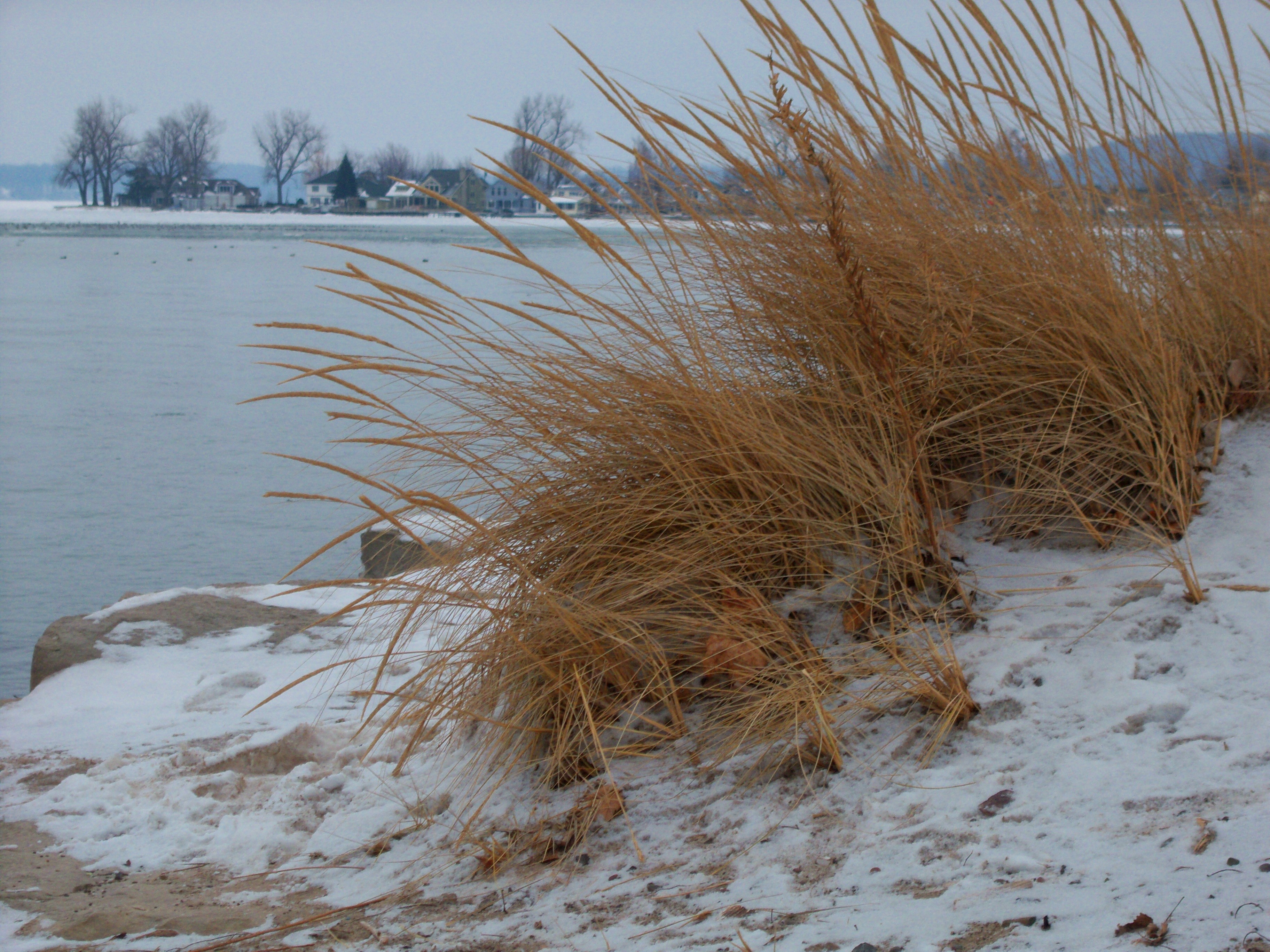
Some friends and family who don’t live where we do wonder how we manage during this time of quiet and isolation, with weather that’s fickle and can change in a minute or two. For us it’s a time of centering and peacefulness, and it’s very beautiful with white caps on the water, grey skies intermittently clearing for brilliant blue and bright sun, starry nights, and a landscape dotted with wheat, rust, faded green and brown. Because many of the trees are barren of leaves, I can see the lake and bay and the tops of the two lighthouses that flank each end of our village beach from several rooms in our house.

By March, we’ll be ready for a change and begin to search for signs of spring: daffodils peaking above the thawing ground; buds starting to swell on trees and bushes; a greening of the grass. But for now, we’re enjoying the peace that follows chaos.

A member of Crime Writers’ Association of the UK ( CWA), North America chapter, Karen Shughart is the author of the Edmund DeCleryk cozy mystery series, published by Cozy Cat Press, including the award-winning Murder at Freedom Hill.  All books have historical backstories that provide clues to why the crime was committed, and recipes at the end. They are available in Kindle, Kindle Unlimited, paperback, and Audible.

In 2024, I Resolve To . . .

By Margaret Lucke

Here we are—halfway through January. Have you broken your New Year’s resolutions yet?

I recently came across this definition:

New Year’s resolutions = a to-do list for the first week of January

Maybe it’s true that most resolutions don’t last. In fact, a lot of people claim not to make them at all. But I sort of enjoy the annual ritual. If you’re like me, this is the year you’ve resolved to do things right—to break all your bad habits, finish all the projects you’ve been procrastinating on, and become that all-around perfect person you know you have it within you to be.

Most of my resolutions have to do with writing. It’s the same list I made last year, and the year before, and, well, probably every year since 2010.

If you’re a writer and you’ve neglected to make your own New Year’s resolutions, I hereby make you a gift of mine. I probably won’t keep them this year either, so someone else might as well put them to good use.

Note well: If carefully followed, these resolutions are guaranteed to lead to fame, fortune, and bestsellerdom. How do I know? Because they’re based on the never-fail counsel I’ve received over the years from how-to books, English teachers, and writers far wiser than I. Or is it than me?

That question leads me to:

Here are the rest of them:

3.  I will study the markets and never submit anything that is not tailored precisely to its intended home.
(I will also learn to read editors’ minds as well as their guidelines.)

4.  I will write about what I know.
(Hey, that puts me back to writing only once or twice during the whole year!)

5.  I will not try to second-guess market trends but will write only what speaks to my heart.
(Wait a minute—does anyone else detect a contradiction here? See Number Three.)

6.  I will keep pen and paper handy so that I can jot down ideas as they come to me.
(Especially those ideas that are so huge, so fabulous and solve so many plot problems that I could not possibly ever, ever forget them—until the next time I’m at my desk, when I will remember that I had this idea that was so huge, so fabulous … but I will have absolutely no recollection of what it was.)

7.  I will get organized.
(I’ve got a head start on this one. For New Year’s 2022 I bought myself a box of file folders. As soon as I find it, I’ll be all set to go.)

8.  I will eat right and exercise so that I will be in excellent shape for producing excellent work.
(That is, I will follow the Writer’s Diet Plan. It has been scientifically established that creativity is stimulated by the four basic food groups: caffeine, chocolate, wine, and nacho chips. And if getting up to refill your mug isn’t exercise, I don’t know what is.)

9.  I will quit procrastinating.
(Well, maybe I ought to wait until 2025 before committing myself to that one.)

10.  I will persevere, because writers with perseverance and no talent are more likely to succeed than writers with talent and no perseverance.
(All the books say so. Of course, it would be nice to have perseverance and talent both. Not to mention luck.)

11.  I will follow all the good advice I receive about my writing and ignore all the bad advice.
(And I will suddenly be blessed with the perspicacity to know which is which.)

12.  I will double-space my manuscripts when I submit them.
(Hey, I had to throw in one resolution that I might actually keep.)

So there you are—help yourself. Learn these lessons well, and let me know the minute these little gems make you rich and famous. And have a wonderful 2024!

Guest Blogger ~ Erica Miner

Prelude to Murder: Bringing Murder and Music Together

Everything about my journey to the mystery genre was connected to my love for writing and my life as a violinist with the Metropolitan Opera in New York.

Though I had played the violin most of my life, I had started writing before I began studying the instrument. In grade school, at the age of 7 or 8, I was placed in an afterschool program for Creative Writing. I don’t remember much of what I wrote (it was about 100 years ago!). But I do remember loving the entire process: creating characters and plot lines and weaving them all together to tell stories. Then I discovered I also had a talent for the violin. That fiendishly difficult instrument monopolized my creativity, though my passion for writing never left me.

Eventually I ended up in the orchestra of the most prestigious opera company in the world, where I was part of a uniquely exciting, glamorous subculture. What I hadn’t anticipated was the hotbed of intrigue behind that famous “Golden Curtain”—an operatic Tower of Babel with clashing egos, rampant jealousies, and nefarious happenings. I then realized an opera house was the perfect place for mischief and mayhem. Why not bring murder and music together in that milieu? My Julia Kogan Opera Mystery series was born.

When it comes to the old adage “Write what you know,” I was not immune. My main character, Julia, is a young violinist much like me when I first started out at the Met: a starry-eyed neophyte who knows nothing about the backstage conflicts that take place between the fascinating but maddening characters who work there. In the first book of the series, Aria for Murder, on the night of Julia’s debut performance at the Met, an unthinkable tragedy occurs, and suddenly she becomes entangled in a murder investigation. Julia’s sleuthing makes her the target of the killer, and she uses her own ingenuity to survive.

There was little research involved in my Met Opera mystery, since I had been there for 21 years; but Prelude to Murder, the recently released sequel, takes place in a totally different atmosphere: Julia goes off to the desert to perform with the Santa Fe Opera. I had never been to Santa Fe, so I visited the area to do copious amounts of research on its history and culture. It was a revelatory experience, and the book is infused with rich details. Of course, no sooner does Julia arrive in Santa Fe than operatic chaos ensues, and she finds herself involved in yet another murder investigation, this time with the added element of Santa Fe’s ghostly activity. Her wits carry her through, and in Book #3 she goes to San Francisco for more operatic mayhem.

Though I find the mystery genre the most difficult to write, it also is the most challenging. The potential for murderous intrigue against the background of a theatre, where the turmoil behind the scenes is often more dramatic than what occurs onstage, is limited only to the number of opera houses in the world—and to my wicked imagination.

Prelude to Murder

Young, prodigious Metropolitan Opera violinist Julia Kogan, having survived her entanglement in an investigation of her mentor’s murder on the podium, and a subsequent violent, life-threatening attack of a ruthless killer, is called upon for a key musical leadership position at the Santa Fe Opera. But at the spectacular outdoor theatre in the shadows of the mysterious New Mexican Sangre de Cristo Mountains, she witnesses yet other operatic murders, both onstage and off. Dark and painful secrets emerge as, ignoring warnings from her colleagues and from Larry, her significant other, Julia plunges into her own investigation of the killing. Ghostly apparitions combine with some of the most bloody and violent operas in the repertoire to make Julia question her own motives for searching for the killer. But this time the threat to her life originates from a source she never would have imagined.

Buy links:

Amazon: https://www.amazon.com/Prelude-Murder-Julia-Kogan-Mystery/dp/1685124429/ref=monarch_sidesheet

Barnes and Noble:

https://www.barnesandnoble.com/w/prelude-to-murder-erica-miner/1144067662?ean=9781685124427

https://www.thirdplacebooks.com/book/9781685124427

After 21 years as a violinist with the Metropolitan Opera, Erica Miner is now an award-wining author, screenwriter, arts journalist, and lecturer based in the Pacific Northwest. Her debut novel, Travels with My Lovers, won the Fiction Prize in the Direct from the Author Book Awards. Erica’s fanciful plot fabrications reveal the dark side of the fascinating world of opera in her Julia Kogan Opera Mystery series. Aria for Murder, published by Level Best Books in 2022, was a finalist in the 2023 Eric Hoffer Awards. The second in the series, Prelude to Murder, published in 2023, glowingly reviewed by Kirkus Reviews (https://www.kirkusreviews.com/book-reviews/erica-miner/prelude-to-murder/), finds the violinist in heaps of trouble in the desert at the Santa Fe Opera. The next murderous sequel takes place at San Francisco Opera. As a writer-lecturer, Erica has given workshops for Sisters in Crime; Los Angeles Creative Writing Conference; EPIC Group Writers; Write on the Sound; Fields End Writer’s Community; Savvy Authors; and numerous libraries on the west coast.

https://www.facebook.com/erica.miner1

https://twitter.com/EmwrtrErica

https://www.instagram.com/emwriter3/

AUTHOR WEBSITE:

https://www.ericaminer.com

To Cuss or Not to Cuss, That Is The Question by Heather Haven

I have to admit it. Even though I write cozies, and mostly humorous cozies at that, I am sometimes at a loss as to whether or not to have some of my characters talk the way they would in real life. Putting aside I am half-Italian and a quarter-Irish, for the most part, I’m considered a pretty mellow soul, and try to err on the lady-like side in my daily life. However, I have been known to let a few colorful words rip when I bang my toe or lose the tip of a freshly manicured fingernail. And do NOT wake me up with a spam call at six am asking me to buy your storm windows. It will not go well for you.

But, but, but, that is my private life. Professionally, I receive emails and comments about the fact that I write a pretty clean novel. I do. No body parts are fleshed out or described in a way that could be called salacious. I do not salache. If you want salacious, please visit Joan Collins. Who, by the way, sells about a gazillion more books than me. That should tell me something right there, but I’m not listening.

While I do write a peppery word upon occasion in my books, I don’t think it can be described as vulgar or offensive. I have Lee Alvarez describe her buttocks as her derriere. The upper, front portion I don’t talk about much. The word bosom comes to mind and if I’m feeling peppery, boobs. But I try to keep that kind of jargon or slang to a minimum. Possibly someone, somewhere might be offended. I once said “hello” and was challenged as to what I meant by that.

But what I really try to keep to a minimum is having that sway my writing or make me back off on what I’m trying to say. Because you can’t please everybody all the time. And if you play it wrong, you’re going to please nobody at any time. So, I try to please myself. I write what I am comfortable writing. I say what I want to say. But I am always aware of my contract with the reader. This is especially true for the Alvarez Family Murder Mysteries and Persephone Cole Vintage Mysteries. There are expectations and I respect that. When writing these two series, I sometimes have to rethink the selection of a word or phrase and not use the first one that came to me. It doesn’t happen often but when it does, I pick and choose with care. I never dilute or sell out, but try to be clever.

The reality is it’s easy to throw the “f” word into every other sentence. It’s easy to shock people, titillate them, and make them remember your writing for its sensationalism. That’s not me. I focus on things I consider to be important in life: honor, respect, truth, positivity, family, standing up for yourself, being good to people and animals, and making a difference, even in a small way. Oh, yes! Then I throw in a dead body. Maybe two. But I try to do it with a clean sense of fun, a lot of humor, and from a point of view that’s a little off the beaten path.

Because we’re all different. We all go our own way. And we’re all wonderful.

Happy New Year, my friends.

A Year of Possibilities

There’s a song lyric I think of a lot. From the musical Follies by Stephen Sondheim—it’s called “I’m Still Here.”

In the lyrics, a character reviews the hills and valleys of her life. With equal parts humor, bravado, triumph and bittersweet, she declares that she made it through all of last year.

That’s what I feel like on this New Year’s Day. Particularly since 2023 has been one for the books. The year was far more dramatic and eventful for me than I would have liked. Lots of hills and valleys. One of the ups was the publication of The Things We Keep in March. The 14th Jeri Howard novel was my 20th book and that’s quite a milestone. Hey, call it a mountain.

As the year progressed, I had my share of downs—a computer crash and the loss of a book I was working on, followed by my mother’s passing, then the condo flood. But another up—I finally took that trip to Greece I’d been contemplating for several years, after taking an art history course. I thoroughly enjoyed myself. Climbed all the way to the top of the Acropolis, marveled at the remnants of ancient civilizations in Delphi, Corinth, Mycenae, Crete and Akrotiri on Santorini. I ate delicious food. Olives, especially Greek olives. And the scenery! Lots of hills and valleys there.

A year of ups and downs may hold true for you as well.

I don’t make New Year’s resolutions. Haven’t for years. I prefer to think of the new year as a new page in the journal, where I can write dreams, aspirations, and list the things I’m grateful for.

It’s also a time when I make year-end donations to various charities, my way of making the world a better place in the new year. For the most part I keep it local—the food bank, Meals on Wheels, the animal shelter, and the San Francisco Chronicle’s Season of Sharing Fund.

Things that happened in 2023 will affect what happens in 2024, and that can be good as well as bad. The past is always an influence. For me, this is a time to let go of the bad things that happened last year, the things that can clutter up my life and impede my progress. It’s time to consider the possibilities of what comes next.

So here comes a year of possibilities. New Year’s Eve will be a quiet evening at home with a favorite movie, surrounded by my feline foursome. New Year’s Day will bring a celebratory brunch with friends of long standing. After that, I’ll take down the Christmas decorations and work on my book.

Happy New Year to all of you and all the best for 2024.