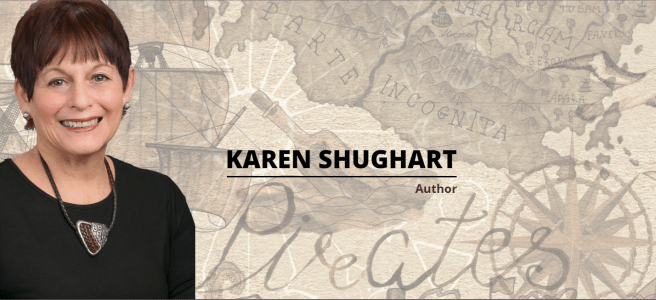
Picking Up Steam by Karen Shughart

I recently received an email from someone who has read all the cozies I’ve written. She said that while she enjoyed each of the books in my Edmund DeCleryk series, she thought the most recent one, Murder at Freedom Hill, was the best; with each book my writing skills have evolved, with layers added to each story. I appreciated her candor, and she probably was correct. My writing has in many ways been like a train, metaphorically picking up steam, and adding railroad cars as necessary to accommodate a growing number of passengers seeking to get to their destination.

With the first book in the Edmund DeCleryk cozy mystery series, Murder in the Museum, I wrote a prologue that introduced a historical backstory that provided clues to why the present-day murder occurred. As the mystery unfolded, the backstory, spanning the late 1700s to the mid-1800s, continued with artifacts found in the basement of the museum and discovery of a memoir written by a man who, in his youth, had made terrible mistakes but who redeemed himself in adulthood. It was a short story within the book.

I continued with the historical backstory concept in my second book, Murder in the Cemetery, after deciding it would always be part of my cozies. But this time after the prologue, I conveyed it with the discovery of an artifact at the cemetery where the victim was killed, and a series of letters a lonely wife wrote to her sister while on a quest to find her husband, who had been transported to England as a prisoner of war during the War of 1812. Instead of one prologue I wrote two, the first introducing the backstory, and the second giving the reader the seasonal setting for the present day murder.
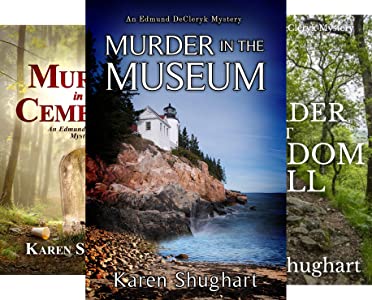
In the third book, Murder at Freedom Hill, I continued with the two prologues and the backstory-a narration for an exhibit at the historical society about the victim’s ancestors, both Black and White-who were involved in the Underground Railroad and Abolitionist Movement. Then I added a subplot that was separate from, but intricately woven into, the main story.

Now I’m working on book four, Murder at Chimney Bluffs. In this one, I continue with techniques I used before: the two prologues, the historical backstory -now rumrunning and the Prohibition era -but the backstory will also be the subplot. And I’ve added a second mystery, a cold case from decades ago that may lead the investigators to the killer.

I’m happy with the progression of these books, it keeps me interested and stretches my brain, but I confess that the writing is taking me a bit longer with each one. Now I’m compiling more notes and have added a timeline and a list of characters, many of whom are recurring; some new. As I continue to write the series I, too, am picking up steam, which will, hopefully, make each book better than the one before.

Karen Shughart is the author of the award-winning Edmund DeCleryk cozy mystery series, published by Cozy Cat Press. She has also co-written two additional mysteries with Cozy Cat authors, and two non-fiction books. A member of CWA, North America Chapter, and F.L.A.R.E., she lives with her husband, Lyle, on the south shore of Lake Ontario in New York state.

A Long Take on Short Stories

By Margaret Lucke

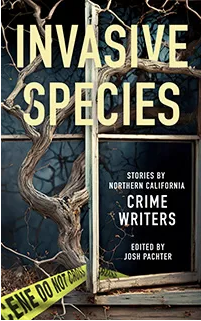
This weekend I’m in the Seattle area attending Left Coast Crime, a wonderful convention of mystery writers and readers. One of the highlights for me came on Thursday night, when the Northern California chapter of Sisters in Crime celebrated the official launch of its new anthology, Invasive Species. I’m thrilled that the book includes a story of mine. Called “Open House,” this tale recounts what happens two unwelcome visitors arrive at a showing of a home for sale.

So lately short stories have been on my mind, though not for the first time. I’ve always been fascinated by the power of stories and the joy of creating them. From the time I was very small, I thought of once upon a time as magic words with which to conjure a fascinating adventure. I started writing stories of my own when I was four.

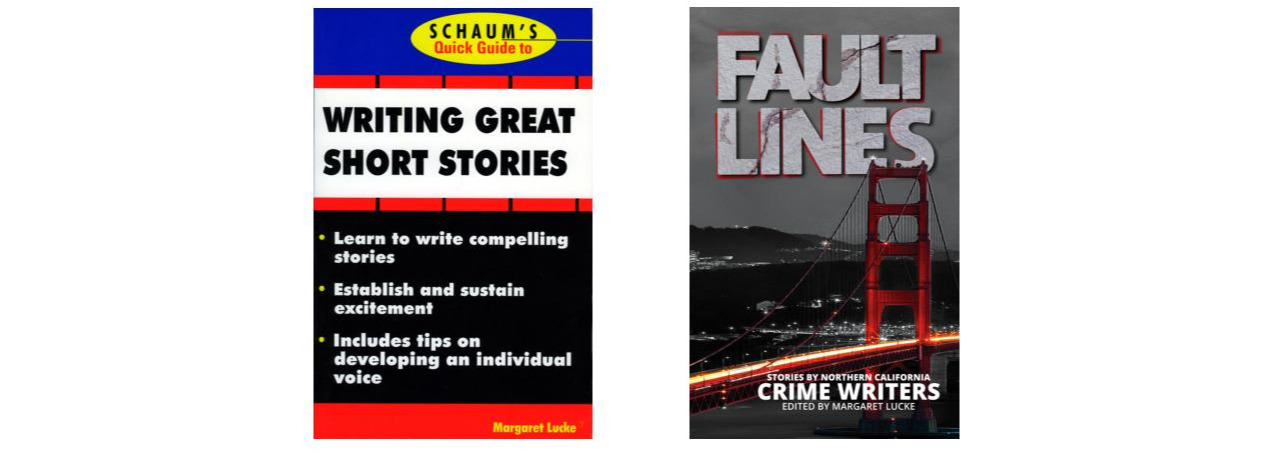
I teach fiction writing classes for the University of California-Berkeley’s Extension program. That gave rise to the opportunity to write a book for McGraw-Hill called Schaum’s Quick Guide to Writing Great Short Stories, which I’m told is a pretty good handbook for aspiring writers. I’ve edited story collections for a couple of authors, and a few years ago I had the privilege of being the editor for Sisters in Crime NorCal’s first anthology, Fault Lines.

What does it take to write a good short story? Writing a successful one takes less time than writing a novel, but in many ways it can present an equal challenge.

Not long ago, a local writers organization asked me to be the judge for their short story contest. A panel had narrowed the roster of entries to eight finalists, and my task was to choose which one would win first place.

It turned out not be an easy task. Too many of the entries were not, in fact, short stories. They were character sketches, anecdotes, or descriptions of random events. Some had no clear protagonist. In others, the narrative wandered around too long before settling into a plot. Several lacked tension. Too often, the narrative didn’t build to a logical ending, but simply stopped.

Since none of the stories stood out as the winner, I did a deep dive. After charting their strengths and weaknesses, I came up with a rating system, assigning scores to how well they handled characterization, plot, point of view, reader experience, language and style. When I totaled their points, the winner became clear.

When it comes to writing a short story, it helps to pay attention to two key words: short and story. That seems obvious, right? But it turns out that both words may be a little more complicated than they seem.

Let’s start with story, as this was something that several of the contest entrants didn’t seem to understand. In order to have a story, Something Happens to change a character’s life in some large or small way.

Here’s a definition I’ve found helpful:  A story is an account of the journey that a person takes as they move from one point in their life to another.

This might be a physical or geographical journey as the person moves from one spot on the map to another. The journey could cover a long distance, like a trip to a different city or a faraway planet, or a short one. Even getting out of bed in the morning can constitute a journey for some of us.

Or it might be mental or emotional journey, as the person gains new knowledge, new ideas, or a new understanding of themselves or others.

Early in the story, something happens that creates a challenge, a problem, or an opportunity for our person. So the person sets out on a path to meet the challenge, solve the problem or take advantage of the opportunity. Along the way, they encounter conflicts and obstacles that they must overcome if they are to succeed.

By the end of the story the person and their circumstances are different in some large or small way. Because of their accomplishment, or their failure, or the insights they’ve gained, nothing will ever quite be the same.

Change is the key—what is different for the person as a result of what happens? If there is no change there’s no story.

The protagonist in my short story “Open House” is a woman who, in midlife, is starting a new career in real estate. She is holding her first open house and has high hopes of having a buyer by the end of the day. That plan is derailed with the arrival of the two unsavory characters who are up to no good, but the encounter teaches her some valuable lessons about her own capabilities.

Then there’s short. Some sources define a short story as 10,000 words or fewer; others say 7,500. But it really depends on the market you’re aiming for. For Fault Lines we set a limit of 5,000 words, and I recently submitted a story to a different publication whose cap was 3,500.

But short means more than word count. It’s also a matter of focus. Compared to novels, short stories focus tightly on one event or sequence of events. They have fewer characters, cover a shorter timespan, and take place in a limited number of locales. They have room to raise and answer only one or two questions, to deal with only one or two themes. While a novel allows you delve into a complex series of events, relationships, backstories, and subplots, a short story requires you to make your point quickly and move on.

And while a novel might forgive you for meandering a bit, in a short story every single word has to pull its weight.  

Yet a short story also grants you a certain amount of freedom. You have the opportunity to to explore and experiment with language and form in ways that would be hard to sustain in a novel.

So go ahead and write your story in second person, tell it from the point of view of a giraffe in a zoo, and end it with an explosive twist. Have fun, and enjoy the challenge and creative reward that writing a short story provides.

Musing on the Moon and a Miracle

by Janis Patterson

Today is Thursday. On Monday I experienced a miracle. A true miracle. I am fortunate enough to live in the path of totality of the Solar Eclipse. For several days thick clouds had been forecast (putting my husband into a fearsome temper – he had actually bought a special solar telescope for the event) and on Monday morning the sky was indeed thickly clouded. We had been invited to some friends’ house with an upper deck perfect for viewing; The Husband didn’t even want to go, saying it was a lost cause, but I insisted, so we did.


The whole group – about 10 people – was worried about the eclipse being invisible, but we went on and took our lunch up to the deck and had a lovely meal and good companionship and – Mirabile Dictu! – just about the time the event was supposed to start holes began to appear in the clouds. To make a long story short, we saw most of the eclipse. We did lose a little of the first part of it, but by about one-quarter of the first half there were only a few thin rags of clouds that really didn’t obscure the view. Seeing the dark circle that was the moon inexorably sliding across the face of the sun, nibbling away at the light, was incredible. Sometimes being seen through the thin scraps of cloud it was even more impressive.


The totality was perfectly visible – and perfectly magnificent. While it is both dangerous and extremely stupid to look at an eclipse without proper protective lenses (you can damage or lose your sight permanently), during the totality you can take a short – SHORT, like a couple of seconds – look because the visible corona is the gas, not the sun itself. Seeing that great dark circle, like a hole in the sky, surrounded by a sparkling halo of white is a sight like none other.
During the totality it is pure magic. The world darkens to a late evening hue, but it is not the same – there is a different quality to the light, an almost aqueous thickening unlike any moment in a regular day. One instantly thinks of fairyland or hidden realms – at least I did. The temperature drops perceptibly and there is a silence almost as if time itself has been suspended.


During the 2017 eclipse in Missouri we were set up in the parking lot of our hotel and there was a dog park for the guests. There were about a dozen dogs in residence and during the totality they went mad, barking and jumping and howling and almost knocking over the fence. I had always thought such a reaction was an old wives’ tale, but no – it happened. Perhaps the ‘old wives’ know a lot more than we give them credit for. There were no dogs where we were on Monday, so no chance of hearing any barking, but I did notice that there were no birds flying during the totality. Neither was there any wind, at least where we were, as if the entire world were caught in a gelatinous stasis.
The totality did not last long and the moon began a stately progression away from the face of the sun, inch by inch retreating and bringing back the light. Eclipse glasses went back on, movement resumed and the light became normal again.


I can see why primitive peoples went in such terror of eclipses. Even in our scientific era, when we know exactly why and how they happen and can predict its happening almost to the exact minute it is a wondrous and somewhat unnerving experience.


So what does all this have to do with writing? To be honest, not much. Oh, we can draw neat little moral aphorisms such as ‘expect a miracle’ or ‘never give up’ and they would be true, but really I just wanted to share the magic I felt. We can always use a little bit of magic, can’t we?

Feng Shui and Me

Did you know that today is International Feng Shui Day? According to The Spruce.com, Feng shui is the practice of arranging pieces in living spaces to create balance with the natural world. The goal is to harness energy forces and establish harmony between an individual and their environment.

Years, okay, two decades ago, I took an online class on how to Feng shui your workspace hoping to help give me harmony to become a published writer. And it work!

Well, I don’t know if it was the Feng shui or being at the right place at the right time or knowing the right person at the right time. Whichever of the three it was, I became a published author with a just starting small press who has grown immensely over the years. I put out 10 books with them before taking the Indie route in 2012.

I kept my desk top and writing space Feng shui just as I’d learned to place items from the class the whole time we lived in Central Oregon. Then we moved to SE Oregon, and I worked in a ten by twenty cabin for 8 months while we built the house we live in now. Nothing was Feng shui but I kept writing books and publishing them.

We built the new house with one room set up for my office and my husband’s desk. (we have matching desks- but he only uses his to hold stuff) At first I placed the desk under a window so I could look out when I needed thinking time while writing. But that put my back to the door. And the one thing I learned during the Feng shui class that stuck with me was to always be facing the door as that is where opportunity walks through. Keep books to your back for knowledge. Those are the only two things I remember from the workshop.

When I was feeling like my writing had stalled and wasn’t feeling as optimistic about my future, I changed my desk. It now sits with one end under the window but it faces the doorway. I don’t have book cases at my back but I have them on both sides of me some just an arm’s reach away.

My husband says my desk takes up too much room this way, but I say I’m open to the opportunities that are coming my way. What they are, I don’t know but I’m ready to embrace them when they do show up!

I have joined a Facebook group that is actively helping me promote my audiobooks. Since it is a whole different group of people than those who read print or ebooks. The owner of the group puts together Indie Author Deals once a month. I’m hoping that one of these days I can use links to my audiobooks on my website. For now I have links to multiple audiobook vendors. Right now there is a sale going on and you can get the first audio 3 book box set from my Shandra Higheagle Mystery series for $0.99 at: IndieAudiobookDeals.com

Being part of this group is one of those opportunities that I found while trying to find someone to help me promote by audiobooks. Feng shui or just luck? I think a little of both!

I’m also excited that through this blog, I’ve met some amazing mystery, suspense, thriller writers and I will get to meet 6 of them in person at the Left Coast Crime conference I’m attending this week in Bellevue, WA. Several of the Ladies of Mystery bloggers and I will be riding from the airport together and then having brunch together the following morning. I’m excited to meet them in person and make even more connections to them and with others throughout the conference.

One of my favorite sayings is: Life is never boring, embrace it!

Guest Blogger ~ Ron Roman

How Of Ashes and Dust Came To Be Written

    The timeline for the composition of Of Ashes and Dust dates to when I was teaching college courses to the US military on Diego Garcia, an atoll in the Indian Ocean; a beautiful spot if there ever was one. That was a halcyon interlude in my life; there was plenty of time to linger on the beach every morning, since I taught evening classes, pondering the story arc, which appeared seamlessly out of nowhere in my mind. Perhaps it was the charming and calming atmosphere of the place that so easily birthed in my mind’s eye this novel’s initial events. Everything just fell into place; it wasn’t until later, when I left the island after about five months, that difficulties arose in the narrative flow and at almost every juncture in it. Episodes of doubt and stagnation occurred almost consistently, the bane of any writer. The following are appetizers, some profound, others perhaps not that deep, for readers to nibble ….  

    Envisioning the plot came easier to me than the development of the three main characters. I knew I wanted to write an alternate-history apocalyptic doomsday thriller set in rural New England around the time of the Millennium. Something about the rounded-off number 2000 buried itself in my head. I wasn’t the only one. Older readers may recall the expression “Y2K” for Year 2000, a neologism that soon fell into disuse and ultimately oblivion when civilization didn’t collapse after all. To be sure, just before the Millennium there were calls from hotheads to bring the world as we knew it down.  “Let’s get it on now!” and “Why wait!” went the refrain.  There was even an exchange of high-ranking officers between the Pentagon and the Kremlin; each had their man in the bowels of the other’s secret war room to disable any accidental computerized nuclear launch. (It was feared that computer systems, even sophisticated nuclear-weaponized ones, could go haywire after midnight of the last day of the Millennium for not having been programmed to function after the 20th century; that planes might fall out of the sky in mid-flight, etc.). The worst thing to happen was that a guy in Ohio, or so I believe it was, got an astronomical fine for a public library book believed overdue by a century. Yet even he survived. In Of Ashes and Dust, except for the protagonist, tortured Vietnam War veteran Professor Will Watson and his Japanese-born paramour Kimiko Tanimoto, along with another local couple, nobody else is initially that lucky. Nobody.

    Speaking of Watson and Tanimoto, their names and character development came easily. Watson was a compilation of several military vets I’ve come to know; Tanimoto was the compilation of several, if not many, Oriental women I’ve come to know equally well. (Use of the term “Oriental,” which some may consider outdated, is deliberate. No time for elaboration here).  “Tanimoto” was the name of a soldier in my own Army unit; it stuck to me long after my discharge from the way it rolled off the tongue. Mine, at least. Also, the name of the third major character, Watson’s friend, confidant and fellow Vietnam War vet Mark Mercotti, was named after a college football player I used to work out with in the local YMCA. Development of his character, however, was more diffuse, having been derived from many guys I’ve gotten to know down the years.

    As for the origins of the rest of the story and its explosive ending, buy and read the text. No explanation forthcoming here, dear reader. So, shake a leg, get the book, and bear witness to the kaleidoscopic patterns of unholy madness in Of Ashes and Dust. It’s the ultimate “alternate truth.”*  

Of Ashes and Dust

At the turn of the Millennium, a trio of tormented souls grapple with their existence in a humble town in New Hampshire while the world spirals into anarchy. Unbeknownst to one another, they hold dark secrets that would eventially ignite a conflict.

Their tale traces back to two covert operations from the Vietnam War era–a revelation about UFOs from the U.S. Air Force and the clandestine Project Sixty-Seven.

At the heart of the story is Professor Will Watson–a war-ravaged Vietnam veteran, a fervent activist of the New Hampshire Liberty Militia, and a man haunted by specters of his past. As the world edges toward Armageddon, he seeks solace in the arms of his Japanese graduate student assistant, Kimiko Tanimoto. Amidst escalating pursuit by the State Police and FBI, Watson is confronted with the harsh realities of his traumatic past and the imminent downfall of a world crumbling around him.

The ebook is currently on sale for only $0.99!

Buy link: https://a.co/d/8V9oYe2

Associate Professor of English, ESL, and Humanities Ron Roman taught with the University of Maryland Global Campus (UMGC- Asia) since 1996.  He retired from full-time employ and later as adjunct during the COVID-19 crisis (2020).  His hobbies include jogging, hiking, camping, weightlifting, roller-coasters–and his beloved 1968 Rambler American antique auto for which he received Third Prize in the Hemmings (Motor News) National Antique Auto Show in Bennington, Vermont shortly before returning overseas.  (The Rambler has undergone a complete restoration.) 

He has written extensive travel, academic, and political articles for regional, national, and international publications. He studied writing (both fiction and creative) for his third graduate degree (Humanities) from Wesleyan University/Connecticut.  Currently he resides in South Korea with his wife where he works on US military installations assisting US military retirees and dependents.  He continues to write and has acted in numerous Korean TV dramas and motion pictures like Operation Chromite portraying Admiral Forrest Sherman opposite Liam Neeson as General Douglas MacArthur.  His alternate-history apocalyptic doomsday thriller Of Ashes and Dust was a 22 November 2022 release by Histria Books.

www.writerronroman.com