Rejected! (A Fact of Life)

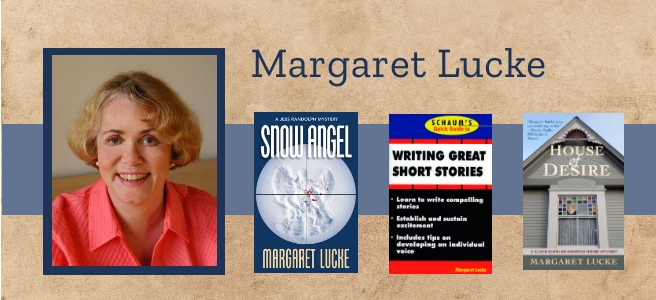
by Margaret Lucke

The other day I received word that a short story I’ve written has been turned down by the publication I submitted it to. A disappointment for sure, but I like the story, and I’m confident I’ll find a home for it. 

In the earliest days of my writing career, I read a biography of the iconic author F. Scott Fitzgerald. It mentioned that Fitzgerald received 287 rejections before he ever sold a word. He papered his bedroom walls with them. This may not be the exact figure, but it’s close, and it’s the number that sticks in my mind. 

Let’s face it, rejection is a fact of life for writers. If we let it discourage us, pretty soon we’d be writing nothing but grocery lists.
Sometimes it’s hard to accept that no means no, straight and simple. When we receive a rejection letter, we try to read between the lines. Was my story rejected because it’s awful and I’m a terrible person who should never set my fingers on a pen or a keyboard again? Of course not, though with my first few rejections it was easy to read them this way. But there are lots of reasons why rejection can happen. Maybe the editor was rejecting everything on the day she read my story because a headache or a fight with her boyfriend had put her in a foul mood. Maybe my story was the twelfth one she’d read that week to feature a four-foot-high green-haired vampire as the detective and she was weary of concept by the time she got to mine.

Being on my way to assembling my own collection of rejection slips, I took heart from this. If a literary icon like Fitzgerald could be rejected that often, and persevere and succeed, then so could I.

I’ve discovered that there are hierarchies of rejection, and I’ve received them at every level. At the bottom of the list is silence. After you submit your work, you wait …and wait  … and wait … for a reply, but you never receive one. Apparently the editor or agent you sent it to is too busy to say a simple no and assumes that if several months go by and you haven’t heard from them, you’ll figure out that they’re not interested. This is rude, in my opinion, but it has become all-too-common practice in today’s publishing world. 

Next comes the basic form letter that says, “We regret that your submission does not meet our present needs.” Maybe that’s true, or maybe the publisher words it that way because it sounds slightly better than “Are you kidding? You were really thinking we’d ever publish something this terrible?” 

Somewhat better is the form letter with the electronic equivalent of a handwritten scribble — the words “thank you” or, even better, a personal note.

At the fourth level is an invitation to submit something else “Try us again.”

If I’m really lucky I’ll achieve the fifth level, getting a comment that refers to details in the story so I know someone actually read it.

At the top of the pyramid is the personal letter so glowing and complimentary I have to read it twice to realize they’ve rejected me. Though I’ve never received one as flattering as this legendary rejection, purportedly sent to a would-be contributor by the China Economic Review:

“We have read your manuscript with boundless delight. If we were to publish your paper it would be impossible for us to publish any work of a lower standard. And, as it is unthinkable that, in the next thousand years, we shall see its equal, we are, to our regret, compelled to return your divine composition, and to beg you to overlook our short sight and timidity.”

At the other extreme, I’ve also never received rejections as chilling as these  letters, cited by novelist Lawrence Block in one of his Writer’s Digest fiction-writing columns years ago. (Note: They weren’t addressed to him; they were examples provided by publishing industry sources.) The first was brief and to the point:

“I regret that I must return the enclosed shipment of paper as unsatisfactory. Someone has spoiled it by typing gibberish on every single sheet.”

The second provided detailed instructions to the writer, who had sent a literary agent a novel that was apparently a vicious racist screed:

“I suggest you take the following steps with regard to your manuscript.  1) Go out in the back yard and dig a hole several feet deep.  2) Place your manuscript at the bottom of the hole.  3) Fill in the hole and firm the soil in place.  4) Do not plant anything intended for human consumption in that portion of your garden for at least seven years.”

These make the standard form letter look good, don’t you think?

It’s time to send that turned-down tale of mine to the next market on my list.

Driving My Novel by Heather Haven

I started a new novel a few weeks ago, Cleopatra Slept here, Book 11 of the Alvarez Family Murder Mysteries. All enthusiastic, I got off to a rip-roaring start, only to peter out several days later. I found any excuse not to sit down and write, some of them pretty lame. Watching the leaves grow on a rosebush is not a valid excuse. Neither is watching the new season of Bridgerton, although the costumes are fantastic and there is a lot of huggy-poo-kissie-face. But still, not a good enough reason to put off my work. So, I called myself on it and found, as usual, I was in a stall because I was on the wrong road.

I should be used to this. I am directionally challenged. I remember back in ’86, when my husband and I packed up everything we owned, including two reluctant cats, and headed from New Jersey to California. It was December 14th. Chilly weather, but drivable. Naturally, the car hitch to the truck didn’t work. As it was a Sunday and Avis Rent-a-Truck was closed, we decided he would drive the truck (alone) and I would lead the way driving the car (with the two cats). I was the leader because I was in charge of the Trip Tik, an involved layout of driving instructions from Triple A, before the internet was a going concern. I think I mentioned I am directionally challenged. That was the day we found out. December 14, 1986.

Instead of heading west and south to Texas, I managed to head us northwest, even with directions. We discovered this error about 9 hours later, 5 miles to the gallon, during a blizzard. Divorces have been caused by less. Norm became suspicious about the blizzard and not seeing any signs for Texas. He honked me over to the side of the road where reality hit. Lake Erie was in view.

Near the border of Canada, we crashed for the night at a Motel 6 when it really was 6 bucks. I will not go into the discussion about me leading us closer to Lake Erie than we had ever been before or since, but sufficeth it to say I gave up my rights to the Trip Tik or any other directional leadings in the future. But at least my husband was still talking to me, even if it was through tight lips. The cats were not talking to me, so it was a long night, blizzard and all. A week later we arrived in California, no thanks to me.

I allude to this December 14th snafu as it has a direct bearing on my writing.  Metaphorically speaking, I was heading in the wrong direction, about to run into the Lake Erie of writing, a lovely lake I’m sure, but not my destination. Initially, I may not have known that’s what I did to myself, but somewhere in the deep recesses of my soul, Life’s Trip Tik did. It took a while because I didn’t have a snow-covered, tight-lipped husband standing over me with flames shooting from his mouth, but eventually, I got the message. I had gone north when I should have gone south.

This is particularly important with book 11, Cleopatra Slept Here. I will elucidate. Book 9, The Drop-Dead Temple of Doom, takes place in Guatemala, the storyline dealing with ancient Mayans, archeology, and what have you. So here I am in book 11 writing a storyline dealing with ancient Egyptians, archeology, and what have you. I knew from the beginning the story had to be as different as possible from book 9 but Laudie, Laudie, Laudie.

Leave it to me to head north when I should be going south. I’d started out with the same scenario as book 9. It was comfortable. Missing person, trip to the pyramids for Lee Alvarez, protagonist; former Navy SEAL husband, Gurn; and she-who-must-be-obeyed mother of Lee, Lila. Really, Heather? It took me a long time to find a U-turn from that road.

After I slept on it, played in my garden, and bought things on the internet I am now returning, what to do hit me. Start the stupid story ANEW. Forget anything you wrote before. Pretend you never wrote book 9. Don’t be influenced by it. Every series writer knows it’s tough not to repeat yourself, but you simply can’t. The readers remember, bless their hearts. And it’s about as close to cheating as you can get. I mean, plagiarizing yourself? How gauche.

And I realized I did want something different in book 11. I wanted the entire Alvarez family together on a ship floating down the Nile. The three mentioned above, but I also wanted Tío, retired chef uncle; brother and IT guru, Richard; his wife, Vicki; their 2-year-old daughter, Steffi; and Lee and Gurn’s 2 cats, Tugger and Baba. Why? Why not. The more, the merrier. But how to accomplish that?

A 2-week vacation! No need to stick in missing people, mishaps, or mysteries in the story. Yet. Just a family vacation laid out as simply as possible, with everything falling into place. This includes free private transportation to Egypt, thanks to Gurn’s pilot buddy who happens to be flying a large plane to Luxor and needs him for a co-pilot. There’s also free lodging on the Blue Nile, a ship with rooms to spare, thanks to the original dig seeking out Cleopatra’s tomb in Alexandria being canceled and most dig members scattering. Gurn’s parents, amateur archeologists, were willing to pay through the nose to be included in this canceled dig but have been persuaded to join a new one, the search for Cleopatra’s mother.

Cleopatra VII, of Julius Caesar and Mark Antony fame, was born in early 69 BC to the ruling Ptolemaic pharaoh Ptolemy XII and an unknown mother, possibly Ptolemy XII’s wife Cleopatra V Tryphaena. But it is not certain. The Dig Director and main benefactor of the original dig decides instead of following the pack in Alexandria trying to locate Celopatra’s tomb, sailing aboard the Blue Nile for Aswan to find out just who the queen’s mom was is the way to go. The Alvarez family decides to join in the search. And all for free!

But nothing is free in this world, not even in fiction. What starts out as a gentle, family-oriented vacation lolling around on the Nile ends up with the Alvarez clan being caught up in a mind-numbing ride of murder, drugs, and other chicanery. The trade of heroin may persist in Egypt, despite efforts by security forces to eliminate it, but something is mightily wrong with the elegant Blue Nile. Who are these strange voices heard in the middle of the night? Why do missing waiters seem to be commonplace aboard this ship?  And what is the secret the elusive captain’s log holds?

Egypt’s strategic location makes it a significant destination and transit point for heroin moving from Asia to Europe, Africa, and the US. But all of this settles in on the Alvarez clan too late to do anything but ride posse on the truth, camel-style.

Recycle, Reuse, Throw it Out—Maybe

I don’t consider myself a pack rat. Others may differ. Well, maybe I will admit to pack rat tendencies. But not the whole rat. I don’t have empty plastic yogurt tubs and months’ old stacks of newspaper cluttering up my home. I really do try to recycle and reuse, and throw out, if need be.

I am, however, a paper magnet. It’s a tendency acquired early in my writing career. I spot something in the newspaper or a magazine, clip it out and set it aside, thinking I might use that someday, in a story or a novel.

And I have. Here’s where recycling comes in. Back in 2005, I clipped a short article from the San Francisco Chronicle. The story concerned a stash of old wallets found in the rafters of a barracks at Camp Roberts, in central California. It’s a California National Guard base now, but during World War II it was an Army training base. The contents of the wallets dated back to that era, the 1940s. The theory was that the wallets had been stolen, all valuables removed, and the wallets then disposed of in the rafters. I was so intrigued by the story I kept it pinned to my bulletin board. And indeed, I did use the story in a Jeri Howard novel—Bit Player.

I started writing in the ancient times before computers and the internet, so I would stash all these clippings and assorted notes in file folders. Some of those folders date back decades and are still hanging around in file boxes, taking up space in my office. I really would like to purge that paper. But I am reluctant to get rid of anything that I might use someday. I know, I know, the mantra of a pack rat.

These days, with the internet, I can save the article onto my computer, or at least the URL. Saves paper and space, that’s for sure. I can even use my iPhone to scan documents. I have file folders of clippings and notes awaiting such action. Then maybe I can throw out all that paper and free up some space in my office.

There’s another kind of throwing out. I’ve excised scenes from novels and told myself the finished work is better for it. At times, though, I reuse a scene. In the Jeri Howard novel Nobody’s Child, Jeri gets shoved off a BART platform in San Francisco. That scene originally appeared in an early version of Till the Old Men Die. I really like the excitement of the scene, with Jeri’s narrow escape from an onrushing BART train. Too good not to reuse.

I also recycle and reuse characters. An earlier unpublished novel had a character named Lowell Rhine. He was a shifty character. I liked the name, so I recycled it in Cold Trail, using the moniker for a somewhat shady lawyer. As for that unpublished novel, and another lurking in my files, I have some recycling and reusing in mind.

Frequently characters who appear in my books wind up in other books. History professor Lindsay Page first appeared in the Jeri Howard novel Witness to Evil. Later she had her own book, my standalone novel What You Wish For. After attending my 50th high school reunion, I wrote a novella, But Not Forgotten, about a semi-retired reporter named Maggie Constable, who attends her reunion, determined to solve a long-ago mystery. I like Maggie a lot, so she appeared in my most recent Jeri Howard book, The Things We Keep. Maggie is going to have a book of her own, as soon as I can get around to it.

And yes, I did write a short story about a pack rat. Entitled Pack Rat. I’m not as bad as the guy in the story. Really.

Guest Blogger ~ Jacqueline Diamond

I never thought of myself as a rule-breaker but…

One “rule” prescribed for novelists is to establish your “brand” and stick to it. Romantic comedies? Write a zillion! Medical-themed romances? Stick with that! Mysteries with a medical twist? Make that your one-and-only.

Although I have a good imagination, I can’t picture spending more than forty years writing basically the same type of book over and over. Or maybe it’s because I have a good imagination.

Since I sold my first romance (Lady in Disguise) in the early 1980s, I’ve published more than one hundred novels. They include mainstream mysteries and paranormal suspense, romantic comedies and contemporary romances.

Isn’t that enough for any writer? Well, no.

About ten years ago, after completing my Safe Harbor Medical romance series for Harlequin, I felt an urge to use that small-town hospital setting for mysteries. Since that type of novel didn’t align with Harlequin’s needs, I decided to venture into self-publishing.

I’d already begun reissuing some of my earlier books, including the mystery Danger Music, so I had a sense of the technical requirements. This turned out to be a rewarding creative decision that resulted in my Safe Harbor Medical mysteries, starting with The Case of the Questionable Quadruplet.

The four books in the series feature a young widowed doctor who solves murders in conjunction with his cranky, private investigator sister-in-law. Much as I enjoyed writing them, though, that series eventually reached what felt like a natural conclusion.

In the meantime, I’d become intrigued by cozy mysteries with talking cats, magical villages and mystical libraries. What I needed was a fresh, original take on the genre.

Coincidentally (or so I thought), with the end of the Covid lockdown, my husband and I seized the opportunity to travel to a place I’d always been intrigued by: Prague, in the Czech Republic. This turned out to be an inspired, and inspiring, choice.

Prague is a gorgeous city with an impressive literary history. We stayed at the Art Nouveau Palace Hotel, whose café was once a meeting place for artists and writers including Franz Kafka.

I’d heard tales of a golden age in Prague when Jewish intellectual life flourished. Since that’s my ancestry, I especially loved the stories of a magical rabbi who created an artificial man of clay, called a Golem, that acted as a protector for Jews.

Unfortunately, they needed one. The Austro-Hungarian empress Maria Theresa, a religious bigot (and mother of Marie Antoinette), expelled the Jews from Prague in December, 1744.

Don’t you wish you could right the wrongs of the past? Maybe I could… in fiction.

What emerged from my offbeat mind was a reimagined, alternate version of Prague, ruled by wizards. When an evil queen tried to seize their city, they pooled their powers and accomplished the near-impossible, shifting their land halfway around the world.

The disruption shook loose and redistributed their town’s intrinsic magick, with surprising results. One of these was to imbue humanlike speech into a breed of cats. Yes, talking cats!

In a realm isolated from their surroundings (the West Coast of what became the United States), their culture developed in a unique way. Nearly three hundred years later, a young woman, an orphan who has no idea she’s from this enchanted city, is “summoned” there to discover that she’s inherited the town’s ancient library from her grandmother, who’s been murdered.

To solve the mystery and bring justice for her grandmother, she has to awaken her hidden powers. Along the way, she finds a touch of a romance and realizes her longtime companion cat, Kafka, has the power of speech.

The writing process was fun and challenging, splashed with humor and danger as my heroine, Chess, and I explored this new world. The climax proved even more exciting than I’d hoped, with a dash of bravery by Kafka and his pals.

My favorite review came from National Book Award winner Neal Shusterman, who wrote, “Master storyteller Jacqueline Diamond draws you in to this magical feline mystery, enchanting you page after page. You’ll fall in love with Chess Vevoda, and the wild world she’s stumbled into!”

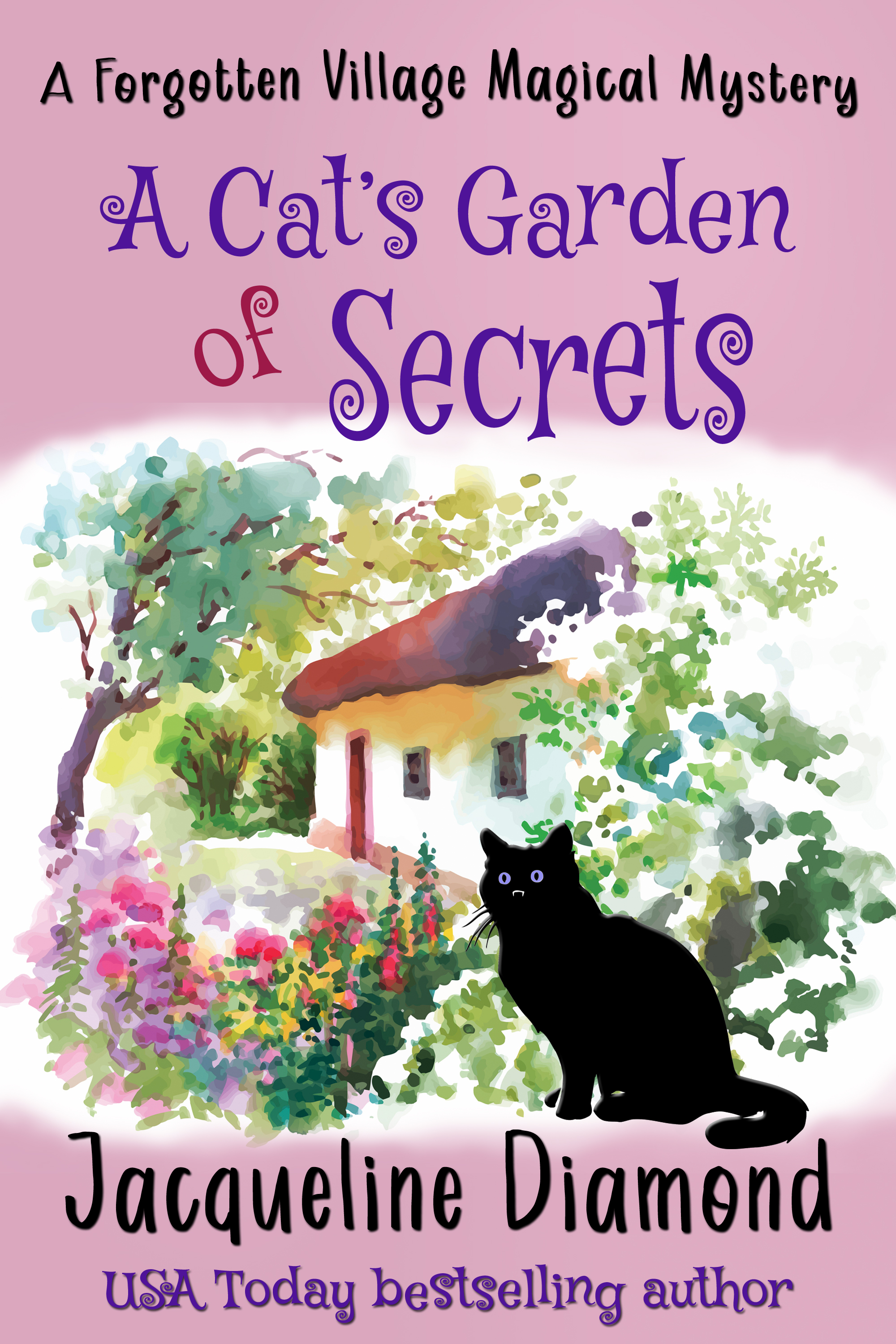
A Cat’s Garden of Secrets launches my Forgotten Village Magical Mystery series. It’s complete in itself—no cliffhanger endings in my novels.

Now, I’m happily writing the next book, A Cat’s Nose for Murder, with a storyline that gives Chess and her cat a new mystery to solve and a little more romance (for both of them).

A Cat’s Garden of Secrets is my 109th book. But in a sense, I feel like I’m just getting started!

A Cat’s Garden of Secrets

Awakening magical powers? Yes! Solving a murder, sure. But turning into a cat? Who, me?

On the weirdest day of my life, my cat starts talking, my car kidnaps me to a charming hidden village, and I inherit a mystical library. Plus, I discover I have superpowers!

As an orphan who grew up in foster care, I had no idea I came from an enchanted land full of furry shapeshifters, including—surprise!—me. Or that I had a gifted grandmother, who’s been murdered. Now it’s up to me, with the help of a handsome, otherworldly detective and my know-it-all cat, to uncover the truth… if someone doesn’t kill me first.

Enjoy cozy mysteries with talking animals? Love tales of awakening supernatural abilities and small-town bookstores and libraries? Discover why National Book Award winner Neal Shusterman wrote, “Master storyteller Jacqueline Diamond draws you in to this magical feline mystery, enchanting you page after page.”

Buy links:

Amazon: https://www.amazon.com/dp/B0CR4KYCM9

Barnes & Noble: https://www.barnesandnoble.com/w/a-cats-garden-of-secrets-jacqueline-diamond/1144921034?ean=2940185636138

GooglePlay: https://play.google.com/store/books/details?id=Kcn9EAAAQBAJ

Kobo: https://www.kobo.com/us/en/ebook/a-cat-s-garden-of-secrets

Smashwords: https://www.smashwords.com/books/view/1542627

Apple: https://books.apple.com/us/book/a-cats-garden-of-secrets/id6480234897

Audio https://www.amazon.com/dp/B0CR5PBK9Y

USA Today bestselling author Jacqueline Diamond has sold more than 100 novels in popular genres from fantasy to mystery to medical romance to Regency. A former Associated Press reporter, Jackie has traveled widely, and currently lives in California. Among her honors are a Romantic Times Career Achievement Award and a Thomas Watson Foundation fellowship. A Cat’s Garden of Secrets launches her Forgotten Village Magical Mystery series. You’re welcome to learn more about her and her books on her website, Jacquelinediamond.net.

In Praise of Envelopes

Scattered around the house, until I finally gathered them in one place, were a number of pretty, well-decorated pads of paper in various colors. Some are aqua with little sprigs of white flowers in one corner; others are yellow, or pink, or off white with cute titles such as To Do, or Not To Do, with a row of colorful books at the bottom, below the hand-drawn lines. Some only say Notes in florid fonts. Some have bouquets in the corners and others have snowflakes along the borders. My favorite is the collection of library book cards that used to be found, stamped, in the back of every book. I never use any of these.

I also have a stack of journals I received as gifts. They come with nice covers and silk bookmarks, and beautiful pages, some lined, some not. I don’t use these either. When I travel, I take a plain black Moleskine journal, the small size, and it’s just the right tool for a short vacation, about a month or less.

For taking notes, keeping track of my to-do list, I use envelopes, plain white, usually used envelopes. I can’t break myself of the habit. When I get the mail the first thing I do is examine the envelopes, hoping for one that isn’t stamped or printed on the back, torn or stained. The envelope might end up with coffee spots on it, or smears of butter from a morning pastry break, but I don’t want it to begin that way. I want pristine, a pure white envelope calling me to list all the goals I have for the day, the list of things I believe, in my arrogance or delusion, that I will get done in the next ten hours. I can be very ambitious, and with small handwriting to accommodate the space, I can list a month’s worth of tasks on the back of a No. 10 envelope.

When I think about it, I admire my smarts in choosing this disposable vehicle for my ultimately disposable thoughts. The item is plain, it fits neatly into my hand, and there’s room on the back for additional notes and clarification. Because the No. 10 envelope, a standard size, is 4 1/8 in by 9 1/2 in, it is roomy enough for a clear statement of the task but not so roomy that I’m tempted to get wordy. There’s no point in a to-do list if it reads like a lecture or an essay. In addition, it folds neatly to fit into a pocket, and slides into my purse easily.

This week I cleaned my desk and found no less than seven (that’s seven) envelopes packed with things to do, books to read, household chores to get to, handymen to keep in mind for various repair jobs (I live in an old house), and writing ideas so terse I had no hope of ever figuring out what I had intended. That’s okay. I always tell myself if it’s a good idea, it’ll come back—several times—until I either get to it or discard it. I’d crossed out much of the items on each envelope, and as I read through the remainder I smiled at my plans, and was glad to let them go. I have new ones now.

There’s another reason I like envelopes, one that I rarely admit to myself. You can probably guess what it is, or who I’m going to refer to. In my quiet writerly life, I’ll never rise to the level of him, the great one, nor will I ever write anything so perfect as to be quoted decades or centuries after I wrote it. But here I sit, with my stack of envelopes honored by having its own desk drawer, thinking of what is possible with a simple envelope. The great man’s example is simple and can be summarized by anyone, and is always worth remembering and thinking on. Be direct, be honest, be brief. This is good advice for the writer, no matter what she writes on. Thanks, Abe.