Why Do We Write? What Do We Write About?

Many of my fellow authors here have been sharing their thoughts about how and why they write, so I thought I’d chime in, too. Sometimes, when I speak to writing groups or classes, an individual in the group asks me how they should decide what they want to write about. Frankly, that question usually astounds me, because I often have at least a dozen ideas competing for attention in my imagination. In my opinion, it all begins with passion.

“What are you passionate about? What do you think about every day?” I ask. One man’s face lit up and he answered that his passion was music. He had been writing about his grandfather using his ham radio, memories that were pleasant, but not really connected to his passion. He was inspired to develop a story about a musician right at that meeting. Another person started musing about the pioneer history of the area.

I have three passions, and those are always the basis of my stories. First is my passion for justice. I worked as a private investigator for a decade, and nobody hires a private investigator when everything is going well. Someone is always being cheated or threatened or mistreated. And as anyone in the law enforcement or legal profession would tell you, justice does not always prevail in real life. I worked on multiple cases where a crime had obviously been committed, but there was not enough evidence to charge the perpetrator, or in some cases, not enough evidence to even find the perpetrator. The sad real-life case of two murdered hikers in my area was the inspiration for my novel Backcountry. I had to fictionalize what might have happened, but the frightening, ugly fact is that the real killer is still out there. But in my novels, I can make justice prevail, and that feels good.

My second passion is for wilderness and wild animals. I spend a lot of time hiking, kayaking, snowshoeing, scuba diving in wild places, and I want to share my enthusiasm for our public lands and fellow creatures with as many readers as I can. So each novel in my Sam Westin Wilderness Series is set in a wild place, and each features wildlife. And yes, humans are nearly always the villains of my stories, because that is nearly always the case in real life. Humans kill wild animals a million times more often than any wild animal ever kills a human.

My third passion is for animals in general. I couldn’t live without animals in my life. I am constantly fascinated by their physical abilities and their intelligence. I love the fact that they are not human, I celebrate the special powers of their species. Imagine being a bird, living in a world of air where moving in any direction is possible. Imagine being able to dive to great depths in the ocean and swim through clouds of squid and fish like a whale. Imagine being able to jump to the top of a refrigerator like my cats, or find people by scent like a dog. So my passion for animals comes out not only in my wilderness novels, but my fascination with animal intelligence is the basis for my Neema Mysteries, which feature signing gorillas.

So, my advice to aspiring writers is always: Find your passion. And then share it in your stories.

Guest Blogger~Susan Elia MacNeal

Hello and thank you for having me, Ladies of Mystery!

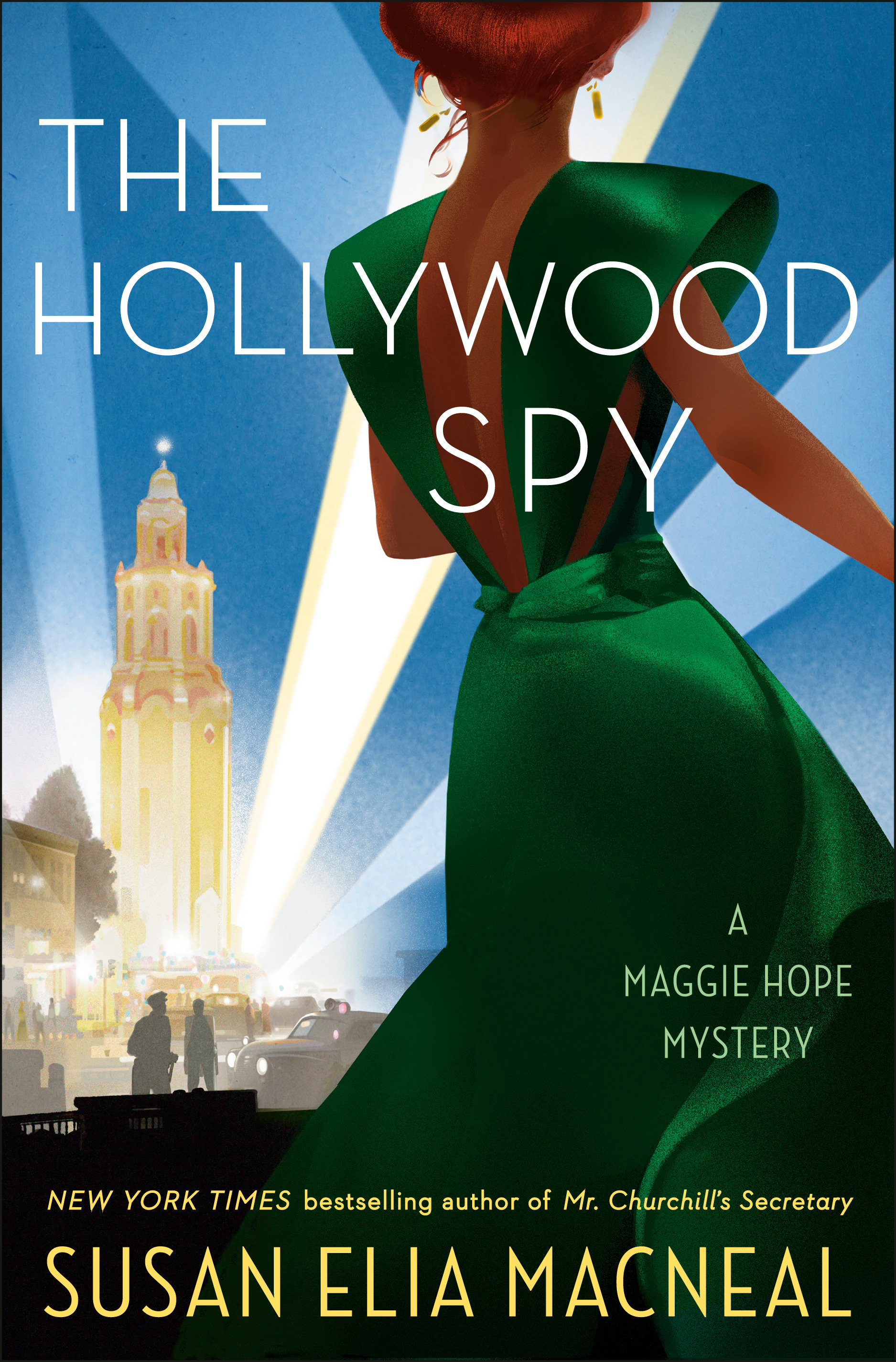
            I’m thrilled to be here talking about The Hollywood Spy. It’s the latest novel in the Maggie Hope series—but it can also be read as a stand-alone, so don’t worry about needing to catch up.

            In The Hollywood Spy, Maggie Hope returns to the United States—and not just anywhere, but Los Angeles, in the summer of 1943.

            Why Los Angeles? Typically, the setting for the books has been London and the UK. Well, I read the Pulitzer-Prize-nominated non-fiction book, Hitler in Los Angeles and that was the catalyst I needed. Yes, you read that title correctly—in the 1930s and even after World War II began, southern California was a hotbed of fascist activity for both German and American Nazis. When I finished reading the book (which reads like a thriller, by the way), I knew I wanted to set a book there and then.

            Los Angeles turns out to be a perfect place for Maggie Hope’s adventures to continue. She’s asked (by her former beau) to investigate his fiancée’s murder. Well, that’s a bit awkward! But Maggie needs a change of scene from dreary grey London—and what starts as a cursory inquiry turns much darker and twistier as more clues are discovered.

            Los Angeles, the city, is a character in her own right in this book. Some of the locations are the Chateau Marmont (where Maggie and her friend Sarah Sanderson stay), the Walt Disney Studios (where John Sterling, Maggie’s ex beau works), the swanky Cocoanut Grove at the Ambassador Hotel, Schwab’s Pharmacy, Caltech, and the Carthay theater. I loved reading books and articles about L.A. during the war, as well as watching documentaries. Taking a research trip was also both productive and fun.

            In The Hollywood Spy, we also meet some famous names from Hollywood at the time: Walt Disney, of course, but also choreographer George Balanchine, composer Igor Stravinsky, singer Cab Calloway, aviation and movie tycoon Howard Hughes, and actress Lena Horne.

            But it’s not all glitz and glamour in Los Angeles, as Maggie and her friends soon find. There’s a dark underbelly as well—all historically documented. In June of 1943, L.A. was torn apart by the Zoot Suit riots. People who identified as LGBTQ were in danger of being arrested or worse. “Smog” was just beginning to appear as traffic increased and rubber plants and war industry polluted the air. And there was significant corruption in the LAPD.

            Los Angeles proved to be a wonderful setting to punch through the soft fog of nostalgia about “the Greatest Generation.” While it’s true most of America was standing shoulder-to-shoulder to fight the Nazis and Axis powers, things (especially in L.A.) are a bit more complex. After all, the government needs the country’s unity—to produce the men and machines for war. Los Angeles was not only home to Hollywood, the propaganda machine for the U.S., but also the aviation industry. While “pulling together” was supposed to stitch up tears in the social, racial, sexual inequality in America, the reality wasn’t as simple as the propaganda and shared memories would have it sound. Los Angeles—and America—stood both divided and together.

            Thank you for having me—hope you read and enjoy The Hollywood Spy!

THE HOLLYWOOD SPY

A Maggie Hope Mystery

by Susan Elia MacNeal

Los Angeles, 1943. As the Allies beat back the Nazis in the Mediterranean and the United States military slowly closes in on Tokyo, Walt Disney cranks out wartime propaganda and the Cocoanut Grove is alive with jazz and swing each night. But behind this sunny façade lies a darker reality. Somewhere in the lush foothills of Hollywood, a woman floats, lifeless, in the pool of one of California’s trendiest hotels. When American-born secret agent and British spy Maggie Hope learns

that this woman was engaged to her old flame, John Sterling, and that he suspects her death was no accident, intuition tells her he’s right. Leaving London under siege—not to mention flying thousands of miles—is a lot to ask. But John was once the love of Maggie’s life…and she won’t say no.

Maggie is shocked to find Los Angeles as divided as Europe itself—the Zoot Suit Riots loom large and the Ku Klux Klan casts a long shadow. As she marvels at the hatred in her home country, she can’t help but wonder what it will be like to see her lost love once again. But there is little time to dwell on memories once she starts digging into the case. As she traces a web of deception from the infamous Garden of Allah Hotel to the iconic Carthay Theater, she discovers things aren’t always the way things appear in the movies—and the political situation in America is more complicated, and dangerous, than the newsreels would have them all believe. 

Buy Link: https://www.penguinrandomhouse.com/books/617760/the-hollywood-spy-by-susan-elia-macneal/?pdivflag

Susan Elia MacNeal is the New York Times bestselling author of the Maggie Hope mysteries. MacNeal won the Barry Award and has been nominated for the Edgar, Macavity, Agatha, Left Coast Crime, Dilys, and ITW Thriller awards. She lives in Brooklyn, New York, with her husband and son.

Visit randomhousebooks.com or susaneliamacneal.com
You can find the author of on Facebook @MrChurcillsSecretary, Twitter @SusanMacNeal, and Instagram @susaneliamacneal


The Murder Person

by Janis Patterson

After the wonderful reception of my last two blogs on the Murder House I couldn’t stop thinking that it was foolish to limit our villain just to the interior of an average house. Murder can be just as deadly and diabolical with what our villain has on his person. Of course, it will require more knowledge, more planning, even more daring than in the theoretically private environs of a house, but a canny villain can be just as deadly with what is on their body.

Of course, there are the obvious things – a belt or scarf or even a necklace for a garotte or perhaps in the right circumstances smothering, a concealed knife or gun, even a blunt instrument such as a few rolls of coins in a sock or scarf – the ‘cosh’ so beloved of old-style gangsters. However – while effective, those tools are crude and totally lacking in imagination. The canny mystery writer wants something more stylish, more imaginative… and less traceable.

The first thing that comes to mind is those sky-high stiletto heels worn by young fashionistas. Properly applied to a suitably vulnerable portion of the anatomy – say the nasal cavity into the brain, or the temple, or with the right knowledge of anatomy the brain stem or any of the major arteries, especially in the neck or groin – they can be very deadly. That is, once our murderer is sure they can walk in them without falling or attention-drawing staggering – something I was never able to master even in my youth. Another drawback is the relatively short space between the heel tip and the beginning of the sole – usually no more than 2 ½ – 3 inches. That would constrict the field of effective use and rule out punctures to the heart.

A nice touch would be to have the murderer be a man dressed as a woman who immediately divests himself of the female clothing – where it could be neither found nor traced to him, a challenging exercise in itself. I’m sure a clever writer could overcome that, though.

Let’s get more creative. Remember a generation or so ago a man was killed on a London street by the means of a small (I mean really tiny) ball filled with ricin (made from the castor bean plant, remember?) injected from the tip of an umbrella by a seeming passer-by? That’s very convoluted and unless the killer is a scientist very dangerous way of getting rid of someone, but it worked. As I remember it took the authorities years to figure it out. However, it has been proved to work and if it fits your scenario, go for it.

More workable are more common poisons, and unless the murderer and victim meet quite often so a long-term poisoning is feasible, they have to be fast-acting. Again there is the crushed OTC pain reliever which will kill over time after one dose by creating a cascade liver failure. This has the benefit of death occurring long – sometimes weeks – after the murderer has dosed the victim, but one drawback is that the resulting necessary powder is a fairly large amount and the taste is quite bitter. However, if the murderer is clever, he can carry a lethal dose on his person, give it all to the victim in some innocuous fashion and, once sure the victim has ingested it all, get away scot-free.

One of the classic means is the poison ring. After all, if it worked for Lucretia Borgia, it should work for our villain. An anecdote – my father was a wonderful and intelligent man who had the same wacky sense of humor as I. Our family had just come back from a trip to Mexico, where Daddy had bought me a poison ring, which I still have. It was a cheap tourist thing, with an obvious hinge on the side of the stone that wouldn’t fool any reasonably alert person. Daddy used saccharine tablets in his coffee, and in play – since he could never remember to bring his tablets with him – I started putting them in my poison ring. Instead of giving them to him, I simply started dumping them into his coffee cup, which Daddy and I both thought highly amusing. (Yes, we were easily amused!) My mother’s thoughts on our charade are not suitable for public pixilation, but she was a very starchily correct lady. How she must have suffered with my father’s and my antics!

Anyway. One day we were having lunch at our club and Daddy was involved in a conversation with a colleague when the waitress came by to fill his coffee cup. As was our custom I reached over, opened my ring and dumped two saccharine tablets into his coffee. The colleague’s eyes widened and – ostentatiously accidentally – he managed to knock the cup off the table, spilling it, before Daddy could take a sip. No one ever said a word – except Mother, who said a great deal of them to Daddy and me later – but we didn’t do the poison ring thing again. Sigh. It was fun while it lasted.

However – you don’t need a real poison ring to get the benefit of similar surreptitiousness. The good ones are incredibly expensive, too. All you need is a (hopefully cheap, since your villain will probably be discarding it right after) large costume jewelry ring where the base of the stone sits high above your finger creating a fair-sized gap big enough to hold a sufficient amount of poison.

Now this is important. It is a terrible fashion faux pas to wear rings on top of gloves, but you have to protect your skin from accidental absorption of the poison. Put a circle larger than the base of the ring of Liquid Glove or NuSkin (there are other brands, too – these are the only ones I can remember at the moment) to create a barrier between your skin and the poison. Depending on the size of the ring and the situation your villain will have to practice to be able to get the poison from under the ring into something your victim will ingest without drawing undue attention.

Now this is important. Once the poison has been delivered, your villain must get rid of the under-ring barrier. As it contains both poison and your contact DNA and possibly your fingerprints, that little circle of fake skin – probably between the size of a quarter and a half-dollar – is a conviction ready to happen, so you must be very careful of how it is disposed of.

For Heaven’s sake, do not eat it – there might be enough residual poison to do your villain a mischief. Don’t just throw it away in a handy waste can, either; destroy it. Cut it into teeny-tiny pieces and flush it, making sure all of it enters the sewer system. Burn it and if there is an ash residue, flush it. Whatever you decide, just make sure it is thoroughly, completely destroyed with no hope of being reconstructed. How many villains have been caught because of inadequate aftercare?

By now you have probably decided that I am thoroughly warped, and you might be right. However – this post has gone on much too long and I haven’t finished. So – if you are brave, or equally warped, think about coming back next month when I (hopefully) finish up with The Murder Person.

Shove Everything To One Side – And Write

That’s what my mother used to say, back in the era when I had a day job. Time to write was limited. So I got up early in the morning and wrote before heading off to the day job.

I also had deadlines. Which would make me crazy. I felt as though I never had enough time to devote to the writing, what with said day job and the day-to-day at home. Vacuuming, decluttering, and other delights of caring for my home, as well as keeping ahead of the weeds in my garden. Exercise, yes, doing that as much as possible. And keeping up with friends and family, the social connectivity that is important in my life.

Back when I was working, I would lament the approaching deadline and the things that crop up demanding time and attention. Mom would say, “Just shove everything to one side and write.”

Okay. I shove. And I write.

That’s why the cat hair is getting thick on the carpet right now and the pile of mail remains unopened. When we went into pandemic lockdown, I swore I was going to clean out the closets and drawers. I still haven’t gotten to that.

Meetings I used to attend in person, of the local chapters of Mystery Writers of America and Sisters in Crime, were replaced by Zoom. Logging into that wasn’t as time-consuming as driving to wherever the meeting was to be held, but it still took time and I got burned out on the online meetings.

I am publishing my own work now, so the deadlines are self-imposed. But they are deadlines nonetheless.

At the end of June, I returned from visiting family in another state. Waiting for me were several commitments. One included providing feedback on several stories I’d agreed to read. Another was sending along a photo, bio, and other information to the host of an upcoming podcast. That done, I focused on the monthly newsletter I do with fellow Ladies of Mystery writer D. Z. Church. And this blog, which goes up on the first Monday of each month.

And the biggest self-imposed deadline of all—the next book.

The day job no longer consumes time and energy. But still, I feel like there is never enough time to write.

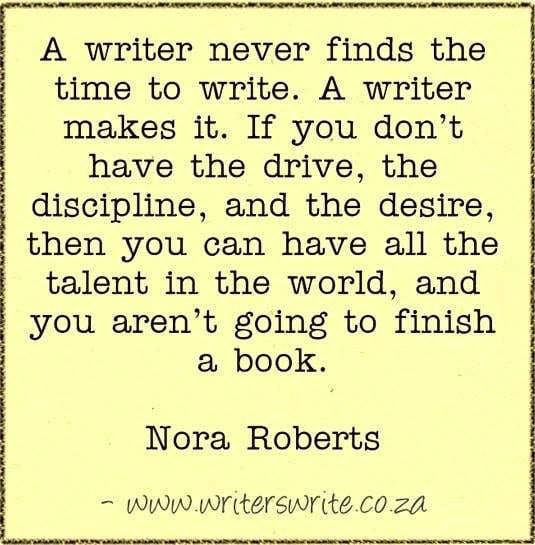
Unless I make it. Here’s what prolific author Nora Roberts says. And I concur.

On Writing by Heather Haven

People often ask me how one goes about writing a book, be it a novel or a memoir. How do you get started? How do you finish? I don’t have a lot of answers but I do know one simple fact: you can’t be a writer if you don’t write. Below are a few things I’ve learned along the way to get me writing. Not foolproof, but helpful, I think. Now and then, I revisit these few rules. I don’t want to make my craft so complicated or get so lost in it I forget the basics.

1 – Give yourself permission to write. Many people think they can’t or shouldn’t write something. Maybe it’s not the time. Maybe other things are more important. Not so! If you want to do it, it’s important. Don’t let family, friends, or circumstances discourage you. If writing is something you want to do then do it! Giving yourself permission is the first step.

2 – Think about what it is you want to write, what you want to say. Fiction or non-fiction? A short story or novel? A memoir, biography, autobiography? It doesn’t have to be big, maybe a couple of pages to start you off. Then put pen to paper, so to speak. Following through is a big part of success in any field.

3 – Find the right set up. You’ll need a quiet place where you can work undisturbed. To be literary for a moment, Virginia Woolf makes this point in A Room of One’s Own. It doesn’t matter if it’s an office with a computer desk or a kitchen table and a tablet. Whatever and wherever you choose, make it your own. Claim it, at least for the span of time you’re writing.

4 – Have the right tools on hand. Notepad, pencils, pens, computer, printer, paper, etc. Be ready for the job of writing. Remember, it’s your job. Approach it that way.

5 – Set up a schedule for yourself and stick to it. Find or make the one time of day when you can concentrate on what you’re doing — writing. Try to choose the same time of day, every day, but if it can’t be that way, go with it. Let everyone around you know this is the time to give you some space. Make it a habit, whether it’s fifteen minutes a day, one hour, or six. Writing is a lot like playing tennis. The more you do it, the better you get. Practice, practice, practice.

6 – Explore the craft of writing. Take classes, read books on subjects that interest you, go to a few lectures. Join a writing group, join a reading group. Make it a living, breathing, attainable craft. Writing can be yours. It can also be a gift for future generations and your family. But most important, it’s what you want to do.

Happy Writing!