Where Does Cultural Appropriation Begin and End?

If you pay attention to current discussions of literature, art, or even music, you have no doubt stumbled across accusations of “cultural appropriation.” When JK Rowling mentioned “skin walkers” on her Pottermore website, she was accused of appropriating the culture of Navajos. Justin Bieber was blasted for wearing dreadlocks, accused of appropriating a Black hair style. Jeanine Cummins, author of American Dirt, took a tremendous amount of flak for writing about a Mexican immigrant when she’s never been one.

I remember years ago when a writer for a TV series about teenagers was discovered to be—gasp—over 30 years old! How dare she claim to be capable of writing about teenagers? Never mind that she had already written many episodes for the hit series. A prizewinning Australian artist creating Aboriginal dot paintings was revealed to be—omigod!—not an Aboriginal person, although clearly a master of the Aboriginal dot style. He’s been erased from the internet and is probably living in exile on some remote island now.

Even I, an infinitesimal speck in the universe of writers, have experienced this prejudice of “you can’t do it if you’re not it.” I was once verbally offered a contract for a prizewinning children’s book I wrote about a Kikuyu girl in Africa. Upon learning that I was not African-American, the editor immediately withdrew the offer.

Writers throughout history have written from the points of view of many others. Mary Shelley, author of Frankenstein, was neither a male scientist nor a monster. How did Leo Tolstoy write Anna Karenina when he was never a woman? How dare Gene Roddenberry write about a pointy-eared Vulcan named Spock? He clearly had no idea how many other planetary species he had insulted. I guess we’ll find out when they arrive to teach us how ignorant we actually are about their cultures.

Good writers are observers, researchers, and explorers. We are creative. We live in our imaginations as well as in the real world. We try to “step into another’s shoes.” We are often telling someone else’s story, and why shouldn’t we be allowed to do that? In my Neema mysteries, I tell the story from three points of view: a female scientist, a male police detective, and a gorilla. That’s at least two and half violations of “cultural appropriation,” because although I am female, I’ve never been a scientist. The protagonist of my Run for Your Life trilogy is a teenage girl of mixed race. I guess I get points for having been a teenager at one time, but I don’t have a Black father like my character. I also own a salwar kameez, the tunic-and-loose-pants-and-long-scarf ensemble worn by many Hindu and Muslim women—am I not allowed to wear that? Just shoot me now.

Can a Black or Hispanic author write from the point of view of a Caucasian character? I have no problem with that—do you? Can a Native American man wear a suit and tie, or does he need to don bark and buckskin so he won’t be accused of appropriating White culture?

Yeesh. I once read the beginning of a book that was written from the point of view of an elk. While I rolled my eyes and certainly thought that was over the top, it certainly never entered my brain to say the author couldn’t write that passage because she wasn’t an elk.

So, publishers, please publish more varied voices and authors of different backgrounds so we can read about their authentic experiences. Critics, discuss the stories and the characters all you want. We all have individual tastes and preferences; that’s what makes the world a richer place. But please, let’s share ideas and cultures. Let’s encourage imagination, not stifle good writers. Let’s not talk about “cultural appropriation.”
The Pear Garden by Karen Shughart

We call it the Pear Garden, and this is how it started. I come from a family of dog lovers. Almost everyone has or has had dogs: my husband and I, our kids, my siblings, nieces and nephews, cousins. When they pass, we grieve for our fur babies for a long time; and we always remember them fondly, even after we adopt a new pet.

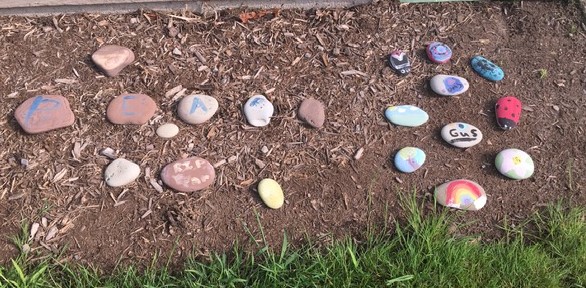
A few years ago, one of our great nieces and nephews came to visit with our daughter, Jessica. Emil was maybe about nine or ten that year and still grieving for the family’s dog, Pear, a lovely, gentle Golden Retriever who had been laid to rest a few months before. Emil was still sad about the loss. We live on Lake Ontario, and Jessica and Emil went off to the beach to collect smooth stones at the water’s edge. Then they came back and painted them with creative, colorful designs including four of them each with the initials that spelled “PEAR.”

Behind our garage there’s a mulched bed of shrubs with some spaces between them. The stones were artfully arranged in one of those spaces to honor Pear’s life. We said prayers and sang songs.  I had wondered if the stones would survive our harsh winters, but to this day they are as bright as when they were first painted.

A few weeks ago, our niece, Suzanne, her husband, Tom, and their two daughters came to visit. While they don’t have a dog, my brother and sister-in-law, Didi and Grammy to the girls, had recently sent Gus, their sprightly Wheaton terrier, over the rainbow bridge.  Maya and Hannah had loved Gus and were taken with our Pear memorial. Our daughter was visiting this time, too, and a little while later we added painted stones for Gus.

When I told my sister about the expanding garden, she remarked that when she and her husband visit us from Florida this fall, they would like to paint rocks and place them in our garden for their beloved dog, Sally, another gentle Golden who had recently succumbed to an unexpected illness.

In the past, we’ve scattered the ashes of our own dogs where they most liked to romp and kept the remainder in ornately carved boxes stacked upon shelves in our library. Now I’m thinking that we need to paint stones for them and add them to the growing display. Our adopted Beagle, Nova, has been with us for about a year-and-a-half. We love her dearly, and she’s as much a member of our family as our other dogs were. I hope, though, that it will be years before painted rocks bearing her name are placed beside the others.

As it turns out, there’s a new tradition that’s begun in our family to remember all the dogs we’ve loved. Perhaps Pear is watching somewhere from puppy heaven, proud to have been the first of these and pleased that we’ve named our memorial garden after him.

Do you like SWAG? by Paty Jager

While I enjoy writing my books more than promoting or marketing, I do enjoy coming up with items to give away as swag. S.W.AG.= Something We All Got. I had to look that up! LOL I didn’t realize it actually meant something.

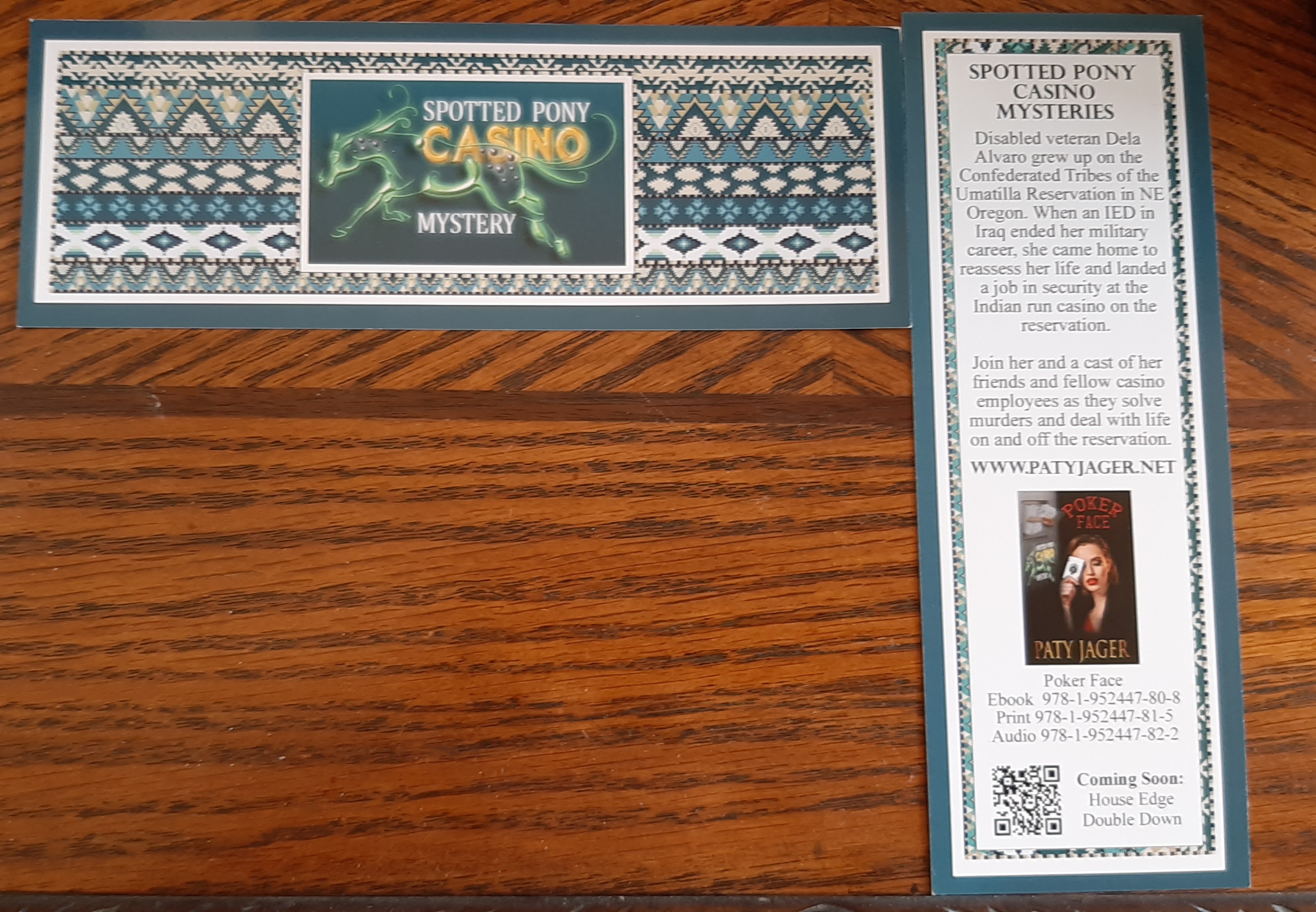
Anyway, as I chortle over the definition… With the new series I needed bookmarks. My awesome daughter to has designed most of my covers and all of my bookmarks and swag, came up with this design for my Spotted Pony Casino Mystery bookmark.

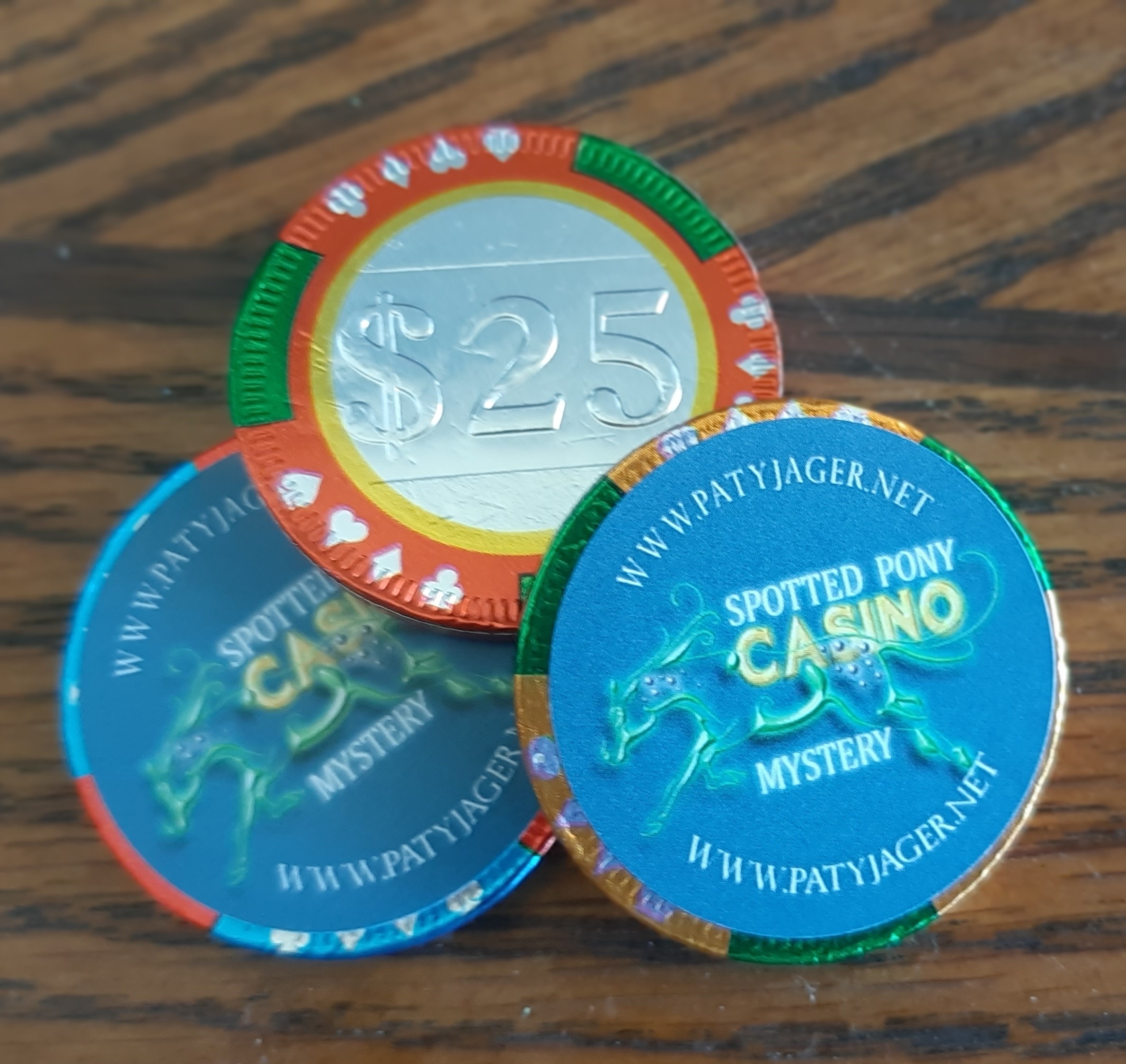
And because I’m headed to Bouchercon this month and wanted items to give away during the event, she also designed these chocolate poker chips I’ll be handing out. I wanted something that said “Casino Mystery” and was lucky enough to find a promotion site that made custom chocolate poker chips.

The one on the left is fuzzy due to the setting on my camera.

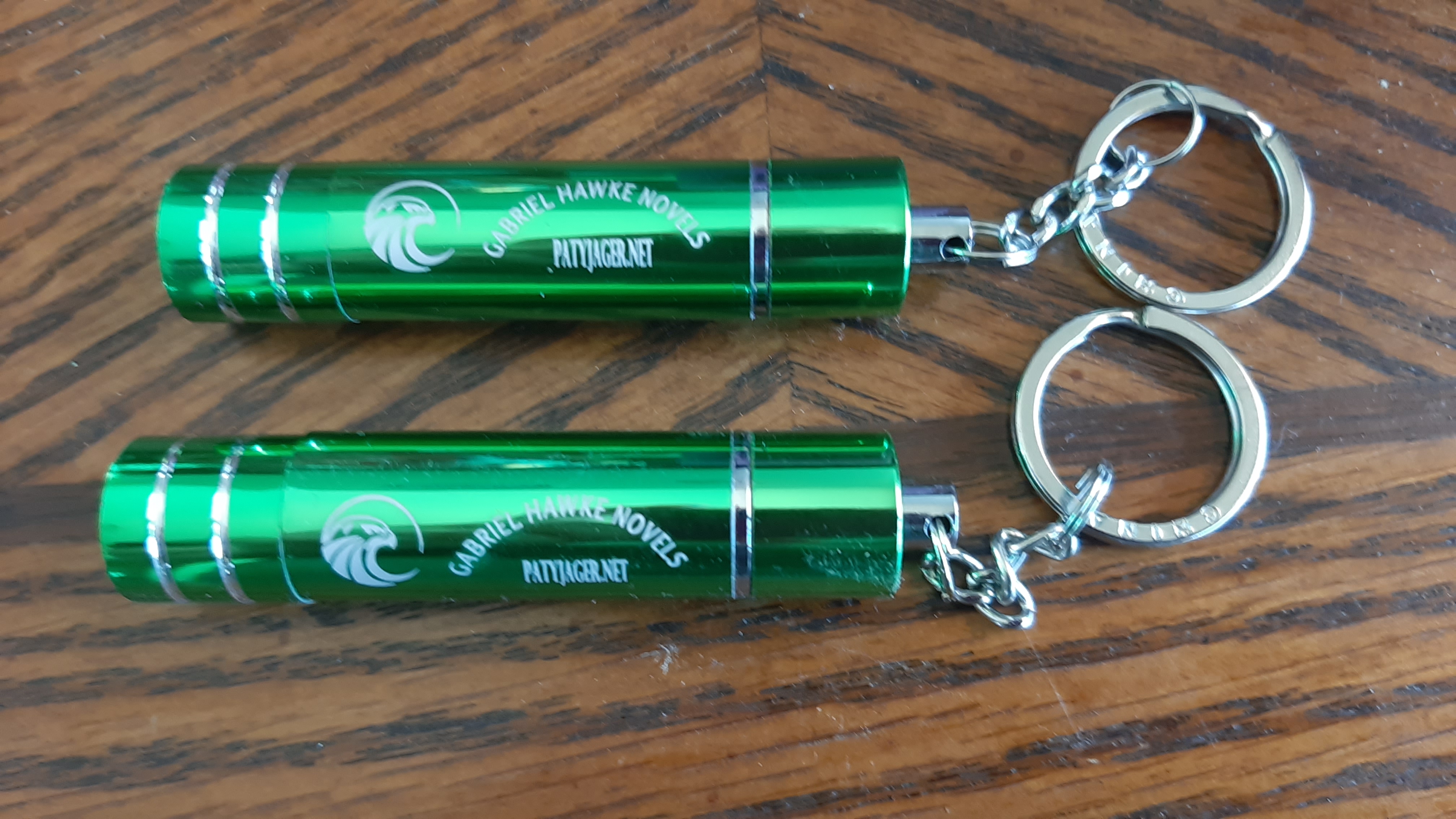
For my Gabriel Hawke fans, I ordered these fun flashlights for Bouchercon last year. A conference that never happened. Good thing flashlights hold over well. 😉 Worried about transporting this on the plane, I asked a security person when we took our grandson to the airport if they would be allowed and he said, “yes.”

Over the years I’ve given away ereader covers I made, Dream catchers I’ve made, and I hand out small tote bags with purchase at the Sumpter Flea Market twice a year. The bags do help. I had one woman tell me that seeing someone carrying one of my bags reminded her she needed more of my books. I am finding out that while I’ve picked up swag over the years that didn’t move me to purchase a book, it does seem that a bit of the freebies handed out do help to sell the next book by an author.

For Bouchercon, I also made a 4″ x 6″ chap book with the first chapter from each of the first books in my mystery series and my Romantic Suspense trilogy. I’ll be handing those out during my “Speed Dating” event. I’ve made several of these over the years that I hand out at conferences. I have one that is the first book of my historical western romance series. One that is the first chapter of the first book of my trilogies or series with Native American elements. And one with the first chapters of my mystery books, like this one, only minus the new mystery series.

As an author what are some of the things you’ve given away over the years? As a reader what are some of the items you’ve received that you kept? Did that every remind you to look for a book by that author?

SINCE WRITING THIS POST BOUCHERCON HAS BEEN CANCELED. So the swag will have to wait for another conference.

Guest Blogger ~ Randy Overbeck

“An accomplished work of haunting mystery fiction fans of the genre won’t want to miss.”—ReadersFavorite.com

A mystery is a mystery is a mystery—not.

Readers who enjoy solving a whodunnit with their fiction can chose a cozy, a hard-boiled detective mystery, a police procedural, a noir mystery or even a historical mystery.

They each have their own conventions, required elements and fans. But they all have in common one thing …a body, often on the first page, almost always within the first chapter. Readers of these sub-genres will usually meet the victim—sometimes a nice, unwitting fellow, sometimes a despicable character even a mother couldn’t love—within the first few pages and learn about them, often with a nice dash of back story thrown in. Just before the victim, well, becomes the victim.

Then the reader spends the remainder of the novel trying to unravel the puzzle as they encounter character after character, searching each for motive, means and opportunity, dodging red herrings to try to arrive at the culprit, hopefully right before the great reveal by the author.

It’s how it’s done, it’s expected. For all the types of mystery—except mine.

Like the other types, my Haunted Shores Mysteries are classic whodunits, with the parade of possible bad guys (and girls), turns down wrong alleys, and a meticulous shifting through clues—though all these are harder to navigate because each is a cold case murder, the deed occurring years earlier.

But the aspect that sets my narratives apart from these other mysteries is the victim. Oh, Darrell—and the reader—encounters the victim in the first few pages, but he has no idea who the victim is. And it’s not a simple case of mistaken identity. You see, when Darrell first stumbles onto the victim—or more likely he/she runs into him—he/she is a ghost.

And his or her death has been covered up so as to not look like murder. The challenge for Darrell—and the reader, I hope—is to sift through clues together to first learn who the victim really was, then determine how he/she died, then try to unravel the clues that lead to the murderer. It’s a complicated process fraught with peril.

In CRIMSON AT CAPE MAY, the newest novel in the series, a tall, injured female chases Darrell down the street of Cape May—all in the first few pages. He has no idea who she is, why she is following him or that she is a victim. Until she reveals she is a ghost and pleads for his help. Even when he finally decides to help this poor woman find justice, he has no idea who she is, how she really died, much less who could be possible suspects for the murder. A tall mountain to climb.

If you’re a mystery lover who enjoys solving a complicated puzzle, check out CRIMSON AT CAPE MAY (or the other #1 best selling entry in the series, BLOOD ON THE CHESAPEAKE). See if you can get to the top of the proverbial mountain before Darrell. I’ll guarantee it will be fun trying.

No matter how far you run, you can never really escape a haunted past.

Darrell Henshaw—teacher, coach, and paranormal sensitive—learned this lesson the hard way. With his job gone and few options, he heads for Cape May to coach a summer football camp. The resort town, with gorgeous beaches, rich history and famous Victorian mansions, might just be the getaway he needs. Only, no one told him Cape May is the most haunted seaport on the East Coast. One resident ghost, the Haunted Bride, stalks Darrell, begging for his help.

He can’t refuse. 

Joining forces with Cassie, a street-wise teen and another sensitive, he investigates the bride’s death and discovers her murder is connected to a far greater horror. But can Darrell and Cassie expose those behind the crimes before they end up being the killer’s next victims? 


Incredible sale on the entire Haunted Shores Mysteries series! 

BLOOD ON THE CHESAPEAKE-$.99, CRIMSON AT CAPE MAY–$1.99, SCARLET AT CRYSTAL RIVER (pre-publication price)—$2.99.

Purchase links:

https://www.amazon.com/Crimson-Cape-Haunted-Shores-Mysteries/dp/1509231633

https://www.barnesandnoble.com/w/crimson-at-cape-may-randy-overbeck/1137088608?ean=9781509231638

https://www.bookbub.com/books/crimson-at-cape-may-by-randy-overbeck

Dr. Randy Overbeck is an award-winning educator, author and speaker. As an educator, he served children for more than three decades in a range of roles captured in his novels, from teacher and coach to principal and superintendent. His thriller, Leave No Child Behind (2012) and his recent mysteries, the Amazon and B & N No. 1 Best Seller, Blood on the Chesapeake and Crimson at Cape May have earned five star reviews and garnered national awards including “Thriller of the Year–ReadersFavorite.com, “Gold Award”—Literary Titan, “Mystery of the Year”—ReadersView.com and “Crowned Heart of Excellence”—InD’Tale Magazine. As a member of the Mystery Writers of America, Dr. Overbeck is an active member of the literary community, contributing to a writers’ critique group, serving as a mentor to emerging writers and participating in writing conferences such as Sleuthfest, Killer Nashville and the Midwest Writers Workshop. When he’s not writing or researching his next exciting novel or sharing his presentation “Things Still Go Bump in the Night,” he’s spending time with his incredible family of wife, three children (and their spouses) and seven wonderful grandchildren.

BOOK TRAILER—CRIMSON AT CAPE MAY

Randy Overbeck

randyoverbeck@authorrandyoverbeck.com

www.authorrandyoverbeck.com

@OverbeckRandy

FB: Author Randy Overbeck

Coming Into Its Own by Heather Haven

Back in 2007, I had been challenged by other writers to create a protagonist who wasn’t Barbie doll perfect. So I came up with The Persephone Cole Vintage Mystery Series. It takes place in 1942 Manhattan during the beginning of the country’s entrance into WWII. The stories revolve around one of the country’s first female detectives, a full-figured gal named Persephone (Percy) Cole. She is 5’11”, strong, able, and very secure living in a man’s world. At 35 years old, which was considered middle-aged for the times, she has a mouth on her, wears Marlene Dietrich pants suits, altered for her size, and her father’s fedora hat. She is also a single mother who moves back into her parents 4th floor walk-up on the lower east side, as much for her 8-year old son’s sake as that of her parents.

From the git-go I loved Percy. I had accidentally created my ideal protagonist, a woman who could go anywhere a man could go, do anything a man could do, and was smarter and sassier about it. I was surprised when the books didn’t leap off the shelves after publication. Or at least climb off. I thought for sure women would love to read about a woman who found her place in the sun, even with everything stacked against her, and did it with humor and guile. Didn’t happen. Meanwhile, the Alvarez Family Murder Mysteries continued in their popularity, this sparkly, contemporary series about a Silicon Valley detective agency led by protagonist Lee Alvarez, who is, frankly gorgeous on every level. Make no mistake, I am forever grateful for that. But still.

I had a pang in my heart for my beloved Percy, her son, Oliver, Mother, Pop, and their 1940’s world. However, after the 3rd book of the series didn’t sell any more copies than the first two, I decided to stop writing them and move on. But still the pang lingered. The Alvarez Family grew in popularity, Percy Cole continued to languish.

But I see the world has changed. And a woman’s place in it. Women like being physically strong now. They like knowing they can defend themselves and not depend on a big strong man to do it for them. They appreciate – we appreciate – self-sufficiency. So I have decided to pull Percy out, dust her off, and see if this pistachio nut eating heroine will go. I am currently writing the 4th book of the series.

Wish me luck.