So much so, I forgot I needed to write a post for this blog. The main reason for my forgetfulness is I attended a board meeting for the Public Safety Writers Association last week. I’ve been a part of this group since its formation, first as the program chair for their annual conference and second as the newsletter editor. I’ve since passed on both jobs to other younger and quite capable members. I’m still a member-at-large on the board.
I must confess though, I mainly wanted to attend because the board members are all good friends and I wanted to see them all again.
PSWA is a group for anyone writing with a connection to public safety, and this included all kinds of law enforcement, fire, EMTs, military, dog handlers, etc. and for anyone writing about any of these including mystery writers.
The conference is my favorite for various reasons: interesting speakers and panels on different aspects of writing and public safety, and a place to ask all those law enforcement and other related questions. Mystery writers are welcome on appropriate panels and encouraged to bring books for sale in the bookstore.
This is an affordable conference, always in the Orleans hotel and casino in Las Vegas. The night-before reception and delicious lunches are included in the price. A writing workshop before the conference is offered for an extra fee.
On a variety of blogs lately, writers have been talking about drafts, and I’ve been taking note. I’ve enjoyed reading other writers’ processes, and learning where I can. My process is a little different from the others I’ve read.
I begin with an idea and an opening scene, which sets up the core problem for the main character. As the idea develops while I’m working on other things, I jot down more ideas—a scene later in the story, a line of dialogue, a supportive character, a subplot, an interesting name, setting details. After a while I have a few pages of these bits and pieces, and I can feel the story growing warm and alive. That’s when I begin writing. I know it’s the right time because I wake up in the morning looking forward to working on the story.
By about page fifteen I have added something else, a detail not on my original list, which will mean correcting an earlier statement. This happens all the way through, with sometimes larger changes and scenes inserted to bring the various threads into alignment. Is each change a new draft? By the end of writing out the story for the first time, which could be Draft 23, I’ve made numerous changes, added at least half a dozen scenes to flesh out information I hinted at, and changed the murderer at least twice. Each change shifts the story, tightens the plot, clarifies and sharpens. What I end with feels close to what I had imagined, but in execution it can seem quite different with a fullness I didn’t imagine.
And then comes what I consider the real work—reading through the entire ms again, before printing it out, to ensure that other details (motivations, physical appearance, timing of revelations) are consistent throughout. This is when I find it necessary to add another two or three scenes to reinforce the logic of the entire mystery, and the story begins to feel complete. After that, I print out the whole thing, which by now should be the word length I wanted, about eighty thousand words, and read it again, this time with pen in hand to polish and tinker with words. I may do this twice. I know I’m finished when I find less and less to change or improve, and can read through pages without scratching out or inserting anything.
Perhaps I have only two drafts—online and printed, or four, two online and two printed. Or perhaps I have about 25 online drafts and two printed. However they are counted, the drafts pile up slowly until the finished narrative feels new to me, partly a surprise and partly a relief that it actually holds together.
How many drafts do you produce? How do you count them?
Remember when Amazon first began? The company’s one goal was to be the biggest book store in the world with enough books to fill the coliseum. Well?
It is, but it isn’t.
Have you ever tried to find a book on Amazon by the title alone? I did recently and was provided a whole array of sponsored electrical equipment and beauty products before the book’s cover appeared. Well, actually all the books with similar titles appeared, the book I sought among them.
In my dream world, Amazon goes back to its roots and splits into separate websites, such as: general retail; groceries, and bookstore. So, as a reader, I can sign on to a site called Amazon Reads or Books and wander the shelves, if virtually, without inundation by merchandise sellers and all the other piffle you get when you sign onto your Amazon main page.
Amazon has the chops to do this, and I believe book sales would increase because us poor readers could actually find the book we want, instead of being bombarded with books of no interest and unrelated products from random departments, including bras, electrical generators, and bamboo sheets.
I am talking about a nice, clean site for books, like the wonderful old bookstore in San Francisco, A Clean Well-Lighted Place for Books. You sign-in, a published today feature lets you know the new books in the genre you most often buy, from there you type in the book you seek, and up it pops. Any book advertising runs down the side of the screen, including bestsellers and sponsored book ads. Other books with similar titles appear after the book you seek, not before it.
On this dedicated book site, when you type in the author’s name all of that author’s books appear, uninterrupted by sponsored books, sponsored products (like bread pans), or whatever the heck else Amazon is pushing. This would be great for those who write in more than one genre because someone who reads your cozy mystery might see a cover, read the description, and decide to buy one of your very un-cozy thrillers.
In addition to finding books by author, readers should be able select and search in more defined and specific genres according to their taste, such as cozy romantic suspense, not-so-cozy romantic suspense, and not-even-close-to-cozy romantic suspense.
On a personal level, I don’t mind other related books appearing in my searches, I might find something I like, but they should come after the book I’ve asked for and not include sponsored ads for books from a different genre like vampires, fifty shades of whatever, and the dystopian world of aggrieved youth. Call me cockeyed, but I think a search for a Vietnam thriller should not result in a screen full of sexy vampire books, vampire books should remain among the undead.
And as I wrote last year, without a consistently applied scale, reader reviews should stop —now (both number of stars and quantity of reviews). Books aren’t camping equipment. We used to buy books by word of mouth or by discovery, Amazon’s review system is an antithesis of this, squelching triers. I have read, as I am sure many of you have, books by bestselling authors with a gazillion reviews all swearing the book is the best thing ever when the book was garbage. In fact, I left a one star review for a bigtime author in nearly those words. Truthfully, I was harsher. And likewise, we have all discovered/taken a chance on/read books without reviews that were to die for (and probably didn’t leave a review when we should have). Hopefully, we touted the book and author to all we met, and in our blogs or newsletters.
Amazon favors the big names and big spenders now, just like the publishing houses did before Amazon came into the world hoping to be the biggest book store ever. Sales is their king, but I suggest that book sales would increase for Amazon if they ran a bookstore where readers could find the book they want to buy with ease (not the DVD version, the Amazon Prime version, or the game version) whether hardcover, paperback, e-, online or audio — and without bedsheets or vampires.
I think every writer has words or phrases that she writes too often. I know I do. My particular nemesis is the word “look.” In my rough drafts, my characters are always “looking” at the landscape or each other, “tossing someone a look,” “giving something a hard look,” “looking bad,” “looking like a fool,” etc., etc., looking etc.
Just how many times did I write “look”?
After I finish a rough draft, I always have to go searching for this enemy word and do my best to annihilate it whenever I can. But I find it difficult to use substitutions without sounding stilted or losing the meaning I want. Do you have repeated words or phrases that haunt your writing?
Then there are the words or phrases that make me cringe when I hear someone say them. I guess it’s the editor in me. At least I’ve learned over the years not to constantly correct others, but sometimes it’s hard to keep my lips zipped. The common phrase that I cannot hear without wincing is “I could care less.”
I just want to scream, “That doesn’t make sense! We could always care less about anything. What you mean is that you couldn’t care less! Could not care less! That’s the insult you’re aiming for—use it!”
But of course, carrying on like that would probably get me banned from the few social gatherings I’m invited to in these times of lingering Covid restrictions. Another word, not quite so grating for me, is “irregardless.” It means the same thing as “regardless,” so why add the extra “ir”? But Webster insists it is actually a word. I have to remind myself that language does evolve and it sometimes evolves in nonsensical ways.
My mother hates it when I write that a character “trekked” somewhere. To her, a trek is only a major expedition in the Himalayas; it can’t be just a long arduous hike like my character Sam Westin often undertakes. Another one of my writer friends takes the word “pray” to always mean beseeching God when I often mean “fervently hope”; she marks that word and also the adverb “hopefully” every time she finds them in my drafts. So, I guess we all have our word challenges. What are yours?
And yes, in between rants, I am s-l-o-w-l-y crawling toward the finish line on Cascade, my sixth Sam Westin wilderness mystery, which involves avalanches and wolverines in the North Cascades. I’ll dig out of the snow filling my brain and finish one of these days. I promise.
My second book in the Spotted Pony Casino Mysteries is up on pre-order, publishing on February 18th. I have been fascinated with my main character, Dela Alvaro, ever since I conjured her up for a short story I entered in a contest. She kept knocking around in my head until I decided to make her a main character in her own series.
Even before starting her series, I introduced her to my readers in a Stolen Butterfly, book 7 in the Gabriel Hawke novels. Readers liked her and the secondary characters who are in her life. I was excited to start her series. I had gathered gambling terms to use for book titles because she is head of security at a casino on a reservation. The first book was Poker Face. It delved deeper into what makes Dela tick as the reader is in her point of view, not someone seeing her on the outside.
She has been medically discharged from the Army due to losing a lower limb from an IED. Her plans had been twenty years in the army, which was cut five years short due to the explosion. In book one she has returned to the reservation where she grew up and is trying to piece her life back together. She’d planned on a job in law enforcement but being an amputee put a stop to that plan. Through Grandfather Thunder, the man who lives next door so her mother, Dela gets a job working security at the casino.
During book one, while Dela and FBI Special Agent Quinn Pierce work together to find out who killed and stuffed a casino employee in a laundry chute, Dela, myself, and readers discover more about her and how determined she is to not let her disability be who she is. One of my beta readers thought I’d talked too much about her disability in the first book. But I wanted readers to feel how she felt. She has only been an amputee for less than two years, a year of that was spent in surgery and rehab in an army hospital.
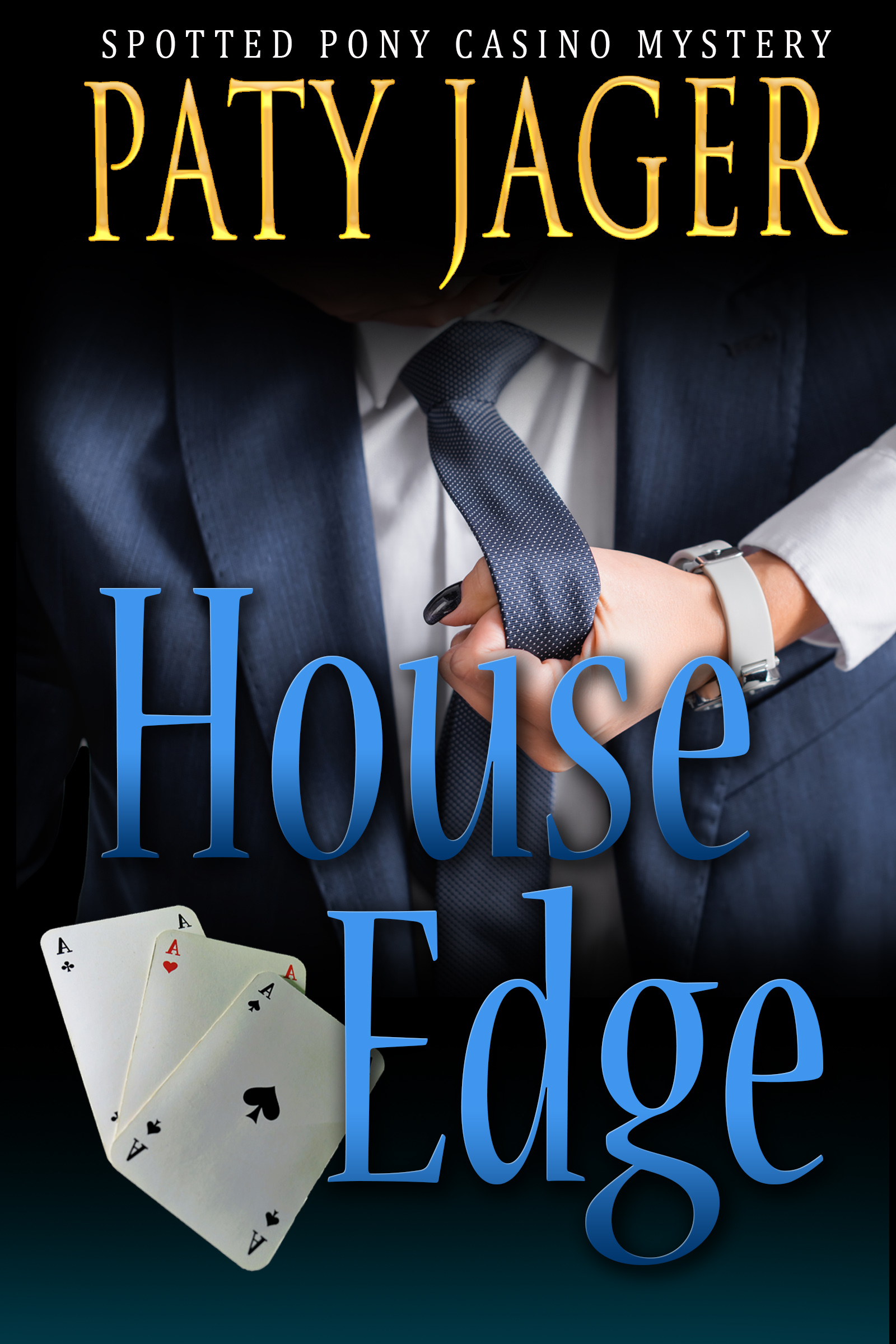
Fast forward to House Edge, book 2, the same beta reader said she loved how I handled the disability, how she’s coming into her own, and the expanded men in her life. That made me feel good. Because I thought after the short story and Dela having a large role in Stolen Butterfly that book 1 wouldn’t feel like an author exploring what she could do with a character.
As I wrote book 2, the premise I had planned for book 3 took root and I planted a hint of what will happen in book 3 in book 2 and I wrote the opening scene for Double Down while I was writing House Edge. It felt right to get the information accurate while the start of the conflict was fresh in my mind.
It isn’t new for me to come up with ideas for future books while I’m writing the current book. I do it all the time. I generally just jot down the idea and then when I’m not writing, swirl it around in my head figuring out how to make the idea work and where in the line of books it will fall.
I have several ideas for what will happen down the line in various books. Some deal with her friends in trouble and some will deal with the father she was told died before she was born.
There will be more mystery in Dela’s life as she continues to solve murders that happen at the casino and on the reservation. It’s a good feeling when a character becomes real in my mind and writing the book is like walking in their footsteps. That’s when I know I have found the rhythm of the character.
Book 2 in the Spotted Pony Casino Mysteries has Dela Alvaro not only trying to keep her job by discovering the killer before word spreads about the murder, but she also has to deal with FBI Special Agent Quinn Peirce butting heads with her high school sweetheart who has returned to the reservation as a tribal police officer
Zealous Environmentalists
Greedy Power Companies
…and a body
A bitter dispute over the breaching of dams in Idaho sparks emotions at a summit held at the Spotted Pony Casino. When the keynote speaker is murdered, Dela Alvaro, head of security, teams up again with FBI Special Agent Quinn Pierce.
The suspects are many since it appears the victim was playing both sides of the controversial environmental issue. Did someone take advantage of a marital dispute… witnessed by a crowd of casino spectators? Or did an angry wife murder her husband?









You must be logged in to post a comment.