I don’t know about all writers, but for me, the best part of writing a book is the “stewing and brewing” process. It’s the time between, “Bing!” I have an idea and when I start writing the actual story.
source: Depositphotos
What I call the “Stewing and Brewing” process is where I come up with the story idea or setting and then start researching and filling out my suspect chart.
I get to scan websites and look through baby name books to come up with character names and then give the attributes and reasons they are part of the story. Suspects, officials, friends, the whole bit.
And even better! Figuring out how the victim dies. I love putting a twist on the cause of murder. My newest Shandra Higheagle release, Toxic Trigger-point the death is caused by an acute allergic reaction to bees. The book I’m “stewing and brewing” right now I’m thinking the death appears accidental at first. Then… as things get investigated further it was murder.
There are times my devious mind astounds me! LOL However, coming up with the out-of-the-box scenarios is so much fun. Taking the reader on the trip of; this person did it, no, that person did it, is almost as much fun as coming up with the characters, motive, and cause of death.
I pinch myself all the time wondering how I can have so much fun writing when other writers are always complaining how hard it is. I do agree, the editing, revisions, and making the story shine are hard, but it’s like child birth. I forget about those things when I’m in the throes of “stewing and brewing”. 😉
Here is my latest Shandra Higheagle release:
Toxic Trigger-Point
Adultery… Jealousy… Murder
Shandra Higheagle Greer is minding her own business when she
walks into a room for a massage and it is already occupied—by a dead body.
Always the champion for someone she knows, when her favorite
masseuse looks like the murderer, Shandra listens to her gut and dreams choreographed
by her deceased grandmother.
Detective Ryan Greer can’t believe his wife has walked into
another homicide. He’s learned no matter how he tries to keep her out of the
investigation he can’t. But this time the consequences could be deadly for Shandra—she
heard the murder happen.
I never realized that a book cover was a lot like a hairdo. They need to be updated every now and then. Frankly, I love my covers, especially for the Alvarez Family Murder Mysteries. They’re familiar. They’re comfortable. Whoops! Maybe when you start saying stuff like that it’s time for a redo. Sigh.
Let’s face it. A good, eye-catching cover is what helps sell a book, big time. Times change. What worked in the early 2000s may not work now. So here I am, deciding what I should do. Should I continue to do the covers myself or should I job them out? Has competition gotten so keen, I need to have a real professional do them for me? Although, I thought I was a professional. But am I a real, dyed-in-the-wool professional CA who can compete in today’s market? Okay. So there I got me. I’m not.
What I am is a professional writer who has enough on her plate and needs to job certain things out. Like my covers. Truth be told, I really would like more time for writing. For playing with my cat. For having lunch with my friends. For canoodling with my husband.
The more I read, the more I notice when digital technology isn’t a part of the story. It’s become a way for me to quickly decipher how old a book is. If I’m reading a novel and there’s no mention of texting or social media, or even Googling something, it sometimes pulls me out of the story.
The thing is, I’ve been a frequent texter for more than a decade. I’ve used social media regularly that long as well. But it feels like publishing has been slower to accept digital technology in stories and it’s only becoming more common in the past couple of years.
Digital technology is such an important part of our lives. Sure, the extent of that importance may vary from person-to-person, but you’re here reading a blog so it’s important to both of us on some level. 🙂
When I read a romance, I like seeing one character Google another. If I’m going on a date with someone or crushing on another person, you bet your britches I’m going to be checking them out online. Not only for curiosity’s sake, but for my own safety. My true crime obsession doesn’t help.
It’s even more glaring to me as a reader of mysteries. Particularly when a sleuth is a millennial or younger (late 30s or below). I’m at the upper end of the millennial group, which means I’m part of a small subset of millennials who remember life before cell phones and computers, but they’re important to how I operate daily because they were introduced during childhood. That’s the big difference I see between myself and my parents. When I’m curious about something, one of my first instincts is to Google it. That’s not instinctual to my parents because these digital technologies were available later in their lives.
So, when I read about a sleuth in their 20s or 30s (at least, but not limited to those ages), I expect to see them using the internet in their investigations or slyly using their cell phone to record someone, or sending out a help beacon from their Apple Watch if they’re in trouble. Granted, age does not equate to technological comfort and skill. I have friends who don’t have a social media presence and only switched from a flip phone to a smartphone in the last year or two. But, to me, that’s the exception not the rule.
I feel like I see the use of digital technologies more in television. Hallmark has been doing a great job of incorporating texts, video chatting, internet searches, and more into their movies (I’ve been watching Hallmark movies pretty non-stop since June). I’m not sure if it’s because authors are hesitant to write it, publishing professionals advice against adding a technological shelf life, or some other reason I haven’t thought of.
I’ve been thinking about this a lot during revisions of my cozy mystery. I’ve been intentionally trying to find ways to incorporate digital technologies.
Do you incorporate digital technologies in your stories? Do you think there’s a trend toward seeing more of it? Curious about your thoughts!
The mystery? Why is it, then, that the leading lady of the cozy
mystery today is a baby-faced, early career, 30-something, rather than a
mature, perhaps somewhat disgruntled, widowed or divorced, half-retired woman
of 50+ years?
I turned 60 this year, and I read like a demon, devouring
novels like M&M’s. Why, I wondered, was my feisty generation—all prime
readers for Pete’s sake—so invisible in women’s mystery fiction today?
OK, so the term “baby boomer lit” has gotten a bad rap. Much
of that is justified. The indie market is awash with badly written “boomer” novels
that feature highly forgettable “senior sleuths,” seeking second chances in the
confines of gated retirement villages.
Too much of this lit pounds home a “sundowner” theme – think
cancer, moving into assisted living, fighting over men with competing ladies in
Leisure Village – OR a “second chance” theme. Think “widower dares to date
again” or “the search for the one that got away.”
Problem. I don’t see my life as in need of “second chances.”
I see it as more of what it always has been: a bit of a hair-raising adventure.
Why not, I thought, write about cantankerous, every day women who are aging,
but who are also busy having a go at life, every morning, pretty much as they
always have?
Oldsters are as varied as youngsters (really, they are). Being
of the mind that if there’s a problem it’s my responsibility to engineer a solution
– a great notion from the 70’s when I first hit the road out of high school —
I began to create a new crime comedy series loaded with oldsters of all
varieties.
In my new amateur detective series, The Shady Hoosier Detective Agency, the protagonists are lifelong
gal pals, ages 67 and 71, living in small town Indiana. They share a house, a
1960 Chevy, and reluctant custody of grown children who still reside in their
basement.
One in particular (Veenie) has been a lifelong snoop. The
other (Ruby Jane) has great computer skills. For them, the decision to punch a
time clock post-retirement as sleuths with the Harry Shades Detective Agency is
as much a way to exercise their curiosity as it is a path to supplementing their
social security.
Back in the 90’s the TV drama “Golden Girls,” about older widowed
and divorced women sharing a home and laughter, broke through ageism to show
that the closing chapters of life can be as varied and exciting as the
beginning and middle. I believe that there remains pent up demand for older,
feisty women characters in the cozy mystery niche.
My goal in creating the Shady
Hoosier Detective Agency, with Book 3, The Chickenlandia Mystery, coming out as this is posted, is to update
the cozy to better serve publishing’s core reading demographic by creating
books that mirror the more diverse evolving lives of Boomer women like me.
Like all publishing undertakings, it is up to the cosmos to
decide if the series will find a readership, but a few stars do seem to be
aligning. The Shady Hoosiers’ debut
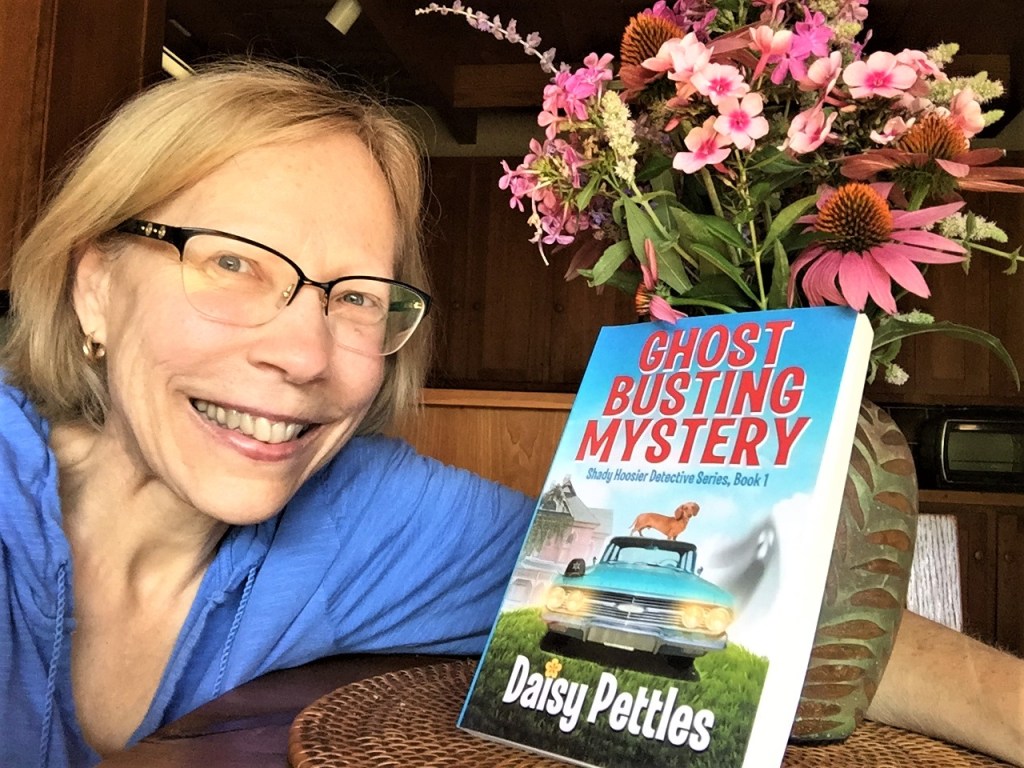
book, Ghost Busting Mystery, has
thus far won three Best Indie Humor Book Awards and two Best Indie Cozy Mystery
Book Awards,
In the end, I write what I want to read. There has never
been a more active, curious, diverse, witty, kick-ass generation of women. Why
not gift ourselves leisure reading that reflects this?
Author
Daisy Pettles
Daisy Pettles was born in southern Indiana, in a tiny river
town. As a child, she was fed a steady diet of books, pies, and Bible stories.
Her debut cozy series, the Shady Hoosier
Detective Agency, crime comedies set in fictional Pawpaw County, Indiana,
won the 2019 Gold Medal as Best Humor Book from the Indie Reader, The Next
Generation Indie Book Awards, and the American Fiction Awards. Visit her
anytime at https://www.daisypettles.com





 Ladies of Mystery
You must be logged in to post a comment.